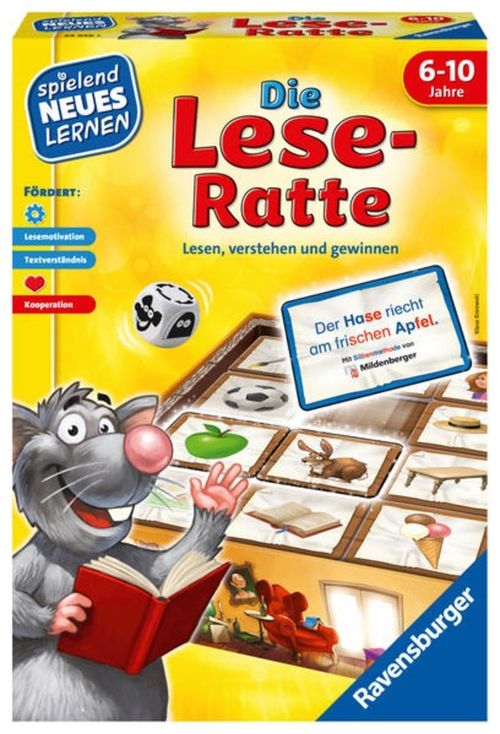
Die Lese-Ratte
Die Lese-Ratte Rulebook
Table of Contents
Table of Contents
Before the First Game
Take the playing material out of the box. Punch all the cardboard parts out of the punch sheets.
Place the game board with the simple side (with two rats and two rat holes) facing up in the plastic insert. Make sure the board lies flat. For later rounds you can use the harder reverse side (three rats and three rat holes each).
Spread all the sliding tiles across the board so that they lie flat next to each other.
Insert the Lese-Ratte into the stand base and shuffle the task cards.
Components
- 1 double-sided game board
- 24 sliding tiles
- 1 plastic insert
- 1 die
- 1 Lese-Ratte (Reading Rat) with stand base
- 1 bookshelf
- 40 double-sided task cards
The task cards each have a blue front with shorter texts and a harder red back with longer texts.
Why are the words coloured? When we speak, we speak in syllables. In the Mildenberger syllable method, the coloured marking makes the syllables in the reading texts visible. This way a word is grasped more quickly and learning to read is easier. More on the Mildenberger syllable method at www.silbenmethode.de.
Basic Game
Cooperative reading game for 2 to 4 children aged 6 and up.
The goal of the game is to solve as many of the six task cards as possible before the Lese-Ratte has eaten through the entire bookshelf. Can you even save the valuable books on the upper shelves?
Setting Up the Game
Set out six task cards as a stack. The others are put aside.
Are you readers of different skill levels? Then each time you take a turn you may choose whether to read the easy side or the harder side.
Take the sliding tile with the star off the board so that one space is free. If a rat or a rat hole would appear there right away, quickly slide a tile over this space.
Place the Lese-Ratte on the drawer at the very bottom of the bookshelf and set out the die.
Getting Started
The youngest player begins. Play then continues clockwise.
Reading
When it is your turn, draw a task card. Choose a side and read the card aloud. The text contains two terms that are shown on the sliding tiles.
Fellow players, pay attention! Listen closely, because you can help work out which tiles are meant.
Sliding
The player whose turn it is now tries to slide these two tiles together in the sliding puzzle.
Example: the two tiles with the boy and with the ice cream must be slid together in the insert.
The goal is to place them so that they lie side by side. It is not enough for only their corners to touch.
To do this, slide tiles into the respective gap on the board as often as needed until the two desired tiles lie next to each other. You have any number of moves. It is also allowed to slide several tiles together.
But beware! Under some of the tiles a Lese-Ratte or a rat hole is hidden:
- Can you slide the two sought tiles next to each other without uncovering the rat or a rat hole? Or do the tiles already lie together? Great! You have solved the task and set the card aside. The next player takes a new task card and reads it aloud.
- Did you uncover a rat while sliding? Too bad! The Lese-Ratte eats further up the bookshelf. Move the figure one shelf further. Your turn ends immediately. Set the task card aside. The next player takes a new task card and reads it aloud.
- Did you uncover a rat hole while sliding? Now it gets exciting: does the rat come out of its hole, or are you lucky and it stays in hiding? Roll the die.
The die roll gives one of three results, shown by pictures in the rulebook:
- Bad luck (picture of the rat): The rat comes out and eats further up the bookshelf. Move the Lese-Ratte one shelf forward. Your turn ends immediately. The task card is set aside.
- Lucky (picture of the rat hiding): The rat stays in its hiding place. You may keep trying to slide the tiles together.
- Lucky (picture of the rotating arrows): The rat does not come. Turn the box a quarter turn clockwise and keep trying to slide the tiles together.
The rulebook does not print which die faces produce which result; the pictures are the only indication given.
End of the Game
The game ends after 6 task cards, or when the Lese-Ratte has reached the top shelf with the golden book.
Did you manage to play all 6 task cards before the Lese-Ratte has eaten her way up to the top shelf? Great! You have all won together.
Did you even manage to stop her before the shelf with the blue books? Excellent! You have won and saved the most precious books.
Has the Lese-Ratte reached the top shelf before you played all 6 task cards? Unfortunately you have lost to the rat and could not save the books. Try again right away! In the next round, the left-hand neighbour of the last starting player becomes the new starting player.
Teamwork is needed! If all players help by remembering under which spaces the rat is hiding, you can more easily defeat the rat.
Perhaps you can also divide up the tasks? Who is responsible for the rats, and who for the holes?
During sliding, you can also give each other tips on how the tiles can come together. But only the player whose turn it is may slide.
Solo Variant
Solo variant (sidebar in the rulebook on page 5): How many task cards can you play before the rat has eaten through the shelf?
Play by the rules of the basic game. However, set out all task cards as a stack. Now read and slide as described above.
Can you manage to play 6 cards before the rat reaches the top shelf? Well done, you are a true reading and sliding pro! Can you even manage more than 6 cards? Try to beat yourself!
Competitive Variant
Educational game for 2 to 4 children aged 6 and up.
The goal of the game is to win three task cards.
Setting Up the Game
Set up the game as in the basic game. However, set out all task cards as a stack. Here too, the player whose turn it is may choose the easy or the harder task. You do not need the bookshelf for this variant.
Getting Started
The youngest player is the starting player and takes the Lese-Ratte, so that everyone knows where the round began. Play then continues around the table in turn order.
When it is your turn, draw a task card and read it aloud. Then try to slide the two sought tiles next to each other.
If the two tiles already lie next to each other at the start, put the task card back under the stack and draw a new one.
- Do you manage to slide the sought tiles next to each other? Great! You may place the task card in front of you as a winning card. Your left-hand neighbour is next.
- Does a rat appear? Then your turn ends immediately. Set the task card aside.
- Does a rat hole appear? Then roll the die and proceed as described in the basic game: either you may keep sliding, turn the box, or your turn ends.
End of the Game
As soon as a player has 3 winning cards lying face up in front of them, the round is still played until the last player before the starting player has had their turn. Whoever then has 3 cards in front of them wins.
Does anyone else manage it? Then there are several winners.