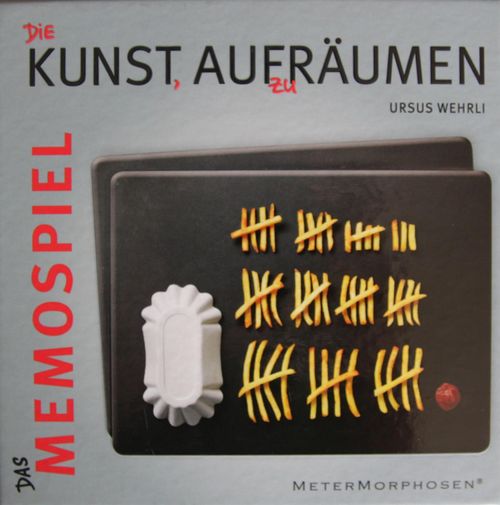
Die Kunst, aufzuräumen
Die Kunst, aufzuräumen Rulebook
Table of Contents
Table of Contents
Game Instructions
A memory game is child's play. All it takes is finding the two cards that belong together and collecting pairs, and doing that 36 times. Only in this memory game the motifs are not identical. Instead, each motif appears once in everyday chaos and once in Ursus Wehrli's tidied-up version. That the two pictures really belong together can be checked by counting, because all elements appear on both cards.
In the memory game, all cards are well shuffled and spread face down on a table or the floor among two to eight players. But a whole school class can also play.
Beginners turn over two cards at the start, and those cards stay face up. Experienced players always turn over only two cards and put them back exactly where they were. Unless a pair is found: then the player may keep that pair, and remains on turn for as long as they keep finding pairs, until they find no pair. Play passes around the table in turn until all pairs have been found. The player who can build the highest card tower wins.
In Die Kunst, aufzuräumen the arrangement of the cards naturally matters a great deal. The chaotic spreading of cards traditionally faces the fierce opposition of precise card arrangement, and Mr Wehrli will be pleased that the lovers of structure usually prevail. Order must be. Yet the true purpose of the memory game is served when exactly four players spread the 72 cards out as chaotically as possible and then, through brilliant associative art, turn them into four accurate stacks of 18 cards, each full of pairs. Then nobody has won, but everyone beams, because perfect order has been restored. And Ursus Wehrli can breathe a sigh of relief. That, however, is the high art, and when playing memory one should always start small.
Translator's note: the leaflet does not spell out how the card tower is built from the collected pairs; the winning condition is transcribed as printed.