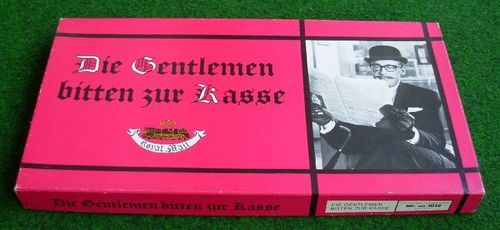
Die Gentlemen bitten zur Kasse
Die Gentlemen bitten zur Kasse Rulebook
Table of Contents
Table of Contents
Components
- 1 game board
- 6 robber pawns
- 1 detective pawn
- 6 dice
- 12 money bags
- Play money:
- 6 notes of £100,000
- 6 notes of £50,000
- 40 notes of £20,000
- 20 notes of £10,000
- 30 notes of £4,000
- 10 notes of £2,000
- 6 property cards, together with the matching receipt cards for the farms
- 1 card: Evidence Room (Asservatenkammer)
- 10 previous-conviction cards (Vorstrafenkarten)
- 6 credit letters for £40,000
- 6 credit letters for £20,000
- 16 incident cards for robbers (Zwischenfallkarten für Posträuber)
How is the game prepared?
Each robber receives £150,000 starting capital from the bank.
The bank holds 12 or fewer money bags, depending on the desired length of the game.
The card "Evidence Room" (Asservatenkammer) is placed on field 27.
Shuffle the incident cards (§) and place them on the reserved space of the game board.
The detective from Scotland Yard is set up on the space reserved in the centre of the game board.
What is the goal of the game?
Each robber must try to seize as many money bags as possible on fields 9, 10 and 11, and hide them on fields 33, 34 and 36. The winner is the robber who has brought the most money bags into a hideout at the end of the game.
How is the game played?
Two to six robbers line up at the start and roll the two dice in turn. If both dice show the same number (a pair, "Pasch"), the robber must roll again. If a robber rolls three pairs in a row, he moves onto field 27 and removes the card "Evidence Room" lying there. For the rest of the game, field 27 is then an additional hideout for all robbers.
Whenever a robber enters a mail-robbery field (Postraub), he takes one money bag from the bank each time and hangs it on his pawn. The aim now is to bring this money bag into one of the hideout fields. Once it has been brought in, the money bag is unhooked and removed from the game.
Until this has been achieved, the robber must pay the bank £4,000 of bribe money (Schmiergeld) with every roll for each money bag he carries; with two money bags that is therefore £8,000, with three money bags £12,000, and so on.
If a robber enters field 27 (as long as the card "Evidence Room" still lies there) or field 32, all money bags he carries are seized by Scotland Yard and attached to the detective in the centre of the board. A robber may take money bags from another robber as soon as he enters a field on which the other robber is standing with his money bags. In this case, all money bags carried must be taken over.
What is the money for?
Working capital is used to buy farms, to cover running costs and to pay bribe money.
A robber may, if he wishes, have a seized money bag handed back to him by the detective, but only before a roll. For this he must deposit £100,000 bail with the bank. He must then, like all the other money bags he carries, first bring this money bag into a hideout. Whether or not he succeeds, the £100,000 bail is forfeited in any case.
Only if the robber rolls a "12" may he take an already seized money bag from the detective free of charge.
How do the robbers get money?
The robbers finance the mail robbery by a cash-desk raid at the London airport, the so-called Airport Job. If a robber enters field 28 or field 29, he receives £50,000 from the bank.
Further sources of money can be found, for example, on field 2 (Accomplice, Mitwisser), through a favourable incident card, or by owning a farm (see Farms).
If a robber has run out of money, he may take a credit letter from the bank. The bank pays him the amount printed on it. After every roll (even while he is in jail), the robber must then pay interest of 10% of the credit sum to the bank, until he has repaid the credit.
Credits are, however, only granted up to £100,000 per robber.
If a robber's credit is overdrawn and he has no other assets left, the robber drops out of the game early.
Assets that can be turned into cash are:
- Farms, which can be returned to the bank at any time in exchange for the full purchase price;
- money bags that are already hidden (not those still being carried on the board). These money bags can be returned to the bank at half their value, £50,000.
Incidentally: where a figure has to be rounded, it is always rounded up.
What are the farms for?
The farms are both sources of money and hideouts. If a robber enters a farm that is not yet covered by a property card, he may buy this farm at the printed price. He covers the field with the matching receipt card and takes the corresponding property card from the bank.
Each robber may acquire any number of farms.
If the farm owner enters his own farm with money bags, he enjoys the following privileges:
1.) No other robber may take money bags from him here.
2.) After his next roll, the farm owner may decide whether to leave the farm or to stay "at home". (He must still pay £4,000 bribe money per bag, even if he does not move away from his farm.)
The owner may remain on his farm for as long as he likes. Only if he rolls a "7" must he leave his farm.
If he does not carry any money bags, the owner must leave his farm at his next roll, like every other field.
A robber who enters another robber's farm pays the owner £20,000 hush money (Schweigegeld). If he is carrying money bags, he pays a further £20,000 for each money bag.
Farms may be blocked by Scotland Yard (field 24). The receipt card is turned over, and the property card is returned to the bank. In this case, a robber who enters a blocked farm must, instead of the hush money due, pay a fine of the same amount to the bank. This also applies to the former owner, who has now lost his farm to Scotland Yard without compensation. The fine is collected only once; after that the block is lifted and the farm can be sold freely again.
What happens in jail?
A robber goes to jail through an incident card or by entering field 3. He must then go to field 19 and remain there until the other robbers have rolled three times. He must, however, take part in the rolling in turn, and if he rolls a pair he leaves jail immediately. Money bags he carries are taken along into jail, and the bribe money due is paid with every roll. Entering the jail square directly (field 19) counts only as a visit and has no consequences.
Three previous convictions, which can be acquired only through incident cards, automatically lead to the exclusion of the affected player. He may, however, have the third previous conviction removed by immediately paying £150,000.
When does the game end?
As soon as there are no money bags left in the bank or on the board, the game is stopped and the totals are counted. The robber who has brought the most money bags into a hideout is the winner. If the detective has seized the most money bags, all robbers have lost.
In the final accounting, each robber has the opportunity to settle any outstanding debts by selling his farms. If he is still not free of debt after that, he must hand over one money bag to the detective. This money bag is deducted from him in the final reckoning and credited to the detective's account.
If several robbers end the game with the same number of money bags hidden away, the winner is the one who still has the most cash.
The game ends early when all robbers but one have gone bankrupt or been excluded by three previous convictions. In this case, depending on the number of money bags brought in, either the remaining robber or the detective is the winner.
Those who absolutely want to play for money
Each money bag may be played for any stake, for example 1 Deutsche Mark (DM). Each robber then pays the same stake into the bank, which is calculated as 12 divided by the number of players. Example: with two robbers each pays DM 6 (12 : 2); with three robbers each pays DM 4 (12 : 3); with four robbers each pays DM 3 (12 : 4); and so on.
If only one robber remains at the end, he wins the entire stake. Otherwise the stakes are divided among the remaining players according to their final standing. The money bags seized by the detective are in every case credited to the account of the winner.