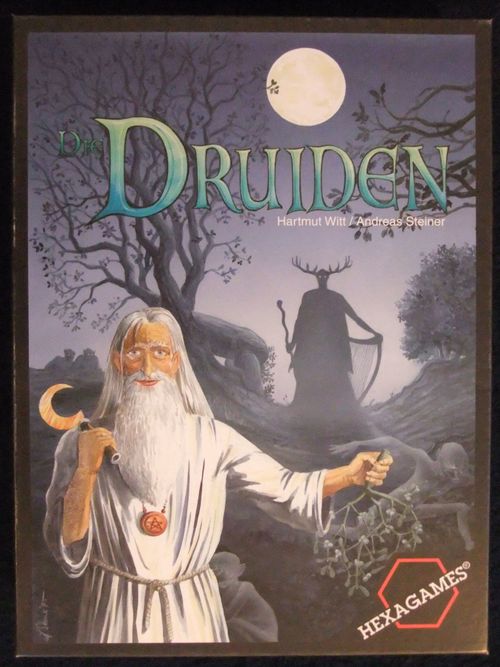
Die Druiden
Die Druiden Rulebook
Table of Contents
Table of Contents
The Board
The board has three concentric stone circles. The fields of the circles are the only places pieces move. In the centre is the Place of Decision (Platz der Entscheidung), where the druids begin and end their contest.
Outside the circles are the spirit places. The sheet calls the area beside the circles the Place of the Spirits (Platz der Geister). The diagram labels the Sun spirits (Sonnengeister) and Moon spirits (Mondgeister), and marks the Morrigan and the Dwarf King (Zwergenkönig) on the board. A separate area at the top right is the discard place for plant and spell cards (Ablage der Pflanzen- und Zauberkarten).
Sequence of Play
-
Leave the centre. The druids must first leave the centre of the stone circle. On your turn, place your druid on one of the Drudenfuß (druid's foot, pentagram) fields. Only these fields can be used to enter and leave the centre.
-
Roll and move. Roll both dice. At the start of the game you have only one piece, your druid, so choose one of the dice and move your druid with it. The second die is only used once you have two or more pieces; see step 4. The meaning of each symbol on the dice is explained under "Dice Symbols."
-
Follow the field. The field on which your druid lands determines what happens next. The meaning of each field is explained under "Board Fields." Once the instructions are carried out, your turn ends. If your druid lands on an empty field, your turn ends immediately and the next player takes their turn.
-
With two or more pieces. As soon as you also command one or more spirits, you may distribute the rolled symbols freely among your pieces. For example, you may move two spirits, or one spirit and the druid. You must follow the instructions of both fields on which your pieces land.
-
Movement rules.
- At most 2 pieces may stand on any one field of the stone circles.
- Spirits may be jumped over. Druids may not.
- If a druid moves onto a field next to another druid, the newcomer may demand a card exchange. The newcomer draws one or two cards from the hand of the other druid player (face down), and gives that player the same number of their own cards.
-
The vote on the victory of a cult. As soon as five pieces stand on the Place of Decision (in the centre of the board), the vote takes place immediately. The vote decides which cult wins the contest. See "The Vote."
Dice Symbols
Number (1-6). The player moves one of their pieces the number of fields shown. The direction of movement may be chosen freely, but the full number rolled must be used.
Straight line. The player must move one of their pieces in one direction. Turning is not allowed. [Example diagram omitted.]
Bend (Knick). The chosen piece must turn once during its movement. Before and after the turn, the piece may move as far as it likes. [Example diagram omitted.]
Double bend (Doppelknick). The chosen piece must turn twice during its movement. Before and after each turn, the piece may move as far as it likes. [Example diagram omitted.]
Ring. If only one die shows a ring, it has no effect on movement. The symbol in the middle of the ring is used. If both dice show a ring, the player may choose between "normal movement" and "magic movement."
- Normal movement. The player ignores the rings and follows the instructions of the other symbols on the dice.
- Magic movement. The player may not move their druid. Instead, the player may choose one of the following:
- draw two cards from the stack; or
- move any spirit to a field of the stone circle.
Board Fields
Druid's foot (Drudenfuß). Druids leave the centre (the Place of Decision) through these fields and enter it again through them. Attention: Every piece that lands on a druid's foot during the game (not at the start) must immediately be placed on the Place of Decision. It may not be moved again for the rest of the game.
Spirit field (Geisterfeld). When a piece (spirit or druid) lands on this field, the player may choose one of the following:
- a) Summon a spirit. The player may summon any spirit. They take the spirit piece from the Place of the Spirits and place it on the field next to their calling piece. As a sign that they control this spirit, they receive the large spirit card, which they lay face up in front of them.
- b) Banish a spirit. The player takes any spirit piece from a field of the stone circle and places it outside, on the Place of the Spirits. If a player thereby loses control of this spirit, they must return its spirit card to the stack.
Plant field (Pflanzenfeld). When a piece lands on a plant field, the player draws the top card of the face-down stack. Exception: the Dwarf King always gives two cards.
Important: If a piece lands on a field and the player could carry out several actions from it, they must choose one of them. Only one action may be carried out. Example: if a druid lands on a plant field where a rival's spirit stands, the druid's owner must decide whether to draw a card or to take control of that spirit.
The Cards
Card stack. The face-down stack contains spell cards and plant cards. Spell cards that a player has drawn are kept face down in their hand. When a spell card is played, it must be placed face up on a separate discard stack. When the face-down stack is used up, the discard stack is shuffled and becomes the new card stack.
Spell cards. Their uses follow from the printed text. Some can be played during the game (for example, to prevent another player's action); others are kept until the vote or the scoring.
Plant cards. There are plant cards for both the Moon cult and the Sun cult. The printed points matter only for the final scoring at the end of the game. Important: Only the plant cards of the winning cult score points. For example, if the Sun cult wins, only the plant cards of the Sun cult count.
The potion (Der Zaubertrank). Mistletoe cards (Mistel) carry the symbols of both cults, so they can score for either cult. A mistletoe card alone scores no points; its printed bonus of 30 points applies only to a complete potion. The card Tollkirsche (Deadly Nightshade) gives its owner 20 minus points at the end of the game.
If a player holds a complete potion at the end of the game, they receive:
- 60 points in scoring, and
- 1 additional vote in the vote.
The 60 points are made up as follows: three different plant cards of one cult with the values 5, 10 and 15, together 30 points, plus 30 bonus points for the mistletoe card. As stated, a mistletoe card alone is worthless.
Example of a Sun potion: Johanniskraut (St John's wort) with value 5, Wilder Rosmarin (wild rosemary) with value 10, Raute (rue) with value 15, and Mistel (mistletoe) with value +30. The plant cards show the Sun symbol; the mistletoe card shows the symbols of both cults.
Spirit cards (Die Geisterkarten). A player receives a spirit card only when they command a spirit. The spirit card is placed face up on the table in front of the player. Two spirits have special rules:
The Dwarf King (Der Zwergenkönig)
- The Dwarf King always gives its owner two plant cards when its piece lands on a plant field.
- If the Dwarf King stands on the Place of Decision, its one vote in the vote goes to the cult chosen by its owner.
- In scoring, the Dwarf King scores no (0) points.
The Morrigan (Die Morrigan)
- If the Morrigan is set onto a field with a druid, she immediately steals one or two cards from that druid. The owner of the Morrigan draws these cards face down from the hand of the druid's owner.
- The Morrigan then passes into the possession of the player on whose field she stands; the card changes hands to the new owner.
- If a druid moves onto the Morrigan's field, it takes possession of her without the Morrigan carrying out any action (the stealing does not take place).
- At the end of the game, whoever owns the Morrigan has 20 points deducted.
- The Morrigan may not move onto the Place of Decision.
Note: the sheet prints the heading as "Die Morrigam" once; the spelling "Morrigan" is used here, as in the rest of the sheet.
The Vote (Die Abstimmung)
As soon as five pieces stand together on the Place of Decision, the vote follows immediately. To enter the Place of Decision, a piece must land exactly on a druid's foot field; it then moves on at once to the Place of Decision.
In turn, each player casts their vote(s) for one of the two cults. The vote begins with the player who brought the fifth piece onto the Place of Decision.
Players have the following votes:
- 1 druid = 3 votes for one of the two cults
- 1 spirit = 1 vote for its own cult
- Dwarf King = 1 vote for one of the two cults
Additional votes are given for:
- 1 complete potion = 1 vote
- 1 Magic Picture (Magisches Bild) = 1 vote
- Teutates = doubles the vote of one of your own spirits
- Lug = doubles the vote of one of your own spirits
The cult that receives the most votes is the winning cult. That cult will provide the new Archdruid.
If there is a tie, a second round of voting follows immediately. In it, each piece on the Place of Decision has a single vote. Abstaining is not allowed, and additional votes do not apply.
All players take part in the final scoring. In it, only the points that come from cards of the winning cult count.
End of the sheet. The sheet ends with the heading "Die Punktwertung" (scoring) and the sentence above; the point values are on the cards and no further scoring rules are printed.