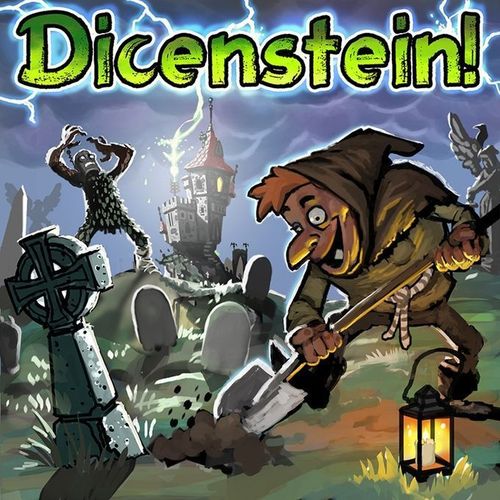
Dicenstein
Dicenstein Rulebook
Table of Contents
Table of Contents
Contents
-
Graveyard (board)
-
VP track (board)
-
Burial Key (board)
-
rulebook
-
4 Labs, with slots for “controls”.
-
24 plastic spindles for sliders
-
4 player VP pawns
-
4 Monster Meeples
-
12 Secret Monster Army cards (one per monster )
-
12 Monster Info reference cards (one per monster )
-
1 large dice bag {4 as stretch goal}
-
Die-cut tokens
-
12 Monster tokens (for the Burial key)
-
3 Monster Boss tokens (placed on the VP track, and flipped face-down when exploited)
-
-
108 Monster Parts dice (9 per monster type)
-
9 attack dice
Construct Labs (before play)
Before your first play, you need to create the Labs. You need only do this once.
Game Setup
Boards
Place the Graveyard within easy reach of all players. Place the VP Track and the Burial Key to one side, where all players can see them. Each player takes a Lab, a Monster Meeple, and a VP pawn, all of the same color, and places the Lab & Monster in front of himself. The Lab entrances are color-coded, so players should sit more or less near the Lab entrance of their color. Each player now places his VP pawn on the VP track, on the 0 spot.
Burial Key, Graveyard, & Monster Part Setup
Place all the die-cut Monster tokens in a dice bag and shake the bag to randomize them. Blindly pull one monster token and place it on the first available tombstone on the Burial Key. Repeat this process, filling in each tombstone, until each has a unique monster.
Dr. Frankenstein’s Tip: if you only own the core game, you have exactly 12 monsters available. If you own one or more expansions or exclusive monsters, you’ll have more than 12 monsters. In this case, put ALL the monster tokens into the bag, but just draw the first 12 monsters to populate your Burial Key – only 12 monsters are used in any one game of Dicenstein!
Using the Burial Key as reference, place 3 monster parts dice for that monster in each Graveyard area containing that monster’s tombstone. Example: if the first Monster token you draw is a Vampire, place the Vampire token on the number one tombstone on the Burial Key – the sarcophagus. Then place three Vampire parts dice in each Graveyard area containing a sarcophagus.
When you are finished, the four Graveyard center areas should each have 9 dice, and the Graveyard edge areas each have 6 dice. The Burial Key and Graveyard are ready for play.
Secret Monster Army Setup
Next, pick out the 12 Secret Monster Army cards for the 12 Monsters that are on the Burial Key. Shuffle the cards, and deal 3 cards to each player.
Review your 3 cards, and discard one card face-down, returning it to the game box, along with any unused Secret Monster Army cards if you have fewer than 4 players. Each player will have two Secret Monster Army cards left over. Place these face-down near your respective Labs. They’ll be used at the end of the game to earn a final Victory point boost.
Monster Info Card Setup
Next, choose the 12 Monster Info reference cards for your 12 selected Monsters, and place them near the game board, so all players can easily see them. It’s okay for a player to pick up these reference cards during play and examine them – that’s why they’re named “reference cards”!
If you own more than 12 monsters, then the Monster Parts dice, Secret Monster Army Cards, and Monster Info cards for ALL unused monsters are just placed back in the game box. You won’t use them this game.
Lab Setup
Set the sliders on your Lab’s scales to match your Hunchback’s stats. Each mad scientist has a Hunchback printed on their Lab’s slab, with the following characteristics:
-
Head – Body 1
-
Body –Body 4; Dig 1; Move 1;
-
Hand – Dig 1; Attack 1;
-
Foot – Body 1; Dig 1; Move 1
His sliders should be therefore set to:
-
Body (heart symbol)– 6
- (4 from his body, 1 from his Head, and 1 from his Foot)
-
Rerolls (brain symbol)– 0
- (he has no Head points at all)
-
Dig (gravestone symbol) – 3
- (1 each from his body, hand, and foot)
-
Move (boot symbol)– 2
- (1 from his body, and 1 from his foot)
-
Attack (starburst symbol)– 1
- (from his Hand)
These stats are further explained later, in the Monster Making rules section. For now this suffices.
Your hunchback also comes with a unique ability, Disloyalty. Again, see the Monster Making rules section for details.
Object of the game:
Players move their Monsters around the board digging up Parts, battling competing Monsters, and sending forth their Monster Army and accumulating a Secret Monster Army. Eventually they earn enough points to win the game, and it’s over!
Determine First Player
Choose the first player using any means you please. We recommend letting the game’s owner go first (or the player who most recently saw a Frankenstein movie), but it’s up to you. Once the first player is chosen, play proceeds clockwise from him and keeps going around till the game ends.
Game Sequence
Your turn is broken into several phases, but you will never perform more than three of them in a given turn.
-
Starting Lab phase (if you start the turn in your Lab)
-
Action phase (always)
-
Move & Attack segment(s)
-
Retreat segment (if you end your turn in the same area as another monster )
-
-
Dig phase (if you end the turn in the graveyard)
-
Final Lab phase (if you end your turn in your Lab)
Starting Lab phase
If you have no monster on the Graveyard, you are considered to be “in your lab”.
Dr. Frankenstein’s Tip: On the very first turn, skip the Starting Lab phase. Yes, you are technically “in your lab” but you have no Monster Parts dice, so you can’t build a monster nor can you do a Monster Army turn-in. Just go straight to the Action phase!
You have exactly two things you can do in the Starting Lab phase, and you can do them in either order. (I.e., you can do your Monster Army turn-in either before or after you roll to build your new monster.)
Build New Monster
See the Monster Making rules section for details.
Dr. Frankenstein’s Tip: there is no need to wait to build your monster for the Starting lab phase – you should start construction while the other players are taking their turns. It only wastes time if you wait until your own turn actually begins!
Monster Army turn-in
This is optional – you can turn in one (1) set of Monster Parts dice from your Lab pool to earn points. Place the selected Monster Parts dice back in the game box – they are out of play for the rest of this game. See the Victory Scoring rules section for details.
Action phase
During this phase, you move and attack other monsters. After you finish your movement, you may use the Retreat segment to bump an enemy monster in your area to another area.
How to Move
You may move your monster orthogonally over adjacent areas up to your monster’s total Move. You may re-enter areas you have already visited, but you may NOT end your turn in the same location at which you started. This includes your Lab!
If you started the turn in your Lab, you may NOT voluntarily re-enter your Lab during the Action phase (though you may conceivably “return” if you are killed in battle during your Action phase).
Example: your starting Hunchback has a Move 2, so can move two areas. The area directly in front of your Lab counts as one of these two areas! Picture your Hunchback as starting his move from inside your Lab to understand how he moves onto the map.
. A Hunchback (or any monster with a Move 2 can move from Lab Alex to any Graveyard Area marked with a Spade.
If you started on the Graveyard, you may move your monster back into your Lab. It does take 1 Move point to move from the Graveyard into your Lab. Entering your Lab always immediately ends your Action phase.
How to Attack
If you move into an area containing an enemy Monster, you must Attack. You can do this in the middle of your Move, or at the end. Both your Monster & the enemy Monster may be damaged or even destroyed as a result of the Battle. After the Battle, if you have any Move points remaining, you can continue to Move.
This means that you can move into an enemy’s Area, attack him, then move into another enemy’s Area, and attack him! You could, in theory, make one attack per move point you possess, if there were a chain of enemy Monsters standing in adjacent areas.
Only Attack a Monster Once – you cannot Attack a particular enemy Monster twice in a single turn. This means you may NOT re-enter its area, once you’ve attacked him.
Attack procedure
Both you and your enemy roll an attack die for each point of your Monster’s Attack. Example: the starting Hunchback has Attack 1, so he rolls 1 die.
Each attack die has two blank sides (misses), three 1-damage sides, and one Critical Hit (2-damage) side.
Rerolls & determining damage!
After rolling your attack dice, check your Head stat – you may choose to reroll up to that many Attack dice. You do not have to reroll any dice if you are satisfied with the results though.
Dr. Frankenstein’s Tip → It is pointless to have a higher Head stat than an Attack, since you can only reroll the number of dice you attack with. Remember this when building your Monster. I do!
After the reroll, tally up the total damage shown on the attack dice and each player reduces his monster’s Body score by the amount rolled by his foe.
Your enemy rolls his attack dice at the same time, and scores them the same way.
If you have remarkably high-rolling monsters, you may have to take turns rolling the dice, since only 9 dice are in the set. Damage is inflicted simultaneously however (exception: Unicorn).
Killing an opposing monster
If a monster’s Body is reduced to 0, it is killed. In this case, the killer scores 4 Victory Points, then claims one die of his choice from the destroyed monster as a trophy, adding it to his dice pool. (If both monsters are destroyed simultaneously, both receive these rewards – 4 VP, plus a chosen trophy.)
When your monster is destroyed, remove him from the Graveyard, and place him to your Lab. All its remaining dice go back into your dice pool. If the destroyed monster belongs to the active player, you do NOT get a Final Lab phase.
If your monster is killed, immediately begin the process of constructing a new monster, so that when your turn begins, you can start your turn normally. This speeds play and is a courtesy to your fellows.
Retreat Segment
If, at the end of your Action phase, you are in the same area as an enemy Monster, you must “push” the enemy Monster into the orthogonally adjacent area of your choice. Certain limitations apply:
-
You may not push a Monster into a Lab – even his own!
-
You may not push a Monster into an area containing another Monster.
-
You may not push a Monster through a wall (the basic game does not include walls)
-
If a Monster is surrounded, so it cannot be pushed, you may not enter that Monster’s area – retrace your Move and try again!
Diagram caption: The red monster ends its turn in the green monster’s area. The green monster cannot be pushed back into its lab, nor into the graveyard area marked with an X, because the black monster is there. He can only be pushed to the areas marked A and B.
Mind Attack
Some monster types are able to use their Reroll stat (i.e., brains) to do something to another monster. In the core game, the Vampire can use a Mind Attack to Hypnotize another monster. Here is how all Mind Attacks are done:
-
once during your turn (only once!) you must be in a straight orthogonal line from another target. (If you have two Mind Attack Abilities, you can attempt both of them, once each.)
-
You then declare your Mind Attack and the target.
-
Both you and your target roll combat dice equal to your Reroll (brains). Neither of you get any rerolls. If you roll more hits on your dice than your target, you succeed in the Mind Attack. Otherwise, you fail.
Example: Frank’s Vampire wants to Hypnotize Rich’s monster. His Reroll is 4, and Rich’s is 3. Frank rolls a total of 3 hits on his dice. If Rich rolls 3 or more hits on his dice, then he won’t be Hypnotized.
Dig phase
After your Monster finishes his Action phase you can Dig up monster parts in your area. Pick up all the Monster Parts dice in the current location, place them in the dice bag and shake the bag to mix them up. Now, refer to your Monster’s Dig stat and blindly pull that many dice from the bag. Add those dice to your dice Pool. Replace the remaining dice from the bag back in the area.
Dr. Frankenstein’s Tip - If your Dig stat equals or exceeds the total Monster Parts in the area, just pick them up and add them directly to your Lab. No need to bother with the bag.
Final Lab phase
If you end your turn back in your Lab you must perform the Lab phase. This consists of three steps:
-
Disassemble Current Monster
-
Monster Army turn-in (only if you voluntarily returned to your Lab)
-
Build New Monster
To speed play, you can perform your Final Lab phase while the next player takes his turn.
If you returned to your Lab because your monster was killed in battle, you still disassemble your current monster & build a new one, but you don’t get a Monster Army turn-in.
Disassemble Current Monster
When your Monster returns to your lair, whether he voluntarily returned, or was destroyed, you must disassemble him, by adding his dice to your dice pool. If your current Monster is your starting Hunchback, he won’t have any dice to add to your Pool, of course.
Monster Army turn-in (if your Monster voluntarily moved back to the lair)
This is optional – you can turn in one (1) set of Monster Parts dice from your Lab pool to earn points by building your Monster Army. Place the selected Monster Parts dice back in the game box – they are out of play. See the Victory Scoring rules section for details.
IMPORTANT – if your monster returned to your lab because it was destroyed, you do NOT get to perform this turn-in!
Build New Monster
See the Monster Making rules section (which follows) for details. You can build your monster while the other players are taking their turns.
Monster Making
Your Hunchback
Your starting Hunchback has his points, but after you’ve dug up a few Monster Parts, it’ll be time to construct a more effective Monster. This is done during a Lab phase (when your Hunchback has returned to your Lab, either voluntarily or because he was killed.) To build a monster, simply take all the monster part dice in your Lab dice pool and roll them together. Many players find it easiest to sort the results by body part (head, body, arms, legs) before selecting one of each part to form a new monster.
If you are missing a body part, you’ll be forced to leave that spot blank, and use the Hunchback part printed on the slab. You can always choose to use a Hunchback part though, even if you managed to roll a particular part.
Sidebar
Hunchback Ability
Disloyalty: at the end of each turn your monster takes 2 damage. If you are killed by Disloyalty (rather than battle damage), you lose 1 Victory Point.
End Sidebar
Dr. Frankenstein’s Tip - because the Hunchback’s “Ability” is Disloyalty, and because (except for Dig) his stats are terrible, it’s rare you’d want to voluntarily use a Hunchback part. Even if you are forced to use a Monster Part with worse stats than the Hunchback’s corresponding part, at least the Monster part gives you a useful Ability and avoid Disloyalty.
Monster Parts Dice
Each monster consists of four dice faces. He needs a Head, a Body, a Hand, and a Foot. These are all in the diagram on your Lab, shown by the Hunchback on the slab.
The dice results are divided into five categories, each indicated by a symbol. These are:
H – “Head” (brain symbol) often featured on the Head die face.
B – “Body” (heart symbol) always featured on the Body die face.
A – “Attack” (starburst symbol) always featured on the Hand die face.
M – “Move” (boot symbol) always featured on the Foot die face.
D – “Dig” (gravestone symbol) always featured on the Foot die face.
It is common for a dice face to have more than one symbol. For example, the Invisible Man’s Head die face features Head 3 and Dig 1. The Mummy’s Head die face features only a Body 1 (it doesn’t even boast any Head points!)
After building your new Monster, add up his stats from ALL his dice, and then set the sliders in your Lab accordingly. Your sliders may be adjusted later, due to a particular monster’s ability, or of course due to damage (hurting your Body stat).
Monster Stat Limitations
You cannot have a score more than 15 for your Body, or more than 9 for any other stat. If your monster is so awesome that you would otherwise rise above these levels, just cap it at 9 (or 15).
Monster Powers
You are building a monstrous hybrid creature. Each individual type of Monster included in your creation grants your monster a special Power. You get this Power even if you only have one body part from that Monster type. If you have more than one body part of a particular Monster type, you still only get the basic Power once –it is not “strengthened”.
Dr. Frankenstein’s Tip – obviously, if each part of your Monster is from a different monster Type, your creation gains the most Powers. Sometimes it’s better to use a really good body part, even if it means you may have one less power, though.
Hunchback – Disloyalty
If your monster has any non-Hunchback parts, then at the end of your turn your monster takes 2 damage. If your monster is killed by Disloyalty (rather than battle damage), you lose 1 Victory Point.
Dr. Frankenstein’s Tip – you really don’t have to get your Hunchback to the lab before he “dies” via Disloyalty. Yeah, you theoretically lose 1 VP, but since you don’t’ have any VP yet, you have none to lose. Just dig up another 3 dice instead!
Dr. Frankenstein’s Tip – one use of the Mantis’s Brainless ability is to get your monster back to your Lair before he falls apart, so you can score a Final Lab phase Monster Army turn-in!
Dr. Frankenstein’s Tip – normally a Unicorn has to move orthogonally to Charge – but if he is also a Gargoyle hybrid, he can charge diagonally! Look for other clever combinations.
Victory Scoring & the Monster Army
Players gain victory points in three ways:
-
Battle – Each time you kill an enemy monster, score 4 Victory points.
-
Monster Army turn-in – scored during a Starting Lab phase or an Ending Lab phase (in the latter case only if you voluntarily returned to the Lab).
-
Secret Monster Army – scored only at the end of the game (q.v.), after accumulating the correct types of Monster Parts throughout play.
Monster Army turn-in
During a Lab phase, you can turn in a set of Monster Parts dice as determined by the Burial Key setup. You can only turn in ONE set of Monster Parts per Lab phase.
Types of Monster Army Turn-ins
-
5 VP – the top four Monster types on the Burial Key earn 5 VP when you turn in four Monster Parts dice drawn from these Monsters.
-
3 VP – the next three Monster types on the Burial Key earn 3 VP when you turn in three Monster Parts dice drawn from these Monsters.
-
1 VP – the next lower two Monster types on the Burial Key earn 1 VP when you turn in two Monster Parts dice drawn from these Monsters.
-
Zero VP – the final three Monster types cannot be turned in as sets for VP. However, they may be included as part of the Monster Boss turn-ins (see below).
-
Monster Bosses (6, 4, or 2 VP) – three large tokens represent the Monster Bosses. The VP Track has three empty slots for these tokens. These earn 6, 4, or 2 VP when you turn in a large enough set of Monster Parts and the tokens are flipped face-down (see below for details).
Example: say the VP track is set up like this:
-
5 VP→ 1st mummy, 2nd werewolf, 3rd clown, 4th unicorn
-
3 VP → 5th plant man, 6th giant mantis, 7th invisible man
-
2 VP → 8th vampire, 9th swarmling
-
Zero VP → 10th gargoyle, 11th robot, 12th gill man
For a 5 VP turn-in, you’d need 4 Monster Parts chosen from among the mummy, werewolf, clown, and unicorn types. You could turn in one of each of those monster parts, four of the same monster, or any mixture of dice, so long as you had a total of 4 dice, all from these types.
For a 3 VP turn-in, you’d need only 3 dice chosen from the plant man, giant mantis, and invisible man types. Again, it can be any mix of dice, so long as it is 3 from those types.
For a 1 VP turn-in we only need 2 Monster Parts taken from the vampire & swarmling types. This can be one of each, or both of the same type.
The Zero VP monsters – gargoyle, robot, and gillman – are worth nothing for the Monster Army, but you can turn in Parts from them for the Monster Bosses (q.v.).
You can turn in Monster Parts dice for your Monster Army many times in the game, but only once per Lab phase.
Dr. Frankenstein’s Tip - Perspicacious mad scientists should notice that because of the turn sequence, if you return your monster to your Lab by movement, you get a Monster Army turn-in in the Final Lab phase, PLUS at the start of your next turn you get ANOTHER Monster Army turn-in, during the Starting Lab phase. That’s twice the points!
Monster Bosses
The VP Track has three Monster Boss token slots, on which are placed the Monster boss tokens. Each can be triggered only once per game, and give players bonus VP for recruiting that Boss. This DOES count as your one Monster Army turn-in for that Lab phase.
You can turn in any combination of Monster Parts dice, regardless of Monster type, then score points as follows:
-
6 VP – for turning in seven Monster Parts dice, from any monsters.
-
4 VP –for turning five Monster Parts dice, from any monsters.
-
2 VP – for turning three Monster Parts dice, from any monsters.
Once a player claims a Monster boss slot, flip that Monster Boss token face-down to its Used side, showing that it cannot be claimed again.
The End-Game, the Secret Monster Army, and Final Victory!
Throughout the game players collect Victory Points until someone reaches the total of 20, which begins the end-game. At this point, the game continues for one more round for each other player. Each other player gets one (1) more turn, then all score their Secret Monster Army and the game ends.
Example: Frank, Guy, Rich, and Angela are playing a game. On Frank’s turn, he kills Guy’s Monster and rises from 18 to 22 points. This triggers the game’s end. He runs back to his Lab and makes a Monster Army turn-in. Then Guy builds his new monster, and takes his final turn. Then Rich takes his turn. Then Angela. Frank, who triggered the end of the game, does NOT get a final turn. The game is now over, and all players score their Secret Monster Army.
Game End Trigger: the end-game gets triggered on the current player phase regardless of who reached 20 VP. Example: in a different game with the same players, on Frank’s turn, he attacks Angela, and gets killed BY her. She scores 4 VP, and this brings her above 20 VP. The end-game is now triggered, so Guy, Rich, and Angela each get one more turn. Frank does not get another turn, because the end-game was triggered on his turn, even though he was not the person who rose above 20 points!
Secret Monster Army
At game end, all players reveal their Secret Monster Army cards and score 1 points for each Monster Parts die in their lab for EACH of the two Monsters displayed.
Example: Guy’s Secret Monster Army cards are the Mummy and Plant Man. He has 2 Mummy parts in his dice pool, and 4 Plant Man parts, so he scores 6 points for his Secret Monster Army at game’s end.
Final Victory
Add up your Victory Points accumulated during the game, along with your Secret Monster Army, and the player with the most victory points wins! In cases of a tie, the player with the largest Secret Monster Army parts wins. In case this is also a tie, players rejoice in their shared triumph.
May the best mad scientist win!