Diceland
Diceland Rulebook
Table of Contents
Table of Contents
Components
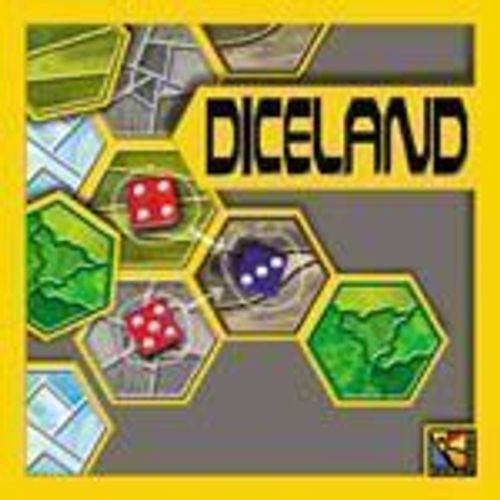
- 36 hexagonal territory-cards that can easily be combined, each time creating a different scene. These hexagonal pieces represent different types of terrain.
- When playing with the advanced rules, each terrain has its own strategic value.
- When playing with the basic rules, the differences are purely aesthetic.
- 6 blank hexagonal cards let you customize the game. For indications as to how to use these pieces, see the chapter entitled "Diceland: An Ever Expanding World".
- 20 blue dice
- 20 red dice
Basic Rules
Creating the scene
Each scene must be created with an even number of hexagons: minimum 8, maximum 36. There are no rules or particular limitations indicating how the hexagons are to be placed. They can be positioned at random or following an agreed-upon outline.
For beginners, it is best to play with a relatively small scene.
Deploying the forces in the field
- The players select their colors and pick a certain number of dice. The number of dice must be equal to half the number of territories in the field plus 2. For example: if you have decided to play with a 10-territory scene, each player takes 7 dice (5 + 2).
- Each player rolls all his dice on the table (outside the territorial playing area). This roll gives a random value for the forces in the field. From this point on the players can no longer modify the value shown by their dice until Territorial Occupation has been completed.
- The player that rolled the greatest number of sixes (6) wins the right to start the Territorial Occupation. If there is a tie, the one that rolled the greatest number of fives (5) goes first. If there is still a tie, the greatest number of fours (4) counts, and so on. In the unlikely case that both players rolled exactly the same combination of dice, roll again.
Occupying the territories
The players take turns occupying the territories with their own dice, continuing until all the territories have been occupied. Each territory can only contain one die and, when all the territories have been occupied, each player should be left with two dice.
The sum of the value of these dice is fundamental because this determines who goes first. If they are tied, the player that started occupying the territories goes first.
Turns
Each player's turn is divided into two steps:
- Attack
- Move
1. Attack
The player must attack the enemy territory from its own adjacent territory and can only make a single assault per turn. The player declares which territory he wants to attack and then rolls one of his free dice (not any of the dice placed on the territories). He then checks the value he has just rolled against the value of the die within his own territory.
Three different situations can arise:
- Perfect Attack
The score obtained is the same as the value of the die in the field: in this case the value on the defender's die is lowered by the number of points rolled. The value on the attacker's die does not change.
- Valid Attack
The die rolled shows a value lower than that of the die in the field: the value on the defender's die is lowered by the number of points rolled. The attacker replaces his own die in the field with the one rolled.
- Failed attack
The rolled die shows a value higher than that of the die in the field: the value on the defender's die is not changed. The value on the attacker's die is lowered by one point.
Combined Attacks
To increase the possibility of success, the player can attack his opponent's territory from two adjacent territories as long as they border on each other as well. In this case, the player can throw both dice and select the highest value for the attack. After having seen the result of the throw, the player can decide from which of the two territories he wishes to launch the attack. The player cannot voluntarily decide to let the attack fail.
Occupying a territory
- If, after an attack, the value of the defender's die falls to zero (or lower), it is eliminated and the attacker can invade the territory he just conquered, moving his die in the field into the territory which has been left vacant.
- If the attacker's die drops to zero or lower following a failed attack, it too is eliminated from the game but the adversary cannot invade the vacant territory.
2. Move
During the course of the game, territories become vacant and the dice can be moved. Moving basically serves to enter into an opponent's territory, force an attack or prepare for the next attack. All moves must follow these rules:
- Only one move can be made per turn.
- The die that just occupied an enemy territory cannot be moved.
- A situation of contact cannot be abandoned; in other words, it is not possible to move a die that is located adjacent to an opponent's territory.
Note: to give the game greater strategic implications, we suggest you also apply the rule of "fatal attraction" described below.
End of the game
The game ends when it proves impossible to launch an attack for two turns in a row (for example: the red die cannot attack and, then, the blue die finds itself in the same condition) or when one of the two players is left without any dice in the field.
Victory
There are three possible win situations:
- The player with the greatest number of dice in the field wins no matter what the value.
- In case of a tie, the value of the dice in the field is added up and the player with the greatest force (highest score) wins.
- If the score is still tied, the player who made the first move wins.
Special Rules
Kidultgame "Diceland" can be enhanced with new rules that add elements of strategy to the game, making it even more fun. These special rules do not modify the basic structure of the game but do make it more complex. The players can decide whether to apply all or just a part of the special rules described in this section as long as they make this clear before the game begins.
Fatal Attraction
The dice are fatally attracted by the adversary. During a move, if a player finds that he can move his die into contact with his opponent's die, he is obliged to do so. When more than one move is possible, the rule permitting only one move per turn still holds and the player is free to choose which of the moves he wishes to make. If a player forgets to make a compulsory move, when it is the other player's turn he can lower by one point the value on the die that should have made the move.
Grouping
During his move, the player can decide to group two dice together to reinforce the defenses of a given territory. This is done by moving one die into an adjacent territory that is already occupied by the player's own die and then adding the two values together. The two dice are eliminated and replaced by a single die whose value indicates the sum of the other two. Any excesses are lost. In other words, if a player decides to group together a die reading 3 with another one reading 4, the final result will be 6. Obviously, the die moved to make the grouping must meet the normal rules governing movement.
The inverse, that is separating the two dice, is not possible.
Territories
The diagram numbers five terrain types, described below. When playing with the advanced rules, each terrain has its own strategic value. When playing with the basic rules, the differences are purely aesthetic.
-
Pains (printed as "Pains"; the text describes the plains) The plains are the "normal" territories. The dice occupying these territories enjoy no special privileges.
-
Hills The dice in the hills have a particular defensive advantage. It is not possible to launch a combined attack against a hill.
-
Towns The dice set in towns enjoy the advantage of regeneration. At the end of his own turn, a player can select one of his dice located in a city hexagon and increase its value by one point. This can only be done if the die was not used in an attack and did not participate in the move in any way. Obviously, a die can never have a value of more than 6.
-
Mountains The mountains have the same defensive advantage as the hills but if they are abandoned they cannot be reoccupied. In effect, a mountain hexagon can only be occupied during the initial phase of the game; if not occupied at that time they will remain vacant throughout the entire game, creating an impassable zone.
-
Forests The dice in the forest areas enjoy a special advantage during moves since they can totally ignore their position with respect to the opponent's territories. In practice, a die in a forest area can move even if it finds itself adjacent to an adversary.
Alternate Rules
The alternate rules let you play Kidultgame "Diceland" differently. They can be used with the simple basic rules as well as with the special rules.
Capital
When preparing the game, after having created the scene, add two towns set apart from one another. At the beginning of the game, these two cities are occupied by the two players and become their capitals. If, during the course of the game, one of them succeeds in occupying the other's capital, he wins the game on the spot.
Fill-the-void
If the attacker's die drops to 0 points and is eliminated, the defender's die must move into the territory left vacant. This rule radically modifies how the game is played and adds a new element of strategy. For this reason it should only be applied by expert players who have already thoroughly explored the potential of the basic game.
Author's Note
Diceland is special in that it is an extremely simple game that can, at the same time, be quite complex. As all dice games, luck plays its part in the final result. However, when the game is played with the maximum number of hexagonal cards and dice possible, the values tend to even out and strategy comes to the forefront. A beginner has very little chance of beating an experienced player when a 36-card scene is used. The initial phase of the game is very important and planning a good strategy from the very outset is a must. Avoid improvising from one move to the next. Try to carefully "read" the arrangement of the dice to see through the weak points in your opponent's deployment. In time you will learn that certain positions can be extremely advantageous but you will have to get used to determining them on a game-by-game basis since the overall scene is quite different each time. Remember, do not underestimate the strategic strength of a die with a low value. An attack by a die with a value of 6 against a die with a value of 1 can, in fact, prove disastrous for the attacker: he will certainly eliminate the adversary's die but he also runs the risk of suffering even greater damage than he inflicted. When you launch a combined attack, if it proves possible, do not use two die of the same value, particularly if that value is high. Don't forget that the foremost condition for victory is the number of dice remaining on the field, no matter what their value. This means that, at the end of the game, four dice with values of 1 will win out over three dice with values of 6. Remember that if you have eliminated one of your adversary's die through an attack, you must move in to occupy the territory (hexagon) left vacant.
Carefully study your moves because, at times, these can make all the difference in the world: the difference between winning or losing. It is not unusual for a game to be won (or lost) following a single attack, particularly when the rule of "fatal attraction" is applied. Finally, do not despair if your score is terrible; your opponent's could be even worse!
FAQ
How are the hexagon-cards arranged in the field? At random or following any scheme the players have agreed upon. Some players alternate, placing the cards down one at a time.
Who starts placing the dice in the field? The player who rolled the most sixes. If there is a tie, the one who rolled the most fives and so on. In the unlikely case that both players rolled the exact same combination of dice, roll again.
Who attacks first? The player whose two remaining dice have the highest value (the values are added together). In case of a tie, the player that started placing the dice in the field goes first.
Can I make more than one attack? No. The turn involves: ONE attack (with possible invasion) and ONE move.
Can I forfeit an attack? No. If the attack is possible, it is mandatory.
Can I attack from three territories with three dice? No, the maximum combination is an attack from two territories. Remember that the territories must border on each other and on the opponent being attacked.
Can I decide not to move the dice when it is my turn to move? Yes, moving is optional. Remember, however, that there are some conditions where moves are compulsory.
I rolled a disastrous value. Can I decide not to use the die and lose a unit? No. If the die rolled can be used (its value is equal to or lower than that of the attacking die in the field) it must be used. This is also true for combined attacks. In this case, if at least ONE of the two points can be used, it must be used.
Diceland: An Ever Expanding World
If you wish to keep your Kidultgame "Diceland" new and exciting, visit the publisher's site at www.kidultgame.com.
- You will find many original ideas to enhance your play, and for all levels of difficulty.
- And not only ideas! You will also find materials you can print to enhance your game with new territories (you can glue them onto the blank hexagon-cards supplied with the game), scenes and other game tools. And all free of charge.
- At www.kidultgame.com you will find all the information you need to participate in the gaming and entertainment initiatives organized by Kidultgame.
The site is constantly being updated with hosts of ideas that players have sent in. So, please, do not hesitate to send us your proposals!
Remember that www.kidultgame.com is a free site and, at the time of this printing, is on-line in English, German and Italian.