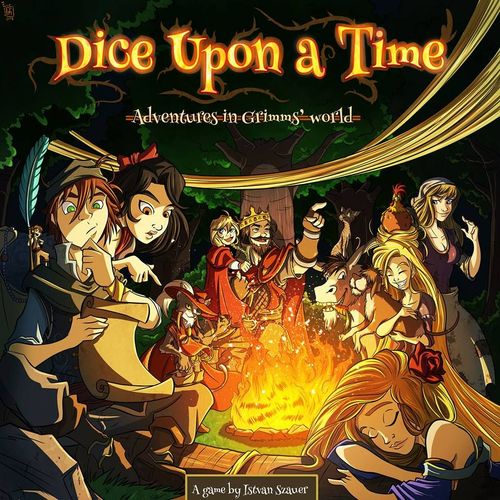
Dice Upon a Time
Dice Upon a Time Rulebook
Table of Contents
Table of Contents
Components
- Quest tokens (4 pieces)
- Rabbit tokens (5 pieces)
- Tokens (45 pieces): Apple, Coin, Bread, Bow, Sword, Golden lock, Flute
- Quest cards (39 pieces)
- Magic Item cards (18 pieces)
- Story cards (65 pieces)
- 1 Snake Die
- Chapter cards (6 pieces)
- 1 starting player marker
- Character figures (8 pieces)
- Character cards (8 pieces)
- Unique dice (5 per player, 20 pieces)
Setup
- Place the game board on the table.
- Separate the cards into decks (Magic Items, Story cards, Quest cards separately by value), shuffle and place them face down next to the game board.
- Put the tokens next to the board to form a supply.
- Put the Snake Die next to the Snake field.
- Each player chooses or draws a Character card, takes the respective figure and places it on the Town in the middle of the map.
- Each player chooses a color and takes the set of 5 dice.
- Put the 6 Chapter cards next to the board at the slots marked by Roman numerals.
- Choose the starting player and take the starting player marker.
Tip: The starting player is who defeated a dragon most recently (online or offline). In case of a tie decide randomly.
- The starting player draws a Magic Item card and 2 Quest cards from any decks of their choice. (The higher the value, the more complex are the quests in the deck.) All players do the same in clockwise order. Magic Item cards are always hidden from other players, but the Quest cards go face up next to the Character cards.
Goal of the Game
The player who collects the most Adventure Points (AP) by completing quests will be the winner.
Adventure Points are the values on the back of the Quest cards.
Gameplay
Play proceeds clockwise. In your turn you must place one die, you can move your figure, collect resources, complete quests, acquire cards.
At the Beginning of a Chapter
The game consists of 6 chapters (rounds). At the beginning of every chapter take away one Chapter card. The remaining Chapter cards indicate the number of the remaining rounds. At the beginning of every chapter players roll their dice and place them next to their Character cards without changing the result. This forms their pool of available dice. A chapter normally consists of 5 turns per player: as a player has normally 5 dice and places 1 die per turn.
A Player's Turn
Order of the phases of a player's turn:
- Place one die
- Die effect activates
- Move your figure
- Location ability activates
- Complete quests
Tip: See the Guide cards for reference during the game.
1. Place One Die
The first move of the active player in their turn is to place a die from their pool on the board into any of the dice sockets, including the four Spirit Animal fields in the corners of the board. By placing a die players activate the route or the Wolf field. Dice can be placed on top of each other as well regardless of who has placed them on the board.
General dice placement rules:
- The newly placed die has to have at least the value (same or higher) indicated by the socket or the die on which you wish to place it.
- A dice tower may consist of maximum 3 dice.
- The special faces of the dice are worth 6. This means they can be placed on value 6 (or lower) sockets or dice, and value 6 (or special face) dice can be placed on top of them.
Example: The red player places a value 5 die on the value 5 socket. The white player also places a value 5 die on it. The green player puts a special face die on top of the previous two dice. The special face is value 6, so it activates the route.
2. Die Effect Activates
In case you place a special face die into a dice socket (or on another die) on the board in your own turn, the ability of that face gets activated.
See section "Special die faces" for details.
3. Move Your Figure
The active player may move their figure to an adjacent field if they have activated the route by placing a die in its socket.
Normally one die can be placed per turn, this way one route can be activated and therefore one movement is possible.
You may place a die on any of the dice sockets of the board (e.g. to block the way of an opponent), but your figure can move to an adjacent field only in case you have activated that route by placing a die on its socket.
In case you would like to use a route where you already placed a die in one of your previous turns, it must be activated again by placing another die from your pool.
Example: Red Riding Hood is standing on the Town field. She puts a value 3 die on the route to the Old Woman. Now she has activated the route and can move to the Old Woman field.
4. Location Ability Activates
As soon as the active player's figure arrives on a location with a special ability, it gets activated.
See section "Locations on the board" for details.
Important: Requirements cannot be contracted. One resource token can be used for one quest only.
Example: Quests "Give 2 Apples to the Huntsman" and "Discard 2 Apples" cannot be contracted. If you have only two Apples and you give them to the Huntsman, you cannot discard two further Apples.
5. Complete Quests
In the last phase the active player can complete a quest if the requirements are fulfilled.
Passing the Turn
It can happen that a player gets stuck or cannot move with their lower value dice. Players may choose to pass their turn any time, when they cannot or don't wish to place a die on the map. By doing so, they have passed also all their upcoming turns for that chapter.
Tip: Instead of passing, it is worth using the abilities of the available Spirit Animals (if any) to gain advantages for the next chapter. See section "Spirit Animals" for details.
At the End of a Chapter
A chapter ends when all the players have used all their dice or passed their turns.
Tip: Some field or card effects may grant the players extra dice or the opportunity to reuse their dice or move without placing a die. This can result into cases when some players run out of dice, while others still have some.
The players take their dice back from the game board in the following order:
- Check the Spirit Animal fields:
- Take the Snake Die, take the Rabbit Token, hand over the starting player marker, take and set the dice that have been put on the Fox field.
- If nobody won the reward of the Rabbit field, the starting player marker stays with the previous winner.
- Take back all the remaining dice from the board.
- Turn the Character cards back with their ability side up (if used).
Locations on the Board
Town
The Town is the starting field at the beginning of the game. When arriving on this field later in the game — either by normal movement or by card effect — the player can draw a Quest card.
King
The King is one of the best possibilities to obtain new quests. On this field you can draw 3 Quest cards (from any decks in any combinations), keep one of them and put the rest back to the bottom of their decks.
Fairy
On the Fairy field you can take one of the resource tokens of your choice: a Gold Coin, a Loaf of Bread or an Apple.
Note: The Fairy and the King are both powerful locations, but you can get there only with a value 6 die. In addition, both of them are dead end routes. At popular places like these there's a higher risk of getting stuck because of the dice placement rules.
Resource Fields: Gold Coin, Bread, Apple
Arriving on one of these fields you can take one token from the supply. These tokens are mainly used for fulfilling quests.
Tip: It's worth it to keep tokens that seem to be useless at a certain point of our journey, for you can never know what will read on your next Quest card you draw.
Supporting Characters: Huntsman, Old Woman, Woodsman, Soldier
When arriving on one of these fields, the player must immediately draw a Story card. Remember: You cannot complete any quests before drawing the Story card, since the location ability (4th phase) has priority over quest completion (5th phase).
Buildings: Well, Bridge, Church, Inn
These fields do not have any abilities or effects. Players will visit them to complete quests.
Other Locations: Clouds, Hell, Big Sea, Big Mountains
These fields do not have any abilities or effects. Players will visit them to complete quests.
Steed Fields
When arriving on one of these fields, the player may immediately jump to another Steed field.
Magic Items Field
When arriving on this field, the player must immediately draw a Magic Item card.
Special Die Faces
If you were lucky enough to roll some of your dice at the beginning of a chapter with their special faces up, you can use their abilities during your adventures. When the active player places a special face die into a dice socket on the board as a normal dice placement action, that special face gets activated immediately.
Normal Values
Every set of dice has one die with no special face, but some of its more valuable faces appear on it more than once.
Magic Item Face
When activating this face you must immediately draw a Magic Item card.
Story Card Face
When activating this face you must immediately draw a Story card.
Tip: If a player activates a Story card die and moves to a field where a second Story card is to be drawn, draw the two cards separately one after the other. There's a chance that the first card drawn because of the die sends the character to another location. In this case the second Story card must not be drawn as the character lost their way and did not arrive to the original Story card field. (See the order of a player's turn.)
Ban Face
OTHER players' dice may not be placed on top of the die with this face up. Other players can override this only with their Ban die. Players can override their own Ban die with their other dice (with at least value 6, according to the general dice placement rules).
Token Doubling Face
If you activate a die with this special face and you would take tokens after moving, you can take one extra token of that type. This face is valid only for taking tokens on the Resource fields, not for cards. (So you cannot draw two Quest cards, Magic Item or Story cards by this effect.)
On the Fairy field you can draw 2 of the SAME type of tokens. (The doubling effect lets you draw 2 tokens, but they cannot be of different types.)
Spirit Animals
If you get stuck during the game or just would like to gain special advantages, you can turn to the Spirit Animals for help. Four animals in the four corners of the board symbolize spells that our characters can cast. Players can place dice on these fields' sockets in their turn, just like any other sockets on the board.
The Spirit Animal fields have the lowest value (1), therefore any dice can be placed here. Mostly the lower value dice will be used here. The special die faces do get activated here, when placed by the active player in their own turn into a dice socket.
Rabbit — Starting player + Free movement
The maximum number of dice on this field is 3, so a dice tower can be built here like on the sockets of the map.
The player whose die is on the top of this tower (or is the single die on this field) at the end of the chapter gets the 2 rewards of the Rabbit field:
- First reward: The winner of the Rabbit field will be the starting player from the next chapter and has the starting player marker until another player takes it from them in some way.
- Second reward: The winner can take a Rabbit Token. They can use it in their turn to move to an adjacent field without placing a die.
The Rabbit Token is equivalent to the dice placement. After using it, the token must be put back to the supply, don't place it on the board. When using it, the player may not place a further die in the same turn.
The Rabbit Token can be used to pass through a path with already 3 dice in the socket.
Snake — +1 Snake die (unless it slips out of your hands)
The maximum number of dice on this field is 3, so a dice tower can be built here like on the sockets of the map.
The player whose die is on the top of this tower at the end of the chapter gets the reward of the Snake field: the Snake Die. The winner can add this die to their set of dice for the next chapter.
At the beginning of the next chapter roll it together with the other dice.
- If the result is 4 or 5, the Snake Die can be used like any other normal face die in the game. This is a great advantage, since this player will have an extra action opportunity compared to their opponents.
- If the result is the Snake, you lost the die, put it back on the Snake field.
- If the result is the Gold Coin, the Bread or the Apple, you can take 1 respective token from the supply. Then put the Snake Die back on the Snake field, just like when having rolled the Snake symbol.
Wolf — Gobbles up the dice
When the active player activates the Wolf field by placing a die in the socket, all players in clockwise order must place one of their unused dice on the field.
This field can be activated once per chapter, even if the dice socket gets freed up by some effect (e.g. taking back a used die). Dice towers may not be built here.
If the active player places a special face die into the socket of the Wolf field, the ability of that die gets activated. The discarded dice of the other players do not get activated, as they were not placed as a normal die placement action.
Fox — The sneaky trickster
One die can be placed in each of the two sockets of the Fox field. No dice towers may be built here.
At the beginning of every chapter all players roll all their dice, except for those that were put on the Fox field in the previous chapter.
At the end of the chapter players take their dice from the Fox field (if any). At the beginning of the next chapter set them to any face of choice and roll only the remaining dice.
Tip: Handle these dice separately. It's easy to forget about them and roll them together with the other dice.
Card Types
Character Card
Players choose (or draw) their Characters during the game set-up.
Character abilities can be activated once per chapter.
When used, turn the character card over till the beginning of the next chapter to indicate that it has been already used.
Tip: Character abilities are optional. We recommend ignoring them for example during the first game.
Quest Cards
The goal of the game is to collect the most Adventure Points. Most of the APs will come from the Quest cards. There are Main Quests. Main Quest cards must be separated into three decks during the set-up, based on their value indicated by the numbers 2-4 on the back of the cards.
Whenever a player draws a Quest card, it is up to them which deck they choose to draw from. Value 2 quests are the easiest, while value 4 are the most complex to fulfil.
Players' Quest cards are always open. Whenever you draw a Quest card (at the beginning or during the game) put it face-up next to your Character card. This means the Quest is active. When you complete a Quest, turn that card face down. Face-down Quest cards are passive, indicating the Adventure Points you get for them at the end of the game.
The limit of the active Main Quests (Quest cards) is 5 per player. Side Quests are not limited (see section "Story cards").
Some Quest cards require special items. These items can be collected only by the owners of these Quest cards when visiting the location specified on the given card.
Incomplete active Main Quests have no negative effects at the end of the game.
Magic Item Cards
These cards are kept secret, don't show them to your opponents. These cards can be obtained mainly by activating the Magic Item die face or the Magic Item field on the board.
These cards can be activated both in the active player's own turn and other players' turn, but only when triggered by the event written on the card.
Activated and discarded Magic Item cards all go into one discard pile that can be reshuffled when the draw pile runs out.
Example: King Thrushbeard would take two Apples, but Little Red Riding Hood plays Magic Item "Cudgel in the Sack". She would take the two Apples from the King, if he didn't ward it off with Magic Item "Starwort".
Story Cards
When you activate a Story card die face or a Supporting Character field on the board, you must draw a Story card and read it aloud.
There are four types of Story cards in the deck:
- Good luck cards (green) and Bad luck cards (red).
- Lucky Side Quests (green) and Unlucky Side Quests (red).
All types of these cards are open information to all players. Side Quests go face-up next to the active Quest cards.
Good and Bad Luck Cards
These cards take effect immediately.
If they drew a Bad luck card the active player must choose from two negative effects.
- In case only one effect is possible to happen, that effect must be chosen.
- If none of the effects can be carried out, discard the card without fulfilling either of them.
"You choose" Bad luck cards: There are several Bad luck cards that have no negative effect to the active player but reward their opponents. The active player decides which effect to carry out. The active player takes no benefit in these cases, only the other players get the chosen reward.
Example of a Good luck card: "Draw a Quest card."
Example of a Bad luck card: "Discard a token - OR - Discard an unused Magic Item card." If the player has no tokens but has unused Magic Item cards, they must choose the latter effect.
Tip: "You choose: Every opponent can get a Gold Coin - OR - Every opponent can get an Apple." In a case like this it's good to consider which reward would get the opponents closer to or further from completing their active Quests.
Lucky and Unlucky Side Quests
Drawn lucky and unlucky Side Quests must be placed face-up in front of the players. They can influence the number of APs at the end of the game.
Lucky Side Quests give extra APs, if their conditions are met at the end of the game.
Unlucky Side Quests are worth negative APs at the end of the game. However, you can get rid of these cards by fulfilling the requirements listed on them.
Example of a Lucky Side Quest: "...if you are in the Town at the end of the game."
Example of an Unlucky Side Quest: "Ride a Steed to discard this card."
Tip: "Discard 1 token to get your reward: draw a Quest card." This can be a useful or a permissible move, but sometimes it isn't worth it to complete right away. It can be rewarding to set it aside in front of you and use it tactically.
Activated and discarded Story cards all go into one discard pile that can be reshuffled when the draw pile runs out.
Card Combinations
It can happen that some effects trigger other effects as well. In these cases you must follow the order of the activation.
Example 1: Snow White has got a Loaf of Bread and wants to move on the Huntsman field to complete her Quest: "Give 1 Loaf to the Huntsman". She places the Story card die, draws a Story card that says she must immediately go to the Big Sea. She could not finish the quest there, so she plays a Magic Item card that negates the effect of the Story card. Arriving to the Huntsman this way, the field effect gets activated: she draws a second Story card that makes her discard her single Loaf of Bread she was taking to the Huntsman. Snow White is unlucky today.
Example 2: Sleeping Beauty places the doubling die and arrives on the Apples field. Instead of taking 1 Apple, she could take 2, but she plays also a Magic Item card which modifies this to 3. The tricky Puss in Boots waited till the end of her action and tops off this nice combination with a Magic Item card that gives him the newly acquired 3 Apples.
Summary of the Gameplay
- At the beginning of a chapter everybody rolls their dice.
- The starting player begins their turn: they place a die to activate a route, following the dice placement rule. If it was a special face die, it takes effect.
- Then the active player moves to an adjacent field through the activated route.
- If the destination field has an ability, it takes effect.
- Then the active player can complete quests, if requirements are met.
- After that the next player goes. The chapter ends when all the players have used all their available dice or passed their turn.
- Then everybody takes their dice back and the next chapter begins.
Tip: There can be more than one figure on one field at the same time. This is called Encounter in the game. When two (or more) players meet (their figures are on the same field), they can exchange resource tokens, active Quest cards (including Side Quests), and Magic Item cards with each other by common assent.
The End - Scoring
The game ends after Chapter 6 (when there are no more Chapter cards to take away). Then the scoring begins.
- All players count the Adventure Points (AP) on the back of the completed Quest cards.
- Count the positive APs on the completed green Side Quest cards and the negative APs on the remaining red Side Quest cards.
The player who collected the most Adventure Points wins.
Is it a tie? Possible. If it's a tie, the winner is who can kill more flies with one blow. ;)
2 Players Variant
The 2 players mode has the same rules with one change: The maximum height of the dice towers is 2 dice (in every socket, including the Rabbit and the Snake field).
Any effects that modify the dice towers by a plus or minus must be applied to a default number of 2 dice in the towers.
Example: "You can place a 4th die on the top of a tower" means here "you can place a 3rd die on the top of a tower."
Short and Extra Long Game Modes
You can reduce the play time by playing the short version of only 3 chapters.
For those who never want to end the game, we present the Extra Long variant, which lasts until the chapter when the last Quest card drawn will be completely finished, then comes the scoring.