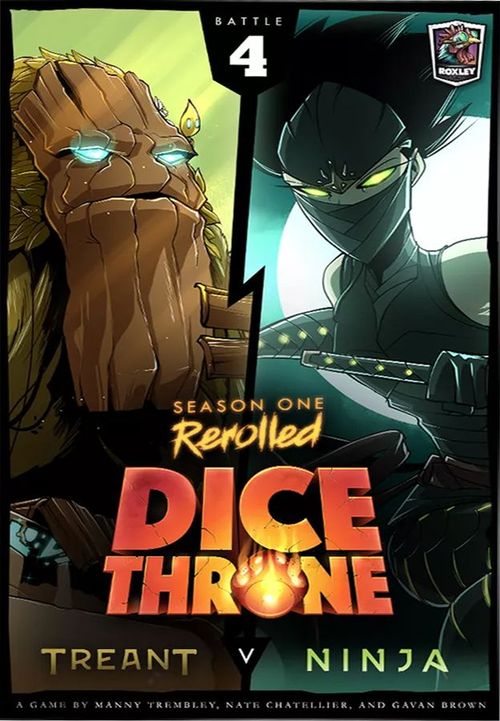
Dice Throne: Season One ReRolled – Treant v. Ninja
Dice Throne: Season One ReRolled – Treant v. Ninja Rulebook
Table of Contents
Table of Contents
Gameplay Overview
A heart-pumping, fast-playing game of skilled card play and dice manipulation. The game is played over a series of rounds where you will be rolling your hero's dice up to 3 times. You will use the combination of dice symbols or numbers to activate your hero's abilities to attack your opponent(s).
Winning the Game
Defeat your opponents by reducing their health to 0.
Tutorials
Hate reading rules? We got you covered. Watch a Video Tutorial: http://learn.dicethrone.com
Hungry for lore? Download a free digital comic: http://comic.dicethrone.com
Game Setup
Each player should place all of their chosen hero's components in front of them:
- Hero Board
- Hero Leaflet
- Tokens
- Stack your Status Effect and Companion tokens on your leaflet in their associated places.
- Health Dial
- Set your starting Health to 50 (for a 1v1 game).
- Combat Points (CP) Dial
- Set your starting CP to 2.
- Deck
- Shuffle your cards to create a deck.
- Draw the top 4 cards from your deck. This is your starting hand.
- Dice
- Roll 1 die. The player who rolls the highest number is considered the Start Player and gets to go first.
- Additional Setup
- Some heroes require unique setup steps. If applicable, these steps will be located on the back of your Hero Leaflet.
Turn Phases
Beginning with the Start Player, take turns as the Active Player, with each turn progressing through the following phases:
- Upkeep Phase - Resolve any Upkeep Phase maintenance (generally specified by Status Effects or Passive Abilities).
- Income Phase - Gain 1 CP & draw 1 card from your deck. Start Player skips their first Income Phase.
- Main Phase (1) - Spend CP to play Hero Upgrade cards or Main Phase Action cards. Sell (discard) unwanted cards for 1 CP each.
- Offensive Roll Phase - Roll any number of your dice up to 3 times and activate a single Offensive Ability that your Final Dice Result meets the Activation Requirement for. Any player may play Roll Phase Action cards.
- Targeting Roll Phase - Skip this phase in a 1v1 game. If you are playing with more than 2 players, see "3 & 4 Player Games". Any player may play Roll Phase Action cards.
- Defensive Roll Phase - If you activated an Attack during your Offensive Roll Phase, your opponent rolls their dice once to activate their Defensive Ability. Any player may play Roll Phase Action cards.
- Main Phase (2) - Identical to Main Phase (1).
- Discard Phase - Sell (discard) cards for 1 CP each until you have 6 or fewer cards in your hand.
Health
- The moment your health is reduced to 0, you have been defeated.
- If all remaining players are simultaneously reduced to 0 health, the game is a draw (an opponent cannot be "more dead" than you).
- You may heal a maximum of 10 points above your starting health.
Combat Points (CP)
- CP is spent primarily to pay for cards.
- You can have a maximum of 15 CP. If you gain CP while you are already at 15 CP, do not increase your CP Dial.
- At the start of your Income Phase, increase your CP Dial by 1.
Important: The Start Player must skip their first Income Phase.
Your Hero Board
A. Offensive Ability
- May be activated at the end of your Offensive Roll Phase.
- You may only activate a single ability as the result of your Offensive Roll Phase.
B. Activation Requirement
The Final Dice Result required to activate an Offensive Ability.
- Offensive Abilities generally require a specific set of symbols to activate.
- C. Small Straight abilities require any 4 sequential numbers in a row (e.g. 2-3-4-5) and are represented by 4 escalating dice.
- D. Large Straight abilities require any 5 sequential numbers in a row (e.g. 1-2-3-4-5) and are represented by 5 escalating dice.
E. Passive Ability
- Always active and/or available for use.
F. Ultimate Ability
Your hero's most powerful attack! If activated, the effects are completely unstoppable.
Important: The damage and effects of an Ultimate Ability can be enhanced, but cannot be reduced, prevented, avoided, responded to, or interrupted by anything (e.g. cards, Status Effects, Companions, etc). Opponents may take no action of any kind from the time it is Activated until the conclusion of the Roll Phase. The only way to prevent an Ultimate Ability is to alter a die roll before its activation.
G. Ability Description
- The effects to be resolved when an ability is activated.
- Dice rolled as part of the ability's effects may apply multiple times during the resolution of the ability.
H. Defensive Ability
- Activated when you are Attacked by an opponent.
- If you have the choice of more than one Defensive Ability, choose one before rolling your dice.
- The Defensive Ability is not activated if the incoming damage type is undefendable, pure, collateral, or is the result of an opponent's Ultimate Ability (see "Damage Types").
I. Defensive Dice
- The number of dice you roll when activating your Defensive Ability.
- For example, "Defense Roll 1" means the Gunslinger rolls 1 die during her Defensive Roll Phase.
- These dice are only rolled a single time.
Your Hero Leaflet
Leaflet Front
- A. Status Effects and Companions — Rules for your hero's Status Effects & Companions.
- B. Dice Key — The symbols on each face of the hero's dice.
- C. Complexity Rating — A value between 1 and 6 that measures how difficult a hero is to play. Higher complexity heroes often take more time to master and require good strategy to play effectively.
- D. Hero Setup — Some heroes require additional setup steps before the game begins.
Leaflet Back
- E. Frequently Asked Questions — The answers to questions about complex rules for this hero.
Status Effects
Each hero has a unique set of Status Effects, represented by tokens. If you need more tokens than are provided, represent them with something else.
Positive or Negative Status Effects can be gained or inflicted on yourself or other players. Status Effects are usually gained or inflicted through cards or Offensive Abilities.
When you gain or inflict a Status Effect, take the corresponding token from your Hero Leaflet and place it in the middle of the receiving player's Hero Board. This Status Effect is now considered to be "in play". If a player is defeated, Status Effects they inflicted on other players remain in play.
Removing Status Effects
When a Status Effect is removed, return the token to the appropriate space on its Hero's Leaflet. When using cards or abilities that remove a specific number of Status Effects, remove that many tokens.
Spendable Status Effects
Some Status Effects are removed when you spend them. Unless otherwise specified, you may spend these status effects at any time during any phase of any player's turn and their effects are immediate.
Persistent Status Effects
A Status Effect marked as "Persistent" remains in play until the end of the game, or until a card or ability causes its removal.
Stack Limits
Many Status Effects can be applied multiple times to a hero, creating a stack of them. The Stack Limit represents the maximum number of tokens of a particular Status Effect that can be on a single Hero Board at a given time (e.g. a Status Effect with a Stack Limit of 2 can have a maximum of 2 tokens on each Player).
Example: Cursed Pirate has inflicted a Powder Keg and two Wither Status Effects on the Gunslinger. Wither is marked as Persistent in the Status Effect description, so it will remain on the Gunslinger's Hero Board until the Gunslinger is able to remove it. Wither has a Stack Limit of 2, allowing the Cursed Pirate to inflict it twice on the Gunslinger.
Increasing Stack Limit
If a player increases the Stack Limit of a Status Effect, the increase only applies to that player, and lasts for the duration of the game.
Unique Status Effects
These fundamentally break the standard Status Effect rules (explained in their description). Unique Status Effects often have a custom shape and/or size.
Interrupting Status Effects
If a Status Effect is spent, its effects cannot be interrupted.
Companions
Some heroes have Companions, which are represented by tokens, dials, or other custom components. Companions are not Status Effects, and are therefore immune to cards and abilities that alter Status Effects.
Companions feature custom rules on the Hero Leaflet. They cannot be removed, transferred, or destroyed, unless otherwise specified in the Companion's ruleset.
Hero Cards
There are two types of cards: Hero Upgrade cards and Action cards.
During your Income Phase, you draw a card from your deck. If you need to draw a card, but your deck is empty, shuffle your Discard Pile to create a new deck first.
Playing cards costs Combat Points (CP). This cost is indicated on the left hand side of the card. Cards costing 0 CP are free to play.
You must conclude your Discard Phase with no more than 6 cards in your hand. If you reach the Discard Phase with more than 6 cards, you must sell cards until you have 6 or fewer. To sell a card, discard it and increase your CP Dial by 1 (all cards are worth 1 CP when sold, no matter how much it costs to play).
The phase during which a card may be played is indicated by the symbol on the left hand side of the card.
Hero Upgrades
Hero Upgrade cards permanently upgrade the space with the same name on your Hero Board. Identified by an up-arrow icon on the left side of the card.
Offensive Ability upgrades have a white border, Defensive Ability upgrades have a green border, and Passive Ability upgrades have a purple border.
Hero Upgrade cards:
- may only be played during your Main Phase (1) or Main Phase (2).
- may not be sold after they have been played.
- may be upgraded directly to level III. If upgrading an already upgraded ability (i.e. upgrading from level II to level III), play the new card over the top of the previous Hero Upgrade and pay only the difference in CP cost between the upgrades.
To Play an Upgrade Card
- Spend the required CP (shown on the left side of the card).
- Place the card onto the space of your Hero Board with the same name.
Action Cards
Action cards (identified by a star icon) are single use cards that provide a benefit. Action cards may be played at different times, depending on their color.
To Play an Action Card
- Spend the required CP (shown on the left side of the card).
- Perform the described action and then place the card onto your Discard Pile.
Instant Action Cards
- Identified by a red border and an exclamation mark icon.
- May be played at any time, during any player's turn (as indicated by the exclamation mark icon on the left side of the card).
- May be played to interrupt actions or abilities (except other Instant Action cards), and are resolved immediately. The interrupted action or ability completes afterward (see "Timing Conflicts and Interrupting").
- Instant Action cards cannot be interrupted.
Main Phase Action Cards
- Identified by a blue border and a star icon.
- Only playable on your own turn, during Main Phase (1) or Main Phase (2) (as indicated by the Main Phase icon on the left side of the card).
Roll Phase Action Cards
- Identified by an orange border and a star icon.
- May only be played during an Offensive Roll Phase, Defensive Roll Phase, or Targeting Roll Phase (as indicated by the dice icon on the left side of the card).
- May be played during any player's turn.
Resolving Text
"Roll [#]"
Roll the indicated number of dice a single time, then resolve the effects that follow. Dice rolled previously cannot be used to resolve the listed effects.
"On [symbol]"
If your roll contains the symbol shown, you get the listed benefits. However, you only get these benefits once, even if your roll contains the required result multiple times.
Multiplication (e.g. "4 × [dice symbol]")
Multiply the [number] by the [quantity] of your dice displaying the symbol to determine the total.
"Then"
You may spend Status Effects and play Instant Action cards or Roll Phase Action cards at the point of a "Then" statement.
The effect following a "Then" statement is performed after the effects that came before it.
"Or"
When statements are separated by an "or", you may resolve only one of the options.
Example: "Choose one: Steal 1 CP - or - opponent discards 1 card of their choice."
"Steal"
Take the indicated resource from your opponent and give it to yourself.
When stealing Health/CP, increase your Health/CP Dial and reduce their dial accordingly.
If your opponent does not have the specified amount, Steal as much as they have.