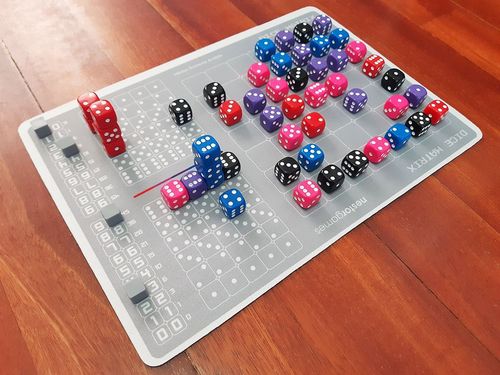
Dice Matrix
Dice Matrix Rulebook
Table of Contents
Table of Contents
Components
- Board with a 7x7 'matrix', 2 scoring areas and 2 scoring tracks (with tens and units).
- 50 dice in 5 colours (10 each)
- 4 grey scoring markers
Setup Up
Roll all the 50 dice and place them randomly on the 7×7 matrix; one die per cell. One die will remain outside the matrix. Once placed, the dice won't change their face value during the game (i.e. only the setup is random).
Example of setup. A Red 5 has been left remaining.
How to Play
Determine the starting player by any peaceful means.
Each player places their 2 scoring markers on '0' of both the tens and ones columns of their scoring tracks.
The starting player takes the unplaced die and decides which side to keep (1, 2, 3, 4, 5 or 6). Then scores 2 points for that die (move the units marker to space '2') and places it on the corresponding cell of her area.
Example: The starting player turns the 5 into a 3, places it on the corresponding cell and scores 2 points for it.
From now on, starting with the second player, players alternate turns executing one and only one of these two actions:
a) Pick any one die from the matrix and score for it.¹
b) Pick any two dice from the matrix so that all the following applies:
- They are on the same row or column
- They have no other dice in between
- They are of the same colour or number (or both)²
… and place them next to the board (outside the matrix) without changing their values. Then score one of them, and then the other (not both at once).
Example: The second player takes a black 1 and a black 5 (both are in the same row with no dice in between, and have the same number or colour).
Then the player places them next to the board.
Then the player scores for the Black 1 (1 point for column and 1 point for row).
And then the player scores for the Black 5 (two points for column and 1 point for row).
The turn passes to the first player, who decides to take the pink and red 3s (8 points in total). Notice that a stack of red 3s has been created.
Then the second player picks two 5s, and so on….
Scoring for a Die
In order to score for a die, place it on the corresponding cell of you area (by number and colour). If there is already a die or a stack of dice there, simply place it on top (hence creating or enhancing a stack).
Then count the number of dice on it's column (including the die you've just placed and the dice underneath, if any) and add this number to your score by moving the units marker (if it goes beyond 9 continue on zero and advance the tens marker 1 space forward).³ Don't worry about the numbers by the side of the scoring track by now (see 'Recount').
Do the same for it's row.
Game End
The game ends when the last die of the matrix has been scored. The player with the highest score wins. In case of a tie play again.
Recount
A player may ask for a recount, because scoring mistakes might have occurred during the game. In order to recount reset the scoring track to zero and do the following for every row and column of your area:
- Count the number of dice (even stacked).
- Look for that number in the scoring track.
- Read the number that is next to it and outside the track (this is called a Triangular Scale⁴).
- Add that number to your score.
Here is an extended table in case the number of dice is higher than 9 (number of dice above, score below):
| Number of dice | 1 | 2 | 3 | 4 | 5 | 6 | 7 | 8 | 9 | 10 | 11 | 12 | 13 | 14 | 15 |
|---|---|---|---|---|---|---|---|---|---|---|---|---|---|---|---|
| Score | 1 | 3 | 6 | 10 | 15 | 21 | 28 | 36 | 45 | 55 | 66 | 78 | 91 | 105 | 120 |
Variant
Don't score points during the game and simply do a "recount" at the end instead. This speeds up the game and also adds some uncertainty and tension.
Tournament Play
Play two games, with each player starting on one of the games, and add up the scores.
Strategy and Tactics
-
As the first player, choosing the die face that is more abundant on the board is usually a good idea, although positions on the matrix also matter.
-
Stacking dice is the best way to score high.
-
Sometimes you will be tempted to pick one die that's very valuable rather than two dice that are not that much. But those two dice might be valuable for your opponent or might even open the path for higher future scores in your area. This is a trade off that you must face quite often.
-
It might be a good idea to pick a valuable die and a not-so-valuable 'partner' rather than picking just one die.
-
Sometimes picking a die creates a 'pair' for your opponent. Be careful with those.
-
The total number of dice you score during the game is very important. Usually games end with 25 dice for each player, but I've seen games won by a player with 24 dice (26 for the opponent).
-
Control the tempo. If your opponent picks the last pair, you might be in trouble.
¹ This will mostly happen in the endgame.
² Picking two adjacent dice of different colour and number is a common mistake. Be careful with this.
³ If the score goes beyond 99 simply go back to zero and keep the hundreds in mind.
⁴ The sum of all natural numbers up to that number. So Triangular(5) = 1+2+3+4+5 = 15