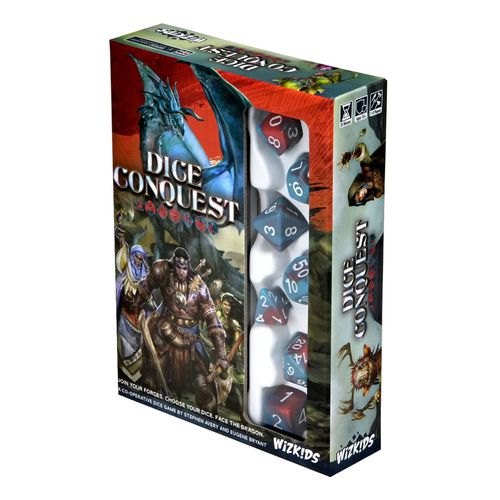
Dice Conquest
Dice Conquest Rulebook
Table of Contents
Table of Contents
Components
- 23 Creature cards
- 8 Hero cards
- 4 Health Tracker cards
- 4 Player Aid cards
- 1 1st Player Token
- 4 Health tokens
- 7 Polyhedral dice
- 9 Trap cards (only used in Advanced Play for added difficulty)
Overview
In this cooperative game, one or more Heroes will battle Creatures by selecting and placing dice. Once the total of the values of all the dice on a Creature is equal to or more than that Creature's health, it is defeated! Using inherent special abilities, critical hits, and Magic Items gained from defeating certain Creatures, the Heroes will be able to face the final foe, the dragon, Kalterstorm. Should any Hero fall, at any time, all players have lost.
Setup
- Each player chooses one of the Hero cards. Remaining Hero cards can be discarded back to the box.
- Each player also chooses one Player Aid, Health Tracker card, and a Health token. Remaining Player Aids, Health cards, and tokens can be discarded back to the box.
Place the Health token on the number of health corresponding to the number of Heroes in the game.
- 4 Heroes: 4 health each
- 3 Heroes: 6 health each
- 2 Heroes: 10 health each
- 1 Hero: 20 health
- Give the First Player token to the noblest Hero. If the players cannot decide, the youngest adventurer will be given the token.
- Remove Kalterstorm from the Creature deck and shuffle the remaining Creature cards. Place the shuffled Creature cards in a deck facedown and place Kalterstorm on the bottom of the deck.
- Draw three Creature cards and place them faceup in a display next to the Creature deck. Place each Creature to the right of the previous one. Resolve any Reveal effects on these cards from left to right. Note: some Creatures make you draw more Creature cards – these are also added to the display and their Reveal effects are also resolved.
- Place the dice within reach of all players. This area will be called the Available Dice area. Choose another area to be the Spent Dice area: where dice that have been discarded are placed.
Setup Example: 4 Players
- A Hero card
- B Health card
- C Hero Ability
- D Critical Hit Ability
- E Starting Health
- F Creature deck
- G Creature Health
- H Creature Damage
- I Creature Ability
- J Magic Item
- K Available Dice area
- L Spent Dice area
Gameplay
Dice Conquest is played over a series of rounds. Each round begins with the First Player rolling all dice in the Available Dice area. Then, starting with the First Player and going clockwise, each Hero will choose one die and resolve it to attack a Creature. This continues until the end of the round is triggered (see Round End, below).
Attacking Creatures
On your turn, you must choose one die from the Available Dice area to attack a Creature. Once chosen, you may not select another die. You may keep the number shown on the chosen die, or you may reroll that die one time. You must keep this new roll.
To attack a Creature, place the chosen die on the Creature's card keeping the value of the die faceup. This is the amount of damage done to the Creature.
Example: The Knight chooses a D6 showing a '1' and decides to reroll it to get a higher number. A '4' is rolled. The Knight places this die on the Skeleton, which means the Skeleton has suffered 4 damage so far.
Special Dice Notes
- When choosing the D10 die (10-sided die with one digit on each face), the "0" face is equal to a 10.
- When choosing the D10% die (10-sided die with two digits on each face), the 00 face is equal to a 10.
For all other faces, only use the first digit (for example, 20 = 2, and 30 = 3). A 10 on this die is similarly read as a 1 (and not a 10).
Creature Abilities
Several Creatures have abilities that activate upon their reveal, to be resolved after a minimum of 3 Creatures are drawn to the display (during setup and the end of a round). Other abilities, such as those that affect themselves or the Heroes, are active when the Creature is in the display.
Example: The Giant Spider has two abilities: when revealed it does one damage to a Hero, and it will only accept odd-numbered dice placed on it.
Example: The Basilisk, while in the display, prevents the Heroes from rerolling dice for any reason until it is slain.
Slaying a Creature
As soon as the sum of all dice on a Creature equals or exceeds the Health Number, that Creature is slain. This can happen when a new die is placed on the Creature and/or when an effect alters the current dice on a Creature that would now meet the threshold to slay it.
If the Creature does not possess a Magic Item, remove it from the game. If it possesses a Magic Item, give the card to any Hero.
All dice on the slain Creature are discarded to the Spent Dice area.
Hero Abilities and Critical Hits
When attacking Creatures, you may use your Hero's ability which may modify the normal game rules. In addition, if you choose a die equal to your Critical Hit number, you may also use the ability shown for the Critical Hit when attacking with that die. You can use abilities in any order you choose.
Any abilities that bring dice out of the Spent Dice area back into the Available Dice area are rerolled first.
Example: The Wizard wishes to attack the Stone Golem which has 16 health left. He chooses the D12 showing a 4 on it and rerolls it. A 7. Not what is needed so the Wizard uses his ability to reroll again. A 10! This allows the Wizard to use his Critical Hit ability to slay a Creature with 20 or less health. The Stone Golem gets discarded and the D8 that was on it as well as the D12 that was just used are placed in the Spent Dice area.
Magic Items
Some Creatures have Magic Items listed on the bottom of their card. If you slay a Creature, you may take the Creature card and keep any Magic Item for yourself or give it to another Hero. Magic Items may be used at any time during your turn by discarding the Magic Item, unless stated otherwise.
Example: The Rogue has the Magic Item, Dagger of Piercing (found on the Gargoyle). He really wants to use his Critical Hit ability but there isn't a "4" showing on any of the Available Dice. However, the D4 is showing a "1" so he discards the Magic Item and chooses to use the D4 to activate his Critical Hit ability.
Round End
When either (a) all Creatures in the display have been slain, (b) all dice have been placed or Spent, or (c) any Hero chooses to pass, the round ends and you must do the following:
- Take Damage. If there are any remaining Creatures in the display, the Heroes take damage equal to the sum of the damage shown on the Creature cards. Starting with the First Player and going clockwise, each Hero takes 1 point of damage until all Creature damage is allocated.
Example: A Skeleton, Hag, and Banshee are in the display. The sum of their damage is 4. The First Player is the Cleric, followed by the Rogue and then the Wizard. Allocate one damage to the Cleric then going clockwise, the Rogue takes one damage, then the Wizard takes one damage, and finally, the Cleric takes a second point of damage. Since 4 damage has been allocated, no more damage is taken.
If the Health of a Hero ever reaches the skull, that Hero has fallen, and all players have lost the game.
- Remove or Keep Spent Dice. Any dice that have been placed on Creatures that have not been slain may be left on the Creatures or removed to the Spent Dice area, to be rolled next round.
Example: a D20 showing a "2" is on a Cave Giant. Since that is such a low number for the die, the Heroes decide to remove the die so it can used next round to hopefully better effect.
- Prepare for the next round. a. Pass the First Player token clockwise. b. Draw 3 new Creature cards and place them in the display next to the rightmost Creature card (if there is one) then resolve any Reveal effects on these 3 new Creatures from left to right. If there are no more Creature cards in the deck, continue a new round without dealing any new Creature cards (it often takes more than 1 round to defeat Kalterstorm).
Advanced Play: Traps
Trap cards are optional cards that increase the game's difficulty. After mastering the standard game, you may shuffle in 2, 3 or 4 Trap cards into the Creature deck during setup.
Each time a Trap is revealed, draw an additional Creature card (a minimum of 3 new Creatures are always drawn during Setup and when preparing for the next round), and any Reveal effects are resolved on all new Creature and Trap cards from left to right as usual.
Game End
The game ends when Kalterstorm is slain (all players win) or one Hero has fallen (all players lose).
Clarifications
a. For each damage that is healed, move the Health token up the Health Tracker. (You may not heal past your original starting health). If there is a Heal and damage effect at the same time, you can Heal first.
b. If placing a die will cause a Creature to be slain, all the dice on it are immediately considered Spent for purposes of Hero abilities that let you return or roll Spent dice. However, a Creature's ability (such as a Hero having to take damage when a die is placed on that Creature) will still occur even if the die causes the Creature to be slain.
c. The dice are limited to their maximum number, and you may not change a die to be more than it otherwise could be (i.e., you cannot change a D10 to an 11).
d. In most cases, Creature abilities will override conflicting Hero abilities and Magic Items, but certain types of abilities may be countered:
- Damage Abilities: Abilities that let you avoid damage (Knight, Warrior, Ring of Invisibility), will override the Creature ability of dealing damage (Cave Giant, Kalterstorm, etc.).
- Dice Manipulation: Abilities that let you manipulate dice on a Creature after placement (Ranger, Sword of Flame, etc.) may be used even if their use would violate a number limitation (Troll, Rat Swarm) or an odd/even restriction (Stone Golem, Giant Spider).
- Magic Items Dealing Damage: Magic Items that deal damage to a Creature (Wand of Blasting, Potion of Strength) are not limited by odd/even restrictions, but cannot slay a Creature if their damage causes the total damage to exceed the Health of a Creature with an exact restriction (Gremlin, Doppelganger, Skeleton).