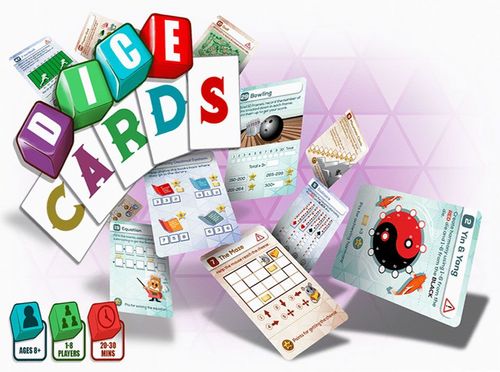
Dice Cards
Dice Cards Rulebook
Table of Contents
Table of Contents
How to Play
When the dice are rolled, all players will record 1 number on any one of their six cards. The number can be an individual number from one of the dice or the combined total from both dice.
Some cards require a specific color dice (Black or Red) to be rolled. Only the individual dice work for those cards (you can't add a Black 1 and a Red 2 to make a 3 for a card like Solitaire).
Other cards will require the sum of both dice, or a specific combination of two dice.
Each card will list its own specific rules & requirements.
Example Recording
Let's say a 6 is rolled on the Black die and a 3 is rolled on the Red die. Each player will record only 1 number. Tuck might mark a Red 3 on his Solitaire card, where Katie might write a 6 on Sudoku and Jennie may choose to mark off the 9 on her Bingo card. Remember, you only record 1 single number on any one card.
Rolling & Recording
You can have one designated roller, or pass the dice from player to player, whatever suits your group. Every roll of the dice, regardless who rolls, all players will record 1 number to any of their 6 cards.
Roll Tracking
Each player will record the number they choose every roll on the Roll Tracker card. This helps with keeping track of how many rolls remain in the game.
If someone misses or forgets recording a roll and other players are confident the Roll Tracker is correct, put a line through that tracking turn and continue on. You can count how many numbers have been recorded across all of your cards to verify the turn.
Players sometimes record a number on a card, but forget to mark it on their tracker.
Note: For cards like Hopscotch or Doubles where it has you record two numbers, you can write both on one line.
Ticket Tracking
At the bottom of the Roll Tracker card, you will also keep track of any tickets you accumulate throughout the game. Put a diagonal line one direction through the box when you get a ticket. When you spend a ticket later on, mark the opposite diagonal line, making an X through the box.
Selecting Your Cards
For a fast setup, deal out 9 cards at random to each player. If a player receives a card they already have, deal them a new one so they have 9 unique cards to choose from. From those 9, each player will select 6 they would like to play this game. Unused cards may be put back in the box.
There are 2 copies of every card in the box, so it is possible for two players to play the same card.
All-or-Nothing Cards
Some cards have a warning icon in the upper right corner. This means the card is an "All-or-Nothing" card. You only get points if the card is completed, no partial points. It's important to start these early.
Note: If a player receives 2 or more "All-or-Nothing" cards, you might want to exchange 1 or 2 to give them more scoring opportunities.
Alternate Setup
Once players know the game, they may select the 6 cards they would like to play from all 50. Some players might take a head-to-head approach, picking the same 6 cards to see who can score better.
Spending Tickets
Tickets may be used in two different ways:
1) Roll Modification
During the course of the game, you may use tickets to add or subtract from a number rolled at a cost of 1 ticket per 1 number adjusted. You may not modify a single die above 6 or below 1.
For example, if a 9 was rolled but you needed a 12, you may use 3 tickets to add 3 to the roll. Each player's ticket usage is their own and does not affect the dice for other players.
2) Scoring — 2 Tickets = 1 point
At the end of the game, if you have any unused tickets, they may be exchanged at a rate of 2 tickets to 1 point added to your final score.
At the end of 50 rolls, all players will total up the points from their cards and add any points from unused tickets. The player with the most points wins! In the event of a tie, compare unused tickets. If still tied, you may share victory, or roll for your fates, highest number claiming ultimate victory.
Every card has its own rules on the card itself, as well as a scoring example on the backside. If you're still unsure of how to play a card, you can check our website http://www.cardlords.com for a detailed rundown on all of the cards.
Individual Scoring
Since Dice Cards may be played with any number of players, we've also included a table to compare your score against The CardLord's:
- 90 or above: Lord
- 87-89: Scholar
- 84-86: Master
- 81-83: Expert
- 70-80: Novice
- 69 or below: Practice Run
Digital Dice
If playing somewhere you can't roll dice, or in a large group setting, try the digital dice at http://cardlords.com/dice