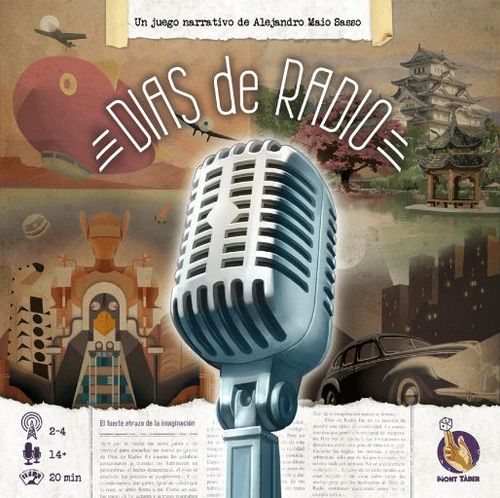
Días de Radio
Días de Radio Rulebook
Table of Contents
Table of Contents
- Components (Componentes)
- Brief Description of the Game (Breve descripción de la partida)
- Setup (Disposición inicial)
- Turn Sequence (La Secuencia de Turno)
- The 12 Genres, Explained (Los 12 Géneros, explicados)
- Press (Prensa)
- Press Board Explanations and Variants (Explicaciones de los Tableros de Prensa y Variantes)
- Characters (Personajes)
- Character Sheets (Láminas de personajes)
- Alternative Game Modes (Modos alternativos de juego)
Components (Componentes)
- 120 Script cards (cartas de guion)
- 12 Genre tokens (fichas de género)
- 1 End of Programme token (ficha de final de programa)
- 1 microphone die-cut token (troquel de micrófono), used to mark the player whose turn it is
- 4 Press boards (tableros de prensa): Creativo, Atrapante, Poético and Bizarro
- 36 Opinion tokens (fichas de opinión), 9 in each colour
- 4 player markers, one in each colour
- 4 Character sheets (láminas de personajes), one character per side, 8 characters in total
- 1 Rulebook (Reglamento)
Brief Description of the Game (Breve descripción de la partida)
The players narrate a story as a team. Before starting, they choose a Genre to set the scene. Each player takes six Script cards, a player is designated to begin the story, and the show begins.
The Narrator's turn lasts two minutes. While the Narrator tells the story, the other players listen attentively, and each passes to the player on their left a Script card from their hand bearing the Genre icon in use. The Narrator chooses one of the cards they have been given and introduces its idea into the story. When the two minutes are up, the next player to the left becomes the Narrator and continues the story from where their predecessor left off. The other players pass them a card with the corresponding icon, the Narrator chooses one to introduce, and so on.
When the two minutes are up, the Narrator passes the role to the player on their left, and this continues until the End of Programme token appears on the Timeline. The Narrator whose turn it is then uses their two minutes to bring the story to a close. Then everyone hugs, jumps, dances and sings. Suggested song: We Are the Champions, by Queen.
Setup (Disposición inicial)
- Select one Genre token and place it where everyone can see it. The story to be created will have this setting for the whole game.
- Form a pile with 9 of the remaining Genre tokens. Shuffle the End of Programme token at random among the bottom 3 of the pile. The result of this infallible scientific process should be a pile of 10 tokens, with the End of Programme token among the last 4. You have just built the Timeline, which tracks the progress of the game and triggers the end of the story.
- Shuffle the Script cards and deal a hand of 6 to each player. Place the remaining Script cards in one or more face-down decks, boxed side up, within everyone's reach.
- If you decide to use the Press, place the Boards (Creativo, Atrapante, Poético and Bizarro) in the centre of the table, within everyone's reach.
- If you decide to use the Characters, place the selected ones in the centre.
- The most experienced player will be the first Narrator and will take the large microphone token. They will start the story when ready, revealing cards from the Script deck until one appears whose icon matches the Genre token in use. This idea will be the initial trigger of the story. Also, during their turn, the other players will pass them Script cards which they must introduce within their two minutes.
* We recommend not using the Press and the Characters together in the same game.
Turn Sequence (La Secuencia de Turno)
-
The player whose turn it is (the Narrator) starts, continues or ends the story, as appropriate, trying not to interrupt it at any moment.
-
Meanwhile, each of the other players must select for the Narrator 1 Script card from among those in their hand. The phrase on the selected card must bear the icon of the Genre in use, and it is placed face down in front of the Narrator. Then they draw a card from the deck to replace the one they just played.
-
When the Narrator has 3 Script cards face down in front of them, and not before, they may pick them up and choose 1. In a game of fewer than 4 players, complete this number with Script cards drawn at random from the deck. In this last case, the cards drawn from the deck may not have the icon of the Genre in use (see point 4). If this happens, the Narrator may only choose among the phrases that do have it. Cards not chosen by the Narrator go to a discard pile. In the improbable event that the deck runs out, shuffle the discards to form a new deck.
-
The Script cards that the players propose to the Narrator must have the icon of the Genre being narrated. At any moment in the game, if a player who is not narrating has no card with that icon, they may discard their whole hand and draw 6 new cards. Whenever this condition is met, they may do so as many times as necessary, including consecutively. Additionally, once per Narrator turn, each player who is not narrating may discard up to 3 cards from their hand (whether or not they have the required icon) and draw the same number from the Script deck. (As the game progresses, your hand is likely to fill with usable cards, and in that case you may want to discard one that does not fit well with the story as it is developing, to give yourself the chance of drawing one you like better.)
-
The Narrator will try to of the Script card they chose, doing so in the most elaborate way possible. The audience is demanding, and the story must be enriched! To narrate like a champion it is essential to have listened carefully to each of the narrators who preceded you. If not, you may leave out important details, or whole characters, or who knows what! Every great storyteller has good ears. On the other hand, it is not necessary to quote the Script idea word for word: you may rephrase it in your own words to suit your purposes. Of course, if you are Experienced™ and like challenges...
The 12 Genres, Explained (Los 12 Géneros, explicados)
In Días de Radio the stories narrated always belong to one of the twelve Genres, which stem from four Major Themes: Adventure, Science Fiction, Horror and Crime.
- Épica en el Mundo Antiguo (Epic in the Ancient World): Rome. The barbarian invasions. The Arab world. Slaves, gladiators, conquests. The Greek world, Sparta, wars. Men and women with great responsibilities, hidden pasts, vengeance and betrayals. The struggle for power and knowledge. The precariousness of life. Great friendships.
- Espías en la Guerra Fría (Spies in the Cold War): Approximate date: 1945–1989. The KGB confronts the CIA, and in between, their allies and enemies wage the most silent war in history. Paranoia, infiltrators, double agents, hidden missiles, microfilms, chases, assassinations, ideology, and behind it all the enormous shadow of power. The cards are balanced so that you can narrate from any point of view.
- Exploradores & Arqueólogos (Explorers & Archaeologists): In search of great hidden treasures, or legendary knowledge. Whips and sombreros? Wild beasts, treacherous temples, awe-inspiring landscapes. Guardians of secrets, rival archaeologists, bounty hunters. Perhaps the relic has powers...
- Ciencia Ficción Tecnológica (Technological Science Fiction): Beyond conflicts, technology keeps advancing humanity. Its marvels drive these stories. The boldest dreams of science have come true, and although they sometimes create problems, it is a marvellous time to be alive.
- Ciencia Ficción Distópica (Dystopian Science Fiction): More technology, more power. More power... The future has become a dark and terrible place, whether because of totalitarian governments, nuclear apocalypses, or a return to the most primitive human being. It is the flip side of the hope in scientific progress.
- Ciencia Ficción Alienígena (Alien Science Fiction): The extraterrestrials. Solitary creatures, whole civilisations, friends, enemies, ancestors. Perhaps humankind has colonised the stars and lives surrounded by them as a natural thing, or an emissary has come to Earth to deliver a critical message. The universe is the limit.
- Terror Sobrenatural (Supernatural Horror): When what lurks has no rational or scientific explanation. From werewolves to ghosts, passing through soul-devourers, haunted houses and vampires. Even the supernatural has its logic, and whoever possesses that knowledge will have the advantage.
Press (Prensa)
If the players wish, they may incorporate the Press Boards (Tableros de Prensa) into the game. As the name suggests, this mechanism brings in the idea of the newspapers of the era reviewing the programme of our brave actors turned scriptwriters. This cutting-edge technology is used as follows.
Before starting a game of Días de Radio, as seen in the initial setup, the 4 Press Boards are placed in the centre of the table within reach of all. Then each participant chooses their colour: they take a player marker of the colour they prefer and place it in front of them. The remaining tokens (Opinion tokens, fichas de opinión) are divided by colour and placed within reach of all.
At any moment during a Narrator's turn, their companions may take an Opinion token of the colour corresponding to that player and place it on one of the 4 boards. The decision is personal and subjective: place your token on the board that, in your opinion, best describes what you are hearing. Your choice may also be based on the general atmosphere the Narrator is creating, or on something specific they have just said. Either way, you may use only one token per Narrator's turn, so make it count.
When the game is over, the players count the number of tokens on each board and thus obtain the Programme Review (Reseña del Programa). For example, if there are more tokens on Creativo than on any other board, the Press has praised the Creativity of the programme. The same goes for the other three adjectives (Bizarro, Poético and Atrapante, as applicable to the boards in play). In case of a tie in the highest number of tokens, the specialised press is considered to have lavished its praise equally on the tied adjectives.
Next, count the number of tokens of each colour on the Press Boards to obtain the Individual Review (Reseña Individual). For example, the red player checks on which board there are more red tokens. If the largest number of red tokens is on Poético, the press has praised the Poetic qualities of that player's individual performance. The praises are not mutually exclusive: for example, at the end of the game the red player has 4 tokens on Poético, 4 on Atrapante and 1 on Bizarro, while the yellow player has 6 tokens on Poético and 3 on Creativo. This means the Press praises the Poetic and Gripping qualities of the red player, and the Poetic quality of the yellow player.
Now only one thing remains: reading the newspaper article! Any player turns over the board that corresponds to the Programme Review and reads the critique aloud. Congratulations™!
Press variant: if you do not want to do the individual review of each player, you may use the tokens regardless of colour, so that the Press reviews only the programme as a whole. One for all, and all for one!
Press Board Explanations and Variants (Explicaciones de los Tableros de Prensa y Variantes)
Explanations of the Press Boards
- Bizarro: the story has abounded in strange, delirious, transgressive and somewhat grotesque elements.
- Poético: the story, steeped in beauty, captivating images and an evocative language, has made us travel.
- Creativo: a recognition of the narrator's soaring ability, those rabbits pulled out of the hat, that deep imagination, magical we would say.
- Atrapante (Gripping): the narrator has built the climate of the story with such depth that we felt ourselves there, and the outside world faded away. Or, thanks to their handling of time and events, they have kept us on edge.
Characters (Personajes)
Every good story has interesting characters. In each game you may invent characters who have nothing to envy of the icons of cinema and literature. Some of them you will use again in future stories, keeping the development you have given them.
How are they used? First of all, as seen in the initial setup, you choose a Genre in which to set the story. This decision affects which characters may be used. As you can see on the character sheets, to the right of each portrait (and just below the character's name and identity) there is a series of Genre icons. These are the possible Genres for that character. These icons are also ordered according to their affinity with the setting.
With the characters already chosen, place their sheets in the centre of the table within reach of all, leaving a good space between sheets if playing with more than one. Then separate the 36 Opinion tokens by colour and place them within reach of all. The 4 player markers are not used here.
During the game, the Narrator on turn may use any of the chosen characters in the story. Characters are a collective creation, meaning that they are not controlled exclusively by anyone. The qualities shown on a character's sheet indicate the personality of the being in question, but all of these qualities are in potential. It is up to the Narrator to bring them into play.
How are qualities developed? It is simple, and it is best explained with an example. The green player is the Narrator on turn. The Genre of the story is Ciencia Ficción Tecnológica (Technological Science Fiction), and in the centre of the table one of the chosen characters is the android Dal1. The Narrator, taking Dal1's qualities into account, says: "The omniscient computer was set on wiping out humanity. It had concluded that Homo sapiens was a lost cause, and there was no way to convince it otherwise. Dal1, who until then had remained indifferent to the despair of the others, stopped playing with the holograms, approached the computer's interface and began tracing a complex drawing in the air. Its purpose was a mystery. Some thought it was a whim of Dal1's, a caprice." Here the Narrator has brought into play one of the character's qualities: Incomprehensible (Incomprensible).
The story continues: "Almost half an hour later, the computer broke the silence: 'Now I understand,' it said. 'Thank you.' Immediately afterwards, the missiles carrying the toxin were deactivated." Here the Narrator has brought into play Dal1's Genius (Genialidad).
"While everyone in the war room celebrated, Dal1 turned to look at them and said: 'I don't know what you are amazed at. It was obvious that if I wanted to, I would convince her.'" This brings into play Arrogance (Soberbia). Dal1 added: "Although now that I think about it, perhaps it would have been better to let her annihilate you all." This brings into play Misanthrope (Misántropo).
Transcriber's note: the example qualities are shown in bold, as in the source; the italic passages are the source's in-story quotations.
What do the other players do meanwhile? In the previous example we saw the Narrator bring four of Dal1's potential qualities into play. However, fixing these qualities depends on the other players. While the Narrator tells the story using the available characters, the others stay alert to see whether any quality has been put into action. If they perceive that it was, they place an Opinion token next to the quality they believe was brought into play. This decision is personal and subjective.
Example (continuing the above): on hearing the green player's turn, the red player places a token next to Incomprehensible and another next to Arrogance. Perhaps the other qualities did not seem to be activated to them, or in the rush of the story they did not notice; it does not matter. The yellow player places one on Genius, another on Arrogance and finally another on Misanthrope. The blue player, however, understood that Dal1's drawings for the computer had force and vivacity, and therefore on hearing this part placed a token next to Energetic (Energético), although the Narrator's subjective intention was not to activate this quality. (Source aside: "On the other hand, I think being occupied with holograms while humanity is on the brink of extinction is quite Chaotic (Caótico), but well, I am not in the example game and I have no tokens in hand while I write this, so what can one do.")
But then, can we place more than one token per turn? Yes. When playing with characters it is possible, and even recommended, to place more than one token per Narrator turn. For this we use a colour code.
What is the colour code of the tokens? Blue tokens are worth 1, green tokens 2, yellow tokens 3 and red tokens 4. Each time a player understands that the Narrator has activated a quality of the character, they place 1 token point next to the corresponding quality. At first, as is logical, this is done with blue tokens. But, for example, if a quality already has 3 blue tokens and you want to place 1 more point next to it, you remove the 3 blue tokens and place a red one in their place, after which you return the blue tokens to their pile.
When the game ends, the character sheets in front of you will show the development of each character as you have imagined it in this incarnation (or, in the case of Sal... metalización?). The most prominent qualities during the game will have a greater number of token points than the others, and the combination of all this will be a testimony of what the character did, said and thought. And what they did not do, they kept silent about, or it never occurred to them. Often in Días de Radio a game is just one chapter of a larger story, or perhaps that character had another adventure in the future. In any case, you may keep the character as you have developed it for the next game.
You may photocopy the sheet found at the end of this manual to create new characters. Once the game is over, take paper and pencil and note the points you have assigned to the various qualities.
For a first experience with the character sheets, we recommend using just one. The characters are designed to be rich, potent and fertile. Each of them is capable of very many things, so handling several at once as a team can be difficult at first. When you have more confidence, it will be as easy as pie.
Remember that using the sheets does not exclude creating and developing your own improvised characters, which may be more central to the plot than the ones we propose. Using one character, or two, from the sheets can be an excellent way to see how they interact with other characters created on the spot.
Affinity. As we said, the Genres for which each character can be used are ordered by affinity. Besides being ordered from left to right from greatest to least affinity, the icons are distinguished by colour group. The colours also indicate greater or lesser affinity with the Genre. For example, an icon in the first space on the left in red means that this is the character's natural Genre, the setting that fits them like a glove, or vice versa. Below, each colour is explained, naming the different ways in which it affects the characters. Remember that how far to the left an icon sits within its colour matters when deciding what comes next.
- Red: natural Genre of the character. Undisputed protagonist of the story. Strong protagonist supported by a secondary character. Part of a strong protagonist pair.
- Yellow: undisputed protagonist, but needs several things in the story to adapt around them. Antagonist. Co-protagonist, not part of a pair. Important supporting character for a strong protagonist.
- Green: secondary character, who may or may not support a protagonist. Minor antagonist. Source of conflict. If you want to give them more prominence, you must either adapt them to the context and the story, or adapt the context and the story to the character, in a moderate to moderate-intensive way.
- Blue: part of a choral ensemble of characters. Minor character. Occasional, non-permanent character, who appears for something specific and soon leaves the story. If you want to give them more prominence, an intensive adaptation of both the Genre and the character must be applied, and many things in the story must revolve around them.
Character Sheets (Láminas de personajes)
Each character sheet lists the character's name, subtitle, ten qualities (four along the top, three along the bottom, two down the left side and two down the right side), a row of Genre icons grouped into the four affinity colours (red, yellow, green, blue; leftmost is most affine), and a short description. The four sheets reproduced in this rulebook are given below. Genre icons are named by their Genre; the colour groups are listed in the order red, yellow, green, blue.
Joe Bell (portrait label: "Haymaker")
Police homicide detective, ex-lawyer, ex-boxer, ex-prison guard
- Qualities, top: Tough but fair; Born leader; Good with his fists.
- Qualities, bottom: Strategist; Hardened; Patience/perseverance.
- Qualities, left: Unbreakable principles; Enemy of the abuse of power.
- Qualities, right: Edge of oratory (Filo de la oratoria); Logical and deductive.
- Genre affinity: Red: Policial de Acción, Policial Negro, Zombis, Terror Realista. Yellow: Policial de Mafia, Ciencia Ficción Tecnológica, Ciencia Ficción Alienígena. Green: Terror Sobrenatural. Blue: Espías, Ciencia Ficción Distópica.
- Description: Joe Bell is an unusual policeman. On the verge of qualifying as a lawyer, he turned to boxing. His manager's troubles in prison led him to work as a prison guard. Determined to make a bigger difference, he got a transfer to the police, and was soon promoted to homicide detective.
Alex May (portrait label: "Toshiro")
Private detective
- Qualities, top: Shrewd, intelligent; Internal law/Incorruptible; Stubborn/Unstoppable.
- Qualities, bottom: Gift of the gab/Eloquence; Resistance to physical and psychological pain; Sensitive side/Weakness for women.
- Qualities, left: Lover of jazz; Prone to literary figures.
- Qualities, right: Scotch, single malt whenever possible; Hardened/Sarcastic.
- Genre affinity: Red: Policial Negro. Yellow: Ciencia Ficción Tecnológica, Ciencia Ficción Alienígena, Policial de Mafia, Policial de Acción. Green: Espías, Ciencia Ficción Distópica. Blue: Terror Sobrenatural, Terror Realista.
- Description: Hardened, shrewd, unstoppable. As a private detective, Alex May has seen a lot. Sheltered behind a thick layer of sarcasm and Scotch, their sense of justice remains intact. Indifferent to the temptations of power and money, they are the perfect person to uncover the truth in a corrupt world that has lost its way.
S4l v4.dor Dal1 (portrait label: "Sal")
Libertarian android (ANDROIDE LIBERTARIO)
- Qualities, top: Free thinker (Librepensador); Chaotic/Entropy (Caótico/Entropía); Energetic (Energético).
- Qualities, bottom: Irascible; Charisma (Carisma); Arrogance (Soberbia).
- Qualities, left: Genius (Genialidad); Incomprehensible (Incomprensible).
- Qualities, right: Unpredictable (Impredecible); Misanthrope (Misántropo).
- Genre affinity: Red: Ciencia Ficción Tecnológica, Ciencia Ficción Alienígena. Yellow: Ciencia Ficción Distópica.
- Description: Dal1 is a prototype android, the sole product of a cancelled experimental project that sought to endow artificial intelligence with characteristics traditionally conceived as human. Dal1 claims that, even had the project continued, they would not have managed to make anything better, or even equal to itself.
Xiao Meifeng (portrait label: "Xiao")
Taoist nun (MONJA TAOÍSTA)
- Qualities, top: Laconic (Lacónica); Ascetic/Detachment (Asceta/Desapego); Fragile (Frágil).
- Qualities, bottom: Supportive (Solidaria); Respect for all forms of life; Expert in survival.
- Qualities, left: Great observer (Gran observadora); Tradition (Tradición).
- Qualities, right: Never lies (Nunca mentir); Defensive use of [partly illegible in the PDF].
- Genre affinity: Red: Épica en el Mundo Antiguo, Terror Sobrenatural, Exploradores & Arqueólogos. Yellow: Ciencia Ficción Tecnológica, Ciencia Ficción Alienígena. Green: Policial de Acción, Policial Negro, Ciencia Ficción Distópica. Blue: Zombis, Terror Realista, Espías.
- Description: It is not easy to describe someone like Xiao Meifeng. Like the wind, the water or the sun, the only way to understand her is to feel her. Those lucky enough to know Meifeng know that words fall short: serene, intelligent, humble, confident, altruistic. All true adjectives, yet she is so much more than that.
Transcriber's notes on the character sheets: the sheets were read from a high-resolution render of page 4. Two rotated tags (the Xiao Meifeng right-hand tag and the Ascetic/Detachment top tag) are only partly legible in the PDF and are marked accordingly or read with best judgement. The reverse faces of the four sheets, which carry the remaining four characters of the eight, are not reproduced in this rulebook file. Page 16 of the file is a blank, photocopiable character sheet (with the twelve Genre icons as a key) followed by the publisher's author note and credits; the credits are not transcribed.
Author's note (translated; the rest of the page is attribution and is omitted): Días de Radio aims at diversity, and these rules contain allusions to both the feminine and the masculine. This is a trigger and should be treated as one: feel free to change the gender of any phrase.
Alternative Game Modes (Modos alternativos de juego)
This section offers different ways to play Días de Radio. It is designed for experienced narrators who handle Días de Radio with ease and fluency, since the number of elements to keep in mind increases. The difficulty level also increases when using these variants, in some cases significantly. We therefore recommend using them only in groups made up entirely of veteran narrators who love risk.
The game modes are: Storyboard, Memento, Pictogramas (Pictograms) and Multiverso (Multiverse). Before explaining each mode in particular, we look at an element shared by three of them, so as not to repeat the rule each time.
Storyboard
If you want to plan the story and have greater control, this game mode is for you. The only difference from a standard game of Días de Radio is the use of the Expanded Timeline (see below). With Storyboard you can plant an idea on whichever turn you want. Is that phrase in your hand ideal for the end of the game? Well, place it there. Is that other phrase an excellent resolution for the conflict narrated by the present Narrator? Place it for the immediately following turn. Or perhaps you want to plant a plot twist that lies in wait for the best moment. Storyboard lets you do all of this.
The Expanded Timeline (El Cronograma Expandido)
Storyboard, Memento and Pictograms use a variant of the Timeline called the Expanded Timeline.
- Initial setup, modification to step 2: place nine of the Genre tokens that are not being used, one next to the other, in view of everyone. Important: for Storyboard and Memento, the tokens go face down. For Pictograms, the tokens go face up. Place the End of Programme token face up at the end of this row. You have just built the Expanded Timeline.
- Added to step 6: besides revealing cards from the deck until one with the icon of the chosen Genre appears, the other players look in their hand for a phrase with the corresponding icon and place it face down before the start of the Expanded Timeline, under the initial card drawn from the deck.
- What it implies: the number of turns in the game will be known in advance, so you will know exactly how much remains to close the story.
- Changes when offering Script cards: Script cards are not placed in front of the Narrator on turn. While the Narrator tells the story, the other players place 1 or 2 cards (the second is optional) with the corresponding icon next to any of the Expanded Timeline tokens that correspond to later turns. Cards may be placed next to different Timeline tokens or next to the same one. Try not to place cards for a turn in which you yourselves will narrate; you may mark those turns with tokens of your colour. The idea is to respect the philosophy of Días de Radio: narrate with cards proposed by others.
- The Narrator who begins the game, after including in the story the idea of the card revealed from the deck according to the initial setup, takes the card(s) that were underneath (one, two or three cards depending on the number of players) and includes one of them in their story.
That is all for the Expanded Timeline. Now for the new game modes.
Memento
Memento is played like Storyboard, but with a radical difference. The first Narrator tells the ending of the story. Each subsequent Narrator narrates what happened immediately before what they have just heard, until reaching the End of Programme card. On that turn, the Narrator narrates the beginning of the story.
Key: the first turn is undoubtedly the most important of the game, the axis around which everything else is structured. Since it is narrated first, the ending of the story must be powerful and fertile, establishing a good conclusion while at the same time enabling the possibility of reaching that point by many paths. Due to its high degree of narrative difficulty, this mode is for experts.
Pictograms (Pictogramas)
Pictograms is played like Storyboard. Except for the starting Narrator and the one who closes the programme, all the other narrators also use the image on the Genre token of the Expanded Timeline.
How are the images used? Suppose you are next to narrate. When the Narrator before you finishes their two minutes, you do as always: take the cards placed next to the token that marks your turn, draw 3, and choose one. But in addition, you are inspired by the image on the token to create an idea that adds to your story. Remember that, as explained in the creation of the Expanded Timeline, these tokens are placed face up, so you have had time to look at the image and think about something from it. Then, throughout your two minutes and in the order you prefer, you include both the phrase on the card and the idea that came to you from the image.
Important: consider only the image. The idea you develop from it must not have anything to do with the Genre mentioned on the token, and it must fit faithfully with the setting of the Genre you have chosen. When you introduce the idea from the image, flip over the Timeline token that corresponds to your turn, so that the others know you have just done it (and, for the dramatic effect of the gesture, here it goes). If two minutes per turn seems too little to include two ideas, you may extend it to 3 or 4 minutes.
Examples. On the Mont Tàber page, besides longer explanations and more jokes (especially more jokes) about the different game modes, you will find a large number of examples based on the images on the tokens. You may use them as a reference, but at the same time trust in the indomitable power of your imagination. These are only some examples; much more can be done with the images. Also for reference, here are some:
- Nave extraterrestre (Alien spacecraft): a signal in the sky, an important foreigner.
- Planeta Tierra (Planet Earth): a child playing with a balloon or flying a kite.
- Peligro biológico (Biohazard): the viral spread of a rumour or of fear.
- Cuchillo (Knife): a philosophical remark, a rocky passage in the mountains.
- Lobo (Wolf): an improbable friendship with a wild animal, having a good sense of smell.
- Mano y tumba (Hand and grave): the past returns to stalk a character.
- Efigie (Effigy): a great poker player, harsh but necessary words, a crushing hangover.
- Sombrero y gabardina (Hat and raincoat): speaking in whispers, the nightlife.
- Escudo y dos espadas (Shield and two swords): the helm of a sailing vessel, an old round mirror.
- Pistola (Pistol): a piece of clothing full of holes, someone very fast.
- Fajo de billetes (Wad of banknotes): a crowded market, a character owns a press of banned books.
- Sombrero con flor (Hat with a flower): a racetrack, a conceptual building.
Multiverse (Multiverso)
You are watching a film, or reading a book, and you say (sometimes shouting at the screen or the page): "But no! What are you doing?" Or you fantasise about what would happen if the protagonist, facing a crucial moment of the plot, took a completely different decision. Or a thousand small, absurd, curious ways of changing the plot occur to you. Well, if so, this game mode is for you. And if your friends are like that too, you are in luck.
Before starting the game, choose a work of fiction, whether from cinema or literature, or even a historical event you would like to explore. You will have the opportunity to narrate that story with total freedom, making any change you like, including modifying the point of view from which it is narrated. We recommend not deliberating before the game about how to modify the story; let it flow in the improvisation. However, if you want to make a change that modifies absolutely everything from the beginning (such as narrating The Matrix from the point of view of Agent Smith), it is advisable to agree on the basic points before starting.
A small modification of the Timeline. Multiverse uses the standard Días de Radio Timeline (a pile of unused Genre tokens from which turns are discounted until the end is reached), with one slight variation: in the initial setup, step 2, you decide the length of the game. You may take from a minimum of 7 tokens up to a maximum of 11, and place the End of Programme token below this pile. In this way you will know exactly when the last turn will come, and you can also adjust the length of the game.
Genre affinity. An important decision, once you have the work or event to rewrite, is the Genre from which you will set it, since that will naturally affect the cards you have available. If you want the ideas you use to have organicity with the source material, it is best to take the Genre closest to that material. For example, to rewrite The Godfather organically, the best choice is Policial de Mafia. However, if you want to move away from the theme, or play with ideas that do not belong to the original context, then the best thing to do is not use the most organic Genre, but some other you like. For example, Kurosawa's Seven Samurai in the key of Ciencia Ficción Alienígena.
Finally, nothing prevents you from using the Press or the Characters with any of these alternative modes, but given the increased difficulty level, are you sure? If so, salutations, brave ones!