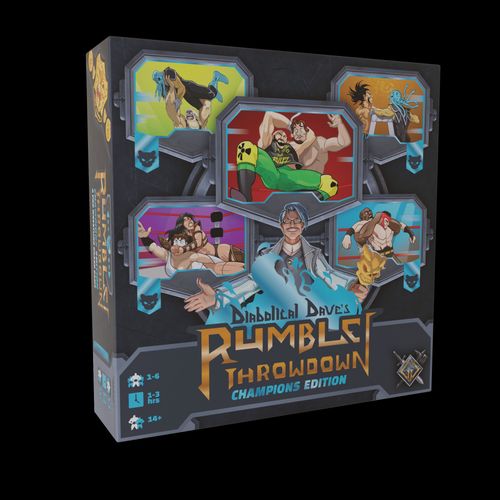
Diabolical Dave's Rumble Throwdown
Diabolical Dave's Rumble Throwdown Rulebook
Table of Contents
Table of Contents
- Welcome and What's in the Box
- Getting Started: Know Your Cards
- Components and Setup
- Gimmicks and Managers
- Playing Gear
- Let's Wrestle
- The Wrestling Match
- Solo and 2 Player Modes
- Playable Superstars
- Game Variations
- Setting Up the Event (Quick Reference)
- Navigating Your Turn's Phases (Quick Reference)
- When Can I Play Cards? (Quick Reference)
- Reference Icons (Quick Reference)
Welcome and What's in the Box
Welcome, Rookie, to the Diabolical Wrestling Council (DWC).
The game includes:
- 323 cards
- 12 colored cubes
- 40 Match Points
- 75 Crowd Points
- 16 Bonus Chits (+6, +1, +8, +2 Heel)
- 1 D6 die
- 1 Game Board
- 6 Play Mats
- 12 Event Cards
- This rulebook
Getting Started: Know Your Cards
Wrestling Pay-Per-Views don't just happen without work ahead of time. The same is true here, but you only need a few minutes to get started. Let the other federations spend the big bucks on expensive commercials and months building excitement! You'll be entering the squared circle in no time.
But first, you need to know what all these cards and other game pieces mean.
Superstar Cards. These are your opponents, the wrestlers you need to defeat to earn eternal fame and glory! Or, you know, infamy and notoriety.
Superstar Action Deck. Solo and 2 Player modes use this deck to give Superstars a fighting chance. It can also be used to create a greater challenge with higher player count games. (PG. 27)
Playable Superstars. Instead of creating a wrestler, all players can choose to play as a Superstar. (PG. 28)
Ring Cards. This deck adds flavor to each match and contains some useful cards that let you change your wrestler's fighting style, affect other wrestlers during their turn, and more.
Gear Cards. You'll start off with Attire, Moves, and specialty gear from this deck and earn more as you defeat your opponents. Gear up and kick some ass!
Event Cards. Every round is an Event with special rules, referees, commentators, and other modifiers.
Bits and Chits.
- Bonus Chits. These help you keep track of temporary bonuses granted by styles, abilities, Run-Ins, and other cards in play during your match.
- Commentator Tracker. Due to extreme excitement, you might forget who the Commentator is! This tracker chit gets passed to the player behind the mic.
- Crowd Points. This is your in-game currency, reflecting how Popular (Pop) or reviled (Heat) your wrestler is by the fans. You'll earn and spend these points throughout the game.
- Match Points. Earn Match Points by defeating Superstars. Every Match Point you earn increases your wrestler's strength and moves you closer to challenging for a title belt.
Now that you know what the primary game components are, we'll break down the pre-match setup into some simple steps.
Components and Setup
- Separate the decks. Place the Superstar, Ring, and Gear decks into their spots on the Game Board. If a deck is depleted during play, shuffle the discard pile and place it face down as the replenished deck. When searching a deck during the game, always reshuffle the deck after searching it. Don't shuffle after searching a discard pile.
- Find your champions! Find the five Title cards (TV, Tag Team (2), National, and World) from the Gear Deck and place them face up. Shuffle the Superstar Deck, draw five Superstars, and place them, face up, on each Title card. Now you know who you need to defeat to achieve ultimate glory.
- Event choices. Lay out the 12 Event Cards in four columns representing each week or round of play. Each column should contain three Event Cards. You'll need these later.
- Styles and Gimmicks. Separate all of the Style cards and Gimmick cards from the Ring Deck into two separate piles. Shuffle the Styles and Gimmicks separately. Deal an equal number of Style cards and an equal number of Gimmick cards to each player, face down.
- Gear up. Shuffle the Gear Deck and deal ten cards to each player, face down. Place the remaining Gear Deck face down in the appropriate spot.
- Discard down. Keep one Style card, one Gimmick card, and six Gear cards. These cards make up your starting hand. Discard the unused cards to the appropriate decks, reshuffle each deck, and place the decks on the appropriate spot on the Game Board.
- Play mats and Crowd Points. Each player receives a Play Mat and eight Crowd Points. Decide if you want to be a Face or a Heel wrestler and flip the Play Mat accordingly. Face wrestlers flip their Crowd Points to the Pop side; Heels flip them to Heat.
- Choose your trackers. There are six sets of two colored tracking cubes, each of which corresponds to a Play Mat with the same color. Grab the cubes that match your Play Mat. Place one on your rank on the Game Board. You'll use the other cube for the weekly Event Player Order tracking table, also on the Game Board.
To Be Loved or Hated? Faction
Are you a Face or a Heel? A little more about your faction. You can decide to start out as a good guy, the babyface, or simply Face, or as a bad guy, the one everyone loves to hate, the Heel. Beware, your faction can change over the course of the game!
During play, Face wrestlers can spend two Pop to draw the top card of the Ring discard pile to their hand. Not to be outdone, Heels can spend two Heat to draw the top card of the Gear discard pile to their hand. These abilities only kick in after setup is complete.
Face wrestlers, due to their Popularity, earn an Extra Reward anytime they win a match. Heels are rewarded for their nefarious ways by earning Heat for acts like being disqualified from matches and other underhanded actions.
Creating Your Wrestler
Get to know the cards in the game and build your DWC wrestler!
Style. Different wrestling styles your wrestler can employ in their career: Brawler, Flyer, Grappler, or Technician.
Gimmick. Gimmick cards add personality, as well as special abilities, to your wrestler.
Angle. Represents storylines in the world of professional wrestling. The target of the Angle card can be any player, including yourself, and can be played at any time by any player.
Manager. As you progress during your career, you can Hire a Manager to help you by employing different abilities, distracting opponents, and being a reliable ally.
Drama. Played by any player on the active wrestler, including the active wrestler on themself, during their Drama phase. As the Commentator is setting the stage for the event, other players have the opportunity to influence the storyline.
Feud. Sometimes, rivalries between wrestlers occur. Feud cards lead to multiple matches between the player and a Superstar, resulting in Extra Rewards and culminating during the next Pay-Per-View.
Move. Move cards, categorized as Basic, Signature, and Finisher moves, increase your wrestler's rank. Matching the right Moves with your Style will maximize their effects.
Attire. Swirling capes, shiny boots, custom props, and more! We often remember our favorite wrestler's Attire as much as their results in the ring. Attire cards can increase your rank or act as Crowd Points.
One-Shot. Single use cards that can only be played during a match on behalf of yourself, another player in an active match, or to benefit a Superstar. Follow the card's text for effects and requirements.
Weapon. Weapons are a special type of single use card that also can only be played during a match. Playing a Weapon always risks disqualification!
Swindle. Swindle cards are designed to break the rules of the game. Swindles can only be played on yourself during your turn. Swindles are always attached to the card they apply to, can't be in play by themselves, and can't be moved to affect another card. Removing the Swindle returns the rules to normal; the affected card either gets discarded or simply loses any status it had gained.
Title. Titles are special cards that never get shuffled into the Gear Deck. This is what it's all about. Defeat DWC champions at each level to earn Title belts. Each title grants special abilities. You can only hold one title at a time!
Your Starting Hand
You have one Style and one Gimmick card in your hand, which you can play to the appropriate spot on your Play Mat. Your Style is an important part of the next step, since it will determine how effective your Moves are.
Your Style card shows the Move types you're strongest using (indicated in red) and weakest (indicated in blue). You gain the average bonus from all other Move types.
The Style cards in the game are:
- Brawler. Strongest with Strike Moves (+2 vs. Weak Grapple Moves); weakest with Grapple Moves. With a barrage of punches and kicks, the Brawler pummels his opponents without mercy. The Brawler's striking moves are unstoppable, but he struggles to master grapples as part of his repertoire.
- Flyer. Strongest with Aerial Moves (+2 vs. Weak Submission Moves); weakest with Submission Moves. Soaring through the air to strike from above, the Flyer's acrobatics and speed are second to none. Her mastery of high risk flying moves is offset by her ineffective use of submission holds.
- Grappler. Strongest with Grapple Moves (+2 vs. Weak Aerial Moves); weakest with Aerial Moves. Pulled straight from the ancient Greek Olympic sagas, Grapplers are masters of the classic wrestling holds and throws. While they're strong in their ground game, they aren't confident at all if they're forced into an aerial contest.
- Technician. Strongest with Submission Moves (+2 vs. Weak Strike Moves); weakest with Strike Moves. Say goodnight to your opponent as the Technician, who specializes in complex but powerful moves designed to force other wrestlers into submission. While the Technician can get nearly anyone to tap out with his specialty moves, striking from a distance isn't his strength.
Gimmicks and Managers
Searching a Deck
If instructed to search a deck for a type of card, always search from the bottom up. Then, reshuffle the deck. If the type of card isn't available, search the corresponding discard pile from the bottom up, but do not reshuffle.
If you can't find the type of card you're looking for in either deck, you can't resolve the action or reclaim any Crowd Points spent to search.
Name Your Wrestler
Put the finishing touches on your wrestler by creating a colorful name. Go wild but don't get too attached. Even your name might change over the course of your career in the DWC!
Choosing a Gimmick
Gimmicks are tied to your wrestler's personality, attire, and attitude. In DDRT, each Gimmick also grants your wrestler unique abilities.
Similarities between Styles and Gimmicks. Certain rules apply to both Styles and Gimmicks, so we'll cover them once. Pay attention!
- If you don't want a Style or Gimmick, you aren't required to play one. Just remember, if you don't play a Style, all of your moves will only grant their weakest bonus.
- You can only have one Style and one Gimmick in play at any time. You may discard, change, or play Styles and Gimmicks at any time except during your match. When you change a Style or Gimmick, be sure to adjust your Move strengths and any extra Moves granted by a Gimmick accordingly. Certain cards, like Repackaged, can force you to change your Gimmick, but also not during your match.
Anytime you discard your Gimmick, you must:
- Discard Attire in play. You can keep up to two pieces of Attire of your choice in play. Discard the rest.
- Adjust any Gimmick-related benefits. For example, the Gimmick Of 1,000 Holds lets you play extra Signature Moves. If you have more than two Signature Moves in play, you must discard down to only two when you discard that Gimmick.
Hire a Manager
You can play a Manager from your hand without having to spend Crowd Points. You can only have one Manager in play at a time. If you want to replace a Manager you have in play, you must fire them first by discarding them.
If you don't have a Manager in your hand to play, you can spend Crowd Points to search the Ring deck for the first Manager you find and play them immediately.
The base cost to hire a Manager is five Crowd Points. This cost is reduced by the Audience Modifier on your Gimmick.
You must play the Manager you find. You can only skip over any Managers you don't meet the requirements to keep in play.
Playing Gear
Gear (Moves and Attire)
Moves and Attire all require you to spend Crowd Points to put into play. Any Gear card that costs Crowd Points will tell you how much it costs. Generally, the more powerful a Move or piece of Attire, the higher the cost.
Attire
For Attire, you can play one of each slot: Head, Body, Tights, Arms, Legs, and Feet. Attire can grant your wrestler rank bonuses or other benefits. Attire with no slot is considered slotless, and the number equipped is not limited.
Moves
How many of each Move severity can I have in play at one time?
- Three Basic Moves
- Two Signature Moves
- One Finisher Move
Unless you use a card that allows you to play more.
Moves have three bonuses listed on the SAW meter (Strong, Average, Weak). If the Move type matches your wrestler's Style, use the Strong bonus. If the Move type is weak for your wrestler's Style, use the Weak bonus. All other Styles receive the Average bonus.
Play Mat
Your Play Mat will help you organize your cards in play. Any card in play must remain visible to the other players and may not be returned to your hand at any time. If you want to replace a card in play, you must discard the original card to the appropriate discard pile.
Let's Wrestle
The Commentator
To start the game, every player rolls a D6. The player with the highest roll is the first Commentator. The Commentator role moves to the right after every Event.
The Commentator. "I've never seen anything like this! The champion tapped out! Can you believe it?"
No wrestling match would be the same without that magical voice on the mic, the Commentator. Players take turns providing color commentary during matches by taking on distinct personalities. Each weekly Event Card provides guidance for the Commentator. The Commentator has the opportunity to really get into the game and recreate the excitement of professional wrestling. Call out Moves, Attire, One-Shots, Weapons, and Run-Ins to craft a story for each match. Hopefully nobody's sleeping nearby, because the Commentator should be loud and larger than life!
When it's your turn to wrestle during the Event and you're the Commentator, choose another player to play the Commentator role for your match. If all the players are involved in the match and there is no one else to hand the role off to, just keep the role.
The Commentator also has the glorious responsibility of deciding each week's Event and the Player Order during the Event. It's an auspicious honor that's not to be taken lightly.
What happens when the Commentator is a Superstar? On occasion, the Drama side of an Event card may show that the Commentator is a Superstar. One of two things can happen based on the die roll. Either a Superstar will interfere in the match or they will host their own talk show with the active wrestler. As the Commentator, you will assume that Superstar's personality.
When Ringside Conflict is the result, the active wrestler can choose to either draw the top Superstar on the discard pile or from the Superstar deck. The interference is treated like a regular Superstar Run-In (PG. 24) where they lend their Finisher bonus to the Superstar competing against the active wrestler, but there is no DQ risk involved.
If the result is a Talk Show Interview, the Superstar is drawn and stays in play near the Event card.
In both cases, the Superstar is not discarded until after the match ends.
There's always an exception! Many of the rules in Diabolical Dave's Rumble Throwdown may be altered by special ability cards or Gimmicks you play throughout the game. Stay alert to these exceptions! They can mean the difference between humiliating defeat and glorious victory!
Events
The DWC circuit takes place over a four-week cycle. Each Event is a round of play that's the equivalent of a televised show or big Pay-Per-View. Each week has three unique Events to choose from; the details of the Event are often determined by Diabolical Dave's "mood" that week! Remove the Event Card from play at the conclusion of the Event.
Here's how Event setup plays out:
- The Commentator chooses the Event for the week and builds the Event Pool.
- Players choose what they'll do during the Event: Enjoy the Show, Wrestle a Superstar or Tag Team, Wrestle a Dark Match, or Challenge a Champion.
- Players that choose to Wrestle a Superstar or Wrestle a Dark Match draw a Superstar card face down and place it in front of them, revealing it after all other players have drawn. Openers can't switch to a Dark Match after drawing.
- The Commentator decides the Player Order and places the cubes on the tracker.
- In Player Order, each player draws one Ring Card, face down, to their hand. Styles and Gimmicks drawn this way can be discarded in favor of drawing another card.
Each Event Card details how the round will be played, including:
- Flavor text, including Commentator and Referee names (useful for commentary)
- Commentator actions that occur during the Drama phase
- Disqualification risk for the Event
Defended Titles. The TV Champion defends their Title at every Event. The Event Card tells you when the National, Tag Team, and World Champions must defend their Titles. Title matches can never be played as Dark matches.
Every fourth week is a Pay-Per-View with some special rules and implications for Feuds and other aspects of play.
Build the Event Pool. This pool represents how many Crowd Points will be available during the Event, reflecting the crowd's size and energy. The Audience Modifier icon shows how many Crowd Points get added. Add Crowd Points to the Event Pool as follows:
- Active Feuds.
- Each Title belt being defended by a Superstar.
- Each Title belt held by a player.
- All Gimmicks in play.
How Do I Win?
Feuds. Sometimes, the events of a match or conflict outside the ring spill over into future Events. These rivalries between wrestlers can happen for a variety of reasons and are often talked about by fans long after the Feud has ended.
You must enter a Feud with a Superstar if you draw a Feud card face up during Roll Call, or you can choose to play a Feud card from your hand on a Superstar you're scheduled to wrestle before the match begins. You cannot play Feuds on other players.
Players can not be in a Feud with each other, and Tag Teams do not enter Feuds. If a Feud is drawn in a PvP or Tag Team match, take the card to your hand.
While in the Feud, you'll compete against that same Superstar until the completion of the next Pay-Per-View event. All your victories while in a Feud will earn you an Extra Reward.
The final match of the Feud at the Pay-Per-View is the special match listed on the card. These special matches often favor Styles or Gimmicks. Don't forget that Superstars have Styles! If a Feud is played at a Pay-Per-View, it ends at the conclusion of the same Event.
The only ways your Feud will end early is if you, or another player, plays a Superstar Challenge card during your Drama phase or if the Superstar is removed from the game somehow (e.g. Relentless Ferocity).
Build the Event Card. The Event Card (or Card, not to be confused with a physical playing card) is the order of player turns during the Event. Here's where the Commentator plays a big role: they get to decide who wrestles when during the Event. To determine Player Order for the Event Card, place each player's colored cube on the Player Order tracker.
Enjoy the Show. You can opt not to participate in the Event, instead choosing to sit on the sidelines and Enjoy the Show for the evening. In this case, you'll draw either a Ring card to your hand or the top card in the Gear discard pile during phase three.
You'll still experience the four turn phases even if you Enjoy the Show but, unless something happens that forces you to wrestle a match on your turn, you won't be entering the squared circle during that phase of your turn.
Defending champions can never choose to Enjoy the Show.
Wrestle a Dark Match (Opener tier only). Dark matches are untelevised bouts in front of a limited crowd and between newer, inexperienced wrestlers. Dark matches are easier to win but yield fewer rewards for victory. They're a great way to build your strength before taking on a Superstar under the brightest lights.
If you choose to wrestle a Dark match, when the Card is set, you'll draw an opponent from the Superstar Deck and compete against that opponent when your turn comes using their Dark match value.
Wrestle a Superstar. These are the matches that build Champions! You'll get the full reward for winning one of these bouts, but the difficulty is greater.
If you choose to wrestle a Superstar, when the Card is set you'll draw an opponent from the Superstar Deck and compete against that opponent using the rank that matches yours: Opener, Midcarder, or Main Eventer.
Note about player tiers: When determining which rank to use, always use the tier you started the Event at. For example, if you're a Midcarder to start the Event, but play a new Move before your match that promotes you into the Main Eventer tier, you still wrestle that match at the Midcarder tier and gain Midcarder rewards if you win.
Printed tier legend on the example Superstar card: Opener 8, Midcarder 30, Main Eventer 50.
Wrestle a Tag Team. Grab a partner and let's get down to some tag team shenanigans! You may have to share Gear rewards with your partner.
The first thing you need to do is decide if you're tagging up with a Stable member or another player of the same faction.
If you choose to wrestle a Tag Team, when the Card is set you'll draw two opponents and compete against them at the same rank as the highest-ranked player in the Tag Team.
The printed page shows the partner options: a Stable member, or another player of the same faction. More on Tag Teams on PG. 22.
Your goal is to become the World Champion. Winning the belt isn't enough, however! To etch your name permanently in the DWC Hall of Fame, you must win and then successfully defend your World Championship Title from the grubby hands of your inferiors. A successful defense means you exit the Event as World Champion, even if you or your opponent was disqualified and the title didn't change hands.
The game also ends if you exhaust all 12 Events. If that happens before a player is crowned World Champion and defends their Title, the player holding the highest Title belt wins the game. If no player holds a Title, the player with the highest rank at the time the game ends is the winner.
Don't worry, Dave knows you have what it takes. That's why you're here!
Challenge a Champion. Oh, you think you deserve a Title belt? The five DWC Champions must defend their Titles at different Events. Now's your chance. Take the belt, and the glory, for yourself!
- TV Championship. The TV Champion must defend the Title at every Event. That means the belt can change hands often! Any player can challenge the TV Champion at any Event. Openers have priority challenging the TV Champion, unless a card says otherwise.
- National Championship. Any Midcarder or Main Eventer can challenge the National Champion when they are defending. Midcarders have priority challenging the National Champion, unless a card says otherwise.
- Tag Team Championship. Any team with at least one Midcarder or Main Eventer can challenge the Tag Team Champions when they are defending. Midcarders have priority challenging the Tag Team Champions, unless a card says otherwise.
- World Championship. Only Main Eventers can challenge for the World Championship. If a Main Eventer has won an Ace in the Hole Feud, they have priority challenging.
If more than one player challenges the same Champion and nothing gives one priority, the player with the most Match Points has the right to challenge. If that's a tie, the player's rank breaks the tie. And if that's a tie? Get creative! Flip a coin, arm wrestle, hold a rap battle. The choice is yours!
Certain Gimmicks give you advantages when challenging Champions. Pay attention to whatever Gimmick you have in play!
If no player challenges the Champion during an Event where they are required to defend, draw a random Superstar to compete for the Title.
PvP: Challenging Other Players for Their Title
It's inevitable. At some point, you'll have to fight a fellow player for their belt. When this happens, the players' turns occur simultaneously. During each phase except for the actual match, the defending Champion(s) goes first, followed by the challenger(s).
Anything can happen during these matches. A Superstar Challenge during Drama would force each player to draw a new Superstar to wrestle, cancelling the challenge. If the Champion has their title stripped before the match begins, the challenger wrestles the new Champion and the old Champion enters a regular match. In PvP scenarios, chaos is the rule!
Vacated Titles
When a player Champion (a player holding a Title belt) challenges and wins a higher tiered championship belt, the lower Title becomes vacated and is automatically up for grabs at the next Event (regardless of what the Event Card says). Any eligible player can challenge for the Title(s). If no players challenge, draw the appropriate number of Superstars to compete for the Title. If only one player challenges, draw a Superstar as the opponent.
This can result in a PvP title match where no player is the champion. In this scenario, roll the die to determine who goes first.
The order of Title precedence from lowest to highest is TV Championship, Tag Team Championship, National Championship, and World Championship.
Navigating Your Turn
Each player turn follows the same four phases.
Phase 1: Roll Call. A bus with blackened windows pulls up to the arena. "You'll never guess who just showed up!"
During Roll Call, draw one Ring card, face up. If it's an Angle card, the card's effects apply to you immediately, if possible. Some Angles won't have any effect (i.e. a card that affects Faces only but you're a Heel). In this case, simply discard the Angle.
If you draw a Feud card, are wrestling a Superstar during the Event, and aren't already in a Feud, the Feud applies immediately. Dark matches become regular matches in this case. Take the Feud card to your hand if it doesn't apply.
If the card isn't an Angle or a Feud, it goes to your hand. If this card is a Style or Gimmick, you can choose to discard it and draw another Ring card. This can be repeated until a non-Style or non-Gimmick card is drawn, but you run the risk of drawing an Angle or Feud.
Phase 2: Drama. "Give me that mic, I've got something to say to everyone!"
The Commentator rolls a D6 and checks the result on the Commentator side of the Event card. Follow the Drama directions for this Event based on that result, including any modifiers players can apply based on their faction or Manager. Any player can play Drama cards on the active wrestler, if their conditions are met. Some Drama cards that involve substituting an Interview can only be played by the active wrestler on themself. Any card you have in play that has an Upkeep cost must be paid by the end of this phase.
If you're wrestling a Dark match or Enjoying the Show, skip rolling for Drama. Drama cards may still be played on you.
Phase 3: Wrestle a Match or Enjoy the Show. "He's coming off the top rope! Ladies and gentlemen, have you ever seen anything like this?"
If you've chosen to wrestle a match (Dark match, Superstar match, or challenging a Champion), resolve that match now. Check out The Wrestling Match section (PG. 19) for more on the actual matches.
If you're Enjoying the Show, either draw a card from the Ring Deck, face down, to your hand OR take the top card from the Gear discard pile and put it in your hand.
Phase 4: Jobber Security. "She's just down on her luck. Maybe next week things will turn around and she'll bounce back with a win."
If you have more than four cards in your hand, you must either play enough cards to get you to four or fewer or discard. You can also choose to discard below four cards.
If you're at the Midcarder or Main Eventer tier, discard to any Opener tier players, face down. If you have multiple cards to discard, split them as evenly as possible between multiple Openers.
If you're an Opener or if there are no Openers to discard to, discard to the appropriate discard pile.
Your hand. Any cards you didn't play remain in your hand. You can't have more than four cards in your hand at the end of your turn, unless a special ability grants you a larger hand size, but you can acquire more cards in your hand after your turn (e.g. buying cards from a discard pile).
Acquiring Crowd Points
Crowd Points are an important resource in DDRT. As a Face, the Pop you earn is a measure of your crowd appeal and the fans' love for you. If you play a diabolical Heel, the Heat you earn shows the crowd's bitter hatred for you.
Whatever faction you play, you'll use Crowd Points for many reasons. And if you act too much out of character, you might be forced to change sides!
Crowd Points are typically awarded from the Event Pool. However, some situations require you to take Crowd Points from the General Pool, which is simply all remaining Crowd Points not in play.
How can I get them? Crowd Points are often acquired from Angle and One-Shot cards. If opposing Crowd Points are acquired, they are placed on the Turn Tracker on your Play Mat. Otherwise, they are added to your Crowd Point total and can be spent on abilities, upkeep, and bringing Gear into play.
When Crowd Points are acquired from an Interview in the Drama phase, they match your faction.
When you play the Cut A Promo card, a pool of Crowd Points is created for you to tap into. These points are unfactioned until you draw them. Thus if you're a Face when you play the card, then turn Heel, you can still draw Heat from the card.
When you Run-In to help another player, you might acquire Heat if you get them disqualified, or you may acquire Heat or Pop for helping them win.
If you get disqualified in your match, you will acquire Heat.
Faction Change
A good guy being mean to a little kid asking for an autograph? A bad guy caught on camera helping change a flat tire on the highway? What is happening???
Yes, faction changes can happen if you accumulate too many opposing Crowd Points. If you acquire three or more opposing Crowd Points, you change your faction (flip the Play Mat). This carries some consequences!
- Discard all of your prior faction's Crowd Points. You do get to keep the Crowd Points from your Turn Tracker. You aren't completely screwed here!
- Discard any cards in play that you no longer meet the faction requirement for.
For every two Crowd Points you spend, you can remove one opposing Crowd Point from your Turn Tracker. If a faction change is triggered, you cannot spend Crowd Points on anything but removing opposing Crowd Points from your Turn Tracker. Again, good sportsmanship wrestlers!
Spending Crowd Points
Players can spend Crowd Points whenever they want, even on another player's turn. Once spent, these points cannot be reclaimed for any reason. Crowd Point costs to play cards and abilities are denoted by Crowd Point icons (the Pop and Heat symbols, which are graphics on the printed page).
Crowd Points are used to:
- Play new Moves. Basic Moves cost one Crowd Point, Signature Moves cost two Crowd Points, and Finisher Moves cost three Crowd Points.
- Play new Attire. Attire can cost between one and three Crowd Points to play.
- Styles, Gimmicks, and Managers. Many of these cards have abilities fueled by Crowd Points.
- Miscellaneous card abilities. Other cards you encounter during the game will have Crowd Point costs listed.
- General actions. The Play Mat includes abilities you can spend Crowd Points to activate or use.
Bidding War. If two or more players try to claim the same card from the discard pile, they enter into a bidding war. For example, let's say that Luscious Luke and Mean Melody, both Heels, say they want to buy the Sledge Hammer Weapon from the discard pile. Luke ups the ante, saying he'll spend three Heat. Melody counters, saying she'll spend four. Luke, who doesn't have four Heat to spend, is out of the bidding and Melody lays claim to her prize.
There's a good chance Luke will end up seeing that hammer up close during his next match. Melody tends to fight dirty.
Tapping Out for Crowd Points. Some cards grant you the ability to Tap-Out and use them as supplemental Crowd Points. Several pieces of Attire grant this ability, along with some other cards you'll encounter.
If you use this ability, turn the card to the side to indicate it's been used. At the end of the Event, reset the card to its normal position to use again if you decide in the next Event.
The Wrestling Match
Wrestler Attributes
Each wrestler has the following attributes, determined by the cards you play and results of each round.
Rank. Your rank is a measure of your wrestler's overall strength. This number is the total of your Match Points (which you earn by defeating opponents in the ring) and bonuses from your Moves, Attire, and Championship Titles. One-Shot cards, Weapons, or special abilities DO NOT factor into your rank. These bonuses are temporary only!
Your rank also determines which tier you wrestle at. The tiers are Opener, Midcarder, and Main Eventer. The higher your rank, the more powerful your opponents become!
- Opener: Rank 0-12
- Midcarder: Rank 13-30
- Main Eventer: Rank 31+
Weapons and One-Shots
If there weren't already enough ways to swing the results of a match, Weapons and One-Shots are quick and sometimes comical tools to turn the tide.
Weapons and One-Shots can only be played during a match. Any player who meets the requirements (if any) can play the card on behalf of either wrestler or team in the match.
Most Weapons have a chance of causing Injury to a player. If a Weapon is used against a player successfully, the player who introduced the Weapon in the match rolls for DQ, and if the Weapon has a chance of causing Injury, the player rolls that chance as well.
Certain cards, Gimmicks, and Managers have the ability to Stop a Weapon, Stop a One-Shot, or Stop a Run-In, which immediately negates the card's or action's bonus. Stopped Weapons and Run-Ins do not risk DQ. Stopped cards are discarded at the end of the match, just like a regular One-Shot or Weapon, unless they were already in play (e.g. Apocalypse Shoulderpads, Signature Weapon).
When you play a Weapon or One-Shot from your hand, draw another Gear card, face down, to your hand.
Ranks and Styles
"Everything's been building up to this moment. Here comes the bell! Ladies and gentlemen, sit back and enjoy!"
Superstar Rank. The player and Superstar ranks determine who wins the match. Player ranks are the sum of bonuses granted by Attire, Moves, Match Points, and Title belts. Your rank is marked on the Game Board by the colored cube that matches your Play Mat color.
Your opponent's rank is determined by the tier you're in when you start the Event. The Superstar's rank for the tier you're wrestling is what you'll need to exceed to win.
Each Superstar card has four ranks listed: Dark Match, Opener, Midcarder, and Main Eventer.
During the match, you can play Moves, Attire, One-Shots, Weapons, and more to achieve victory. Other players can also help you (or your opponent), but be careful! Some actions may result in disqualification. More on Run-Ins and disqualification a little later (PG. 23-24).
Style Bonus. Pay attention not only to your own wrestling Style, but also to your opponent's!
Each Superstar has two move-family icons listed. The left icon represents the Superstar's style (red). If your opponent's style (red on the Superstar card) matches your weak style (blue on your Style card), they get a +2 bonus against you.
The right icon represents the Style the Superstar is weak to (blue).
Finisher. Each Superstar also has a Finisher listed. Their Finisher has a unique name and a standard description along with a bonus. The No Sell card can be used to negate this bonus (since the move is considered Gear). The Finisher bonus is already included in the Superstar's various ranks. The No Sell card can only reduce the Superstar's rank down to a minimum of one.
Steady Eddie's Finisher, the Flophouse, gives him a +7. If he's wrestling in the Opener tier and has No Sell played against him, he'll be reduced to a rank of five.
Tag Team Division
Tag Team Matches. Sometimes, you don't want to do it alone. In DDRT, you can choose to partner up and create a Tag Team for an individual match, several matches, or even to challenge for the Tag Team Championship belts.
You can choose a Stable member as your partner, or another player of the same faction.
Regardless of the combination, Tag Team matches play out like any other. The combined ranks of each Tag Team are affected by Style bonuses between each participant.
The No Sell card can only be played on the Tag Team as a unit, not an individual member.
The Stable. The Stable Swindle creates a "Stable" of Superstars to support a player. When you play a Stable, choose up to two Superstars from the Superstar discards and attach them to the Stable card. During your match, you can have one of your Stable members successfully Run-In and grant their Finisher bonus to help you win the match, or they can serve as your Tag Team partner. The normal DQ risk still applies if you have a Stable member Run-In to your match.
Stable Tag Teams. A Stable Tag Team includes a player and one of their Stable members. Both the player and the Stable member are considered to be at the player's tier. This Tag Team's total rank is the sum of both the player's rank and the Superstar's rank for the same tier.
Player Tag Teams. Player Tag Teams include two players of the same faction. The team wrestles at the higher tier if the members are not in the same tier. This means a Midcarder could team with an Opener, and they would face a Tag Team at the Midcarder tier.
What if a team member's faction changes? Things can get complicated when you've got two DWC egos in the mix. Both members must be the same faction at the start of the Event when the Event Card is created.
If something happens that results in the Tag Team members being opposite factions before the match begins, they end up wrestling each other instead of the other Tag Team. The other Tag Team will wrestle another random Tag Team.
If something happens that results in the Tag Team members being opposite faction before the match ends, the match ends in a draw. No rewards are given, nor are any penalties suffered.
Tag Team Sequence. During Roll Call, each Player Tag Team member draws a face up Ring card normally. The players decide who draws first. Feuds will not affect either member and will go to the player's hand instead. Feuds cannot be played on Tag Teams, nor can a player already in a Feud participate in a Tag Team match.
During Drama, the Commentator rolls once for the team. Any Crowd Points awarded are compounded to each member. So, if the Commentator rolls a Backstage Interview, each Tag Team member gets one Crowd Point from the Event Pool. But, if the Commentator rolls Trash Talk, each Tag Team member receives one fewer Crowd Point Reward if they win the match. Drama cards are played on Tag Team members individually, and any card or ability that ends the Interview for one member ends it for both. Neither Tag Team member can play a Drama card to substitute their Interview.
During the Match, both players can play cards simultaneously.
During Jobber Security, the higher ranked player ends their turn first. If one of the Tag Team members is an Opener, the other team member could discard down to them.
How to Share Rewards. Gear Rewards are divided equally amongst Player Tag Team members. If there is an odd number of Gear Rewards to divide up, resolve the dispute however you see fit. Face wrestlers each get their Extra Reward for winning a Match. Thus, if a Face-factioned Midcarder Tag Team won a Match with a Submission Finisher in play, four Gear cards would be drawn: three face up, one face down. Each member would choose one Gear card and could choose a second Gear card as their Extra Reward.
Match Points and Crowd Points are not divided. Each member takes Match Points they earned for winning a match of their tier. The same goes for Crowd Points unless the Event Pool is nearly depleted. If each member was due two Crowd Points and there are only two or three left, each member would get at least one Crowd Point. Again, resolve any disputes with dice or fists.
Any opposing Crowd Points earned by the Player Tag Team are split as evenly as possible between the members.
Player Tag Team Champions. Things are a bit different when you're part of a championship team. The Tag Team Championships are not defended at every Event. Team members are allowed to wrestle single matches when not defending the titles.
If the Tag Team Champions are not the same faction at the start of the Event when the Event Card is created, their titles are vacated and immediately up for grabs. If no players want to challenge for the titles, two Superstar teams will duke it out.
Betray or Walk Away? If something happens that results in the Tag Team champions being opposite factions before the match ends, a more dramatic turn of events takes place. The member that has turned will have a choice to make. Do they betray their partner and give their rank bonus to the opponents, or do they simply leave the match and take their rank bonus with them?
No matter the outcome, it will almost always result in the Tag Team championships either changing hands or being vacated. A single wrestler cannot hold the Tag Team championships alone or replace their partner with another wrestler.
If a miracle were to occur, and the betrayed team member won the match and both members were the same faction at the start of the next Event, they could retain the titles.
The Tag Team championships have the unique power to allow Player Tag Team members to spend Crowd Points on each other's behalf to stave off faction changes.
Risks: Disqualification
"The ref's seen enough. He's calling it! Both wrestlers have been disqualified, and they can barely stand up..."
Risk of Disqualification. Certain actions risk getting a wrestler disqualified, including:
- Using a Weapon
- Run-Ins
- Other card-specific actions noted in the description text.
For each action that creates this risk, the player causing that risk (unless otherwise noted) rolls a D6 result on the DQ table listed on the Event Card. Some Event referees are strict, resulting in more DQ risk; some tend to look the other way.
The details of these results are listed on the Event Card. Any action that grants an automatic victory holds precedence over any disqualification and can be played after a disqualification result is rolled.
If the active wrestler is disqualified, they get one Heat and lose one Match Point. Titles never change hands on a disqualification.
Superstar Disqualification. Superstars may also be disqualified. Weapons played on behalf of the Superstar by another player or when drawn from the Action deck always risk DQ.
If a Superstar is disqualified, no Match Points, Crowd Points, or Gear are awarded to the active wrestler. The Superstar is discarded. If you were facing a Champion, that Superstar remains Champion and is not discarded but is returned to the Game Board.
Double Disqualification. If the DQ result is a 2X DQ, both wrestlers in the match are disqualified. No rewards are given.
Run-Ins
"What's that music? Look at that, he's running down the ramp to help!"
Sometimes, you'll face off against a Superstar you can't beat. It's time to ask, and maybe beg, your fellow players for help. This usually comes at a cost; you'll probably have to pay for their assistance by offering Gear won from the match. You can't offer Gear already in play or from your hand for their help.
If you get someone to agree or have a Stable in play, they Run-In and help you compete against your opponent. The helping player adds their Match Points and one active Move, Attire, or Title belt bonus to the active player's total. Stable members add their Finisher bonus. Only one player or Stable Superstar can successfully Run-In to help!
Run-Ins risk disqualification. Determine the disqualification result before continuing. The helping player rolls on the disqualification table. If the roll results in any form of disqualification, the helping player receives one Heat from the Event Pool.
If there's no disqualification and the active wrestler wins the match by pinfall or submission, the helping wrestler gets one Heat if they help a Heel or one Pop if they help a Face. Crowd Points awarded for Run-Ins are awarded after the active wrestler and Commentator receive their Crowd Point awards.
Ringside Conflict Run-Ins do not risk disqualification.
Stealing the Show
Sometimes a wrestler wows the crowd and brings them to their feet in a screaming frenzy of excitement! This kind of performance deserves special recognition!
If you win a non-Dark match by 5-10 points, you Steal the Show. Stealing the Show grants you an Extra Reward for victory.
If you Steal the Show and the Event Pool becomes empty, you must steal whatever Crowd Points you've earned from another player, including any Crowd Points on their Turn Tracker. This is the only other time players are restricted from spending Crowd Points; even in the DWC, we encourage some displays of good sportsmanship. No spending Crowd Points to avoid having them stolen!
Finishing the Match
The match is over when all players have expended any cards or actions to influence the result and the Commentator declares the winner, if there is one. At this point, One-Shots and Weapons played in the match are discarded. The Superstar is discarded, if not in a Feud. All rewards (or penalties) are handed out and the action moves on to the Jobber Security phase.
Injury. Wrestling at this high level isn't without its risks! Falling the wrong way, getting piledriven on a steel chair, falling off a ladder; there are countless ways a player can get Injured. When a player becomes Injured, they Tap-out any one Move card they have in play. That Move's bonus will not apply in the player's next or current match, but still counts towards determining their tier.
Rewards
With victory comes the spoils! Defeating stronger Superstars earns you greater rewards.
Pinfall and Submission. Anytime you receive Gear for winning a match, draw three Gear cards from the Gear Deck face up (1, 2, 3!) unless you win with a Submission Finisher in play. In that case, you win by Submission and draw an additional fourth card, face down. Take the appropriate number of cards into your hand from these choices and discard the rest.
The Gear reward drawn for a submission victory remains unknown until chosen and brought to your hand. Other players will not see the card unless it's discarded.
Dark Match. Choose two rewards. You can choose one Gear, one Match Point, or one Crowd Point.
Example: The player wins her Dark Match against Bradley Bufford. She decides to take a Match Point and a Gear card for her rewards. She doesn't receive a Crowd Point for her match; or, she decides to take a Match Point and a Crowd Point instead, and doesn't receive a Gear Card.
Opener Match. Openers receive one Gear card, one Match Point, and one Crowd Point.
Midcarder Match. Midcarders receive two Gear cards, two Match Points, and two Crowd Points.
Main Eventer Match. Main Eventers receive three Gear cards, three Match Points, and three Crowd Points.
Extra Rewards. Extra Rewards can include either one Crowd Point, one Match Point, or one Gear. Extra Rewards stack. You can earn Extra Rewards under the following conditions:
- Win a match as a Face
- Win a match while in a Feud
- Steal the Show
Losing a Match
Defeating weak opponents holds no glory.
Losing a Match. If you lose your match, you lose a Match Point (if you have any). Losing a Dark match has no penalty; only Jobbers wrestle in Dark matches. They don't need any more punishment!
Ending in a Draw. If the match ends in a draw, where both your total rank and the Superstar's rank are equal after all cards are played, nobody wins. No Gear, Match Points, or Crowd Points are awarded. The Superstar is discarded.
If you were facing a Champion, the Superstar remains Champion and is returned to the proper Champion location on the Game Board.
The Squash. There's a fine line between a dominating, exciting match and a boring, one-sided victory. If you win your match by over 10 points, the crowd loses interest and you receive no Crowd Points for the victory. You still get the appropriate number of Match Points and Gear rewards, but cannot claim any Crowd Points, even as an Extra Reward.
Conversely, if a player loses and is Squashed, they are also Injured.
Solo and 2 Player Modes
We don't have enough players. Now what?
All the rules you've learned up until now still apply. There are a few variations to the initial setup and the Action deck enters the game. In these modes, players get to choose their Style and Gimmick from all the available Ring deck cards. During Event Setup, roll the die and add the result, in Crowd Points, to the Event Pool in addition to the Crowd Points added by the Audience Modifier total.
2 Player Mode. In a 2 Player game, remove the Special Guest Referee card from the Ring deck. Additionally, the Commentator role doesn't get handed off during a PvP match.
Solo Mode. In a Solo game, remove all Sneak Attack, Highbrow Huey, Cut a Promo, and Special Guest Referee cards from the Ring deck. You are always the Commentator. Feel free to talk to yourself, but it's not required. If you Steal the Show and the Event Pool is empty, you can "steal" Crowd Points from the General Pool.
Only Stable members can Run-In on your behalf.
The Action Deck. The Weapons and One-Shots in this deck are comparable to their Gear deck counterparts. All faction requirements have been removed, and no Crowd Points are awarded. Some One-Shots will allow Superstars to draw more cards during the match.
Superstars draw from this deck during the match. Openers will start by drawing 1 card from the Action Deck. Midcarders will draw 2 cards, and Main Eventers will draw 3 cards. Tag Teams only draw for the team, not each Superstar. Superstars do not draw more Gear for playing Weapons and One-Shots like players do.
The Action Deck is reshuffled after every match. All Action cards are played at the start of the match. You are the target of any card that mentions target. Gang Up allows you to decide which action occurs and it doesn't change like it can when you play it as a player. These cards can be stopped and can have their target changed.
Playable Superstars
Don't feel like starting from scratch and deciding which Moves, Styles, and other cards you want to play? The Playable Superstars are your answer!
Sometimes you just want to get going more quickly, or maybe you've imagined how you would play Nate Storm or Tarja Torn. This is where Playable Superstars come into play. Instead of following steps 4 to 7 of the setup instructions, each player simply chooses a Playable Superstar card and a Play Mat.
The card tells you which Faction, Style, and Gimmick you start with. Additionally, any Moves and Attire assigned by the card are put into play immediately. Lastly, you get the listed Crowd Points and random Gear drawn from the Gear deck.
The last thing to do is remove the Superstar you selected from the Superstar deck. You wouldn't want to end up wrestling yourself (not like that's never happened before).
This mode is not compatible with the Mid-Season Start and Where The Big Kids Play game variations, nor is it recommended that you mix Playable Superstars with others using the standard setup.
Game Variations
Sometimes you might want to play a quick game or shake things up a little bit. It's up to you if you want to create house rules or game variations on your own, but to help you along we've come up with a few ideas to get you started.
Quick Play. The game is short and victory is simple. Whoever has the highest ranking title or highest rank (if there's no title holder) at the end of the first PPV wins!
Mid-Season Start. Start mid-career with this option.
- Add 4 Match Points to each player's setup.
- Deal 12 Gear cards to each player instead of ten.
- Discard 4 Gear cards.
- During setup, play up to 6 Crowd Points of Gear for free.
Extreme Era. All DQ rolls that would result in a DQ must be confirmed. Otherwise, the match continues.
- If a DQ result is rolled, a second roll is made. If the second result is either a DQ or Double DQ, the original DQ stands.
- If a Double DQ is rolled, a second roll is made. If the second result is either a DQ or Double DQ, the Double DQ stands.
- Abilities that prevent DQ rolls prevent both rolls and must be used prior to the first roll.
- Abilities that allow for rerolling DQ rolls act independently on each roll.
Cameos Count! If your Playable Superstar appears on a card you're playing that supplies a bonus, add +1 to that bonus. (Moves, One-Shots, Weapons)
Where the Big Kids Play. Start late-career with this option.
- Add 12 Match Points to each player's setup.
- Deal 14 Gear cards to each player instead of ten.
- Discard 4 Gear cards.
- During setup, play up to 8 Crowd Points of Gear for free.
Zero Tolerance. Titles can change hands on a DQ and are vacated on a double DQ. If you win by DQ:
- No Gear Rewards are drawn.
- Normal Match Points are awarded.
- Crowd Point Rewards are reduced by 1 (1 minimum).
- No Extra Rewards are awarded.
Superstar Action. Use the Action Deck in a 3-6 player game.
Knockdown Dragout. Superstars use the Action Deck against each other in their matches.
Setting Up the Event (Quick Reference)
- Commentator picks the week's Event (read the description out loud).
- Fill the Event Pool with Crowd Points (Audience Modifiers on Gimmicks, Titles being defended, and Feuds in play).
- Players announce what they are doing:
- Enjoying the Show (skipping a match this Event)
- Wrestle a Dark Match (Openers only)
- Wrestle a Superstar or Tag Team
- Challenge Champion(s)
- Players wrestling a match draw Superstar(s).
- Commentator sets the Player Order.
- All players draw a Ring card, face down in Player Order. Styles and Gimmicks can be redrawn.
- Wrestle!
Navigating Your Turn's Phases (Quick Reference)
Phase 1: Roll Call. Draw a Ring card, face up. Angle and Feud cards drawn face up apply to you immediately. Styles and Gimmicks can be redrawn.
Phase 2: Drama. Commentator rolls for Drama on the Event Card. Any player may play a Drama card on the active wrestler if the card's requirements are met. Active player must pay any Upkeep on an active card.
Phase 3: Wrestle the Match. Compete against your opponent. Match concludes when Commentator confirms no further cards are being played and calls the result. Active wrestler collects rewards (or suffers penalty for a loss or DQ).
Phase 4: Jobber Security. Discard your hand down to your hand maximum (typically 4 cards). Midcarders and Main Eventers discard (face down) to any Openers. If you're an Opener, or there are no other Openers, discard to the appropriate discard pile.
When Can I Play Cards? (Quick Reference)
- Style: Anytime (except during your match).
- Gimmick: Anytime (except during your match).
- Manager: Anytime.
- Angle: Anytime, on any player including yourself.
- Drama: Drama phase only, on the active wrestler.
- Feud: On your turn but before your match starts; only playable on yourself.
- Move and Attire: Anytime.
- One-Shot and Weapon: During a match only, on either participant.
- Swindle: During your turn (must be attached to another card or cards).
Reference Icons (Quick Reference)
- Basic Move: Up to 3 allowed in play at once. Costs one Crowd Point.
- Signature Move: Up to 2 allowed in play at once. Costs two Crowd Points.
- Finisher Move: Only 1 allowed in play at once. Costs three Crowd Points.
- Crowd Points (General): Heat or Pop. Heat is a Crowd Point used by Heels; Pop is a Crowd Point used by Faces.
- Audience Modifier: Crowd Points added to Event Pool during Event setup.
- Match Point: Adds to Rank.