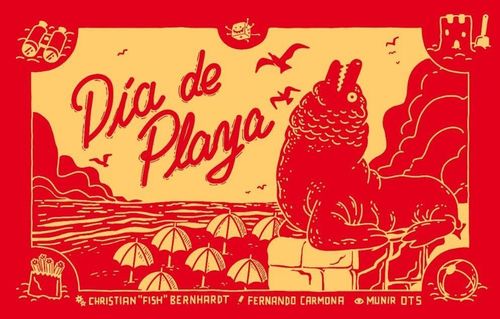
Día de Playa
Día de Playa Rulebook
Table of Contents
Table of Contents
Setup
Rules for competitive play between 2 or 3 players, or 4 players in 2 opposing teams that may not communicate with each other.
- Shuffle the cards and deal one to each player. Players place this card in front of themselves, on whichever side and in whichever orientation they prefer, starting their beach.
- Place the first 3 cards from the deck in a row to the right of the deck, forming the "market zone".
- The starting player is whoever has most recently been to the beach. Otherwise, whoever likes corn on the cob (choclo) the most.
How to Play
The goal is to earn tourism points by forming combinations on the beach.
Starting with the starting player and continuing clockwise, each player must take one of the 3 cards in the market zone, and immediately flip the remaining 2 and slide them to the right if needed to fill the gap. Finally, 1 card from the deck is placed in the space to the right of them.
The card taken may be played in any orientation, but keeping the face that was showing when it was taken.
The card must be placed with its edge adjacent to another previously placed card, or covering one or more cards (covering a maximum of 4 blocks of any other card). Once the card is placed, it is the next player's turn.
(Diagrams show two valid placements: edge-adjacent to a placed card, and overlapping a placed card. A card placed touching only diagonally is invalid.)
Adjacent in Día de Playa means sharing a side; a card cannot be placed diagonally.
End of the Game
The game ends when all the cards of the deck have been placed. At that moment, tourism points are added up for the figures formed according to the chosen scoring criteria. Whoever has the highest tourism score wins the game. Only visible blocks count for scoring.
Scoring
- 2 tourism points for each [blue running surfer figure] facing toward the player (the player is considered to be the sea).
- 2 tourism points for each [magenta tourist figure] that is not touching (whether adjacently or diagonally) another [magenta tourist figure]. 1 extra tourism point if that [magenta tourist figure] is facing in the direction of a [blue surfer figure], at any distance.
- -3 tourism points for each Residuo (waste/litter) visible on the beach.
- 3 tourism points for each 3 [blue standing figures] / [blue surfer figures], in any combination, connected diagonally. Each symbol can be scored only once.
- The player with the largest group of adjacent [umbrella and beach-chair] / [pink umbrella] blocks scores +1 tourism point for each [umbrella] block in that group. In case of a tie, no one receives these points. Cooperative or solitary: 2 tourism points for each 3 adjacent [umbrella] blocks in the largest group.
- 1 tourism point for each different figure (not including Residuo, but including other sands) adjacent to a 2 x 2 sand block. Each sand can be included in only one block.
- 6 tourism points for each [magenta stall] surrounded on its 4 sides by [blue surfer figures] or [blue standing figures]. A [blue surfer] or [blue standing figure] can be used for more than one [stall]. 1 extra tourism point for each 2 [stalls] of the same type visible on the beach.
Game Modes
Cooperative: For 2 to 4 players. One card is placed in the center of the table, which will be the shared play area. No kind of communication, verbal or gestural, is possible between the players. The goal is the same as in solitaire.
Solitaire: For a single player; one card is initially placed in the play area. The player competes to match or exceed the points of the chosen challenge. The game lasts a total of 14 cards (taken at random); the rest are not used in this mode:
- Mar del Plata: 51+ tourism points
- San Clemente: 41 to 50 tourism points
- Mar de Ajó: 21 to 40 tourism points
- Mar Chiquita: 10 to 20 tourism points