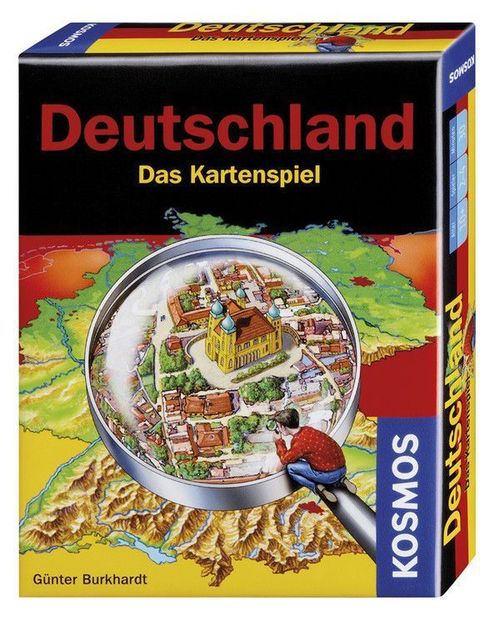
Deutschland: Das Kartenspiel
Deutschland: Das Kartenspiel Rulebook
Table of Contents
Table of Contents
Contents
96 place cards (Ortskarten), 24 guess cards (Tippkarten), 1 map of Germany (Deutschlandkarte).
A sheet of paper and a pencil are also needed.
What It's About
You take turns placing your guess cards to guess which of the places on the face-up place cards lies furthest north, furthest south, furthest west and furthest east, and which place has the most and the fewest inhabitants. The player who makes the best guesses wins.
Die Ortskarten
(The place cards)
Each place card has a front and a back.
- Back (Rückseite): the number in orange shows how far north or south the place lies. 0 is at the very north, 150 is far to the south. The grey number shows how far west or east the place lies. 0 is at the very west, 90 is far to the east. The back also shows the number of inhabitants.
- Front (Vorderseite): the name of the place and the region it lies in, with a picture of that region.
Example card: Bamberg (Bayern). Orange number 102, grey number 49, population 70,860.
Die Deutschlandkarte
(The map of Germany)
The map is divided into a grid. Orange lines run from north to south and are numbered from 0 to 150. Grey lines run from west to east and are numbered from 0 to 90. Using the grid and the numbers on the cards, the places can easily be found on the map.
Spielvorbereitung
(Setup)
- The place cards are shuffled well and placed face-up as a stack with the front side facing up. Take as many place cards from the stack as there are players, plus 1, and lay them out side by side. No player may look at the backs of the cards. With 2 players, 3 cards are used; with 3 players, 4 cards; with 4 players, 5 cards.
Example: with 4 players, 5 cards are laid out.
- Each player receives 6 guess cards of one colour and places them in front of themselves.
Das Spiel
(The game)
The game lasts 6 rounds with 2 or 3 players, and 8 rounds with 4 players. The player who was in a different German state most recently becomes the starting player. They place a small object, for example a coin, in front of themselves to show that they are the starting player.
1. Tippkarten ausspielen
(Playing guess cards)
The starting player begins by placing one of their guess cards face-up below one of the face-up place cards. Then the player to their left takes a turn and plays one of their guess cards. The other players follow in clockwise order. This continues until each player has placed a total of 3 guess cards.
With their guess cards, the players guess which of the face-up places lies furthest north ("N") or furthest south ("S"), which place lies furthest west ("W") or furthest east ("O"), and which place has the most or the fewest inhabitants.
In addition, a player may turn over a "W" guess card and use it as an "M" under a place, if they believe that the place does not lie "furthest" in any of the compass directions. Correct guesses earn points.
Attention: if a guess card already lies below a place card, the player must place the new guess card below the guess card that was placed before it.
Example 1: playing guess cards (with four players):
- Red plays a "W" under Emden, because Red believes Emden lies furthest west of the face-up cards.
- Blue believes Wismar lies furthest north and places its "N" guess card there.
- Green places a "Most inhabitants" guess card under Jena, on the assumption that none of the other face-up cities has more inhabitants.
- Yellow believes Cottbus lies furthest east and places its "O" guess card there.
- Red takes another turn and places its "O" under Jena.
- Blue places its "Most inhabitants" guess card under Cottbus.
- Green places its "Fewest inhabitants" guess card under Wismar.
- Yellow turns its "W" guess card over and uses it as an "M" under Jena, because Yellow believes Jena lies neither furthest north, nor furthest south, nor furthest west or east.
- Red plays the "Most inhabitants" guess card under Koblenz.
- Blue places its "W" under Emden.
- Green places its "N" under Wismar.
- Yellow places its "N" under Emden.
Attention: with two players a special rule applies. The players must place different guess cards. So if one player has placed an "O", the other player may not place an "O" in that round of guessing.
The printed example also shows the card layout (four players) after these twelve placements as a picture; the layout is fully described by the steps above.
2. Tippkarten werten und Punkte notieren
(Scoring guess cards and recording points)
Once all players have placed their guess cards, the guess cards that were not played are first set aside. The place cards are turned over, revealing each place's number of inhabitants and how far north, south, east or west it lies. The players now remove all guess cards that were placed wrongly. The correct guess cards underneath move up. Wrongly placed guess cards do not cost any penalty points.
Each player's points are then recorded, depending on where their guess cards lie:
- A guess card directly under the place earns 3 points.
- A guess card in the second row below the place earns 2 points.
- A guess card in the third row below the place earns 1 point.
- No points are awarded from the fourth row onward. (It can still sometimes be worth placing a card in the fourth or even fifth row, if you expect one or more other players to have guessed that place wrongly, so that your own guess card moves up.)
Example 2: scoring guess cards (with four players):
The northernmost place is Wismar (22), followed by Emden (33), Cottbus (65) and Jena (82). The southernmost place is Koblenz (93). The westernmost place is Emden (12), followed by Koblenz (16), Wismar (55) and Jena (56). The easternmost place is Cottbus (83). Koblenz has the most inhabitants (107,950) and Wismar has the fewest (42,430).
- Red receives 0 points for "O", 3 points for "W" and 3 points for "Most inhabitants", for a total of 6 points.
- Blue receives 2 points for "W", 3 points for "N" and no points for "Most inhabitants", for a total of 5 points.
- Green receives 0 points for "Most inhabitants", 2 points for "Fewest inhabitants" and 1 point for "N", for a total of 3 points.
- Yellow receives 3 points for "M", because the "M" moved up after the two wrong guess cards under Jena were removed; 0 points for "N" and 3 points for "O", for a total of 6 points.
Once the points for every player have been recorded, each player takes all of their guess cards back into their hand. The face-up place cards are removed from the game and returned to the box.
Place new place cards according to the number of players plus 1. The player to the left of the starting player becomes the new starting player, receives the starting player object and begins the new round by playing one guess card, and so on.
Spielende
(Game end)
The game ends after 6 rounds with 2 or 3 players, and after 8 rounds with 4 players. Each player then adds up the points they gathered in each round on the paper. The player with the most points wins. In the case of a tie, there are several winners.
Variante: Verdecktes Ausspielen der Tippkarten
(Variant: playing guess cards face down)
With 3 or 4 players, the players may choose to place their guess cards face down below the place cards. Only once every player has placed their 3 guess cards are they turned face up.
Anmerkungen
(Notes)
- The red dots on the map mark each place's city centre. Places often extend further than shown.
- Positions and population figures: source Wikipedia.