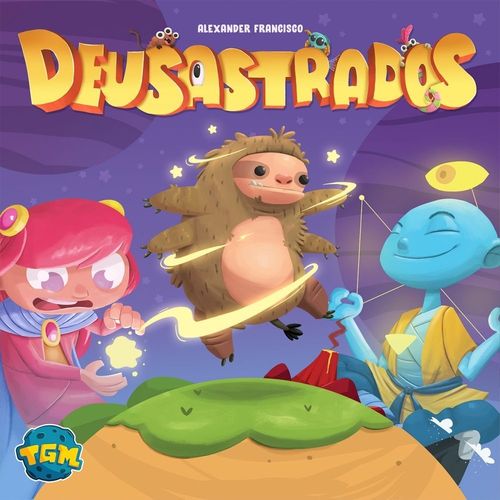
Deusastrados
Deusastrados Rulebook
Table of Contents
Table of Contents
Components
- 1 Chaos Board
- 4 Player Rulers
- 20 Tokens: 6 Type tokens, 5 God tokens, 9 Chaos tokens
- 1 Chaos Miniature
- 72 Part Cards
- 3 Chameleon Cards
- 40 God Cards
Basic Game
The Basic Game is recommended whenever someone plays Deusastrados for the first time. In this mode, the gods have no abilities and everyone has access to the same powers.
Setup
- Place the Chaos Board on one of the edges of the play area.
- Shuffle the Part Cards and spread them face down in the center of the table.
- Each player chooses a god, takes its token, cards and player ruler. Then return to the game box the god's ability card, as well as the two priority-2 cards that show the character image on the front. These components are not used in the Basic Game.
- Separate the Chaos Tokens into three piles, one for each body part: Head, Trunk and Feet, as in the example below. Shuffle each pile separately and remove one token from each pile without looking at its content (these tokens are not used in this game). Then shuffle the remaining tokens and keep them face down near the board.
- Reveal a Chaos Token and cover the matching image on the board, keeping the token face down.
How to Play
The most "disastrous" player (the player who is most clumsy, o jogador mais desastrado) receives the Chaos Miniature and begins the first round as the active player. Each round of Deusastrados is divided into four distinct phases:
- Creation (Criação): Create new creatures to inhabit the planet.
- Powers (Poderes): Use your powers and transform the creatures.
- Chaos (Caos): Chaos discards the parts that are not adapted.
- Scoring (Pontuação): The remaining parts and creatures score points.
The player ruler shows these phases in order, with a Chaos Order (Ordem do Caos) marker between Creation and Powers and between Powers and Chaos.
Phase 1 · Creation
This phase is played in real time. Simultaneously, players take Part Cards from the center of the table and choose either to discard them or to place them in their play area, or in another player's area, forming creatures. Creatures can be created in any order, and any part can be used, as long as there is free space. Once a Part Card is used, it cannot be removed or overlapped. The phase ends as soon as all players have created all creatures for the round. Players must use only one hand during this phase.
Creatures per player:
| Round | Creatures per player |
|---|---|
| Round 1 | 1 creature |
| Round 2 | 2 creatures |
| Rounds 3 and 4 | 3 creatures |
Creating new creatures can seem a bit confusing when seen from afar, but it has its rules. Creatures are always formed by three parts: head, trunk and feet. These elements respectively dictate the way the creature breathes, how it feeds, and the type of environment in which it lives.
Chaos Order
The Chaos Orders are requirements that creatures must meet to adapt to the new planet. The game begins with one Chaos Order, and new ones are revealed during the game. Before and after the Powers phase, while Chaos Tokens are available, the active player reveals a new token and covers the corresponding image on the board.
The nine Chaos Order images are: Air, Gas, Vacuum, Plant, Energy, Meat, Earth, Ice and Magma.
Example: The Chaos Order at the start of the game prohibits creatures that breathe gas. During the Creation phase, Klahri draws the first card and confirms that it is exactly a head that breathes gas. Without losing time, he places the head on one of Zilla's creatures, thwarting her plans.
Phase 2 · Powers
In this phase, players use their powers to transform their creatures and sabotage those of their opponents. Each player looks at their Power Cards and decides on one to use, placing it face down on the table. The cards are then revealed simultaneously, and their effects are activated one at a time, following the priority order from the highest number to the lowest. A player may choose not to activate a power, or to activate only part of the chosen power. If two or more powers have the same number, priority goes clockwise, starting from the active player. At the end of the round, the selected Power Cards are discarded.
Power keywords:
- Protect (Proteger): Protected creatures cannot be affected by powers or discarded in the Chaos phase.
- Trade (Trocar): Trade parts between creatures of one or more players.
- Discard (Descartar): Return the card to the center of the table.
Translator's note: the printed rulebook shows the Power Cards only as small images (priorities 1, 2 and 3 in the example illustration), and their full wording is not legible in the source. The card wordings are therefore not transcribed here; the keywords above are the rulebook's own descriptions.
Example: Lumen used Protect (priority 3) and Primorosa used Trade (priority 3). However, Primorosa is the active player and decides to trade the head of one of her creatures with the head of one of Lumen's creatures. Lumen, for his part, cannot protect the creature from the trade, since his power activates afterward.
Phase 3 · Chaos
In this phase, players discard all parts of their creatures whose card background is not visible on the Chaos Board, that is, parts that are covered by a Chaos Token. These parts did not adapt to the new planet and to the whims of Chaos.
Example: In this round, heads that breathe air or gas are not allowed, nor are trunks that feed on plants.
Phase 4 · Scoring
During scoring, players receive points and advance on the board with their tokens. Each player receives one point for each part of their creatures that survived Chaos, and one extra point for each complete creature (head, trunk and feet).
End of Round
At the end of the round, all parts of complete creatures that survived Chaos are discarded, and the Chaos Miniature is passed to the next player clockwise, who becomes the active player. Parts of incomplete creatures remain for the next round.
End of Game
After four rounds, the player with the highest score is declared the winner!
Advanced Game
After some games, players may move on to the Advanced Game. In this mode, the gods have unique abilities and different powers that bring more strategy to the games.
Differences in Setup
When choosing a god, each player places their God Ability Card on the table and removes from the game the priority-2 cards that do not show the image of the god in front of them, returning them to the box. The player who chooses Primorosa receives the six Type Tokens, and the player who chooses Zilla receives the three Chameleon Cards.
For a long time, across the galaxy, the three most prolific types of creatures have always been the systematic insectoids, the adaptable scaly ones, and the robust hairy ones. Over the millennia these species subdivided and mixed, generating hybrids of all shapes and sizes.
Differences in Play
The inclusion of God Ability Cards and special powers modifies rules and makes the experience of playing with each god unique. In the Advanced Game, the Creature Types (represented by the icons in the upper right corner of the Part Cards) are used in some god abilities, so pay attention!
The Lumen god ability card, titled "The Guiding Goddess", reads: After Chaos phase: take 1 part and place it in 1 empty space.