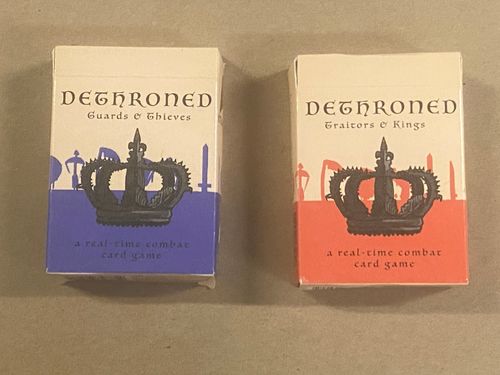
DETHRONED: The Real-Time Combat Card Game
DETHRONED: The Real-Time Combat Card Game Rulebook
Table of Contents
Table of Contents
- Contents
- Role Cards
- Quick Start Instructions
- Discussion
- Combat Placement
- Beating and Attacking in Combat
- Defending in Combat
- Helping
- Modifying Battle Cards
- Modifier Cards
- Real-Time
- Losing & Dying
- Ending the Game
- F.A.Q.
- Suggested Roles: Traitors and Kings
- Suggested Roles: Guards and Thieves
- Greater Detail Section
- Discussion Phase
- Combat Phase
- How Attacking Works Part 1
- How Attacking Works Part 2
- How Attacking Works Part 3
- How Defending Works
- Modifiers (As seen above)
- Getting the Kill
- Combat Example
- Combat Example 2: Advanced
- F.A.Q. (Greater Detail Section)
- Suggested Roles: Traitors and Kings (Greater Detail Section)
Contents
Each box contains:
- 8 Role cards
- 2 Shapeshifter "Make Your Own" Role cards
- 4 Weapon Decks consisting of 14 cards each
- 2 Role Reference cards
Each Weapon Deck:
- Battle cards numbered 1 - 10
- Modifier cards Double, Halve, Bomb, and Redirect
Assailant Role cards are marked by a skull symbol.
Royalty Role cards are marked by a crown symbol.
Role Cards
DETHRONED draws inspiration from the hidden-agenda and hidden-role genres, but adds fast-paced action. Every Role card has a unique win condition. Royalty cards have a crown symbol on them and commoner Role cards do not. Assailants have a skull symbol on them. As soon as an Assailant gets a kill, the skull symbol is then after null [sic] and the Assailant is now a murderer and no longer an Assailant.
Quick Start Instructions
Before You Begin
All Players must:
- Choose a weapon deck. Art is the only difference.
- Shuffle their deck and place it face down on the table.
- Draw 3 cards from the top. This is your max hand size. Cards are not reshuffled into the deck.
- Decide which Roles to play with. See "Suggested Roles" Section.
- Take one of those Roles facedown so no other player can see it.
- Check their Role card, without showing any other players.
- Read and understand their win conditions. These may be checked later in the game, but still not revealed.
- Discussion Phase begins.
Phase Order
- Pre-Game Role Selection and Handout
- Discussion Phase
- Combat Phase
- Vote to End Combat
- Reveal Roles
- Retrieve cards, play again!
Discussion
Starting from either the youngest Player, or the one who lost most recently, each Player declares a Role in clockwise order. The Role must be in play, but need not be the Role you actually drew. You may lie, or even claim a previously declared Role. You may also change your claim at any point, although be careful, as this may make others distrustful of you! Combat is not yet allowed, so use this time to form teams and strategies. To signal that you are ready to start the game, raise your hand. The game starts once 2 Players vote to do so.
Combat Placement
Each Player's deck has 10 Battle cards valued 1 through 10, as well as 4 special Modifier cards. Battle cards are used to attack Players or to beat an already played attack. Attacks happen by placing a Battle card in front of another Player. Defending Battle cards are then placed between that card and the defending Player.
Beating and Attacking in Combat
Attacks are beaten by a defending Battle card that has a value greater than or equal to the attacking Battle card. Defending and attacking Battle card values can each be altered by Modifier cards but only until the attack is beaten. Attacking Battle cards cannot be stacked together but are instead treated as individual attacks. If you cannot or do not want to beat an attack on yourself, you can ask for help from others to beat or modify it.
Defending in Combat
If you're attacked, you are defending as long as an attack remains in front of you: No drawing, attacking, or helping others. Either beat the attack(s) on you, or call for help. When all attacks against you are beaten, try to remember to draw back up immediately; this game plays in real time. Though you're free to forget to draw, you must end a beaten attack on you (and thereby no longer defending) by clearing away all used cards from in front of you. Your attacker(s) must also wait for you to clear their own individual attack before attacking you again.
Helping
In DETHRONED, you will want to trick or sincerely convince other Players to help you out with their Modifiers and Battle cards. Any attacking Battle card can be modified by any other non-defending Player up until a defending Battle card is played that beats it, including it's Modifiers. Unlike Battle cards, Modifiers may be stacked together. You may also help another Player regardless to if they ask for it. Helping works just like defending. Place your Battle card between the attacking Battle card and the defending Player. If your defending Battle card is greater than or equal to the attacking Battle card then the attack is beaten. The player you helped is still defending until all attacks on them are beaten and cleared. As long as you're not being attacked you may place any Modifier card in your hand on top of a defending or attacking Battle card where the attacking Battle card is not yet beaten.
Modifying Battle Cards
Modifiers are played on top any Battle card, and only modify that one card. They can, however, be played on cards already modified. For example: If you are attacked with a 10 so you play the highest card you have which is a 5. Then an ally of your attacker Doubles the 10! Next an ally of yours Halves the new 20 bringing it back down to 10. Your ally then plays a Double on your 5. Both attacking and defending Battle cards are now 10 and suddenly your original defending 5 beats the original attacking 10!
Note: Once the attacking Battle card is beaten, that attack is over. Modifiers can only be played on an unbeaten attacking Battle cards and the Battle card defending against it. The Modifier cards are cleared along with the Battle cards they modified once the attack is beaten.
Modifier Cards
Modifiers have no value, thus cannot be used to attack or defend directly. The Double and Half modify the value of any Attack card without rounding, meaning fractions are possible. They do stack with each other. The Redirect modifies any defending or attacking Battle card to give you ownership of it and all Modifiers on it. Allowing you to move it to any target Player, including the original Player or yourself. Redirecting an unbeaten attacking Battle card will cause it's defending Battle card to simply be discarded. The Bomb modifies a single defending Player's Battle card into a bomb, targeting all attacking Battle Cards against that Player and instantly beating them. A bomb-ified Battle card can not be redirected.
Real-Time
If you forget to draw back to 3 and get attacked, you can only beat the attacking Battle card with whatever is in your hand. If you are not under attack, you may attack or not attack at any moment, there is no right time. If actions conflict, first try good sportsmanship, then try letting both actions continue. Here are some example interpretations:
- A Player is attacked with their hand on the deck to draw. They draw exactly 1 card, then must deal with the attack(s) in front of them.
- A Player is attacked while placing an attacking Battle card. Both attacks go through, but then they must beat the attacks in front of them.
- A Player is killed by 2 attacks of equal value, played at the same time. The defending player chooses who gets credit.
Losing & Dying
If you can't or don't want to beat an attack, you must ask for help... or die. Credit for the kill goes to the Player with the highest attacking Battle card on you at that moment. If there is a tie, credit goes to the first attack. It's the attacker's job to say and count down from 3 to 0 until you die, and if they forget you can spend more time looking for help or deciding on how to beat an attack. Before the count down, a defender gets 3 seconds to deal with an attack. If you die, place the killing blow (face up or down) on your Role card, KEEPING THE ROLE HIDDEN until the game ends. Staying alive is not a goal for all Roles, remember! Not everyone needs to survive to win. Also, dead Players cannot talk.
Ending the Game
Whenever a Player dies, the game immediately pauses. First, resolve any remaining Attacks. Then, living Players may vote to end the game by raising their hand. If your win conditions are not met and you want the game to continue, you can cancel the vote by immediately attacking a living Player to continue combat. Living Players must vote again after each death, and may not vote at any other time. In the case of a stalemate (no one has Battle cards) or some form of impasse where Players cannot or do not wish to attack, then all Players reveal their hands to prove this and vote to end the game. Once the game is finished, Players reveal their Roles, and those that have met their win conditions receive a victory!
F.A.Q.
Can I beat my own Attacks? Yes. If you are not under attack yourself, you can intervene on any or both sides of any combat.
Can I kill myself? You cannot play Attack cards on yourself, but you can Redirect to any Player, including yourself.
Can I Redirect to the same Player? Yes, you can Redirect to any Player, including the original target of the attack.
I don't see a rule about showing hands? You may show your hand to whoever you want at any time, but it's often not recommended unless you completely trust the person. [Printed as "zcompletely"; corrected to "completely".]
Am I dead if I run out of cards? No, you're virtually defenseless but you're still alive.
Can I combine roles from another deck? Yes! A good Role Setup has at least 50% assailants and each role has at least a 50% chance of winning.
Suggested Roles: Traitors and Kings
Note: Setups generally have half Assailant Roles and each Role has approximately a 50% chance of winning.
- Assassin for Hire (3P)
- A Foolish Hunt (3P)
- On Sale (3P)
- A Royal Showdown (4P)
- Trouble in the Family (4P)
- Dethroned (4P)
- King's Day Out (4P)
- The Royal Family (5P)
- The Guest List (6P)
- The Afterparty (7P)
- Full House (8P)
Buy the Guards and Thieves Deck to play with up to 8 players!
Suggested Roles: Guards and Thieves
Note: Setups generally have half Assailant Roles and each Role has approximately a 50% chance of winning.
- A Test of Faith (3P)
- Twin's Trials (3P)
- The Honeymoon (4P)
- Crowd Control (4P)
- Divide and Conquer (4P)
- The Night's Watch (5P)
- Judge, Jury and . . . (5P)
- In The Family (6P)
- Spring Cleaning (6P)
- Out To Play (7P)
- Town Meeting (8P)
Buy the Kings and Traitors Deck to play with up to 8 players!
Greater Detail Section
The following is the publisher's companion document, "DETHRONED - RuleBook" (Greater Detail Section), by KiteLion Games. It expands the main rules above. Where its wording differs from the main rulebook it is kept as printed.
Discussion Phase
Moving clockwise, each player declares their Role, in an attempt to make allies and form a strategy. You may not reveal your Role card, and instead should persuade the other players to believe you. Of course, you do not have to claim your actual Role, and may lie about your identity, or even claim a Role someone else has already declared. You may swap your claim to another Role at any point. Also, players cannot be asked to prove their identity by reading from their card. This counts as revealing your card, which is not allowed until the game is finished. Once each player has claimed a Role, combat begins!
Combat Phase
This phase has no turns, as Players may Attack at any time. If you see an opportunity that is in your favor, take it! The only thing that can stop you is being Attacked yourself, since you cannot take any actions besides Defending while under Attack. Once the Combat Phase begins, Players may Attack at any time, but may also continue to talk, make alliances, and attempt to convince others of their Role. Since gameplay is turnless, multiple people may be in active combats at the same time. In fact, one Player may Attack up to 3 other Players at once, by using their entire hand! If a Player cannot Beat an Attack against them, or chooses not to, that Player MUST "Call for Help". This is to notify the other Players that they are about to die, and to prevent Players from killing themselves off. When a player "Calls for Help", all other Players have the opportunity to Beat the cards that are killing the victim, but they may also choose to play a higher card, thereby stealing the kill for themselves, or to play a Redirect, claiming the attack as their own!
If an attack remains uncontested for 3 seconds, the attacking Player has counted down, and is not beaten, then the victim Player dies. After the first Player death, or after 2, if there are 8 players, gameplay immediately pauses. Players now vote on whether the game should end, and if all living Players must vote "yes", the game ceases. However, in order to vote to continue the game, a Player must immediately attack another, so that combat continues. If the game continues, then the vote is held again after each death. When the game ends, all Players finally reveal their Role cards, proving who they were, and seeing who they have tricked! Any Players who have met the win conditions on their card wins and, if the game is repeated, gain a point!
How Attacking Works Part 1
During the Combat Phase, Players may play Battle cards, these beings cards numbered from 1-10 that make up the majority of your deck. In order to attack another player, you simply play an Battle card in front of them. This prevents the victim from helping other players, drawing more cards, or attacking until the attack is beaten. You Beat a card by playing another card with an equal or higher value on top of it. This could be the same number, a larger number, or a bomb card. Modifiers can change the effective number of a card, either making it easier to beat, or making another number card count for more. If the victim cannot or does not want to beat the card themselves, they must Call for Help, by announcing their plight to the rest of the Players. Any other Player may also beat the card played on the victim. Once the attack is beaten, or the victim killed, the cards are moved to the center of the table and are out of play. You may not shuffle them back into your deck. It is also possible to attack a player who is already being attacked. This may be done either by overwriting the current attack with a larger number, or by playing a separate attack, so the victim must beat two attacks separately.
How Attacking Works Part 2
After 3 seconds without receiving help, the victim must immediately beat the attack upon them, or else die. When a Player dies, they do NOT reveal their Role, and must continue to keep it hidden until the end of the game. Also, when you play a card, you should immediately draw back to a hand size of 3, but being under attack prevents drawing more cards. This means that a victim without friends can quickly be blocked into a position where they simply do not have enough cards to beat the attacks against them. Be careful to not make too many enemies at once! It is a quick way to lose even if you have a good hand.
How Attacking Works Part 3
While a Player can be attacked by any number of other Players at the same time, each attacker may only attack the same Player once at a time. The attacker cannot attack the victim again until their attack is cleared from the field and moved to the middle of the play area. Modifiers, consisting of the Redirect, Half, Double, and Bomb cards, may be played on any attack, including both yours and those of other attacking Players. And just to reiterate! Defending players cannot attack others, draw cards, or help others while under attack. They must first beat the attack, and clear the cards from the field, before resuming normal activity, in that order!
How Defending Works
If and when you are attacked, the same cards that you would use to attack others shall serve as your defense. In order to beat an attack, you simply play a card of equal or greater value to the attack. A defensive play can only be made against one attack at a time, so you cannot beat several attacks all at once with one larger card. The modifiers are exceptions to this, since they are played either on particular cards or on a player as a whole, due to their very different capabilities. Once you beat all the cards in front of you, you must immediately clear the cards from the play area, and draw back up to your maximum hand size of 3. Once both of these are done, you may resume attacking, and the player or players whose attacks you beat may choose to attack again.
Modifiers (As seen above)
Modifiers may be played on cards already affected by other modifiers, but do have a few conditions. Modifiers may never be played on cards which are already beaten.
- Half: Halves the value of any Attack or Defense card. Odd numbers are not rounded, so that a 7 which has been halved twice (equal to 1.75) would be worth more than a 3 which had been halved once (equal to 1.5).
- Double: Doubles the value of any Attack or Defense card.
- Bomb: Beats all Battle cards targeting a single Player. The Bomb does not technically have a value. Rather, it just clears the board in front of a single Player, nullifying and removing all attacks. It cannot be used to remove a defense or to help in an attack.
- Redirect: Allows you to claim any one attack, including all of its modifiers but not any current defenses. The attack now counts as yours, and can be transferred to any Player as a new attack. This includes the Player who was previously victim of the attack, allowing you to steal a kill for yourself. It also includes you, making the Redirect the only way to actually kill yourself. It cannot be used to take control of a defense, nor can the attack claimed be transferred into a defense. The Redirect is purely aggressive.
Getting the Kill
If a Player is going to die with multiple attacks unbeaten, the attacker who receives credit for the kill is the one with the highest value attack remaining unbeaten. Even if the Player with the highest value attack was not the first to play an attack against the victim, they still receive credit. Modifiers do not give credit for kills, but do increase the value of the attack. So, if one Player plays a 4, a second plays a 6, and a third plays a Double on the 4, then it is the first Player who receives credit for the kill. The Redirect, however, does transfer the ownership of the attack to the one who played the Redirect, and so can be used to claim a kill.
Combat Example
There are three Players. Player A is the Fool, and thinks Player B is the King. Player A attacks Player B, since the Fool needs to kill the King. Player B calls Player A an idiot, and blocks the attacks for a while, going back and forth. Finally, Player B ends up with a 5, 1, and Double. Player B is about to play the 5 and Double on Player A, but suddenly Player C jumps in, playing a 10 on Player B. Sadly, Player B uses the two cards to beat the 10, but right before they can draw again, Player A attacks with a 2. Unable to beat it, Player B calls for help, but Player C refuses, and Player B dies. Players A and C both vote to end the game, and all three Players reveal their Role cards. As it turns out, Player B was the Assassin, and Player C was the King, leaving the King and Fool alive. The King has fulfilled his goal of not dying, and the Fool has not fulfilled his goals of not dying and having the King dead. So, the King gets a win, and the Fool gets a loss.
Combat Example 2: Advanced
There are three Players. Player A attacks Player B with a 5. Player B has a 1, Double, and Half in their hand. Player B plays their Half on the 5, reducing it to a 2 and ½. They then play their 1 and Double it to a 2, but they have still not won and cannot draw until they beat the attack, so they ask for help. Player C steps in and plays another Half on the 5, reducing it to a power level of 1 and ¼. Player B has a power level of 2, and so wins the fight, clears the board, and draws 3 more cards. Now Player B can attack others or interfere in other combats again.
F.A.Q. (Greater Detail Section)
Can I beat my own Attacks? Yes. If you are not under attack yourself, you can intervene on either or both sides of any combat.
Can I kill myself? You cannot play Battle cards on yourself, but you can Redirect to any Player, including yourself.
Can I Redirect to the same Player? Yes, you can Redirect to any Player, including the original target of the attack.
I don't see a rule about showing hands? You may show your hand to whoever you want at any time, but it's often not recommended unless you completely trust the person.
Am I dead if I run out of cards? No, you're virtually defenseless but you're still alive.
Can I combine roles from another deck? Yes! A good Role Setup has at least 30%-50% assailants and each role has at least a 50% chance of winning.
Suggested Roles: Traitors and Kings (Greater Detail Section)
- Assassin for Hire (3P)
- A Foolish Hunt (3P)
- A Royal Showdown (4P)
- Trouble in the Family (4P)
- Dethroned (4P)
- King's Day Out (4P)
- The Royal Family (5P)
- The Guest List (6P)
- The Afterparty (7P)
- Full House (8P)
Buy the Guards and Thieves Deck to mix roles and play with up to 8 players!
Suggested Roles: Guards and Thieves (Greater Detail Section)
- A Test of Faith (3P)
- Twin's Trials (3P)
- The Honeymoon (4P)
- Crowd Control (4P)
- Divide and Conquer (4P)
- The Night's Watch (5P)
- Judge, Jury & Executioner (5P)
- In The Family (6P)
- Spring Cleaning (6P)
- Out To Play (7P)
- Town Meeting (8P)
Buy the Kings and Traitors Deck to mix roles and play with up to 8 players!