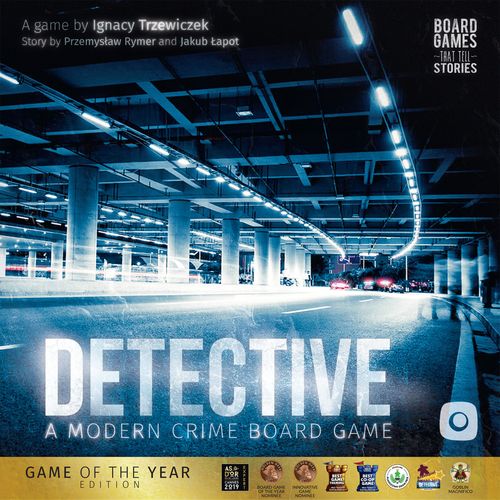
Detective: A Modern Crime Board Game
Detective: A Modern Crime Board Game Rulebook
Table of Contents
Table of Contents
Game Concepts
Welcome, Investigators
Detective is a cooperative game of deduction. Each of you plays an investigator with a unique ability and skill set. You must gather information, collect clues, and follow leads in order to solve a case, which is represented by a deck of cards. At the end of the game, you will answer questions to gain victory points. You will win or lose the game based on the number of victory points earned.
Teamwork
Detective is a cooperative game. All players share the Skill tokens, Stress tokens, and Authority tokens in a common Token pool and use a Time marker to track the passing of time when resolving all Actions. We use the word "you" to represent the entire team. You are going to examine all clues together, as a team.
Metaplot
Detective is a campaign game. The five cases in the box are connected by one overall narrative thread. While playing, you might find clues that seem unconnected to the current case. Sometimes they are dead ends; sometimes they are clues you will need to solve upcoming cases. Don't be discouraged if you don't understand the significance of a clue when you first encounter it. Maybe that information will be crucial one day soon...
One case, one deck
Each case is comprised of a dedicated deck of 36 cards: 1 cover card and 35 "lead" cards. Do not browse through this deck or shuffle it! Draw the appropriate cards from it only when instructed to do so. Read only the front side unless instructed otherwise. Once you draw a lead card, you can refer to it at any time during the campaign.
Cast a wide net
At the start of each case, you will find a few lead cards and clues to get you started. Consider following each of these leads before deciding to investigate further down any particular path. Following a few leads based on a variety of clues to build a wider picture of what's going on is often MUCH better than focusing on only one lead.
Notes
With five interconnected cases in the base game, taking good notes will be crucial. If you start a later case without remembering vital names and clues from earlier cases, you will have a hard time piecing everything together. Do not hesitate to write down important names. Connect them with lines to show their relation to one another as well as to evidence, dates, places and events. In addition, we recommend creating a mind map to organize your thoughts.
Solving cases without a full deck
Each case has many paths to completion. Due to time constraints, though, you will never see the whole deck or discover all of the clues. In fact, the average number of cards drawn in each case is about twenty!
After finishing the game, don't be disappointed that you didn't go through the entire deck. This is a game of deduction. Ultimately, what matters most is how you piece it all together, not how many clues you discover.
There is no "You Won" card
Detective is not a "choose your own adventure" game. There is no final paragraph that says you won and sums up the entire story; no single card that makes everything click. All of the information is scattered among many different cards. You must connect the dots to build up theories and find answers to your final questions.
Remember - no single card will win you the game. The answers for the Final Report must be deduced from the clues you have gathered during the game. You won't get far if you merely cycle through the deck, trying to draw one card after another, hoping that one last card in the chain will win you the game. It will not.
#playtestingtip
Detective is a game night experience and solving a case can take more than three hours. Since you will most likely play each case only once, don't ruin the experience by playing in a rush, in a bad mood, or under any other circumstances that will not help you fully enjoy the game. Find a good quiet place, maybe put some music on in the background, relax, and become a detective!
Components
Game board
The game board depicts all of the major Locations the investigators will visit during the game. It also features a Day track and a Time track to mark the passing of time, which is important because each case has a precise time limit in which it must be solved.
Casebook
The casebook includes game introductions and special rules for each of the five cases in the campaign. Do not open the casebook before starting the game. Play all of the cases in order and don't read the next case until you have finished the current one.
Antares Database
The Antares National Investigation Agency maintains a database of its resources at ANTARESDATABASE.COM. On this website you'll find witness reports, interrogation transcripts, additional materials dedicated to each case, and personal files of the primary characters you'll meet in the game.
5 Character Tiles
With investigators on the front and consultants on the back sides.
5 case decks
Don't read or even open the next case deck until you have finished the current one.
Wooden markers
1 Time marker, 1 Investigation Team (IT) marker, 1 Day marker
Character tokens
15 Authority, 10 Stress, 5 Used Ability tokens
5 Special tokens
Used for various purposes (e.g. as an additional IT, Time or Day marker, as a spare, or to mark important lead cards). Unless instructed otherwise, you can use them as you see fit - be creative!
Skill tokens
3 Research, 3 Technology, 3 Perception, 3 Questioning, and 5 Wild Skill tokens
1 Intro sheet/Antares Guide
This rulebook
Case Set-up
To set up for each case:
- Place the board on the table within reach of all players.
- Place the Investigation Team marker (or IT marker) on the Headquarters Location.
- Place the Time marker on the 8:00 AM space of the Time track.
- Place the Day marker on the day 1 space of the Day track.
- Give each player the investigator tile of their choice. Place your investigator tile face up and collect the Skill token depicted on the tile in its bottom right-hand corner (5a).
- Turn any unused investigator tiles to their Consultant side and collect the Skill tokens depicted on those tiles (6a).
- Create a Token pool of all Skill tokens provided by investigators and consultants.
- Log into the Antares website at antaresdatabase.com, then choose your campaign and the case.
- Take the case deck and place it next to the board.
- Open the casebook and read the introduction to the case, special rules, and set-up changes.
- Make plenty of space for your notes and/or a mind map. Use a whiteboard or a bulletin board if you have one.
- Make sure you have an Internet browser in reach to search for case related information.
Gameplay Overview
Summary
You have a limited number of days, i.e. game rounds, in which to learn as much as possible about a case and achieve the stated goal. Once you run out of days, navigate to that case's "Final Report" on the Antares website and attempt to answer questions related to it. Your answers will determine your final score.
Days and hours
Each day is divided into eight working hours (8:00AM - 4:00PM) to spend on various actions. You can spend additional hours each day by working Overtime. Be careful, though! Working Overtime causes stress, and stress in Detective can end your investigation prematurely!
#playtestingtip
From our experience, taking a five-minute break after each day to stretch your legs, make some tea or coffee, or eat cookies helps to reset your brain for the next Day. This short break helps a lot with processing all of the clues and keeping your team focused.
Daily activity
During a Day, there are NO individual player turns or phases. You act as one team and perform actions together. You should discuss as a team the next steps you would like to take. Note that you may have to move the IT marker on the game board, move the Time marker on the Time track, and so on, depending on your choices.
To take actions during a day, you can:
- Follow a lead,
- Dig Deeper,
- Browse the Antares Database,
- Browse the Internet,
- Write a report,
- Use an investigator's ability,
- Spend authority tokens to perform an action specified on a card, or
- Perform another action defined by the case introduction or a specific card.
Each action will indicate whether or not you must advance Time marker to perform it.
Example: You decide to draw and read a lead card, so you move the Time marker as instructed. That lead card gives you access to two new lead cards in the "Further Leads" section. You decide to draw and read one of the new lead cards, advancing the Time tracker again. There is an option to check something in the Antares Database, which you do (at no cost on the Time tracker). You now draw another lead card, but this lead is in a different Location, so you must first move the IT marker and advance the Time tracker by one hour, then you can read the card. You adjust the Time marker the appropriate number of spaces indicated on that card. Next, you decide to write a report, then check another lead card, etc…
Day's end
When the Time marker reaches 4:00 PM, you may decide to work Overtime or End the Day; if you End the Day, then you must:
- Move the Day marker to the next day on the Day tracker,
- Reset the Time tracker to 8:00 AM,
- Move the IT marker back to Headquarters,
- Sort notes and discuss what you have learned that day,
- Write down all possible leads to keep track of what is available to you.
Three Basic Rules
Rule 1: Clues
During a game, you follow clues to solve a case. Each case has three basic types of clues: Leads, the Antares Database, and general knowledge.
Lead cards
Lead cards represent crime scenes, witnesses, found evidence, and other information obtained during the investigation. Each lead in the game is represented by a single card and is identified by a # followed by a number (example: #103). You may only look at the front side when first gaining a new card. You may later be able to look at the back "B" side - but only when instructed to do so.
Each lead card includes its hour value and the Location where it can be obtained. Each case consists of exactly 35 lead cards.
This is an example of the front side of a lead card. Here you will find clues and instructions that you must follow. This is an example of the back side of a lead card. It can also contain various instructions and a Further Leads section.
This is an example of a Dig Deeper section. It allows you to spend a Skill token to read the back side.
This is an example of a Further Leads section. It allows you to follow new leads.
Note
Before Following a Lead, i.e., drawing and reading a lead card, you will know the card number and its Location, but not its hour value, which depends on many factors. You can only estimate how long a lead is going to take you based on the card Location:
HEADQUARTERS — Time-consuming tasks of obtaining information and doing extensive research are greatly sped up by the Antares system. These leads usually take one to two hours to complete. Interrogations may take longer.
RICHMOND PD & COURTHOUSE — Going through the archives is usually a time-consuming process. These leads usually take two to three hours to complete.
THE LAB — Cutting edge technology and information specialists greatly increase your efficiency, but nevertheless examining evidence can take up to four hours.
FIELDWORK — These leads are robust and can take you to many different places, but getting around town means that each lead card will take you at least two hours. Unless you're in a hurry.
Antares Database
On the Antares Database (antaresdatabase.com), you can find information stored by the police, the FBI, the military, and federal intelligence agencies. When you encounter the "@" character, you need to choose the right section in the menu, then input the correct name or number. Read the Antares Database Guide for more details!
General Knowledge
Detective is set in modern times and you, as the protagonists of the game, have access to all data that can be found on the Internet. You can use Google Maps, Wikipedia, or any other source of data you may need. We call this mechanism "Breaking the Fourth Wall." General Knowledge is identified with the wifi icon. When you see this icon, you can browse the given topic on the Internet to learn more about it. If there is a certain phrase underlined before the wifi icon, you should run it through the search engine of your choice to see what comes up. Read "Browse the Internet" for more details!
Rule 2: Time
Solving a crime takes time. In Detective, the progression of time is represented by the Time marker advancing on the Time track and by the Day marker advancing on the Day track. Investigators have a precise time limit in which to solve each case, and each lead card has its hour value.
- When you draw a lead card, you must move the Time marker a number of spaces on the Time track as indicated by the card.
Example: To resolve this card, you need to move the Time marker by 3 hours on the Time track.
Ending the Day
When the Time marker reaches 4:00 PM, work hours have ended. Unless you decide to go into Overtime, the Time token should now be moved to 8:00 AM and the Day marker moved to the next Day. Remove all Used Ability tokens from the investigator tiles. If you have finished the final day of your investigation, you have to finish the case by making a Final Report in the Antares Database; then read the epilogue based on your report.
You can End your Day at any hour, thus starting the next one, until you run out of Days.
Overtime & Stress
You may choose to use the Overtime spaces on the Time track to continue working after 4:00 PM. In Overtime, continue to move the Time marker on the Time track to 5:00 PM and so on. You may use as many Overtime hours as you want, then (after advancing the Time track as needed to finish your actions) decide to End your Day.
Sometimes you will be forced to take Overtime because the hour value of a lead card makes you move your Time marker past 4:00 PM. Working Overtime has its costs:
- Add 1 Stress token to the Token pool for each hour you work after 4:00 PM.
- If you collect Stress tokens equal to or greater than your Stress limit (indicated in the case introduction), your investigation ends immediately, and you must go to the Antares Database to complete your final report.
Rule 3: Locations
The Detective game board has five Locations. Headquarters is your office and the center of the whole investigation. The Richmond Police Department is a place where you can access files and evidence from old cases. In the Lab, you can examine evidence found at the crime scene. In the Courthouse, you can gain access to the archives and documents from old trials; you also have a few helpful consultants who work there and can give you important advice. Fieldwork represents all other locations in the city — its restaurants, parking lots, witnesses' houses — and other places, possibly all over the world.
When you want to Follow a Lead card and you are not already in the appropriate Location, you must:
- Move the IT marker to the appropriate Location on the board, and
- Move the Time marker one space forward, to represent the travel time.
Example: Resolving lead card #105 requires investigators to go to the Richmond Police Department. Since investigators are currently at The Lab, you must first get there! You move the IT marker to the Richmond PD and advance the Time marker by one hour.
Important:
- At the beginning of each day, place the IT marker on the Headquarters Location.
- Some lead cards do not depict a location, which means that you can follow them from any location, without moving your IT marker.
Actions
In any order, you may take any of these available actions as a team:
- Follow a Lead
- Dig Deeper
- Browse the Antares Database
- Browse the Internet
- Use an ability
- Write a report
Follow a Lead
At the beginning of a case, the "Further Leads" section in the casebook will present a list of lead cards. You can Follow Leads in any order you wish, and you can ignore any that you don't wish to follow. However, once you draw a lead card, you MUST resolve it; you may NOT check the hour value and Skill required to Dig Deeper and then decide not to resolve the card.
Lead card's anatomy
- card number (1)
- location (2)
- hour value (3)
- lead card's text to be read (4)
- an instruction (5)
- dig deeper (7)
- further leads (8)
When you decide to Follow a particular Lead, you must:
- Search the deck for the lead card with the appropriate number.
- Check the lead card's location and move the IT marker and Time marker if necessary. (See "Rule 3: Locations")
- Check the lead card's hour value and advance the Time marker an appropriate number of spaces. (See "Rule 2: Time")
- Read the card aloud and present its contents to all players. Make sure you keep the back side hidden (unless you are instructed otherwise).
- Follow all of the lead card's direct instructions. (See "Instructions")
- When you encounter a Signature, you must input it into the Antares Database, in the Signatures section. (See: Matching Evidence under "Other Rules")
- Decide whether or not to "Dig Deeper" if possible. (See Dig Deeper action)
- Note any Further Leads. (See "Further Leads")
- Place the card aside because it is now resolved. More specifically:
- If the card doesn't have the Dig Deeper symbol or you didn't Dig Deeper, place the card on the right side of the game board to remember that you do not have access to the back side of these lead cards.
- If you saw the backside of the card due to the symbol, Digging Deeper or other instructions, place it on the left side of the game board, which is where you can keep track of all cards that have both sides available to you.
Instructions
This symbol means "turn the card over and read its back side," either after following some additional instructions (see Dig Deeper action) or for free.
The "READ" keyword indicates that you must immediately read the specified card or Antares Database entry. If you are instructed to read more than one clue, you may read them in any order.
The "CHOOSE" keyword means that you have to decide which action to take from the options presented, mostly by following different leads or reading different clues. Once you make your choice, you cannot consult the other options; you must resolve the rest of the lead or follow any instructions given in the Antares Database entry.
"ADD A PLOT CARD" - Plot cards are a special type of cards that represent leads in future cases.
You may encounter some additional, simple instructions that do not require further explanation.
Further Leads
The "FURTHER LEADS" section on the lead card lists other lead cards you may decide to follow at any time later in the game. You must finish resolving the current card before following a new lead.
Spending authority tokens
- Some clues and instructions you encounter may require you to discard a certain number of Authority tokens.
Dig Deeper
Lead cards are double-sided. The Dig Deeper action allows you to reveal additional information by reading the back side of the lead card. To Dig Deeper, you must spend the token depicted in the Dig Deeper section of the card. After you do so, flip the card over, read it, note Further Leads, etc.
Example: You Follow a Lead - a suspect questioning. The front side of the card presents the suspects' testimony. It is not very convincing; you are certain, that he is hiding something. However his alibi checks out. The Dig Deeper section gives you the option of pressing the suspect further. Are you satisfied with what you've learned, or do you want to Dig Deeper?
fieldwork, 2h — "He is right where you expected him to be: In his body shop. You step in, identify yourself, and ask him about his whereabouts on the day of the murder. He squints a little and starts to talk. 'Look, I didn't do it. Had a delivery that day. That's my side job. You can check that - call my supervisor. Besides, I barely even knew the victim! All I know is that his girlfriend was going to visit him that day, but her car broke down and she ended up here. That's all I know, seriously. Now, can I please get back to my job?'"
press him further — "'Not so fast,' you reply. 'Tell me about his girlfriend. What's her name? Can you prove she was here? What time did she leave?' The guy scratches his head for a while. You take a careful look at him. Finally he responds 'Well, I believe her name is Jennifer O'Connor. (MSL) I can't prove that she was here, but I think she should have my business card in her car. (LSL) She left at five if I remember correctly. (HSL)' You nod. 'That will be all for now, thank you.' He is full of shit, that's for sure. If this Jennifer left at five, she wouldn't have had enough time to reach the victim's place from here. It's time to look her up. Read NAME@JenniferOConnor"
When you have the opportunity to Dig Deeper, you must immediately decide whether to spend the appropriate token or not. You have a limited number of tokens to spend during a case, so choose carefully. You can choose whether to Dig Deeper or not to Dig Deeper until you move on to Follow another Lead.
In the rare case when you follow more than one lead card simultaneously, e.g., because of the Read keyword, you can choose to Dig Deeper after reading all of the lead cards you just followed.
#playtestingtip
Digging Deeper is like following your gut instinct. You don't have to Dig Deeper on every lead. Sometimes this will lead to nothing interesting, sometimes you will confirm what you already deduced, and sometimes you'll learn new information!
Card resolution example
First, you draw the appropriate card. Look through the deck for it without reading anything but the numbers at the top of the cards. In this example, you are looking for card #336. You update your Location.
If you were in any other Location than Richmond PD you would have to move your IT marker there and advance the Time marker by one hour.
Then, you update the Time track. Look at the hour value of the card. In this example, the hour value is equal to two hours, so you move your Time marker two spaces forward on the Time track.
richmond pd — "After you reach the precinct, it becomes clear why no one was answering the phone: Halloween. They decided to hold some kind of event for Halloween, a fake heist or something. In addition, lock-up seems to be overflowing with perps dressed like zombies and vampires. It's pandemonium. Nevertheless, you find officer Murtaugh and ask him about the case. After rummaging through some old files, he finally procures an old, cobweb-strewn notebook and offers it to you with an outstretched hand. 'Here. Take it. Put it to good use. I'm too old for this shit anyway.' You acknowledge this with a nod and proceed to examine the notes."
Read FILE@336 Add 1 Authority token to the Token Pool.
Then you must read the content of the card. Note, you have to immediately follow any instructions that are in the text. In this example, the first instruction allows you to open the FILE in the Antares Database. Input the file's number and read its content. It mentions evidence and a fundraiser connected to your case.
Follow any instructions you may encounter there. The second instruction is to add one Authority token to your Token pool. Do it now. Remember, that you can resolve any given card only once, so you will never get a second opportunity to gain this benefit.
There is a Dig Deeper section on the card. You can spend one Perception Skill token to analyze the evidence mentioned in the file. You have to decide now, if you are going to Dig Deeper or not. If you do, read the back side, follow any instructions there and go to the next step. If you don't, go to the next step.
analyze the evidence — "Check the financial statement of a fundraiser - #300 - Headquarters"
Note any further leads to keep track of what is available to you. In this example, there is only one Further Lead: to research the fundraiser mentioned in the file. The card is now resolved. Put it on the right or the left side of the board, depending on whether you have access only to the front side of the card, or both sides of the card. In other words, if you Dig Deeper you will put the card to the left and if you haven't you will put it on the right.
Discuss what you have learned and what your next step is going to be.
Browse the Antares Database
During the game, you will be instructed to read data from the Antares Database.
Login and type the name of a person for Personal Files or an indicated number for all other data.
Example 1: You learn about Rupert Owens being a suspect in the case. The card says 'Read NAME@RupertOwens' You have to login to the Antares Database website, choose Personal Files, then type in 'Rupert' in the first name field and 'Owens' in the last name field. The website will show you a file of that person with all data gathered by the police and from the other sources.
Example 2: You learn about Tony Russo, Italian restaurant owner who was at the crime scene. Card #032 says 'Talk with Tony Russo. Read QUESTIONING@032' You may login to Antares website, choose the QUESTIONING type, then type in 032. The website will show you a transcription of the questioning of Tony Russo.
- NEVER type numbers or names found during the investigation into the Antares Database unless specifically instructed to do so by the @ icon.
- Accessing the Antares Database never costs hours.
- You can access the Antares Database at any time during the game, as many times as you want.
Read Antares Database Guide for more details.
Browse the Internet
During the game, you will find underlined phrases with the wifi icon. These may be addresses, quotes, names, dates, or other information that you can learn more about by browsing the Internet. None of these clues are necessary to solve the case, and you can finish the game without browsing the Internet. However, learning more about the given topics may help you understand the plot and some aspects of the case.
You are free to use any resources you can find to follow the clues marked with the wifi icon, including Wikipedia, Google, and Google Maps.
- You cannot search the Internet for information on a topic if not specifically instructed to do so by the icon.
- Once instructed, you can browse the Internet for clues on that topic at any time during the game, as often as you want.
- Browsing the Internet never costs any hours.
"...and if not for Karl Landsteiner we wouldn't have figured it out. It seems that our victim and his murderer are related, after all. I don't know if that helps you, but we have also found small traces of tetrahydrocannabinol in his hair, so he definitely liked to get toasted once in a while."
Example: You can enter Karl Landsteiner into the search engine of your choice (or use more traditional methods, such as an encyclopedia) and learn that he was an Austrian scientist who developed the modern system of classification of blood groups. If there are persons of interest in your case and you have their blood type data, it would be wise to research this topic a little bit. See if you can learn something interesting about them! Separately, you can input tetrahydrocannabinol and confirm that the victim was a cannabis user. Maybe that will help you deduce some new theories!
Questioning: Stress Levels
While interrogating, questioning, or sometimes simply talking to people, you will be able to identify the speaker's Stress Level, as follows:
- LSL - Low Stress Level
- MSL - Medium Stress Level
- HSL - High Stress Level
When you are reading transcripts of previous conversations, the sophisticated Antares System may have evaluated the speaker's Stress Level for you, and the same nomenclature will be used. The higher the Stress Level, the more likely the suspect or witness is lying, hiding information, or otherwise reacting emotionally to the questioning.
Example: You begin the questioning of the suspect: "Please tell me, Ms. O'Connor, where were you on March 17?" "I was at work, as usual, (LSL) then I was driving back home and I got a flat tire. (HSL) I drove to the nearest car shop and waited there until they fixed it. (MSL)" You could interpret her words and Stress Levels as follows: It is easy to check if she was at work and she has no reason to lie there, so that's probably true, as Low Stress Level would suggest. It is unlikely that she has a strong emotional reaction to the flat tire, unless it was a really stressful situation for her. That could be a lie, as High Stress Level would suggest. Nevertheless it seems, that she went to the car shop, but it is hard to tell if she stayed there, or why exactly she is reacting so emotionally, as Medium Stress Level indicates. She could be hiding some information here, or maybe she has some ties to someone working there.
Use an Ability
Each investigator has a special ability that can be used once per day. After using your investigator's ability, place 1 Used Ability token on your investigator tile as a reminder that it cannot be used again until the next day.
Important:
- Investigators can use their ability at any location.
- Note that Mia Roberts' ability allows another investigator to refresh their ability. Mia's ability can also be used only once per day.
Example: While Following a Lead in the suspect's neighborhood, you had the option to Dig Deeper and spend a Questioning Skill token from your Token pool to question some junkie that was hanging around the suspect's house. You have decided not to do that, as he probably wouldn't be a reliable source of information. The lead was resolved and placed at the right side of the board. However, you have just learned that your perp likes to smoke some weed once in a while. Maybe the junkie knows something about the dealer! Normally you cannot Dig Deeper on an already resolved card. Luckily, one of the players chose to play Chris Stone. Using his ability allows you to spend one Authority token and an appropriate Skill token (the Questioning or Wild Skill token in this case) from your Token pool to Dig Deeper on a lead card that has already been resolved. You can read the back side of the card, learn what the junkie has to say, follow any instruction written there and afterwards place the card on the left side of the board, as you now have access to both sides. Remember to place one Used Ability token on Chris' Investigator Tile after using his ability.
Write a Report
Once per day, you may spend one of your working hours at any location to Write a report in order to receive an Authority token. If you do, move the Time marker one space forward and add 1 Authority token to your Token pool. You cannot Write a report during Overtime hours.
Other Rules
Skill Tokens
At the start of a case, each investigator and consultant adds their Skill tokens to the team's Token pool; some characters have no tokens. Skill tokens do not refresh at the end of the day, so this pool is a supply for the whole team for the entire case. There are four types of skills:
- RESEARCH represents the ability to browse through old archives and files, and speak with librarians. It also represents your general knowledge and thoroughness during an investigation.
- TECHNOLOGY represents the ability to use modern technology to gather information, including browsing government databases, hacking into private systems, creating complex search algorithms, etc.
- QUESTIONING represents the ability to talk with witnesses, interrogate suspects, read body language, ask others for help or favor, etc.
- PERCEPTION represents the ability to spot small details at the crime scene, to find and link evidence, and to imagine the crime and process it internally in order to find missing details. It is also useful in lab work, where spotting the smallest details matter.
- A WILD SKILL TOKEN can be used as a substitute for any of the four types of Skill tokens.
Authority Tokens
Authority tokens represent how well your team is regarded at Antares. Investigators begin each case with a fixed number of Authority tokens in the Token pool (as noted in the introduction). Investigators may spend Authority tokens from the Token pool to activate their abilities.
During the game, investigators may be able to gain more Authority tokens as they proceed in their investigation. Being rewarded with these tokens during the game is a good indication that the investigation is moving in the right direction.
Having Authority tokens also allows investigators to persuade superiors and subordinates to assist them in a variety of ways; some lead cards, for example, ask you to discard Authority tokens from the pool in order to achieve something (e.g., acquire an arrest warrant).
Important:
- Investigators may spend one hour each day using the "Write a report" action to add one Authority token to the Token pool.
- Sometimes you will need to spend Authority tokens to Follow a particular Lead.
- You can't have more tokens in your Token pool than the ones provided in the box. If you are instructed to add more than are available, simply ignore that instruction.
#playtestingtip
Authority tokens may be crucial in some parts of the case, so watch your supply of tokens carefully!
Matching Evidence
When you encounter a signature, visit ANTARESDATABASE.COM, click the "SIGNATURE" button, then type the 12-character case-sensitive signature into the form. The system will automatically recognize the signature type and add a short description. You can add your own description as well, such as what the signature is related to (e.g., fingerprints on a knife on card #108). You have access to all signatures entered in the system at any point during the game. Signatures are divided into three categories — Dactyloscopic (SD), DNA (SDNA) and Material (SM) — and they represent examined fingerprints, blood, hair, dirt, and many other types of evidence.
The Antares Database can match evidence with various people of interest and with one another, giving you valuable data or even enabling an arrest.
Evidence - blood of a victim, traces of alcohol. SDNA: KPUHVS-UDVZCB
EXAMPLE: If you examine the evidence in The Lab or find lab results elsewhere, they will often include Signatures that you have to input to the Antares Database. There you can match them with other collected evidence and learn some new information - for example about the identity of a suspect! If your match is significant for your case, you will earn additional points that will be automatically added to your final scoring.
Important:
- Signatures never match all twelve characters.
- The character 'x' represents an incomplete signature.
- The Antares Database matches signatures to help you find matching entries.
- Inputting encountered Signatures into the Antares Database is mandatory!
Saving the Game
When you finish a case, note which cards that you gained during the investigation you can access from both sides, and which you can access only from the front side. Then place all of those cards in the dedicated spot of the insert. You can access these cards in all future cases, but only as notes - they cannot be used for any actions! All other cards from the case are no longer available in the game.
You should also keep all notes you make during the game. Detective is a campaign game, and all the cases are connected, with characters, names, places, clues, and plots part of the big story.
#playtestingtip
It's good to spend a few minutes at the end of a case to summarize the most important facts, names, and theories that you had during the game. This will be very helpful when you continue the game after a few days — or weeks! After all, approaching the next case with only a vague memory of the previous plot, main characters, and clues is a good way to lose the upcoming case.
Investigators
Detective is for 1 to 5 players, each of whom must choose one investigator that they will play. The main features of a character are their abilities and skills. Skills are simply added to the Token pool at the start of a case. Abilities let you gain or spend authority tokens and use them to gain new actions not provided by the basic rules. All abilities can be used only once per day! After using an ability, place a Used Ability token on the character tile as a reminder. Remove all Used Ability tokens from all character tiles when you start a new day.
The five investigator characters in the base game are:
- Jack Coleman, former cop — When investigators take the "Write a report" action, add 2 Authority tokens instead of 1 to the Token pool. Remember that you can Write a report only once per day!
- Chris Stone, former private eye — Spend 1 Authority token from the Token pool and the appropriate Skill token to Dig Deeper on a lead card that has already been resolved and stored on the right side of the game board. Sometimes new facts will make you change your mind about a seemingly dead lead!
- Ben Harris, former FBI analyst — Spend 2 Skill tokens from the Token pool to add 1 Authority token to the Token pool.
- Julia Jacobson, former investigative journalist — Spend 1 Skill token from the Token pool to change 1 Skill token of any type in the pool into 1 Authority token.
- Mia Roberts, former psychologist — Spend 1 Authority token from the Token pool to remove a Used Ability token from another investigator.
Consultants
Depending on the number of players, you will be assisted by 0-4 consultants. At the beginning of the game, gather all the Skill tokens given to you by consultants and add them to the Token pool.
Plot Cards
Plot cards represent leads that are not related to the particular case you are solving, but to the main plot of the campaign. When you discover leads related to the main plot, you will be asked to place Plot card number XXX into case number YYY. This information may not add much to your present investigation, but in relation to the whole campaign it may make a difference!
When asked to add Plot cards to a future case, take the appropriate Plot card and, without reading it, add it to the zip bag dedicated to the appropriate case. (In the box, you will find zip bags for cases 2-5).
Important:
- Don't read a Plot card when you draw it; wait until the beginning of the appropriate case.
- Plot cards often indicate that you're going in the wrong direction of your current case. However, they are a good indication that you are closer to digging up the main plot of the campaign.
Game End and Scoring
Each case grants you a specific amount of time (e.g., three days) to complete your investigation. The case ends at 4:00 PM (or later, if you decide to work Overtime) on the final day. Once you stop work and End that Day, you must log into the Antares Database and choose "Final Report" from the menu. Once there, you will complete a virtual report explaining the entire case, divided into two sections. The first section will require you to answer the main questions related to the goal of the case; the second section will contain additional questions, related to the metaplot. You will have to collectively discuss and decide how to answer each question.
The answers to questions come from deductions that you have made during and after the investigation. Answers to questions are not on particular cards. Instead you must deduce them!
Each case has a predetermined point total that you must reach to win the case.
- The main questions are worth the most points.
- Additional questions are worth the least points.
- You will automatically receive additional points for each piece of matched evidence you've entered into the Antares Database (worth more than additional questions, but less than the main questions).
- Additionally, you will be prompted to input the number of Stress tokens you've collected. For each Stress token you will lose 1 point.
Once you complete your report, the Antares Database will automatically calculate your final score, then announce whether you have won the case. If you win, great; celebrate a job well done!
If you lose, you can play the case again or move on to the next case. To play the case again, reset the lead deck to its original state; to play the next case, return all unused lead cards to the box and place all the lead cards you gained during the case in the dedicated spot of the insert. In either case, discard the Token pool and start anew as described under "Case Set-up."
Important:
- After the game ends, you cannot read lead cards that you did not draw!
- Each "I don't know" answer is worth 0 points.
- Each wrong answer is worth -1 point.
- It is almost impossible to score the maximum number of points for each case (e.g. some cases may require you to use Overtime hours.)
Designer's Notes
Player Roles
In this game, you choose a character to play, but beyond that I would suggest that you all take on game roles and responsibilities. When playtesting, we discovered that the following roles could lead to a very fun and engaging game:
Notetaker
"I need one more sheet of paper. No, the bigger one…"
You are responsible for taking all notes, drawing the mind map, and connecting the dots and other information. As the investigation develops and older information starts to make more sense, the notetaker verifies and checks the new evidence against old leads.
Techie
"Let me check that in the database…"
You are responsible for browsing the Internet when the icon shows up in the text. You create the account in the Antares Database, log in, open the database entries, and input the signatures you've gathered.
Browser
"I think it was on card number 203, when the guy said something about the green car. Let me check…"
You are responsible for keeping all lead cards in order and browsing through them to double- and triple-check facts. You keep track of which lead cards the team has already resolved, and which Further Leads remain available to you. You know on which cards you Dug Deeper and on which ones you can access only the front side.
Narrator
"I arrived at the lab at 9:15, found a spot to park, and rushed into the building…"
You are responsible for building a great story. You read all the cards aloud, do voices, and help create a great experience by adding some atmospheric flavor to each new lead card.
Fact Checker
"That's impossible. I have it here in my notes, that he was born in 1954. He would have been six years old at this point. He's not our guy…"
You are responsible for the little details scattered all over the campaign. Blood types, dates, addresses, names, daughters, sons, uncles — this is a huge campaign full of data. You will keep track of it all, locating dates on a timeline, knowing that someone had red hair, or pointing out that the suspect was a tall blonde.
Let Everybody Have a Voice
As in all co-op games, one player in the group may want to take charge and decide that their ideas should be the group's ideas. I'd like to encourage all detectives to participate in the game, with all players voicing their ideas and theories. Then you can collectively decide which lead to follow. This is a game about discussion and debate, not to mention finding the most probable solution to the crime. If one player dominates the group, not only will they be acting against the spirit of the game, they may also lead the team in the wrong direction, forcing the group to arrest the wrong suspect and lose. Let everybody have a voice. Respect their ideas and debate all theories. Then you can collectively decide which lead to follow.
Follow Us!
- Our WEBSITE: portalgames.pl/en/
- Detective: A Modern Crime Board Game WEBSITE: detectiveboardgame.com
- Our FACEBOOK profile: fb.com/portalpublishing
- Our YOUTUBE channel: youtube.com/user/portalgamesmovies/
- Our TWITTER: @trzewik