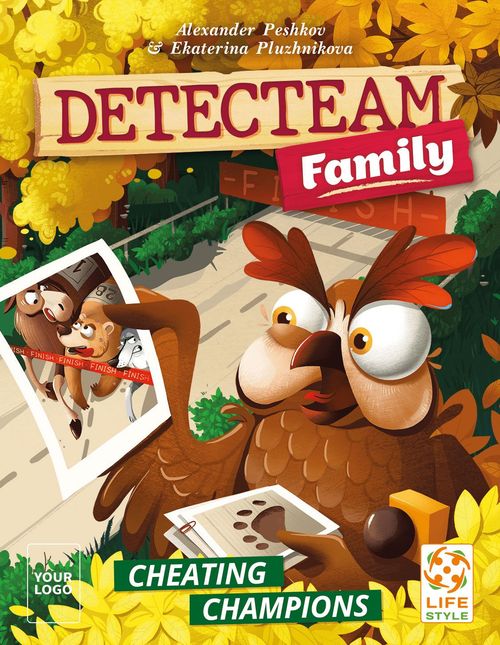
Detecteam Family: Cheating Champions
Detecteam Family: Cheating Champions Rulebook
Table of Contents
Table of Contents
Components
44 cards
Background
Card 01 (side B) and card 02 (side A) set the scene:
Four athletes finish at the same time. However, there's a reason to suspect three of them of breaking the rules.
There has been a real sports festival in the forest − a race! The forest dwellers have been preparing for the competition for a long time, the track has been all set. The fans have been greeting the runners at the finish. Four athletes have finished side by side! However, there is evidence that three athletes have somehow broken the rules... And, in fact, there is only one true winner.
So, who is it?
Aim of the Game
- Select the right cards to lay out, and
- find out what really happened.
About the Game
The players need to lay the useful cards in a 3x4 grid out on the table. The new cards must be connected to the starting cards (and later on, to other laid-out cards) like a jigsaw puzzle so that in the end there's a complete picture on the table.
The background is the same on both sides of the cards (except for cards 01 and 02), but the back side of the cards does not display any characters or their cues. By the back side of the cards, you can easily guess where each card should be laid out.
Starting cards 01B and 02B are located in the middle of the picture. Card numbers are located in the top right corner of each card. There are three cards for each location.
Pay attention to the wide frame along the edge of the picture. The frame will help you lay the cards out correctly. Connect the cards side by side to piece together the whole picture.
Useful and Useless Cards
Cards can be useful to solving the case, or can be useless. They all look the same, so you have to sort those cards out!
Useful cards let you learn the motives of the culprit(s), the alibis of the innocent, circumstances of the event, etc. For example, a witness statement: "I saw one of the athletes finish without their bib number!"
Remember that all the animals are either telling the truth or are honestly mistaken! Do not seek double meaning or deliberate lies in their words.
Useless cards contain information that has nothing to do with your investigation. For example, a testimony: "Bears like honey".
There are 3 cards in the deck for each slot in the final picture: one useful card and two useless cards. Try to lay out the useful cards and discard the useless ones.
Card 04 (side A) continues to card 05 (side A) and asks you to put the memo aside so everyone can see it. The memo will help you at the end of the game, but it is still worth reading now.
What You Get Points For
At the end of the game you will get points for:
- correctly laid-out useful cards;
- correct answers to the following questions:
- Did the HARE break the rules?
- Did the MOOSE break the rules?
- Did the WOLF break the rules?
- Did the BEAR break the rules?
- Which animals STARTED in the race, but did NOT FINISH?
- Which animal is the TRUE winner of the race?
Card 04 (side B) lists these questions. Remember the important facts you need to find out.
Game Setup
Put the deck in the middle of the table without shuffling it. Take the next 4 cards from the deck and, without turning them over, lay the cards out in a row next to the deck (you should only be able to see parts of the track, no characters). These are cards 06, 07, 08 and 09.
Playing the Game
You are playing as a team with a common goal: investigation of the event. The bravest player starts the game, then the game proceeds clockwise.
On your turn, take any 2 out of the 5 cards available (4 cards next to the deck + the top card of the deck). Look at the character side of the cards without showing them to your fellow players.
Note: If you are playing with children who are only learning to read, we advise them to keep their cards character side up on the table. Read the cards together and help the children, if necessary.
After that you may:
- lay out one card and discard the other one, A side up, OR
- discard both cards, A side up.
When laying out a card, you must connect it to the side of a previously laid-out card, animal side up. You may also place your card on top of another card. But you may not discard a laid-out card or swap the top and the bottom cards. Only the top card is valid.
Cards that were discarded cannot be examined.
At the end of your turn, add up to 4 cards from the deck to the row.
At the end of the game, you should have a complete picture consisting of 12 cards (side B up). If at the end of the game you have blank spaces in your picture, you will not gain points for missing cards.
Important: while piecing together the picture of the event, you may not share any information from the cards that were discarded. But you may (and we strongly advise you to) discuss the laid-out cards each turn, reflect and try to make sense of the whole event! Remember the important facts that you need to find out (see card 04, side B).
Put this card away and start playing. The end of the game is triggered when you run out of cards with the background facing up (side A).
End of the Game
The investigation is now over. Let's draw a conclusion and piece the story together!
Now you need to discuss all the information you've collected, even what you remember from the discarded cards. Get ready to answer the questions.*
* If you feel completely and utterly at a loss, you may play again, for a penalty. Put cards 06-35 in order and set up the game according to card 05A. But at the end subtract 5 points from your final score!
To proceed with the questions, turn card 36 over and read side B.
Answering the Questions
Take the next card (37) from the deck. Read the question in the center of the card and then read the 4 possible answers written on both sides of the card (both the front and the back sides). Place the card on the table with the chosen answer facing up.
Then take the next card (card 38), and choose an answer. Partly cover the previous card so your answer remains visible, and proceed to the next question, and so on.
Overall, you need to answer 6 questions.
Notes on This Transcription
- The rulebook PDF covers cards 01 to 36 only. The question cards (37 onward), which carry the answer options, are not included in this PDF, so the point values for useful cards and for each correct answer are not stated in this rulebook.
- Card-navigation instructions printed on each card (for example "Continue reading the rules on card 03") are kept where they tell players which card to read next.