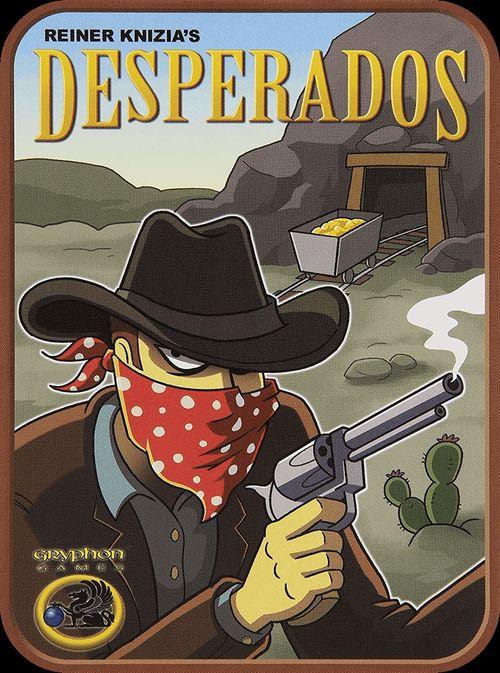
Desperados (1980)
Desperados (1980) Rulebook
Table of Contents
Table of Contents
Game Components
60 playing cards, comprised of:
- 3 each of gold, silver and copper mines (9)
- 9 each of chests, boxes and buckets of gold, silver and copper (27)
- 1 each of double chests, boxes and buckets of gold, silver and copper (3)
- 9 closed and shuttered mines (9)
- 12 Desperados with values ranking them from 1 to 12 (12)
Note: For convenience in these rules, the chests, boxes and buckets depicted on the cards will all be referred to as “chests” and the cards showing these as “chest cards”.
The Partnership Game
In the partnership game, the two players opposite one another play as partners throughout the game, and attempt to win collectively. They open gold, silver or copper mines by displaying those respective cards.
Then they start working the mines. They do this by playing chest cards of that metal onto the respective mine cards. But they are only certain of their points when they have closed their mines. Again and again, Desperados may lay siege to a mine, and its ownership may change. The first partnership to reach the victory condition point total at the end of a scoring round wins the game.
Preparing to Play
The player with the longest beard is the first dealer. He shuffles all 60 cards, and then deals 6 to each player. The remaining cards are placed as a face down deck in the center of the table. The player to the dealer’s left starts and the other players follow in a clockwise direction.
Playing the Game
In turn, each player must carry out one, and only one, of the following 3 actions:
- Draw a card - The player draws a card from the deck into his hand. This ends his turn.
- Pass a card - The player passes a card face down to his partner who places it into his hand. This ends his turn.
- Play a card - The player plays a card onto any of the displays in front of the players, even those of his opponents. Guess what? This ends his turn.
Note that after passing or playing a card, the player does not draw another card. Drawing a card from the deck is an action in itself and may not be combined with passing or playing. Generally, players will have different numbers of cards in their hands. Passing a card to one’s partner can be a strong signal. No other form of communication regarding the game play should be allowed between the partners.
Playing a Card
There are four possibilities in playing a card. Each partnership develops its own joint display. Cards may be played into their own display or into their opponents’ display. Every card played is displayed face up and visible to all players.
-
Opening a mine - Playing a card with a gold, silver or copper mine opens a mine of that type.
-
Working a mine - Playing a card with a chest of metal onto a mine of the corresponding type, i.e. a silver chest onto a silver mine, represents the finding of that precious metal in that mine. A mine card may have any number of chest cards laid on it. The cards should be so arranged that all players may easily see how many chests have been found in a mine. If the first card laid in a mine is a double chest card, then the value of all subsequent chests is doubled (see Point Values and Scoring Examples below).
-
Closing a mine - Playing a card with a closed mine pictured on it stops production in that mine. The card may be played onto any mine, regardless of which partnership owns the mine. That mine is closed immediately, and no further cards may be laid on it. Only closed mines score points (see Point Values below).
-
Fighting over a mine - Playing a Desperado card starts a fight over a mine. To do this, a player lays a Desperado card onto one of the opponent’s mines, including a just-opened mine which has no chests in it. Only one mine may be fought over at a time. Once this fight is over, another may begin. Once a player has played a Desperado card, the other players have just one chance each to affect the fight. Only on their next turn may they play another Desperado card, and thus join the fight. However, there is no obligation to do so. After one round, after each player has had his turn to fight or to choose another action, the partnership whose Desperado cards have the higher combined total value wins the fight and takes, or retains, possession of the mine. Draws are won by the defenders. If the attackers have played a higher total value of Desperado cards, then the attackers take over the mine with all its metal chests and move it into their display. After a fight, all Desperado cards played are put face down into a discard pile. If a mine is closed while it is being fought over, then the fight is over immediately, and the mine does not change ownership. However, if a mine is closed during a fight, the last “chest card” played into that mine is removed and discarded and does not score points for that mine. Closed mines should be folded together in a stack, then put by one of the partners to await scoring.
Ending the Game
Once the last card is drawn from the deck, each player has one further turn. The player who draws the last card has the last turn. Then the points for all the closed mines are counted and scored. The victory condition in the partnership game is 60 points. If neither partnership has achieved 60 points in total, all of the cards are shuffled and dealt by the player to the left of the previous dealer and a new round begins.
Point Values
Only closed mines count. Mines that are still open are valueless. Each card in a closed mine counts as follows:
- Gold chests are worth 3 points each
- Silver chests are worth 2 points each
- Copper chests are worth 1 point each
Cards with a double chest have a double value. However, if a double “chest card” is played as the first card onto an open mine, all subsequent “chest cards” are also counted double.
Scoring Examples
| Silver mine | Gold mine | Copper mine |
|---|---|---|
| One silver chest: 2 | A double gold chest: 6 | One copper chest: 1 |
| One silver chest: 2 | One gold chest: 6 | A double copper chest: 2 |
| A double silver chest: 4 | One gold chest: 6 | One copper chest: 1 |
| Total closed value = 8 | Total closed value = 18 | Total closed value = 4 |
Rules for 2 to 4 Individual Players
Desperados can also be played without forming partnerships, though the designer believes it is best played with 4 players in two partnerships. The game, for 2 to 4 individual players, is played in the same way as the partnership game, but each player has his own display and fights for his own points. The action of “passing a card” is not applicable, and a fight over a mine is played individually: the highest valued Desperado card wins. If a mine is closed during a fight, the fight ends immediately.
It is recommended that with two players, 4 each of the gold, silver and copper chest cards should be removed before the game begins; and with three players, 2 of each of these cards should be removed. Each of these individual games should be played to 40 points.
Notes
Note: Desperados was previously released under the name Digging.