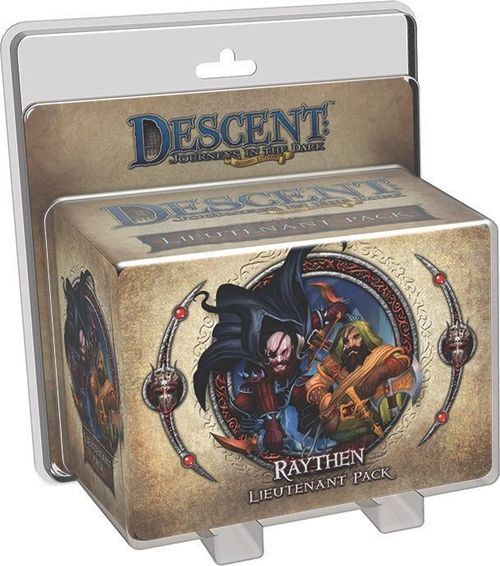
Descent: Journeys in the Dark (Second Edition) – Raythen Lieutenant Pack
Descent: Journeys in the Dark (Second Edition) – Raythen Lieutenant Pack Rulebook
Table of Contents
Table of Contents
Lieutenant Pack Rules
Introduction
Lieutenant packs expand Descent: Journeys in the Dark Second Edition by providing unique plastic figures that can be used to replace lieutenant tokens in quests. In addition, these packs introduce a new layer of strategy and progression for overlord players with the introduction of Plot and Agent cards.
Plot Cards
After hero players choose their classes at the start of a campaign, the overlord may choose one Plot deck. He will use his chosen deck for the duration of the campaign. After the overlord chooses his Plot deck, he takes the basic card (the Plot card with no purchase cost) and places it faceup in his play area. Then, he takes all remaining Plot cards that have the same deck name and places them facedown in his play area. He may look at his facedown Plot cards at any time.
Plot cards are upgrades the overlord player may purchase throughout the course of a campaign. They provide the overlord with special abilities that are available to him when the card is faceup in his play area. Plot cards are different from Overlord cards; the overlord does not add them to his Overlord deck, and he purchases them in a different way.
Important: The overlord player can only use Plot and Agent cards when playing a campaign.
Gaining Threat Tokens
Each time a hero is defeated during an encounter, instead of drawing one Overlord card, the overlord may choose to gain one threat token. The overlord can only gain threat tokens in this way once per hero per quest. If he chooses to gain a threat token, the overlord takes one hero token belonging to the hero and places it near his Plot deck as a reminder that he has gained a threat token for defeating that hero. In addition, there are a number of other ways in which the overlord may gain threat tokens:
- At the end of each quest, the overlord receives one threat token. If the overlord wins the quest, he receives one additional threat token.
- During the Spend Experience Points step of any Campaign phase, the overlord may spend any number of his experience points to gain three threat tokens for each experience point he spends.
- Each time the overlord plays a Rumor card featuring a quest, he gains one threat token. Rumor cards and applicable rules are included in some Descent: Journeys in the Dark Second Edition expansions.
Each time the overlord gains one threat token, he takes one token from the threat and fortune supply and places it in his play area with the threat side faceup. Each threat token the overlord gains during a campaign remains in his play area until he spends it. Between quests, the overlord player records the amount of unspent threat tokens in the Campaign log. He may spend this threat at a future point during the campaign.
Purchasing and Triggering Plot Cards
Each Plot card has a purchase cost that indicates the number of threat tokens the overlord must spend to purchase the card. During the Spend Experience Points step of each Campaign phase, the overlord player may purchase any of his facedown Plot cards by spending threat tokens equal to the Plot card's purchase cost (see "Plot Card Anatomy"). He places purchased Plot cards faceup in his play area and can use them in all future quests during the campaign.
The overlord can trigger abilities on a faceup Plot card as specified on the card. Each time he triggers a Plot card ability that requires him to "exhaust this card" or "use this card", he must spend a number of threat tokens equal to the Plot card's trigger cost (see "Plot Card Anatomy").
Plot Card Anatomy
- Name: This area displays the name of the Plot card.
- Purchase Cost: This area displays the number of threat tokens it costs to purchase the card. The overlord begins play with his basic Plot card. These basic cards have no purchase cost.
- Ability: This area describes all rules for the Plot card, including when the card can be triggered.
- Deck Name: This area displays the Plot deck to which the card belongs.
- Trigger Cost: This area displays the number of threat tokens it costs to trigger this card's effect.
Threat and Fortune
Threat and fortune are represented by different sides of the same token. The red side of the token represents threat, and the white side represents fortune. During setup, place these tokens in a supply within easy reach of all players.
The overlord player may spend threat tokens he has gained (see "Gaining Threat Tokens") to purchase or trigger abilities described on Plot cards. A hero may spend fortune tokens to receive certain benefits (see "Spending Fortune Tokens").
Spending Threat Tokens
When the overlord spends threat tokens, they are either returned to the supply or placed on Hero sheets as follows:
- Purchasing Plot cards: During the Spend Experience Points step of the Campaign phase, each threat token spent to purchase Plot cards is returned to the supply.
- Triggering Plot cards: Each time the overlord spends a threat token to trigger a Plot card, he must flip the token to its fortune side and place it on the Hero sheet which currently possesses the lowest number of fortune tokens.
If there is a tie, the heroes choose which hero among the tied heroes gains the token. If the overlord spends more than one threat token, he follows this process once for each token spent.
Spending Fortune Tokens
Heroes may spend fortune tokens to trigger any of the following abilities:
- 1 fortune token: During his turn, a hero may recover 1 [black drop icon].
- 1 fortune token: After dice are rolled, a hero may reroll 1 of his dice.
- 2 fortune tokens: After performing his two normal actions, a hero may immediately perform one additional action. Limit once per round per hero.
- 2 fortune tokens: During the Shopping step of the Campaign phase, heroes may collectively spend their fortune tokens to draw 1 additional Shop Item card.
When a hero spends a fortune token, he returns it to the threat and fortune supply. Heroes cannot trade their fortune tokens to other heroes. After the Shopping step of each Campaign phase, heroes return all fortune tokens on their Hero sheets to the threat and fortune supply.
Transcription note: The leaflet's text layer contains a glyph that does not extract as text. Rendered from the printed page, it is a single solid black drop icon with no name printed beside it, so it is shown above as "[black drop icon]". Check the printed leaflet if the exact icon name is needed.
Agents
Some Plot cards allow the overlord to use a lieutenant figure as an agent in an open monster group. The Agent card corresponding to the current act lists the agent's characteristics, abilities, and attack dice. An agent is treated as a master monster within its open monster group with the following exceptions:
- Regardless of quest rules, an agent cannot be placed as a reinforcement.
- When an agent is defeated, the overlord must return the Plot card that summoned the agent back to his Plot deck. The card may be purchased again.
- As described on the Plot card, the overlord cannot use an agent in any quest that features the lieutenant version of that agent. Additionally, the overlord cannot use some agents in specific campaigns. For example, the overlord cannot use Baron Zachareth as an agent while playing "The Shadow Rune" campaign because it features Baron Zachareth as an important lieutenant in that campaign.
Plot cards that allow the overlord to summon an agent often require him to replace master and minion monsters of an open group after setup of an encounter. If the overlord cannot meet the replacement requirements, he replaces the entire open group.
When an agent is placed in a monster group, that agent and the monsters in that group are treated as if they are part of the same monster group. While the agent is on the map, the overlord cannot use the monster figures it replaced as reinforcements, regardless of quest rules.
The overlord cannot summon an agent during an Interlude or a Finale. Unlike lieutenants, an agent cannot wield a relic.
Agent Card Anatomy
Agent card front and back.
- Name: This area displays the name of the agent.
- Abilities: This area lists all the abilities for the agent.
- Characteristics: This area lists the characteristics (Speed, Health, and Defense) of the agent. The agent's characteristics differ depending on the number of heroes playing (represented by the gray silhouettes).
- Attack Type Icon: This icon shows the type of attack (Melee or Ranged) the agent has.
- Dice: This area lists the dice used by the agent when performing an attack.
- Ability Rules: This area explains the full details of the agent's abilities.
- Deck Name: This area displays the Plot deck to which the Agent card belongs.
Monster Sizes and Traits
Many Plot cards have effects that interact with monsters that have specific monster traits or sizes. Monster size is defined by the number of spaces the monster's base occupies:
- Small monsters occupy one space (e.g., goblin archers and zombies).
- Medium monsters occupy two spaces (e.g., barghests).
- Huge monsters occupy four spaces (e.g., ettins and merriods).
- Massive monsters occupy six spaces (e.g., shadow dragons).
Note: medium, huge, and massive monsters are still large monsters for the purposes of movement and quest rules.
Raythen Lieutenant Pack Cards
The pack's Plot cards come from the Skulduggery deck, numbered 1/12 to 10/12 in the card footer. The two Agent cards are numbered 11/12 (Act I) and 12/12 (Act II). Raythen is used as an agent by purchasing the Summon - Raythen Plot card.
Transcription note (community source): The card text below is read from community card scans, not from an official card scan or publisher PDF. Costs use the leaflet's terms: the purchase cost is the red number at the top right of the card face, and the trigger cost is the red number at the bottom right (see Plot Card Anatomy above). The Petty Theft card has no purchase cost badge, which matches the basic card described in the leaflet. Icons are rendered as words: the wedge icon as surge, the shield icon as shield, the heart icon as damage, and the curved arrow icon as move. These names are the transcriber's renderings of the printed icons, not names printed on the cards.
Skulduggery Plot Cards
Petty Theft
Skulduggery 1/12 · Purchase cost: none (basic card) · Trigger cost: 1
Exhaust this card at the start of your turn. While this card is exhausted, each of your monsters gains the following abilities:
This monster may spend 2 movement points to reveal 1 adjacent search token. If it is not a unique search token, place it on this monster's base. While a search token is on this monster's base, the token cannot be searched by any hero.
If this monster is defeated or leaves the map for any reason, place any search tokens on its base in the space last occupied by the monster.
Concealment
Skulduggery 2/12 · Purchase cost: 2 · Trigger cost: 0
Exhaust this card when you activate a monster with at least 1 search token on its base. Look at the top 2 cards of the Search deck. Place 1 card on the top of the Search deck and 1 card on the bottom.
This card does not refresh as normal. Refresh this card at the end of each quest, or spend 1 threat token at the start of your turn to refresh it.
Slippery
Skulduggery 3/12 · Purchase cost: 2 · Trigger cost: 1
Exhaust this card when you activate a monster. That monster may move into spaces occupied by enemy figures at a cost of 1 additional movement point per space. The monster must end its movement in an empty space following normal movement rules.
If that monster has at least 1 search token on its base, refresh this card at the end of that monster's activation.
Distraction
Skulduggery 4/12 · Purchase cost: 2 · Trigger cost: 2
Exhaust this card when a hero declares an attack targeting a monster with at least 1 search token on its base. Remove 1 search token from that monster's base and place it in a space adjacent to the hero performing the attack. That hero immediately searches that search token instead of performing the attack. Then he is Stunned, and you may move the monster up to 2 spaces.
Foiled Again
Skulduggery 5/12 · Purchase cost: 2 · Trigger cost: 1
Exhaust this card after a hero draws (and chooses to keep) a Search card. Set that Search card aside and that hero draws another Search card. Then, return the Search card that was set aside to the top of the Search deck.
Covetous
Skulduggery 6/12 · Purchase cost: 2 · Trigger cost: 1
Exhaust this card when a hero draws a Search card. While this card is exhausted, add 1 surge to the results of each attack that targets a hero with at least 1 faceup Search card in his play area.
This card does not refresh as normal. Refresh this card at the end of your turn.
Guarded Treasure
Skulduggery 7/12 · Purchase cost: 3 · Trigger cost: 0
Each monster with at least 1 search token on its base adds 1 shield to its defense results.
At the end of each encounter, if there is at least 1 monster with a search token on its base, gain 1 threat token.
Cursed Treasure
Skulduggery 8/12 · Purchase cost: 3 · Trigger cost: 0
Exhaust this card when a hero within 3 spaces of a monster searches a search token. You may place 1 threat token on this card.
This card cannot hold more than 4 threat tokens at any time. At the end of the quest, gain all threat tokens on this card.
Bait and Switch
Skulduggery 9/12 · Purchase cost: 3 · Trigger cost: 2
Exhaust this card when a hero enters an empty space adjacent to a search token. Choose 1 small monster within 5 spaces of that search token. The chosen monster and that search token trade spaces. Then, that monster may immediately perform an attack targeting that hero. After this attack is resolved, the active player resumes their turn.
Summon - Raythen
Skulduggery 10/12 · Purchase cost: 3 · Trigger cost: 2
Exhaust this card after setup of an encounter to choose an open monster group. Replace 1 master monster in that group with the Raythen agent.
If the Raythen agent is defeated, return this card to your Plot deck.
You cannot use this card in any quest that uses the Raythen lieutenant, ally, or hero.
Raythen Agent Cards
The Raythen agent has two Agent cards, one for each act. Each card's front shows the agent's Speed, Health and Defense for each hero count (2, 3 and 4 silhouettes), its attack dice, and its attack type. Each card's back shows its abilities and their full rules. The Act II card adds the Pilfer ability.
Transcription note (community source): The stats were read from the front of each Agent card, and the abilities from the back, in the community card scans. The attack type is shown by a bow icon, so both acts are ranged. Defense is shown as a coloured die face on the card, and is given here by colour as printed. The attack bar on the front shows two surge icons followed by a damage bonus on each act (+2 on Act I, +3 on Act II). The Agent card backs do not repeat that bonus as rules text, so it is given here as the card's printed bar, with the surge icons rendered as words.
Raythen Agent, Act I
Skulduggery 11/12 · Agent card, Act I (Agent | Skulduggery | 11/12)
- Abilities: Opportunist; Stun (surge icon).
- Attack bar: two surge icons: +2 damage.
- Dice: blue and yellow.
- Attack type: ranged.
| Heroes | Speed | Health | Defense |
|---|---|---|---|
| 2 | 5 | 7 | brown defense die face |
| 3 | 5 | 9 | white defense die face |
| 4 | 5 | 11 | white defense die face |
Opportunist: Each of Raythen's attacks gains 1 surge for each adjacent Immobilized hero and 2 surge for each adjacent Stunned hero.
Stun (surge icon): If this attack deals at least 1 damage (after the defense roll), the target is Stunned.
Raythen Agent, Act II
Skulduggery 12/12 · Agent card, Act II (Agent | Skulduggery | 12/12)
- Abilities: Opportunist; Pilfer (move icon); Stun (surge icon).
- Attack bar: two surge icons: +3 damage.
- Dice: blue, yellow and yellow.
- Attack type: ranged.
| Heroes | Speed | Health | Defense |
|---|---|---|---|
| 2 | 5 | 9 | white defense die face |
| 3 | 5 | 12 | white and brown defense die faces |
| 4 | 5 | 14 | white and brown defense die faces |
Opportunist: Each of Raythen's attacks gains 1 surge for each adjacent Immobilized hero and 2 surge for each adjacent Stunned hero.
Pilfer (move icon): If Raythen is adjacent to a search token, the overlord may look at the top card of the Search deck. Then, he may place it at the top or the bottom of the deck.
Stun (surge icon): If this attack deals at least 1 damage (after the defense roll), the target is Stunned.