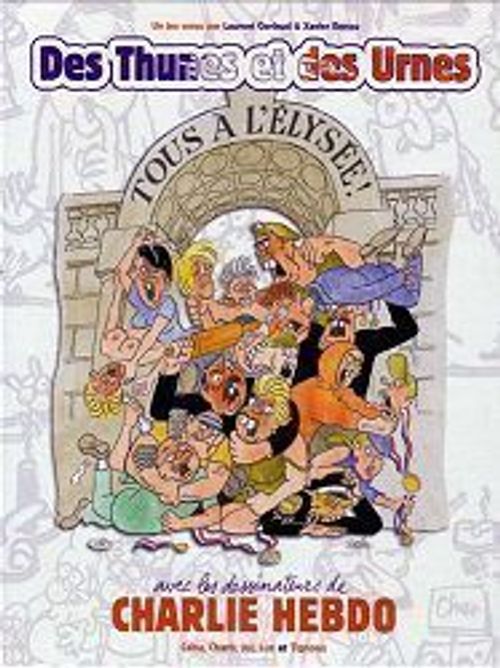
Des thunes et des urnes
Des thunes et des urnes Rulebook
Table of Contents
Table of Contents
I. Components
Contents of the box:
- 146 Political cards
- 62 Vote cards (14 Left, 14 Right, 34 Undecided, of which 5 are Magouille), 2 "A voté !" cards
- 12 Candidate cards
- 1 YA BASTA card
- 1 Majority card
- 100 banknotes (Thunes)
- 1 hourglass
The cards
Political cards serve a little of everything and provide the words used in Debates. Each Political card carries a symbol showing when it must be played, the conditions for playing it, and its effect.
- Action: played one at a time, on your turn of the Campaign (see page 3).
- Reaction: may be played without limit and at any time.
- Current affairs (Actualité): must be played immediately; its effects apply to all players.
- Justice: used to attack a player caught making a shady deal (magouille) (see page 4), or to protect yourself.
Vote cards serve to win the Presidential Election and therefore the game. Each Vote card shows its value, between 0% and 3%, and its colour, which shows its side: Left, Right or Undecided. The symbols on Vote cards are used for the optional rules. Certain Political and Vote cards carry a Magouille symbol (see page 4).
The "A voté !" cards end the Campaign phase.
The 12 Candidate cards identify each player's side, Left (red) or Right (blue).
Extremists are played like the other players, unless you play the optional rules.
The YA BASTA card may determine the end of the game.
The Majority card shows who is the first player of the sequence.
Each Political card has a word printed at the bottom, used in Debates (see page 5).
II. The Rules
Goal of the game
To become President of Francie, a player must have both:
- At least 20% (with 3 or 4 players), 18% (with 5 or 6 players) or 15% (with 7 or 8 players) of the Votes. For this calculation, count all of the player's Votes.
- A greater percentage of Votes of their own side (their colour) than any other player. For this calculation, count only the player's Votes that are of their own side.
Setup
- Shuffle the Political deck and place it face down in the middle of the table. Insert the YA BASTA card into the last quarter of the deck.
- Shuffle the Vote deck. Each player draws 2 Votes, which they place face up in front of them. The rest of the deck is placed face down in the middle of the table.
- Set aside space near each deck for discarded, played or lost cards.
- Each player chooses a Candidate card, but there must be as many Left candidates as Right candidates, give or take one.
- The Majority card is placed in front of the first player of the sequence. According to Francien tradition, which does everything backwards, this is the youngest player.
Sequence of play
The youngest player begins, then their left-hand neighbour. The first player changes at the start of each sequence.
Each sequence is played in four phases:
- A. Political Cards and Thunes
- B. Campaign
- C. Debate
- D. Presidential Election
At the end of the sequence, if nobody has won, a new sequence begins. In a game there are often several sequences before someone wins.
A. Political Cards and Thunes
- Each player receives 5 Political cards. From the second sequence on, a player receives as many as needed to have 5 in hand.
- From the second sequence on, a player may discard (throw away) as many cards as they like before receiving new ones.
Example: Olivier has 2 Political cards left in hand. He receives 3. Lionel, however, still has 6 (he made some good deals this sequence). He discards 2, is down to 4, and can therefore draw 1 new card. Clever Lionel!...
- Current affairs cards are played immediately, then discarded.
- Each player receives 5 Thunes.
- If a player draws YA BASTA, they place it face up in plain view. The game will end at the end of this sequence (see page 6).
In all cases, the Campaign begins.
B. Campaign
Goal: win Votes (preferably Votes of your own side).
Players take turns. Each player chooses one of the following two actions, or passes their turn.
- Com' (communication): pay 3 Thunes to draw 1 Vote, 6 to draw 2, and so on. You pay everything, then you draw.
- Coup: play one Political card, and only one. The card takes effect and is then discarded.
If a player passes their turn, they receive 1 Thune from the bank (inaction pays in politics...), unless another player forced them to pass their turn. Then 1 Vote from the deck is discarded.
When all players have taken an action or passed, the Campaign continues: the first player chooses an action (or passes), and so on.
The Campaign ends:
- if all players pass their turn in a row;
- if an "A voté !" card is drawn. The player who draws it discards it and does not replace it with another Vote. The Debate then follows.
Votes
- Every Vote won is placed face up in front of the player, in full view of everyone. A player may choose to discard a Vote at the moment they draw it, but not afterwards.
- When a player loses, or must give up, one or more Votes, they choose which ones they discard (or give). The only way to take the Vote of your choice from a player is to beat them in a Debate...
- When the Vote deck is exhausted, it is rebuilt by shuffling the discard pile.
Magouille and Justice
At any moment in the game, you may commit a magouille (shady deal):
- if you play a Political card bearing the symbol shown;
- if you place a Vote bearing this same symbol;
- if you receive a Political card, a Vote and/or Thunes from another player.
When you are caught red-handed in a magouille, one Justice card (and only one) may be played against you. But if the turn has passed to the next player, it is too late to play a Justice: it is forgiven! So be quick and discreet...
And remember: in Francie, everything is negotiable! Sell your Political cards; pay the other players so that they defend you or give up on harming you; exchange your Votes...
C. Debate (langue de bois)
Goal: take Votes of your choice from a player.
The principle:
The first player of the sequence may launch a major social debate. If they do not wish to, the decision passes to the next player, and so on.
There may be only one Debate per sequence.
The player who launches the Debate names an opponent, who may not refuse. The two debaters secretly choose a word printed at the bottom of one of their Political cards, and set that card aside (they will take it back into their hand at the end of the Debate).
If a debater has no Political cards left, they draw one, which they will discard without using it after the Debate.
The Debate lasts two hourglasses (a duration you may adapt!).
Starting with the player who launched the Debate, each of the two players in turn tries to make the other say their word. The first player asks a question, to which the opponent is forced to answer, before asking a question in turn, and so on.
Each player may say the word they are trying to get the other to say.
Direct derivatives of the word (for example "démissionner" for "démission", resign for resignation) and homophones (for example "voie" for "voix", way for voice) are accepted.
The other players:
- They are the referees of the Debate. As such, they penalise anti-play (for example, if a player says "euh" for many minutes, stays silent, or dodges their opponent's questions without any subtlety). If necessary, they interrupt the hourglass.
- They are also attentive spectators, who may applaud the funniest or most skilful debater. At the end of the Debate, the most applauded player receives 1 Vote from the deck, because in Francie, when you clown around on television, you can win voters...
Reward:
- If a player gets their opponent to say their word, the Debate is interrupted and they take 2 Votes of their choice from the opponent.
- If neither word has been said, the debaters announce the first letter of their word. Starting with the player who launched the Debate, each tries to guess the other's word. Only one guess is allowed per player. The first player to guess the word takes 1 Vote from their opponent, and the sequence moves on to the Presidential Election.
If neither word has been guessed, the other players make a guess in turn, to take 1 Vote from the first player whose word has been guessed.
The Presidential Election then follows.
Example of a Debate
François, the Candidate of the UFD, has chosen the word "Ouvrier" (worker). Philippe, the Candidate of the UVP, the word "Croire" (to believe).
The hourglass is turned: on air!
Fr.: "Dear sir, what would you do about unemployment if the Franciens elected you?" (he tries to steer towards a nearby subject)
Ph.: "With the confidence of the Franciens, we would take a series of strong measures to put an end to this scourge" (he avoids repeating what has been said, and stays vague). "We would, for example, encourage the return of old trades, such as knife-grinder, musketeer, water-carrier..." Philippe then goes on: "But you, when you were in power, you let poverty overwhelm the Franciens while your friends shone in financial scandals. Do you really think you are still credible?" (he tries to trick his opponent by focusing on the scandal, hoping he will repeat "credible").
And so on.
It is perfectly possible to opt for a debate without playing the comedy, asking questions such as: "What did you do during the holidays?" Especially when playing with younger players.
On the website www.contrevents.com, you will find tips for winning Debates.
D. Presidential Election
It is the end of the sequence. Check whether a player meets both victory conditions:
- At least 20% (with 3 or 4 players), 18% (with 5 or 6 players) or 15% (with 7 or 8 players) of the Votes. For this calculation, count all of the player's Votes.
- A greater percentage of Votes of their own side (their colour) than any other player. For this calculation, count only the player's Votes that are of their own side.
Example: At the end of a sequence, the percentages are split as follows:
- Olivier, of the LRC: 16% (of which Left: 7%)
- Lionel, of the PFS: 21% (of which Left: 6%)
- Jean-Marie, of the NF: 20% (of which Right: 8%)
- Jacques, of the MUP: 18% (of which Right: 10%)
Only Lionel, Jean-Marie and Jacques have 18% or more.
- Lionel has fewer Left (red) Votes than Olivier (and than the others), so he cannot become President.
- Even though Jean-Marie has a better % than Jacques, it is Jacques who has the most Right (blue) Votes.
- Jacques is elected and becomes President of Francie! Good thing it is only a game!
If a player meets both conditions, they are elected President and the game ends. In case of a tie, the greater % of Votes breaks it.
Otherwise, a new sequence begins.
If the YA BASTA has been drawn, the game ends in any case. The winner is then the player with the greatest % of their own colour. In case of a tie, the greater total % breaks it.
Example: At the end of the sequence in which YA BASTA came out, the percentages are split as follows:
-
Arlette, of the OL: 13% (of which Left: 10%)
-
Jean-Pierre, of the MDC: 23% (of which Left: 8%)
-
Alain, of the LD: 20% (of which Right: 7%)
-
Bruno, of the MRN: 15% (of which Right: 10%)
-
On the Right, it is Bruno who has the greatest % of his colour.
-
On the Left, it is Arlette.
-
They are tied on the % of their colour, but Bruno has a higher total %.
-
So it is indeed he who is carried to power by the frenzied crowd! Long live civil war!
III. Optional Rules
These are small, fun rules to introduce once you have mastered the basic rules.
Rule A – Vote of the Majority
Use this rule only from four players onward.
This rule adds another phase, which takes place after the Debate and before the Presidential Election: the Majority.
The vote proceeds in four steps:
1st step – Poll. Each player announces their total %. For this vote, they do not count the Votes of the colour opposite to their own. Then the % of each side is announced, by adding together the % of all the players of each side.
2nd step – Call for a vote or for abstention. All players, at the same time, place their Candidate card in front of them: face up (portrait side) to call for a vote and increase their %, or face down (text side) to call for abstention and decrease their %.
Why decrease your %? You will see.
3rd step – Vote. Each player in turn takes the discarded Votes and those from the deck, shuffles them, and turns them over one at a time until they draw a Vote of a colour. Undecided Votes and Votes of their own colour increase (call to vote) or decrease (call to abstain) their score; Votes of the opposite colour do not count. They calculate their new %, reshuffle the Votes they have just drawn with the rest of the deck, and pass the whole to their neighbour, who shuffles and plays in turn.
4th step – Count. When every player has calculated their score, the % of the Left players and the % of the Right players are added together. The larger total determines the Majority (turn the card over to the corresponding side). In case of a tie, the Majority does not change.
From this result, two players emerge as winners: the one with the highest score of the winning side, and the one with the lowest score of the losing side.
- The first takes 1 Vote from the player of their choice, except the other winner.
- The second chooses the colour of the Vote they will claim from another player, except the other winner.
In case of a tie between two scores, the rule concerned does not apply.
Example: The President has dissolved the Assembly. Poll!
Left, total 20%, of which: PFS, 12% (without their 4% of Right), and LRC, 8%.
Right, total 22%, of which: MUP, 16%, and NF, 6%.
The PFS plays for unity and calls for a vote. The LRC chooses abstention despite the PFS's insistence. On the Right, the MUP, confident, calls for a vote, while the NF, furious at not being able to win, call for abstention (the PFS discreetly encouraged them to do so).
- The PFS player draws Votes: Undecided (1%), Undecided (2%), Right (2%), and stops there. Total: 3%, the last Vote not counting. [sic: the printed text reads "tire le des Suffrages" ("draws the … Votes"); the number of Votes drawn is missing from the source, and the counts given imply three.] They add this score to their %, total: 12 + 3, 15%.
- The LRC player does the same: Left (1%), already finished... Total: 8 - 1, 7%. Instructions badly followed at the LRC...
- The MUP draws only 2%. Total: 16 + 2, 18%.
- The NF manage to draw 7%! Total: 6 - 7 = -1%.
The count is merciless: Left 15 + 7, 22%; Right: 18 - 1, 17%. The Majority passes to the Left.
The two winners are Lionel, of the PFS, who has the highest % of the Left, and who decides to take 1 Vote from Jacques, of the MUP; and Jean-Marie, of the NF, who demands 1 Right Vote from the same Jacques. Jacques, dejected, goes to drink a Corona® while swearing, though a little late, that he will never be caught out again.
Rule B – Proportional Vote
A variant of the previous rule.
After the count, the player of the Majority side who made the highest % must (in addition to what they gain) allow another player of their choice to draw 1 Vote from the deck. With 6 players or more, they must allow 2 draws, or choose two players who each draw 1 Vote.
It is an excellent way to buy an alliance...
Rule C – Lobbying and Strike
At each sequence, during phase A (Political Cards and Thunes), each player draws 1 Thune per symbol on their Votes.
During phase B (Campaign), a player who has a Vote bearing this symbol may decide to make another player pass their turn. This trump may be used only once per Vote and per Campaign.
Rule D – Extremist parties
If you want to play a Left extremist party, it is necessary to adopt Rule C.
There may not be two extremist parties of the same side in play.
Avoid extremists with fewer than five players.
Extremists follow special rules:
- A Left extremist party draws 1 Vote each time a Demonstration (Manif) card is played, or a Strike (Grève) is triggered (even if countered), unless it triggers the Strike or the Demonstration itself.
- A Right extremist party draws 1 Vote each time a Justice card is played (even if countered), unless the card is played against it.
- An extremist may not place Votes opposed to its side. If it draws some, it must discard them immediately (with a grimace of disgust).
- An extremist may not play Promises opposed to its side.
Rule F – Telephone courtesy
(The booklet has no Rule E.)
This variant is strongly recommended.
Any player who answers their mobile phone during play loses 1 Vote per hourglass started during their conversation.
Special cases
- The "A voté !" cards of the Right and of the Left count as Votes of that side at 3%.
- If the number of players is odd, the side with fewer Candidates adds to its final score a bonus equal to the highest score (after the vote) made by a Candidate of that side.
- In case of a call for abstention, a Candidate may bring its score below zero.
Sequence of Play
The booklet's reference sheet (printed page 8), reproduced in full. Its labels for when each Political card may be played sit beside sections A to D; they are listed here in that order.
A. Cards and Thunes
- Discard, then deal Political cards so as to have at least 5 in hand.
- Play the Current affairs cards.
- Deal 5 Thunes to each player.
Label beside A: must be played in the Campaign (COUP).
B. Campaign
- Each player in turn takes one action: COM' (3 Thunes for one Vote); COUP (play a Political card).
- A player may pass their turn (they receive 1 Thune, and 1 Vote from the deck is discarded).
- The Campaign ends when all players pass, or when an "A voté !" card is drawn.
Label beside B: must be played immediately.
C. Debate
- Two debaters, two hourglasses, questions and answers to make the other say their word.
- The winner takes 2 Votes. Otherwise, the player who guesses the word (from its first letter) takes 1 Vote.
- Players may applaud; the most applauded debater draws 1 Vote from the deck.
Label beside C: may be played at any moment (other than as a COUP).
D. Presidential Election
If a player has 20 / 18 / 15% of the Votes and the highest % of Votes of their colour, they win the game. Otherwise, a new sequence begins.
In case of YA BASTA: only the highest % of its side counts.
Label beside D: may be played in case of a magouille (other than as a COUP).
Notes for Moving Between Rules Versions
The booklet's final page, which lists the changes from the full rules to this simplified version.
Subsidies
This rule no longer exists. Exchanges and sales of cards are made without bonus.
Majority
This turn no longer exists, except with the optional rule on page 7 (as printed).
Cronyism (Campaign)
This choice no longer exists. It is possible to exchange your Votes for other Votes, Thunes, Political cards... All exchanges are possible, but beware of Justice!
Political cards
Any allusion in the text of the cards to subsidies or Cronyism must be ignored.
- African Network (Réseau africain) becomes: "If you sell a Political card, you take all of the buyer's Thunes. If you buy, you do not pay."
- Small Shareholder Scam (Arnaque au p'tit porteur) becomes: "If another player receives Thunes, you take them from that player."
- Cohabitation qui tue and Thirty-Year Friends (Amis de trente ans) may be used in case of a magouille, like a Justice.
Cards alluding to the Majority or the Opposition (such as Demonstration (Manif) or Polling Error (Erreur des les sondages [sic], as printed), and so on) must be played in the Campaign and without any particular condition.