Des chiffres et des lettres
Des chiffres et des lettres Rulebook
Table of Contents
Table of Contents
Principle
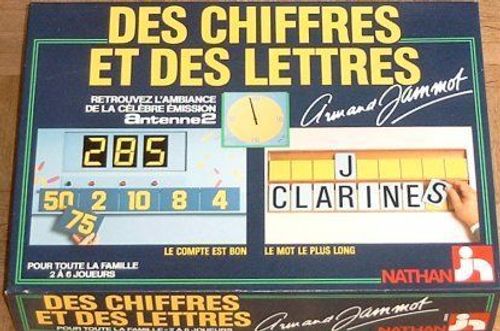
The game pits two to six players against each other in two kinds of trials:
- A spelling and vocabulary trial called "LE MOT LE PLUS LONG" (The Longest Word).
- An arithmetic and calculation trial called "LE COMPTE EST BON" (The Count Is Right).
Objective of the Game
Have the most points at the end of 12 rounds.
Each game is made up of 12 rounds:
- 4 number rounds (Le compte est bon)
- 8 letter rounds (Le mot le plus long)
Number of players: 2 to 6 players.
Le Compte Est Bon (Number Rounds)
In the first round, the youngest player draws six numbers from the NUMBERS bag and places them on the holder provided.
Each player, using their erasable slate, has a set time of 45 seconds (the white hourglass) to carry out a number of elementary arithmetic operations (addition, division, subtraction or multiplication) in order to reach exactly a three-digit target number, or to get as close to it as possible.
One player presses the buzzer to randomly generate the target number, a number between 1 and 999.
To perform their calculations, the players have the six numbers drawn from the bag at their disposal.
Caution: in the players' calculations, each of the six numbers may be used only once, but players are not required to use all of them. The results of intermediate operations may be reused later in the calculation, but only once.
This round provides the players with:
- 20 numbered cardboard tiles, numbered 1 to 10
- 4 cardboard tiles bearing the numbers 25, 50, 75 and 100
Scoring the Number Round
- Exact target reached ("Le compte est bon"): 10 points
- Closest result without reaching the target ("Le compte le plus approchant"): 7 points
The best solution is the one closest to the proposed number, whatever the size of the gap from that number.
Example: for a proposed number of 447, if the solutions of two players are:
- Player A: 444
- Player B: 450
Both players are 3 points away from the proposed number, so each of them scores 7 points.
Le Mot Le Plus Long (Letter Rounds)
In the second round, the player to the right of the youngest player draws one letter from either the VOWELS or the CONSONANTS bag and places it on the holder. The player to their right draws a second letter from either bag, and so on: each player alternately draws one letter, up to a limit of 10 letters.
All players play on the same draw, and they must form the longest word possible.
For each draw, players must request at least 2 vowels.
With the letters placed on the holder, players form a word of 2 to 10 letters and have 30 seconds for this (the blue hourglass).
Official Dictionary Ruling
The reference dictionaries for "LE MOT LE PLUS LONG" are:
- Le PETIT LAROUSSE of the current year (excluding the pink pages and proper nouns).
- Le PETIT ROBERT of the current year, together with its two annexes on words (adjectives and common nouns) relating to characters and to place names.
However, because of imprecisions or discrepancies between the two dictionaries, the following options have been adopted:
Accepted words
-
All simple words of 2 to 10 letters printed in bold (whether or not they are followed by an article), with the exception of:
- prefixes, suffixes and symbols;
- personal verb forms;
- interjections, onomatopoeias and acronyms, unless they are also defined as nouns.
-
All compound words (including set phrases and locutions) printed in bold, except those containing a part in parentheses, which are accepted neither with nor without the parenthesized part. Pronominal verbs are the exception: they are accepted without the personal pronoun.
-
Words that appear only within an entry, called "hidden words" in the players' jargon, are accepted.
- Words sharing the same root as a "hidden word" are accepted if that root is immediately visible from the entry.
- This covers:
- variants of gender and number;
- derivatives;
- spelling variants;
- slang words;
- words appearing in the entries of prefixes;
- abbreviations;
- family names or names of the genus of living things.
- By contrast, verb phrases that are merely examples of use of the headword are refused, for example: Plan d'eau (plan), sac à main (sac), etc.
Accepted forms
Nouns and adjectives
-
The plural:
- If the word is invariable in neither of the two reference works, the plural is accepted even if it is unused. These are most often words used only in set phrases, for example: Abymes balans balants berlues cocagnes cuissages débotters dulies emports escients faires gésines gnognot(t)es gringues guises jouvences latries martels mirbanes paraîtres pops punctums revients sortirs stratums tantinets toutimes toutims vouloirs.
- If the word is invariable, or marked as singular, in one of the two works, and the other work does not specify invariability, the plural is accepted.
- Likewise, the plural is accepted when the word is labelled as a noun by only one of the two works: anas chuts hiers meuhs ploufs pschitts.
- The plural of acronyms written in capital letters is refused unless indicated otherwise (G.I's).
- The plural is accepted for certain words whose grammatical type is not specified: confer, dixit, filioque, Pessah, Pourim, Shabouot and Soukkot.
-
The singular:
- Some words are listed in the plural. The singular is nevertheless accepted:
- if it is indicated within the entry;
- for groups of which one element can be isolated.
- Some words are listed in the plural. The singular is nevertheless accepted:
-
Gender variants:
- They are accepted in all cases where they are indicated, whether at the start or within the entry.
- They are also accepted for adjectives whose gender is not specified, for example: ablatif, baryté, capitulées, cranteur, mesureur, schleu.
Verbs
- Only the infinitive is accepted for the following verbs: accreoire, apparoir, chaloir, courre, ester, férir, gésir, méfaire, quérir, sourdre.
- Other verbs are also accepted in the present participle and the past participle, with a few exceptions.
-
Past participle. It is variable (unless stated otherwise) in the following cases:
- direct transitive verbs, even when used transitively only exceptionally (verbs marked "trans." in the ROBERT);
- intransitive verbs conjugated with the auxiliary "être", even when the indication is given through an example, as for the verbs caner, clamecer (or clamser), résulter;
- verbs with a passive construction: obéir or désobéir;
- purely pronominal verbs, with the exception of entre-nuire;
- verbs used pronominally only when the subject can be a direct object;
- adjectivized past participles listed under the verb entry: foiré, stridulé, surgi, tourbé.
-
Present participle. It is almost always accepted, with the exception of:
- the verbs déchoir, ensuivre, falloir, frire, occire;
- impersonal verbs.
Scoring the Letter Round
- One point is awarded per letter used.
- If a player's proposed "LE MOT LE PLUS LONG" is refused, because of a spelling mistake or because the word does not appear in either reference dictionary (PETIT ROBERT and PETIT LAROUSSE of the current year), that player receives no points and the other player receives them instead.
- In case of a tie, all players who have "LE MOT LE PLUS LONG" score the points.
And the Winner Is...
Once the 12 rounds have been played, add up the totals on the score sheet. The winner is the player with the most points.