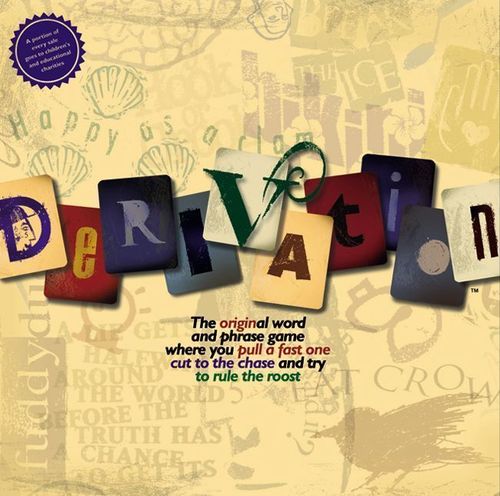
Derivation
Derivation Rulebook
Table of Contents
Table of Contents
Friendly Disagreements
There are "shades of grey" in Derivation, such as whether two incorrect Suggestions are the same, or whether a Suggestion is the same as the answer, or who answered an "All Play" first. All such cases are decided by the player whose turn it is.
There is still some debate concerning the true origins of some of the phrases and words used in Derivation. We did exhaustive research to try and be as accurate as possible. Feedback is welcome at www.derivationfun.com.
Variations
- Two or more players can play as a team.
- Players show their letter cards at all times to the other players.
Setting Up the Game
Open and place the card box and thoroughly shuffled letter cards face down in the center of the table. If this is the first game, remove the Derivation and Action cards from the card box, shuffle them well, and return them to the card box. Players each draw two letter cards, holding them or placing them so they are hidden from the other players. If seven to ten people are playing, players select three letter cards. You can easily adjust the playing time for Derivation by changing the number of letters you start with!
What You Need to Play
4 to 10 people are needed to play.
You will need to supply a pen or pencil for each player. Ideally all the pens will be the same color.
Note: The Action and Derivation cards are colored differently on each side to help you track which sides you have used.
Playing the Game
| Roll (category) | Play |
|---|---|
| Derivation | Pick a Derivation Card and follow the directions. |
| Talk | Pick an Action Card, and follow the Talk directions. |
| Act/Draw | Pick an Action Card and follow the Act/Draw directions. |
| Fortune | Pick an Action Card and follow the Fortune directions. Then roll again. |
* The oldest player rolls first. Play proceeds clockwise.
Derivation Cards
Derivation cards ask a question that each player tries to answer.
For example, the card might state: All players write down the author of: "Ask not what your country can do for you, ask what you can do for your country." Players try to provide the correct answer. If you don't know the answer, you get to make one up!
In this case, if you don't know that John F. Kennedy is the right answer, you might write Dwight Eisenhower to try and fool the other players. You earn a letter if your Suggestion matches the answer (John Kennedy) or if you make up an answer (like Dwight Eisenhower) that other players believe is the real one.
Another example: The card might ask for the derivation of the phrase, "All wrapped up." You may know the answer - "an allusion to a gift that is wrapped and ready to deliver," and submit this as your Suggestion. Or you might make up a Suggestion that you think is a convincing, such as: "comes from the Egyptian practice of embalming their dead and wrapping them in gauze." If another player believes that your Suggestion is the real derivation, you earn a letter.
Determining a correct Suggestion
If a player's Suggestion is close enough to the real one to be a reasonable substitute it should count.
For example, the word Paparazzi refers to photographers who stalk and take unauthorized pictures of celebrities. Paparazzo was a free-lance photographer in Fellini's 1959 movie La Dolce Vita. A Suggestion that says that the word came from a movie would not be considered specific enough. One that said it came from a Fellini film, or from a character called Paparazzo in a movie or from a character in the movie La Dolce Vita would all earn a letter.
The specific steps for Derivation Cards
- Read aloud only the black bold and red bold and italic text.
Sample Derivation card: All players write down the origin of the phrase To put the kibosh on. It means to stop a pointless discussion.
▶ One possible derivation is that in Yiddish, Kibosh meant nine pennies, a paltry sum. During auctions, Dutch Jews living in England would yell "Kibosh!" to end the bidding for an item of little value. The item would go to the person who yelled.
Postscript: Another possible derivation is that in Gaelic, cie bais (cie is pronounced bosh), meaning cap of death, referred to the black cap worn by English judges before pronouncing a death sentence.
-
All the players neatly write their Suggestion (and their name) on a Suggestion sheet, and hand it to the Reader. Remember the goal is to write a Suggestion that is either the correct answer, as shown on the card, or to make up one that other players will believe is the real one. Be as silly or serious as you want.
-
The Reader should write both a false Suggestion and the real answer from the Derivation card on separate Suggestion sheets and add both to the pile of submitted Suggestions. He has the option of including any words in parenthesis, any obvious joke, or anything labeled "Postscript" on the card.
-
As he collects the Suggestions the Reader reads them to himself:
| If | Then |
|---|---|
| Half or more of the Suggestions are correct | Replay the round with a new card |
| One or more Suggestions are correct | 1. Reader announces the winner(s), but does not read their answers aloud. 2. Winners pick a letter and have finished their turn. 3. Play continues for the rest of the players. |
| There are duplicate false Suggestions | The Reader reads only one |
-
Once the correct Suggestions have been announced (but not read aloud!) and duplicates have been set aside, the Reader reads aloud the remaining Suggestions, including the correct answer, in any order he chooses. Of course, he should keep the authors' names hidden.
-
As he reads them aloud he should assign each a number (with the first Suggestion being #1, second #2 and so on) and circle the corresponding number on the pre-printed Suggestion sheet. Since he earns a letter if no one guesses the answer, the Reader should try to read the Suggestions and answer in a way that will fool the other players.
-
The other players should now write down the number of the Suggestion they think is correct. A player cannot choose his own Suggestion.
-
Players reveal their choices.
-
Winning players pick letters (see Earning Letters).
-
Round is over. Flip the card over and place it in the back of its section. The next person rolls the die.
Act/Draw & Talk
With the Talk category, one player verbally describes a phrase to another player in order to help them guess what it is. With Act/Draw, one player acts or draws to help another player guess a phrase.
The steps are:
- Player takes a card but does not look at it.
- Player selects another player to be the guesser.
- The Player can now look at the card and reads the phrase from the category he rolled on the die. He has up to a minute to collect his thoughts.
- He then turns over the timer and has one minute to describe the phrase to the player whom he selected.
- Exception. If the phrase says "All Play" next to it then he describes the phrase to all the players, not only the one he selected.
- If he has a Talk Card then he must verbally describe the phrase:
- Without using the word(s) in the phrase.
- Using only descriptive clues. Using rhyme, saying how many letters are in a word, words in a phrase or clues of similar vein are improper.
- If he has an Act/Draw Card then he must act and/or draw to help the chosen player guess the phrase. Common symbols used in charade type games are allowed. However the player cannot:
- Talk
- Spell words or letters with his fingers, mouth word(s)/letters, point at something in the room, or anything of similar vein.
- Include letters or words in his drawing.
Breaking these rules means the turn is over immediately with no player earning a letter. If the guesser gets the correct answer before time runs out, the round is over and the player and the guesser get to select a letter from the letter deck. Otherwise the turn ends with no letters earned by either player. In "All Play," the first person to guess the phrase and the Reader get a letter. If no one guesses the phrase before time runs out, no one earns a letter.
Fortune
The Fortune category gives players the opportunity to win or lose letters. The text describes what the player(s) do. Unless otherwise stated, letters won or lost from other players are chosen blindly.
More about Letters
Note that there is one letter card with a small case "i" and one with a capital "I." When trying to spell D-E-R-I-V-A-T-I-O-N, players do not need to distinguish between the two. The small case "i" and capital "I" can be used interchangeably.
There are six Wildcards that can be used for any letter. A player with 12 letters must return one before picking up a new one he has earned.
Players may trade letters with one another. Trades take place before a player rolls his die and must include the player whose turn is about to begin. Any type of trade is permitted (including uneven trades such as 2 letters for 1 letter) with the exception that a player cannot trade for the final letter he/she needs to win. If asked, players must reveal how many letter cards they have.
Earning Letters
Reader
- One letter if no one chooses the correct answer.
Rest of Players
- One letter for choosing the correct answer.
- One letter if your Suggestion is correct (matches the answer on the card).
All Players
- One letter for writing a Suggestion that is chosen by another player.
- Two letters for writing a Suggestion chosen by two or more players.
- If a duplicate false Suggestion is chosen by one or more players then each person who authored the same Suggestion earns one letter.