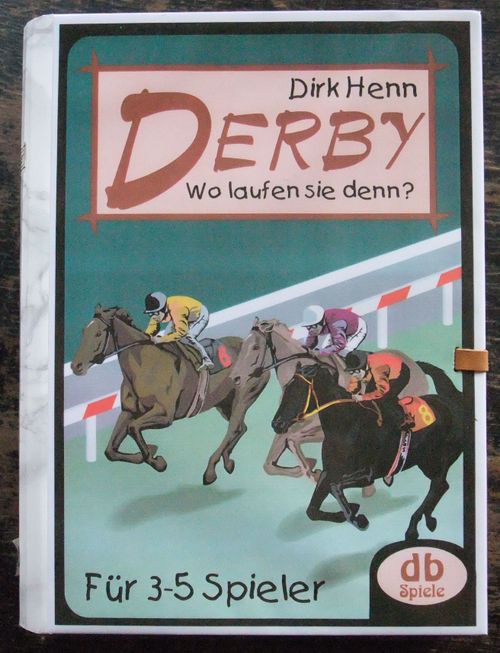
Derby
Derby Rulebook
Table of Contents
Table of Contents
Contents
- 63 movement cards (every color is represented by a symbol as well)
- 81 betting tickets
- 56 number cards (8 times 1 and 6 each, 10 times 2 to 5 each)
- 9 horse markers
- 1 game board
Object of the Game
The object is to accumulate the most money from your 9 betting tickets at the end of the game. You can be successful by exchanging the betting tickets or moving the horses so that the order of the horses meshes with your betting tickets.
Preparation
Shuffle the deck with the movement cards and place them face down on the pale space in the upper left part of the board. The first two cards are turned over and put on the two spaces to the right of it.
The betting tickets are separated by color and every color deck is then shuffled. Every player gets one betting ticket per color. The rest of the decks are put face down on the corresponding space on the board. The top card of every deck is placed face up.
Every player gets, depending on the number of players, the number cards specified in the table below. Every player shuffles this deck of cards well, puts it face down in front of him and turns over the top card.
| # of players | 1's | 2's | 3's | 4's | 5's | 6's |
|---|---|---|---|---|---|---|
| 3 | 2 | 3 | 3 | 3 | 3 | 2 |
| 4 | 2 | 2 | 2 | 2 | 2 | 2 |
| 5 | 1 | 2 | 2 | 2 | 2 | 1 |
Put all horse markers at the start. The player who was the last to attend a horse race begins the game.
Game Play
Movement of the horses
The player on turn chooses a number card and a movement card, which he plays on the corresponding spaces on the blue marked space on the board. The player has the option of deciding whether he wants to play the movement card or the number card first.
- Number card: The player can take the number card lying open in front of him and play it on the left of the two spaces. If he does not want to play this card, he can place it face down at the bottom of his deck. He then turns over the next card and must play it.
- Movement card: The player may choose one of the two open cards and put it on the right blue space. If he does not want to play one of the two cards, he can decide to turn over and play the top card. If he decides to do so, he can no longer play one of the open cards, but has to take what he gets, regardless of what that one shows.
Then the horses are moved according to the two cards just played. The movements of those horses pointed by a race arrow are executed. The movements marked with a red X are not executed. The movements are executed from the bottom to the top of the card moving the horses as many spaces forward as the number on the card indicates. Any number of horses can occupy the same space.
Example: With the combination of the two cards shown in the diagram Lila Veilchen (3rd line) would move first 5 spaces, then Schwarzer Peter (second line) 4 and Grüne Welle (first line) 2 spaces. The three other horses are not moved.
Exchanging of betting tickets
After the movement phase, a player may exchange one of his betting tickets. You can see which of his bets you are allowed to exchange by examining the bottom of the movement card just played. In the gray space below the movement numbers (under the title 'Tauschen' or 'exchange') you find the three colors you are allowed to exchange. These colors are always those that are not involved in the movement phase and thus couldn't have moved that turn.
In the example above the player would be allowed to exchange his red, yellow or white betting ticket.
When exchanging a betting ticket you put down the ticket you want to get rid of face down under the stock of this color on the board. Then you may choose to take the open betting ticket into your hand. Then the next card is turned face-up. If you don't want to have the open ticket, you also put the open card face down under the stock just as the card from the hand before. Then you take the top face down card to your hand and turn over a new betting ticket.
End of a turn
To end a turn, a player has to put aside the two played cards separately (saves sorting them later!) and reveal the top card on his own number card stack. If a horse is moved over the finish line, it is immediately put on the first free place on the board (only for this reason is it important that the lower horse on a card is moved first). Betting tickets for a horse that has already finished may no longer be exchanged.
If Lila Veilchen (line 3) and Grüne Welle (line 1) in the example of played card above would pass the finish line, Lila Veilchen would come in one place before Grüne Welle.
End of the game
The game ends when the last player has played his final number card. Then the horses still on the course are put on the free places corresponding to their present standing. If more than one horse is on the same space, all of those horses are put on the same place and the empty number of places behind them remains unoccupied (so if you have three horses in fourth place there are no 5th and 6th places).
Every player analyses his betting tickets. A bet is fulfilled if the horse has reached the position indicated or better. The numbers for this are indicated on the betting tickets. The profit for a fulfilled bet is indicated on the tickets.
If I have placed a 5th place bet on a horse that comes in third, the bet is fulfilled and 600 points are scored.
The player with the greatest total score from their successful betting cards wins the game.