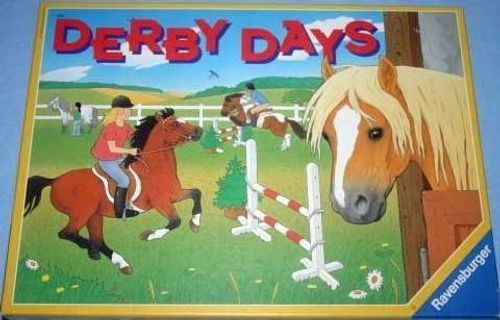
Derby Days
Derby Days Rulebook
Table of Contents
Table of Contents
Contents
- 4 ponies with riders
- 4 plastic bases (for ponies)
- 16 numbered hurdle stands (white)
- 16 plastic bases for hurdles (green)
- 8 red hurdle rails
- 1 die
- 1 game board
Object
The first player to jump all eight hurdles and finish the course is the winner.
Preparation
- Carefully punch out the four ponies and place them in their plastic bases.
- Prepare the game board by punching out the 16 holes and pushing the green bases through from underneath the board. They can be left in the board permanently.
- Before each game, assemble the hurdles by putting a white hurdle stand (called a standard) into each green base in the board with the number 4 on top. Place the red rails into the hurdles at position 3.
- Each player chooses a pony and places it at the start (in the space with an arrow and two red flags near the duck pond).
- Each player rolls the die once. The first to roll the horseshoe symbol begins and play continues to the left.
Game Rules
Basic Game Play
The first player rolls the die again and moves his pony forward that many spaces. Play then continues to the left.
- If a 3 or higher is rolled, see JUMPING HURDLES.
- If the horseshoe is rolled, see ROLLING A HORSESHOE.
- Make sure to follow the arrows on the course. Do not turn at an intersection.
- More than one pony can be on the same space at the same time.
Simplified Game Play
Players who are new to DERBY DAYS may want to make either of the following changes to the game play:
- In preparing the game board, set all the red rails to either position 1 or 2.
- Eliminate the rule that the rail must be reset after the hurdle is jumped.
Jumping Hurdles
If the number rolled takes a player to a hurdle, it must be jumped, if possible. To jump the hurdle, a player needs to roll a number that is higher than the number of spaces before the hurdle plus the position of the rail.
Example: Your pony is two spaces away from a hurdle that is set on 3. You need to roll a 6 in order to jump the hurdle. Two points take you to the jump, 3 take you to the top, and the last point takes you to the space just on the other side of the hurdle. If not enough points are rolled to cross the hurdle, you may move up to the hurdle, but not cross it.
- If the number rolled is more than the player needs to jump the hurdle, the extra points carry him beyond the jump, one space for each extra point.
- If the number rolled is less than the player needs to jump the hurdle, his pony must wait on the appropriate space until his next turn.
- There are a few places along the course where players might be able to jump over more than one hurdle on a turn, if they're lucky!
For example: Your pony is on the space just before the combination (double hurdle) at the end of the course. The first hurdle is set at 1, the second at 3. If you roll a 6 you will be able to go over both hurdles and land on the space after it in just one move.
Resetting the Rails
After a player has jumped over a hurdle, he looks at the number on the bottom of the die (opposite side from the number rolled). The red rail on the hurdle just jumped is moved to that number.
For example: If a six is rolled, the number on the bottom of the die is a 1, so the rail is set to position 1.
- If a 2 is rolled, the symbol on the opposite side is the horseshoe. This means that the player can set any one rail on the course to any level. A player may wish to set his own next rail to a lower level, or set a rail higher for another player.
- If two hurdles are jumped in one turn, then both rails are set to the same level, according to the number on the bottom of the die, as described above.
- If the rail is already at the level indicated by the die, then it simply remains in place.
Rolling a Horseshoe
The horseshoe symbol can change a player's luck.
- If a player rolls a 2 and jumps a hurdle set at 1, he may set any hurdle on the course to any level, because the horseshoe is on the opposite side of the die. (See RESETTING THE RAILS.)
- If a player rolls the horseshoe after he has jumped the last hurdle, he loses his turn.
End of the Game
It is not necessary to cross the finish line on an exact roll. The first rider to jump all eight hurdles and reach the finish line is the winner.
Cooperative Game Version
Preparation and play are the same as the basic game play, but the object is to score as many points as possible as a team. This version can be played with one or all of the ponies, but all the players are on one team. You can pretend you are representing your country in the Equestrian games at the Olympics. You are all working together to make as many points for your team as possible. Each player may be in charge of one pony and rider, or you can all take turns moving just one. Scoring is based on the level of the hurdle that is jumped. For example: If the pony and rider successfully jump a hurdle set at position 3, the team scores 3 points. The game is over when all the ponies have jumped all the hurdles and reached the finish line. Add up all the points to see how well you did as a team.
In a real show-jumping contest the object is not only to jump the highest, but to take each jump well. The winner is the rider who ends the course with the fewest penalty points. If two or more riders end the course with the same score, there will be a jump-off. Usually in this case, each must run a shortened course with higher hurdles. At times, if two riders finish with the same point score, the one who finished the fastest is judged the winner.