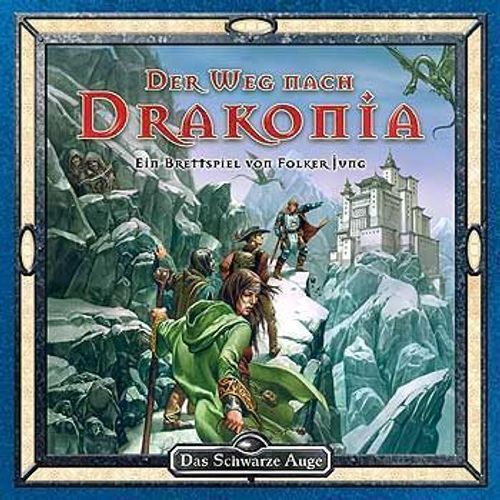
Der Weg nach Drakonia
Der Weg nach Drakonia Rulebook
Table of Contents
Table of Contents
- Preparations
- The Goal
- Maximum Number of Heroes
- Teamplay with 6 Players
- The Heroes
- Game Actions
- Playing Adventure Cards
- The Hero- and the Eye-Symbol on the Adventure Cards
- Warrior Adventure Card
- Thief Adventure Card
- Cleric Adventure Card
- Mage Adventure Card
- Wounded Heroes and Death
- The Final Turn
- Victory Points
- Short Game Variants
- Reference: Adventure Cards
- Reference: Game Actions
Preparations
- Each player chooses a Culture and places the relevant Culture Card in front of her. If two or more players want to play the same Culture, draw lots. Now every player takes the 12 Heroes of her Culture and places them with their healthy side up (see The Heroes) beside her Culture Card.
- The Adventure Cards are sorted into 4 stacks according to the symbols on their back. Each stack is now being shuffled and they are placed with their symbol side up next to each other on the playing table where every player can reach them.
- At the beginning of the game the players have no Adventure Cards on their hand.
- The youngest player beginns the game.
The Goal
Every player leads a group of heroes from her culture from the City ("0: Stadt" – the starting space) to Drakonia (the destination space "6: Drakonia"). Each group consists of 4 to 6 heroes, depending on the number of players. By playing Adventure Cards, the heroes are moved from space to space, most of the times towards Drakonia, but sometimes backwards to the City. The game ends immediately, when the first hero enters Drakonia. Then the Victory Points are being counted. Every hero is worth an amount of Victory Points equal to the space he's standing on. The player, whose heroes have collected the most Victory Points, wins the game. This does not have to be the player whose hero reached Drakonia first.
Maximum Number of Heroes
Depending on the players taking part in the game, each player can bring a fixed Maximum Number of heroes into the game at the same time:
- 2 players: 6 heroes
- 3 to 4 players: 5 heroes
- 5 to 6 players: 4 heroes
Teamplay with 6 Players
The game with 6 players is special in that 3 teams (A, B, C) of 2 players each taking part.
For seating and order of play see the diagram on the right.
Every player is playing with her own culture but is allowed to play Adventure Cards on the heroes of her team member as well as on her own heroes. The players are allowed to discuss and decide on their tactics with each other, but this has to be taken place at the gaming table, where everyone else can listen to what they tell each other. Cards may not be swapped between players or shown in secrecy to each other. At the end of the game the players of each team add their Victory Points together, so there is no single winner of the game but always a team victory.
The Heroes
There are 4 different Hero Types:
- the Warrior (Sword)
- the Thief (Key)
- the Cleric (Temple)
- the Mage (Magic Book)
The bloody hand on the back of each Hero Playing Piece means that the hero is wounded.
Game Actions
A player can perform the following actions, one after the other.
Standard Game Turn
a) Bring a new hero into the Game, as long as you haven't reached the Maximum Number of heroes allowed per player and as long as you still have heroes left to place. The new hero is being placed in the City. He may be brought into play before, after or during the playing of Adventure Cards.
b) Play one or more (up to all 4) Adventure Cards. Playing more than one card in one turn can result in a great advancement for a player and her heroes, as no other player can get in the way. Keep in mind that even when playing more than one card all effects of one card have to be carried out before the effects of the next card can take place.
Alternative to a) and b): Move an unlimited number of your own healty heroes an unlimited number of spaces backwards into the direction of the City, provided you don't want to play an Adventure Card or bring a new hero into play. This includes moving a hero from the City back onto the pile of heroes that have not yet entered the game.
c) Activate or deactivate the InvisibilitySpells of your own Mages, that protect other heroes but not themselves (see Mage Special Ability). An Invisible Person cannot be the target of Adventure Card effects and cannot provide the conditions for playing an Adventure Card.
d) Draw one new Adventure Card from a stack of your choice, as long as the number of Adventure Cards on your hand hasn't yet reached the maximum of 4. Drawing an Adventure Card is always the last action of a player and ends her turn. Even after playing more than one Adventure Card, a player only draws one new card at the end of her turn.
Alternative to the Standard Game Turn
Discard one or more Adventure Cards from your hand and draw the same amount of new cards, choosing freely from all stacks. This is only possible when on the same turn the player plays no Adventure Cards, brings no new heroes into the game and does not move any of her heroes backwards. Her only action before changing cards can be the activation/deactivation of her mages Invisibility Spells. She is not allowed to draw new cards.
Playing Adventure Cards
- A player can never have more than 4 Adventure Cards on her hand.
- When playing an Adventure Card it has to be played on one own hero of the player's Colour/Culture. This is always being done openly for all other players to see and comprehend. For example the Adventure Card of a Mage can only be played, when at least one Mage of your own Colour/Culture is on his way between the City (0) and the Woods (5). As the game ends immediately when a hero moves onto the Drakonia space, there will never be a situation where an Adventure Card is being played onto a hero on the Drakonia space.
- After all effects of the Adventure Card have been resolved, it is placed face up next to the relevant Adventure Cards stack.
- After the last Adventure Card has been drawn from a stack, the player who did that picks up all discarded cards, shuffels them and places the new stack face down on the table.
The Hero- and the Eye-Symbol on the Adventure Cards
For each Hero-Symbol on an Adventure Card there has to be a hero in the space where the card is being played. If one or more of the necessary heroes is not available in that space, the Adventure Card cannot be played. The hero on which the card has been played can but does not necessarily have to be the target of any effect (moving forwards, backwards, being wounded or healed) on the card. The effects on the card can affect any heroes, not just the ones of the players Colour/Culture. All effects take place at a same time in the space on which the Card has been played. When there is an Eye-Symbol, the player may choose freely what Hero Type is being affected by that effect.
Warrior Adventure Card
This card can only be played on one of your warriors (see Example 1). This results in two heroes moving from the space of that warrior forward towards Drakonia (green arrow), while a third hero will be wounded (bloody hand). The warrior used to play the card can be any one of the heroes being affected by it. The wounded hero is flipped to his backside with the bloodly hand and put openly visible for all players beside the space on which the card has been played.
Thief Adventure Card
This card can only be played on one of your thieves (see Example 2). This results in two heroes moving from the space of that thief forward towards Drakonia (green arrow), and a third hero backward towards the City (red arrow).
If a Thief Adventure Card is played in the City, the hero moving backwards from the City is put back onto the pile of heroes of that player that have not yet entered the game. In one of the next turns the hero can try a new start by being brought into play by his player.
Cleric Adventure Card
This card can only be played on one of your clerics (see Example 3). This results in one hero moving from the space of that cleric foward towards Drakonia (green arrow).
When there is a wounded hero lying next to the space on which the card has been played, he has to be healed by the cleric (bandaged hand). If there are two or more heroes lying next to that space, the player may choose which hero is being healed. Important: If there is no wounded hero lying next to the space on which the card has been played, the Adventure Card may be played nonetheless.
A healed hero is flipped back onto his healty side and placed back on the space.
Mage Adventure Card
This card can only be played on one of your mages (see Example 4). This results in two heroes swapping their position on the map.
This spell affects either the space on which the card has been played or the spaces in front of and behind it. The mage can for example move one hero from his space one space backwards and move one other hero from that space into his own space (a), or he can move one hero from his space forwards and move one hero from that space backwards into his own space (b). A third option (in which the mage himself cannot be the target of the card effects) would be to move one hero from the space in front of the mage backwards into the space behind the mage and pick up one hero from that space to move him into the space in front of the mage (c).
Mage Special Ability
A mage is allowed to use an Invisibility Spell on one other hero from his Colour/Culture on the same space as the mage – but not himself. An Invisible Person cannot be affected by card effects and cannot provide the conditions for playing an Adventure Card. As soon as the mage who has used the Invisible Spell chooses to end the spell or is being moved into another space or being wounded, the spell is being ended and the protected hero becomes visible. The Invisible Spells of your mages can only be activated or deactivated in your own turn.
Wounded Heroes and Death
You cannot play an Adventure Card on a wounded hero lying beside a space. He cannot be affected by card effects other than healing and cannot provide the conditions for playing an Adventure Card. All he can do is lying beside the space waiting for healing or death. Wounded heroes still count towards the Maximum Number of heroes in the game.
The player to which the hero belongs is allowed to announce the demise of that hero, placing him with the bloody hand symbol facing upwards beside her pile of heroes that have not yet entered the game. This hero cannot enter the game again.
The Final Turn
When a player plays a card that moves one or two heroes to the Drakonia space, the game ends after all effects of that card have been resolved. Even the player who has played that card cannot play any other card afterwards (but he can of course play a card before it).
Victory Points
Every hero provides his player with an amount of Victory Points equal to the number of the space on which he is standing. Wounded heroes provide points equal to half the number of the space beside which they are lying (for example 2.5 points in the Woods). Every player adds the Victory Points of her heroes and the player with the highest Victory Point Total wins the game. If two or more players have the same Victory Point Total, the one that has a hero closest to Drakonia wins. Only when the same amount of heroes stand on identical spaces, the game is a draw.
Short Game Variants
Short Way Variant (A)
If the players want to play a game that takes only 30 to 45 minutes instead of the usual 45 to 60 minutes, they can agree to move past the Oasis by using the river ferry. The Oasis space can then not be entered by any hero. When playing Adventure Cards, the Swamp and the Caravanserei count as directly connected. When counting Victory Points the numbers of the relevant spaces are being used as usual.
Speed Game Variant (A+B)
If you're playing in a tournament or when there is only time for a 15 to 20 minutes game, you can add a second short cut to the game which connects the Caravanserei with the Woods. In the Speed Game Variant those two spaces count as directly connected. When counting Victory Points the numbers of the relevant spaces are being used as usual.
Reference: Adventure Cards
Quick-reference sheet printed in the rulebook. Icons and maps are described by their text labels.
Warrior Adventure Cards. Can play only on one of your Warriors. Results in two heroes moving forward from that space (green arrow); another hero there is wounded and is flipped over to lay outside of same space (bloody hand). The Warrior used to play the card can be one of the heroes affected by it. (Ex. 1)
Thief Adventure Cards. Can play only on one of your Thieves. Results in two heroes moving forward from that space (green arrow); another hero moving backward from the same space (red arrow). A hero moving back from the City (Stadt) moves to the pile of unused heroes of that player. (Ex. 2)
Cleric Adventure Cards. Can play only on one of your Clerics. Results in one hero moving forward from that space (green arrow); and the healing of a wounded hero lying next to the same space which is flipped over and moved back into the space (bandaged hand). (Ex. 3) Important: this card can still be played without healing a hero.
Mage Adventure Cards. Can play only on one of your Mages. Results in two heroes swapping places on the map. Affects either the space the Mage is on or the spaces directly in front of and behind her. Swap hero from Mages space with hero behind her (4a) or in front of her (4b). Can also swap hero from space in front of Mage with hero in space behind Mage (4c). Mage playing the card can't be one of the heroes in (Ex. 4c).
The Eye Symbol: Any hero type may be chosen.
Reference: Game Actions
A short overview of a player's actions in one turn. You can...
a) ...bring a new hero into the game, as long as you haven't reached the Maximum Number of heroes allowed per player and as long as you still have heroes left to place. The new hero is placed in the "City" (Stadt). He may be brought into play before, after, or during the playing of Adventure Cards.
b) ...play one or more (up to all 4) Adventure Cards. When playing more than one card, all effects of the first card have to be carried out before the effects of the next card can take place.
Alternative 1) ...move as many of your own healthy heroes as many spaces backwards in the direction of the "City" (Stadt), provided you don't want to play an Adventure Card or bring a new hero into play. This alternative move includes moving a hero from the "City" (Stadt) back to the pile of heroes that have not yet entered the game.
c) ...activate or deactivate the Invisibility Spells of your own Mages, that protect other heroes, but not themselves. An Invisible Person cannot be the target of Adventure Card effects and cannot provide the conditions for playing an Adventure Card.
d) ...draw one new Adventure Card from the stack of your choice, as long as the number of Adventure Cards in your hand hasn't yet reached the maximum of 4. Drawing an Adventure Card is always the last action of a player and ends your turn. Even if you played more than one Adventure Card, you only draw one new card at the end of your turn.
Alternative 2) ...discard one or more Adventure Cards from your hand and draw the same amount of new cards, choosing freely from all stacks. This alternative is only possible if you play no Adventure Cards, bring no new heroes into the game and do not move any of your heroes backwards on the same turn. The only action allowed before changing cards is the activation/deactivation of your Mages' Invisibility Spells. You are not allowed to draw a new card to end your turn.
Maximum Number of Heroes per Player on Map at One Time: 2 Players - 6; 3 to 4 Players - 5; 5 to 6 Players - 4