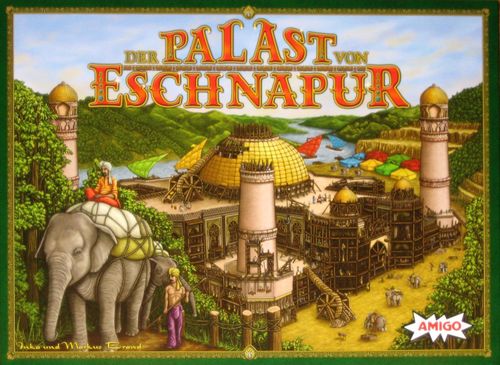
Der Palast von Eschnapur
Der Palast von Eschnapur Rulebook
Table of Contents
Table of Contents
- Contents
- Game Concept and Goal
- Game Preparation
- Gameplay
- Phase 1 – Select construction sites
- Phase 2 – Place gold cards
- Phase 3 – The Blockade marker
- Tie rules
- Phase 4 – The stop construction marker
- Phase 5 – Awarding the bricks
- Phase 6 – New turn order
- Phase 7 – Placing bricks
- The premium
- Phase 8 – Moving bricks
- Phase 9 – Privilege points, wages, and evaluation
- End of the Game
- The Game for 3 Players
- The Game for 2 Players
- Privilege cards
Contents
- 10 privilege cards
- 4 privilege discs
- 80 bricks: 20 in each of the colors red, yellow, green, and blue
- 4 victory point stones
- 8 two-sided palace sections: the front side has the "completed" palace; the back side is the palace "under construction"
- 64 gold cards:
- 8 × value 0
- 8 × value 1
- 12 × value 2
- 16 × value 3
- 8 × value 4
- 12 × value 5
- 1 stop construction marker
- 1 blockade marker
- 4 turn order markers
- 4 50/100 markers
- 4 player tableaus
- 1 victory point track
- 32 construction site cards: each of the 4 player colors comprises eight cards corresponding to palace sections 1 through 8
Game Concept and Goal
The players are called upon to prove their skills in building the new palace of Eschnapur. With a modest supply of gold, they must make themselves helpful to the maharaja's high officials, keeping the competition at a distance. In each round of the game, you will make "donations" to the officials in order to apply their benefits or detriments to the construction process. At the right point in time, palace construction brings much needed replenishment of gold, and interim scoring that provides crucial victory points.
Game Preparation
The following rules apply for four players. Differences in the setup and gameplay for two and three players can be found on page 7.
- Place the eight palace sections in the center of the table, with the numbered construction sites to the top side, with the "under construction" side up.
- Place the victory point track below the palace.
- Each player chooses a player tableau and takes the eight construction site cards, victory point stone, and privilege disc in the corresponding color. Place your victory point stone and privilege disc beside space 1 of the point track.
- Each player receives 16 gold cards (as follows) to form her hand:
- 2 × value 0
- 2 × value 1
- 3 × value 2
- 4 × value 3
- 2 × value 4
- 3 × value 5
- Pile the bricks as a common supply near the palace.
- Sort the 10 privilege cards according to their value, and lay them out above the palace.
- Lay the stop construction marker, the blockade marker, the turn order markers, and the 50/100 markers near the palace.
- At the beginning of the game, the bank is empty, but over the course of the game, it will become filled with gold cards, stacked according to their values.
Gameplay
The game proceeds in rounds. Each round comprises nine phases.
- Phase 1: Place exactly 2 construction site cards face-down.
- Phase 2: Place one gold card face-down for each of the five high officials.
- Phase 3: The blockade marker blocks a player's gold card. The affected player receives a brick.
- Phase 4: The stop construction marker is placed, and prevents the construction of a palace section.
- Phase 5: Each player receives bricks from the general supply.
- Phase 6: The turn order is redefined.
- Phase 7: The bricks are built and any premiums are collected.
- Phase 8: One player may move the last brick from one palace segment to another palace segment.
- Phase 9: Privilege points, wages, and scoring.
Each of the five spaces in the lower half of the players' tableaus represents one of the five high officials of the maharaja.
Phase 1 – Select construction sites
Each player has a set of construction cards numbered 1 through 8. Each card corresponds to the palace segment with the same number. Each player chooses the two palace segments where she'd like to place bricks this round. She places the two cards face-down on the spaces in the upper-left corner of her tableau.
Phase 2 – Place gold cards
Each player selects five of her gold cards to use to influence the high officials. You must assign precisely one card to each of the five officials. Place each card on the appropriate official's space at the bottom of your tableau (see the overview on page 3). The only time you can leave any of the officials' spaces empty is if you have fewer than five gold cards at your disposal.
Phase 3 – The Blockade marker
After all players have placed their construction site cards and gold cards, the players start to reveal their gold cards. In this phase, players simultaneously reveal their first card (the one on the left).
The player who played the highest gold card wins the influence over the first high official, and earns the blockade marker. She may place the blockade marker immediately on any still-face-down gold card of any player. The blocked card can't be revealed this round. If the same card is suppressed by the blockade marker again in the upcoming round, it will be removed. The card is not picked up, and will count as one of the five played cards in the next round.
As compensation for her gold card being blocked, the affected player immediately takes a brick in her color from the general supply, and puts it on the brick space on her tableau.
Basically: In the next round, the blockade marker must be moved to a different player and different official than where it sits now. The blockade marker may be laid next to the palace, having no effect this round. If nobody wins the blockade marker this round, put it beside the palace for no effect.
What to do with the gold cards: The card that won this phase goes immediately into the bank. All the other cards remain in place on their players' tableaus until phase 9, for privilege evaluation.
Gold card with value 0: A gold card with a value 0 can never win a phase. It allows players to give something to less interesting officials without wasting their gold cards. After revealing the cards, the players can basically just take their value 0 cards back into their hand.
Tie rules
If there is a tie for the highest bid, in phases 3, 4, 6, and 8 (but not in phase 5), the next highest bidder wins. If there are ties all the way down, then nobody wins this phase.
Examples:
- 5, 5, 3, and 0 were revealed. The two 5 gold cards cancel each other, and the 3 card wins this phase.
- 5, 5, 4, and 4 were revealed. All the gold cards cancel each other and nobody wins this phase.
- 4, 4, 4, and 0 were revealed. The three 4 gold cards cancel each other, leaving only the 0. Because a 0 can never win a phase, nobody wins.
Phase 4 – The stop construction marker
Everybody simultaneously reveals their second gold card. The player who played the highest gold card wins influence over the second high official, and earns the stop construction marker. She may place the stop construction marker immediately on any palace segment. Nobody can place any bricks in this palace segment this round.
Basically: The stop construction marker must move each round to a different palace segment. A palace segment can never be blocked for two consecutive rounds. The stop construction marker may also be placed beside the palace, such that it doesn't block any palace segment this round. If nobody wins this phase, place the stop construction marker beside the palace for no effect.
If players are tied for the greatest gold card, use the tie rules (see the Tie rules section above).
What to do with the gold cards: The card that won this phase goes immediately into the bank. All the other cards remain in place on their players' tableaus until phase 9, for privilege evaluation.
Phase 5 – Awarding the bricks
Everybody simultaneously reveals their third gold card. Unlike the other phases, every played card has an effect. There is also a special tie rule in this phase.
Any gold card whose value was only played by one player in this phase earn the player the same number of bricks as the card's value. For cards whose value was played by several players, each receives only half the card's value, rounded up. The players take the appropriate number of bricks in their color from the general supply and put them on the upper-right corner of their tableaus.
Examples:
- 5, 5, 4, and 3 were revealed this phase. The 4 earns four bricks; the 3 earns three, because their values were only played by one player. The players who played 5 get only 3 bricks (half of 5 is 2.5, which rounds up to 3).
- 5, 4, 4, and 4 were revealed this phase. The solitary 5 earns its player five bricks. The numerous 4 cards earn their players only 2 bricks (4 halved is 2).
What to do with the gold cards: Because every card has an effect in this phase, each player immediately puts her card on the corresponding pile in the bank.
Phase 6 – New turn order
Everybody simultaneously reveals their fourth gold card. The player who played the highest gold card wins the influence of the fourth high official, and receives the four turn order markers, which he assigns to the four players. This determines the new turn order. If nobody wins this phase, the turn order remains unchanged.
In the first round, if nobody wins, randomly distribute the turn order markers to the players.
If players are tied for the greatest gold card, use the tie rules (see the Tie rules section above).
What to do with the gold cards: The card that won this phase goes immediately into the bank. All the other cards remain in place on their players' tableaus until phase 9, for privilege evaluation.
Phase 7 – Placing bricks
Starting with the player who has the number 1 turn order marker, the players place only the bricks from their tableau on the palace segments. When a player's turn comes around, she reveals her two construction site cards, and places her bricks according to the following building rules:
- You may only place bricks on palace tiles that match the two construction site cards you selected.
- You may not place bricks in the palace segment with the stop construction marker.
- If there are no free spaces in a palace segment, it cannot receive any more bricks.
- You must always place a brick in the lowest available space in the selected palace segment.
- There can only ever be one brick in any space in a palace segment.
- You must always place all the bricks from your tableau in the two selected palace segments. If there are enough free spaces in one of the segments, you may place all your bricks in just one of the two palace segments.
- Bricks may only remain on your tableau if there was no way to use them, perhaps because a selected palace segment has the stop construction marker, or is already completely full. These leftover bricks will be available to you in the next round. Such a situation could allow you to place more than five bricks in a single construction phase.
The premium
When you place a brick on a space that shows a gold bag, a premium will be distributed immediately. Every player that has bricks in this palace segment receives a premium of gold cards with a total value of 3, regardless of how many bricks they had there. The player with the number 1 turn order marker takes a total value of 3 from the bank in whichever combination of denominations she likes: A single 3 card, or a 2 card and a 1 card, or three 1 cards. Then the remaining players with bricks there get the same choice, in turn order.
If there is too little gold in the bank, players receive less – possibly even zero – gold. Players may not use gold cards from their hands to make change.
Phase 8 – Moving bricks
Everybody simultaneously reveals their fifth and final gold card. The player who played the highest gold card wins influence over the fifth high official, and may move a brick. She may only move the last brick from the highest occupied space of one palace segment to the lowest empty space in another palace segment. She does not have to select a brick of her own color.
The stop construction marker prevents bricks from being removed from or added to the palace segment it is blocking.1
If players are tied for the greatest gold card, use the tie rules (see the Tie rules section above).
What to do with the gold cards: The card that won this phase goes immediately into the bank. All the other cards remain in place on their players' tableaus until phase 9, for privilege evaluation.
Phase 9 – Privilege points, wages, and evaluation
Privilege points
Each player now has as many as four gold cards remaining on her tableau. Total the value of your remaining gold cards, and move your privilege disc on the victory point track forward a number of spaces equal to that sum. Then put the cards in the bank. Cards with a value 0 do not get put into the bank, but instead are returned to your hand. You get no privilege points for a cards blocked by the blockade marker. Privilege points can be used to purchase privilege cards at any time (see the Privilege cards section below).
Example: The player still has the 5, 1, and 3 gold cards on her tableau. She didn't win any phases with these cards. She moves her privilege stone on the victory point track the sum of their values (= 9). She puts the three cards on the appropriate piles in the bank.
Wages
For each palace segment whose spaces are all filled with bricks, every player involved in its construction get paid. It doesn't matter whether a player has provided only one brick or several. If several palace segments were completed in the round, process them in order, starting with the one with the lowest number. Each contributing player is paid the value of the bag of gold.
Start with the player who has the number 1 turn order marker (if she contributed to the palace segment), then proceed in turn order. Each player takes the specified wages from the bank, in whatever denominations she chooses. If there isn't enough gold in the bank to pay a player's wages, she gets only part (or none). Players may not make change from their hands.
Example: Each contributing player receives gold cards totaling exactly 11, regardless of how many bricks they contributed. Since the yellow player hasn't contributed any bricks, she gets no gold.
Scoring
Once the wages are paid, score the palace segments. If several palace segments were completed in the round, process them in order, starting with the one with the lowest number. The player with the number 1 turn order marker gets her victory points first, followed in turn by the other players. Add the number on the highest space where you have a brick in this palace segment and the number of bricks you have in this palace segment. Move your victory point marker along the victory point track the sum of those two.
Example: The blue player earns 20 victory points (14 points for her highest-placed blue brick in this segment and another 6 points for having six blue bricks in this palace segment). The green player earns 19 points (16 for the space and 4 for the bricks). The red player earns 13 points (11 for the space and 2 for the bricks).
Once a player has more than 50 victory points, she gets the 50/100 marker and sets it on her tableau with the "50" side up. Once she has more than 100 points, she flips the marker over to its "100" side. Once this is done, start the player's victory point stone back at space "1".
Once a palace segment is scored, return all the players' bricks to the general supply. Flip the palace segment over to show a completed section of the palace. Players set aside the construction site cards for that palace segment, because they won't need them any more.
End of the Game
The game ends when the specified number of palace segments are completed:
- With 4 players, after the 6th palace segment;
- with 3 players, after the 5th palace segment;
- with 2 players, after the 4th palace segment.
Finish the current round, all the way through scoring any palace segments that get completed. It's possible that there are multiple palace segments to score before the game is complete. Finally, the players gain victory points according to their position of their privilege stones:
| Position | 1st | 2nd | 3rd | 4th |
|---|---|---|---|---|
| Victory points with 4 players | 10 | 6 | 3 | 0 |
| Victory points with 3 players | 10 | 6 | 0 | – |
| Victory points with 2 players | 6 | 0 | – | – |
In the event that the privilege stones of two or more players are tied, omit the following places. e.g. If there are two players tied for 1st, they both earn the full points for 1st place, and second place is skipped.
Once the victory points for privilege stones are awarded, the player with the most victory points wins. In the case of a tie, whichever player has the greatest sum of gold on her gold cards wins.
The Game for 3 Players
Palace segment 1 does not need to be constructed, so flip it to its completed side at the beginning of the game. Put the corresponding construction site cards back into the game box.
Put the surplus gold cards intended for the fourth player back into the box – not in the bank.
In phase 3, the blockade marker may be moved to the same player, but must be put on a different face-down gold card.
The game ends when the fifth palace segment is finished. The current round is still played to the end.
The Game for 2 Players
Palace segments 1 and 7 do not need to be constructed, so flip them to their completed sides at the beginning of the game. Put the corresponding construction site cards back into the game box.
Each player will receive additional gold cards: 2 × value 2 and 1 × value 1. Put the other surplus gold cards back into the box – not in the bank.
The first high official (blockade marker) can't be used. You can cover it with one of the surplus construction site cards. As a result, in phase 2, each player only places four gold cards face-down on her tableau.
Return the privilege cards "Overrule blockade marker" (cost 10) and "Select turn order marker" (cost 6) to the box, because you don't need them.
The game ends when the fourth palace segment is finished. The current round is still played to the end.
Privilege cards
At any time in the game, a player can spend his accumulated privilege points (tracked with his privilege stone on the victory point track) in order to purchase privilege cards. The cost of each card appears at the top of the card.
In order to purchase one or more privilege cards, a player announces the purchase, takes the desired cards, and plays them immediately. The player pays the costs of the cards from her accumulated privilege points by moving her privilege stone back appropriately. A player can only buy a privilege if she has enough privilege points. Priority for purchasing the privilege cards always goes to the player that announced it first. The point in time at which each privilege card can be used is indicated in the following descriptions.
Each privilege can only be used once, and is then removed from the game.
- Select turn order marker: If in Phase 6 a player will be determining a new turn order, you may first select a turn order marker for yourself. Then the winner of phase 6 can redistribute only the remaining turn order markers.
- Forbid the last brick: As soon as the winner in phase 8 is determined, the owner of this privilege may select any one palace segment whose last brick may not be moved. This must be done before the winner of phase 8 has selected a brick.
- Win a tie: This privilege must be played before the start of phase 2. You win ties with each high official, for which you have played the highest card. With the bricks (phase 5), you receive the full number, and the player with whom you're tied earns the reduced number according to the tie rules.
- Free construction site selection: Regardless of which two construction site cards you played, in Phase 7 you may place your bricks on any palace segment. As usual, you may not place bricks in the blocked palace segment.
- Ignore stop construction: In phase 7, you may place your bricks in the blocked palace segment, as long as you had played the construction site card for that section of the palace. Or if you win phase 8, you may move a last brick out of or into the blocked palace segment. If a blocked palace segment is completed by use of this privilege, it is scored as usual in phase 9.
- Gold cards totaling 5: You immediately receive gold cards with a total value of 5 from the bank.
- Three bricks: You immediately receive three of your bricks from the general supply, and place them on the brick space on your tableau.
- Gold cards totaling 3, and 2 bricks: You immediately receive gold cards with a total value of 3 from the bank, and 2 of your bricks from the general supply. Put the bricks on the brick space of your tableau.
Footnotes
-
The German rules PDF says blockade, rather than stop construction, but that doesn't make sense, since the blockade marker is on a player's card, not on a palace segment. ↩