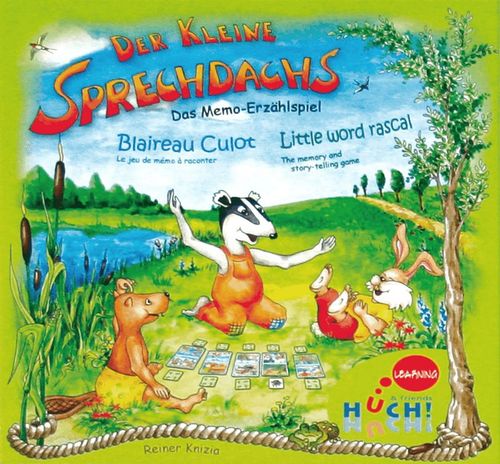
Der kleine Sprechdachs
Der kleine Sprechdachs Rulebook
Table of Contents
Table of Contents
Material
- 6 busy pictures ("Wimmelbilder") that tell stories: The Barbecue Party (Das Grillfest), On the Playground (Auf dem Spielplatz), In the Kindergarten (Im Kindergarten), On the Farm (Auf dem Bauernhof), In Town (In der Stadt), In the Waiting Room (Im Wartezimmer)
- 120 picture cards ("Bildkärtchen")
- 9 preposition cards ("Präpositionskärtchen")
- 1 initial-sound table ("Anlauttabelle")
- 6 game pieces ("Spielfiguren")
- 1 die ("Würfel")
What Kinds of Games Can You Play with Sprechdachs?
Sprechdachs contains a variety of game ideas that encourage playful use of language (for example vocabulary, articles, prepositions and sounds). Whether a game is easy or difficult is shown by the number of Sprechdachs badger icons beside it. The more badgers pictured, the more demanding the game. Each game also states whether a game leader is needed.
Even when the children play on their own, it can make sense for an adult to accompany a game, because the children often cannot yet tell whether their answers are right or wrong. With the material provided, children and adults can invent many further games and variants. It is very important that the children enjoy the games. The feeling of having to learn something should not be the focus.
Which Cards Go with Which Picture?
Each busy picture has matching picture cards. They are easy to match by the colour of the frame on the busy picture and the colour of the lettering on the picture card. For example, the picture "On the Farm" has a green frame. All picture cards that go with this picture have green lettering.
Who Starts?
To decide who may begin, before each game a card is taken from the box at random and placed picture side up on the table. The children look at the picture. The child who first thinks of a word that begins with the same sound may start. Who can recognise a star? Which other word also begins with "scht"? That could be, for example, "Stift" (pencil) or "Strohhalme" (straws). The children's names can of course also be used, and many other suitable words may be known. Play always goes clockwise.
The Games
1. What Is Missing?
For 2 to 6 children, no game leader. Vocabulary, perception and memory.
1. The Team Game
You will need:
- 2 busy pictures as screens
- 20 picture cards of your choice
Setup: First, form two teams. The teams sit facing each other. Each team receives six picture cards and one busy picture to use as a screen. The remaining cards are placed as a face-down stack on the table.
Play: Each team lays its picture cards face up in two rows in front of it. A busy picture is held up as a screen behind the cards, so that the other team cannot see them. When all cards are ready, both teams remove their screens at the same time. Now everyone tries to remember the cards the other team has laid out. One player counts slowly from 1 to 10, then both teams hold their busy pictures up again as screens behind their cards.
Each team now removes one card and shuffles the remaining five cards. The two removed cards are set aside face down. When both teams are finished, the screen is removed again.
Both teams must now find out as quickly as possible which card the other team has removed. Discussion is allowed. If someone believes they know the missing card, they call out the matching word loudly. If the guess is correct, the opposing team must take one extra card from the supply and from then on plays with one card more, because whoever has ten cards in front of them at the end of the game has lost. This makes the game steadily harder, as the teams have to remember more and more cards.
If two players from both teams call out the correct word at the same time, both teams must take an extra card from the supply.
The next round now begins: each team puts its set-aside card back with its other cards. The screen is held up behind the cards again, and any card is removed. When both teams are ready, the screen is removed on command. All players again try to find out as quickly as possible which card the other team has removed, and so on.
If a team has 10 cards in front of it, the game ends. That team has lost.
2. Everyone Against Everyone
You will need:
- For each player, one busy picture as a screen
- For each player, five picture cards of your choice
Setup: Each player receives a busy picture and five picture cards. Each player holds the picture upright in front of them on the table and lays five picture cards face up behind it, so that the other players cannot see them.
Play: When all picture cards are laid out, the busy pictures are removed on command. Each player tries to remember as many of the cards laid out by the other players as possible. The oldest player counts slowly to 10. When they reach 10, the busy pictures are held up again behind the cards so that the other players cannot see them.
Now play goes around the table. The player whose turn it is names a card that they believe is on the table. If a player has that card, they must give it to the player who asked. A card that has been won is set aside as a reward card. These cards no longer take part in the game. The next player then takes a turn.
If someone names a card that is not on the table, nothing happens and the next player takes a turn. That player likewise names a word they believe belongs to one of the other players.
The game ends when a complete round passes with no player naming a correct card. The player who has won the most reward cards then wins the game.
2. Whose Dragon Is It?
For 1 to 6 children, no game leader. Recognising and naming pictures, vocabulary.
You will need:
- As many busy pictures as there are children playing
- Eight picture cards for each busy picture
Setup: Each child receives a busy picture and places it on the table in front of them. The matching picture cards are shuffled and laid face down next to each other on the table.
Play: The player whose turn it is takes a card from the middle of the table, turns it over and looks at it, without the other children seeing what is on it. Then they say clearly and loudly what they see and ask whom the card belongs to. For example: "Whose dragon is it?" All the children now search their busy pictures to see whether the dragon belongs to them. Since only the player whose turn it is can see the lettering colour, they have a small advantage and will surely see at once whom the card belongs to. If the card matches a picture on their own busy picture, they say: "The dragon is mine." They then show the dragon on their busy picture to the other players. They may keep the card and place it beside their busy picture. If another child says "The dragon is mine," that child must also first show the dragon on their busy picture. Only then do they receive the card.
What happens if a child cannot name what is on a picture card? The card is simply placed face up on the table so that everyone can see it. Does anyone know what it is? They may say it loudly and clearly. Then everyone looks to see whom the card belongs to. The child who first finds the picture on a busy picture says: "That is the tree of ..." (name), or perhaps they find the picture on their own busy picture. Then they say: "The tree is mine."
If no child knows what is on the picture card, the children still search for the owner. The card always goes to the player with the matching busy picture. If an older child or an adult is in the room, they can be asked later what the word is.
The player who first has all eight cards lying beside their busy picture has won.
Of course the children may help one another.
Playing alone: The child lays all the busy pictures out in front of them on the table, turns over a picture card and looks for the motif on the busy pictures. Once they have found the motif, they place the card under the matching busy picture. If they wish, they can say where the card belongs. For example: "The cat belongs to the red busy picture."
3. Is It the Balloon?
For 2 to 6 children, no game leader. Finding and naming pictures, vocabulary, articles.
1. Which Busy Picture Is It On?
You will need:
- All busy pictures
- About 20 picture cards
Setup: All busy pictures are placed in the middle of the table. The picture cards are shuffled and 20 cards are counted out. If the children cannot yet count to 20, a child takes hold of the picture cards with both hands and takes out as many cards as they can grasp. The other cards go back into the box. The cards to be used are placed back side up in one or two stacks.
Play: The player whose turn it is takes a card from the stack, turns it over and looks at it, without the other children seeing what is on it. Then they compare the lettering colour with the frame colours of the busy pictures and say which busy picture the card belongs to. For example: "It is on the orange busy picture."
The other children now take turns guessing what is on the card. Each player may ask one question. For example: "Is it the bicycle? Is it the swing? Is it the rubbish bin?" The player whose turn it is may only answer yes or no. The child who has named the correct word receives the card.
The first player to have five cards has won.
2. Which Category Does It Belong To?
You will need:
- Three busy pictures
- All the picture cards matching them
Setup: The busy pictures are placed in the middle of the table. The picture cards are shuffled and placed face down in several stacks beside them.
Play: Instead of naming the busy picture on which the motif appears, categories or groups are formed. The player whose turn it is takes a card from any stack, turns it over and looks at it, without the other children seeing what is on it. Then they think about how they could describe the card without saying what it is. For example: "It is yellow. It is very long. It is made of cloth."
The other children now search the busy pictures for something that fits the description. They may keep guessing around the table until the correct word is named. Again, each player may ask one question. The child who guessed the correct word receives the card.
The first player to have five cards has won.
4. Sprech-Dachs
For 1 to 6 children, with a game leader. Recognising initial sounds.
The initial sound is the first sound of a word. For this reason the sounds themselves (for example "t") should be spoken and stressed, not the letters (for example "te").
You will need:
An arbitrary number of picture cards with as many identical initial sounds as possible. The game leader decides whether only two similar-sounding sounds should be practised, or whether four or six different sounds should be used. Under no circumstances should all of the cards listed below be used at the same time. The following initial sounds and words are particularly suitable:
| Sounds | Words | Words |
|---|---|---|
| p - b | Pilz (mushroom), Pinsel (paintbrush), Papier (paper), Polizist (policeman), Puppe (doll) | Ballon (balloon), Baum (tree), Boot (boat), Buch (book), Bagger (digger) |
| t - d | Teekanne (teapot), Tisch (table), Taxi (taxi), Telefon (telephone), T-Shirt (T-shirt) | Decke (blanket), Daumen (thumb), Doktor (doctor) |
| k - g | Katze (cat), Karussell (carousel), Kürbis (pumpkin), Kuh (cow), Computer (computer), Kartoffeln (potatoes), Küken (chick) | Geschenk (present), Gitarre (guitar), Gummistiefel (rubber boots), Gully (drain), Gipsbein (plaster leg) |
| f - w | Vogel (bird), Fahrrad (bicycle), Verband (bandage), Fieberthermometer (thermometer), Vogelscheuche (scarecrow) | Wurst (sausage), Wippe (seesaw), Wolke (cloud), Waage (scales), Weihnachtsbaum (Christmas tree), Windmühle (windmill) |
| s - sch | Sonne (sun), Sandkasten (sandpit), Sack (sack), Seife (soap) | Schuh (shoe), Schaukel (swing), Schubkarre (wheelbarrow), Ski (ski), Schaukelpferd (rocking horse) |
| ts (z) - st | Zaun (fence), Zeitung (newspaper), Zug (train), Zebrastreifen (zebra crossing) |
Setup: The game leader chooses an arbitrary number of picture cards and places them as a face-down stack in front of them. They make sure that there are enough picture cards with identical initial sounds in the stack (see the list), and roughly the same number of cards with entirely different sounds.
Play: The game leader lays picture cards on the table one at a time, slowly, so that all motifs can be clearly seen. For each card they lay out, they say "Sprech..." The children look at the picture cards and try to find two pictures that begin with the same sound. A child who finds two matching cards taps on both cards, says "...dachs" and names the initial sound. A child who recognises or names the sound correctly receives both cards. The other cards stay face up on the table, and the game leader turns over further cards. When all cards are lying face up on the table, the game ends. The player with the most cards has won.
Example: The game leader has laid out the cards Treppe (stairs), Stift (pencil) and Pfütze (puddle). Next they lay out the Pferd (horse). Who recognises that Pferd and Pfütze begin with the same sound (pf)?
Notes for the game leader:
- This game is about sounds, not letters (see the initial-sound table). Depending on the children's abilities, single and double sounds can also be treated alike. For example, g: Gitarre = Gras (grass): the double sound "gr" can count as the initial sound "g".
- How many cards are used should depend on the children's level. For example, if you want to practise distinguishing two sounds, you can include roughly the same number of "wrong" cards in the game.
5. Who Is Out?
For 2 to 6 children, no game leader. Recognising identical initial sounds.
You will need:
- 12 pairs of picture cards (= 24 cards), each pair with the same initial sound (so each initial sound appears twice)
- One game piece per player
- One die
Setup: The 24 picture cards are shuffled and laid face up on the table so that they form a path. This is the game board. Each player places their game piece on the first card laid out, the starting square.
Play: The player whose turn it is rolls the die and moves their game piece forward by the number rolled on the cards. However, they do not stop there. Instead, they look for the next card (before or behind the card the game piece is currently on) whose motif begins with the same initial sound. The game piece is moved onto that card. Then the next player takes a turn. If a player rolls a number so high that they leave the path, they are out of the game.
The game ends when only one game piece remains in play. That player has won.
6. Der – Die – Das
For 1 to 6 children, with a game leader. Recognising articles (the German definite articles "der", "die" and "das", meaning "the" for masculine, feminine and neuter nouns).
You will need:
- Three busy pictures
- Five picture cards for each busy picture
Setup: The busy pictures are placed in the middle of the table. The game leader takes the picture cards into their hand.
Play: The game leader takes the top card (which could be the letter box), looks at it so that the children cannot see it, and asks a question about it. For example: "What is on the wall?" A player who knows the correct answer says "Der Briefkasten ist an der Wand" ("The letter box is on the wall") and receives the card. The player with the most cards at the end has won.
Notes for the game leader:
- Depending on the children's abilities, they can also name only the article together with the matching word.
- If a wrong article is named, ask: "Is it der, die or das ...?"
7. On, Between, Right and Behind
For 1 to 6 children, with a game leader. Prepositions, "right" and "left", vocabulary.
1. Where Is the Cat?
You will need:
- Three busy pictures
- As many picture cards matching the busy pictures as you like
- All the preposition cards ("auf" (on), "in" (in), "unter" (under), "über" (over), "vor" (in front of), "hinter" (behind), "zwischen" (between), "rechts neben" (to the right of), "links neben" (to the left of))
Setup: The busy pictures and the preposition cards are placed in the middle of the table. The game leader takes an arbitrary number of picture cards into their hand. All the children sit along one side of the table so that they see the pictures from the same perspective.
Play: The game leader takes the top picture card (for example the house) and asks: "Where is the house?" A player who knows the correct answer takes the matching preposition card and says, for example: "The house is to the right of the traffic light," pointing to the house and the traffic light. If they have chosen the correct preposition, they receive the picture card. The preposition card goes back to the middle of the table. The player with the most picture cards at the end has won.
Notes for the game leader:
- More than one preposition may apply. If two children reach for different preposition cards and can explain them, both children receive a picture card. The second card is taken from the box.
- It will happen that a child has a different point of view and chooses what an adult or the other players consider the wrong preposition. In this case the game leader should be flexible and let the child explain what they mean.
2. Who Finds the Paper?
You will need:
- 49 picture cards
- A small piece of paper, clearly smaller than a picture card
- The preposition cards "über" (over), "unter" (under), "rechts neben" (to the right of) and "links neben" (to the left of)
Setup: The cards are laid face up on the table in seven rows of equal length. All children sit along one side of the table. The player whose turn it is secretly chooses one of the picture cards on display. While they think, all the other children turn around, and the player whose turn it is places the piece of paper under "their" card. None of the other players may see where the paper is lying.
Play: When everyone has turned back round, the players take turns guessing under which card the paper is lying. To do this they name, in turn, any motif from the cards on display. If a player has guessed wrongly, the player who hid the paper points with a finger at the card that was just named and gives everyone a hint. They have the choice between the following options: "The sought card is ... over / ... under / ... to the right of / ... to the left of ..." They then name the card they are pointing at. (The motif does not have to be directly over, under and so on the card.) In this way the possibilities for where the sought motif lies are narrowed down more and more. Then the next player may guess. Whenever a guess is wrong, the starting player gives a hint, until someone names the correct card.
For each wrongly guessed card, the starting player may take any card from the supply in the box. The round ends when the correct card is named.
Each player is the starting player once in turn. When everyone has had a turn, the game is over. The player with the most cards at the end has won.
Note for the game leader: The children should already be able to tell "left" and "right" apart.
8. My Favourite Story
For 2 to 6 children, no game leader. Free speech.
You will need:
- All picture cards matching three busy pictures
- For game 2: one die and as many game pieces as there are children playing
Setup: Three colours of picture cards are sorted out and placed back in the box. The remaining cards are shuffled and placed face down in as many face-down stacks as you like on the table. One colour is chosen. (In our example this is the colour red.) As soon as a card with this lettering colour appears, the player must remember the story so far and repeat it.
The games:
1. The Never-Ending Story
The player whose turn it is takes the top card and lays it on the table so that the motif can be seen. In our example this is the scarecrow. They then say a sentence in which the word "scarecrow" appears, for example: "One day the scarecrow became very angry." They then turn the card over so that the scarecrow can no longer be seen. Now their left-hand neighbour takes a turn. They take the top card from the stack (in our example it shows the witch), lay it face up on the table and continue the story, for example: "... because the witch had stolen her hat." They then turn over the card with the witch and place it next to the scarecrow. In this way the story keeps being told until a red card appears.
Whoever has turned over a red card must tell the whole story. It does not matter if the story changes a little in the telling, but the correct words must still be named in the correct order. To prove that the correct words were named, all the cards are turned over one after another as soon as their word has come up in the story. If the correct words were named, nothing happens. The cards are turned back over to their backs. The story then simply continues with the word shown on the red card.
If a player has made a mistake, they must take all the still face-down cards of the laid row. These are all the cards that did not yet appear in the story just told. They then place the red card next to the last card laid out and continue the story from there.
If more than 15 cards are lying on the table, the game ends as soon as a further red card is turned over. Whoever turns over the last red card must, of course, tell the story once more.
The player with the fewest cards then wins.
2. The Dice Game
Before the actual game begins, at least 50 cards are laid out face up. Then all the children together invent a story made up of 15 or more cards. (Depending on the children's ability, more or fewer cards may be used.) The player whose turn it is chooses a card of their choice, lays it face up on the table and makes a sentence in which the word appears. Clockwise, all the children now take turns taking a card, laying it face up next to the cards already on display, and continuing the story. The game leader may help while the story is being invented.
When all the cards belonging to the story are lying next to each other on the table, the children tell the story together once more. Then all the cards are turned over. Each child takes a game piece and places it in front of the first card.
Play goes around the table. The player whose turn it is rolls the die. On a 1, 2 or 3, the game piece is moved forward by exactly as many cards as the die shows. The next player then takes a turn.
On a 4, 5 or 6, the die is placed next to the card that could be reached with the number rolled. Before the game piece may be placed on that card, the player who rolled a 4, 5 or 6 must tell the story up to exactly the card next to which the die lies. Once the player has told the story, that card is turned over and checked. (Only the last card is checked.)
If the other players notice that the player made a mistake earlier, that is not a problem. If the last word is correct, the player may advance their game piece to that card. The card stays face up. If the last word is wrong, or if a player cannot tell the story up to the card next to which the die lies, their game piece must stay where it is. However, the player may turn over one card of their choice. It stays face up. The next player then takes a turn.
Players who, during the course of the game, move over a face-up card no longer need to tell the whole story from the beginning. They start the story at the last face-up card behind their own game piece and end at the card next to which the die lies.
If a player's dice roll could take them to the finish (the place behind the last card; surplus pips on the die are lost), they must tell the whole story from the beginning once more. While the player tells the story, they turn over all the cards one after another once they have named the matching word. If they make a mistake, their turn is over. The game piece stays where it is. The cards are turned back over and the next player takes a turn. If they can tell the story correctly, they have won the game.
9. What Am I?
For 2 to 6 children, no game leader. Mime and vocabulary.
You will need:
- 20 picture cards of your choice
Setup: The picture cards are placed face down on the table and shuffled. The youngest player begins. The player whose turn it is draws any card and looks at it, but so that their fellow players cannot see what is on it. The card is then placed face down back on the table. All cards are shuffled well. Then all the cards are turned face up.
Play: The player whose turn it is acts out what they saw on the picture card. They may use their whole body, but must under no circumstances speak. The other players must now work out what is being shown. To do this they may look at the face-up cards on the table. If a player believes they know the word, they may call it out loudly. Once the correct word has been called, the round is over. The correctly guessed card is taken out of the game. The player who guessed correctly becomes the new mime. The performance continues until the correct word has been called.
The game ends when only 10 cards are still lying face up.
Further Games with the Busy Pictures and Picture Cards
With the busy pictures and picture cards, many more games can be played:
- The game leader names an initial sound and places a busy picture in the middle of the table. The children look for all the pictures or actions that begin with this initial sound.
- With or without the help of the picture cards, the children form new words. These can be real or made-up words. For example: "Schlauch-Boot" (inflatable boat) or "Trommel-Blume" (drum flower).
- The children try to find words that rhyme.
- The children talk about the busy pictures and picture cards in general: What can be seen? What can you do with it? Where can it be found? Who has seen something like this before?
- The game leader lays out an arbitrary number of picture cards on the table and asks the children to find words in which a certain sound occurs.
- The game leader, depending on the children's ability, lays out a certain number of picture cards face up on the table, all of which except one begin with the same initial sound. Whoever first names the "wrong" card may keep it. The list for game 4 can be used for this.
Warning! Not suitable for children under 3 years of age. Small parts. Choking hazard.