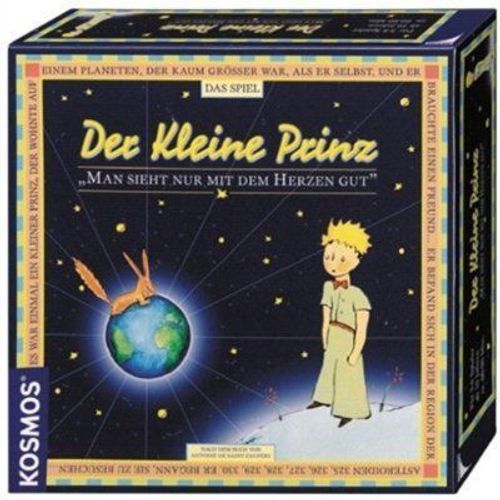
Der Kleine Prinz
Der Kleine Prinz Rulebook
Table of Contents
Table of Contents
Object of the Game
When the little prince and the fox meet on Earth, the player who has managed to place the most stars in the sky wins. If the little prince does not reach the fox, because it has disappeared into its burrow, all players lose, as they have failed to tame the fox.
Components
- 1 game board
- 4 x 55 task cards
- 30 rating cards
- 150 stars
- 1 pad
- 6 pencils
- 1 fox (to stand up)
- 1 little prince (to stand up)
- 1 hourglass
Setup
- Before the first game, carefully punch all cardboard parts out of their frames, and assemble the two game figures with their holders in a cross shape.
- Place the game board in the middle of the table.
- Place the little prince on its light-blue home planet, "Asteroid B612".
- Place the fox on its starting space on Earth, directly below Asteroid 330, the planet of the Geographer.
- Set out the hourglass.
- Each player receives 1 pencil and 1 sheet of paper.
- Each player receives his rating cards, one fewer than the number of players taking part. Example: with 4 players, each player receives 3 rating cards (one each showing 1, 2 and 3 stars). With 5 players, each player receives rating cards showing 1, 2, 3 and 4 stars.
- Each player takes a set number of stars and places them in front of himself: with 3 players, 40 stars; with 4 players, 35 stars; with 5 players, 30 stars; with 6 players, 25 stars.
- Return the remaining stars and rating cards to the box.
- Shuffle the task cards separately by their four backs. Each player receives 2 cards from each stack, face down, so that each player has 8 cards, which he looks at. Place the remaining cards in their four stacks next to the game board.
- The oldest player begins.
Course of Play
Playing a Task Card
Play goes clockwise. The player whose turn it is chooses one of his cards that he wishes to play. This task must now be carried out by all players. If the task is solved successfully, stars may be placed on the game board as a reward. These stars are always placed on the round star spaces at the location where the little prince currently is, that is, on the spaces around the respective planet or above the fox spaces on Earth.
Note: There are white and light-blue star spaces. Only with 5 and 6 players are all spaces used. With 3 or 4 players, only the white spaces are covered with stars.
The Journey of the Little Prince
Whenever all star spaces at the little prince's location are occupied, the little prince is moved one planet further clockwise. After Asteroid 330, it is placed on the fox space directly below it. Then it continues its journey on Earth.
Card Exchange
Whenever the little prince has moved on to the next planet, or one walking space further on Earth, then, starting with the player who placed the last star, each player may exchange any one of his cards for a card of the same task type. He places the card he does not like under the corresponding card stack and takes the top card of that stack into his hand.
Note: If all 8 cards of a player have been used up, he receives 5 new cards. (Transcriber's note: the printed sentence reads "bekommt er nieder S neue Kulten", which is garbled in the scan. "5 new cards" is the transcriber's reading of the printed "S" and "Kulten" in context; check against a clean copy of the sheet.)
The Four Task Types
Erkläre mir ... (Explain to Me ...)
These cards show simple line drawings. When someone plays such a card, it is placed face up on the game board and the hourglass is turned over. Until the hourglass runs out, all players must think of a suitable explanation for the drawing and write or draw it on their paper, the more original, funny or curious the better.
One may write a subtitle or a heading for the picture. One may also explain what can be seen in the picture by, for example, tracing the drawing and adding strokes so that a new overall picture emerges in which the old drawing is contained. What matters is only that one tries somehow to explain what can be seen in this picture. There are no limits to imagination.
Example: Possible explanations:
a) Starship Enterprise after a collision with a Klingon cruiser b) An avant-garde desk lamp c) A trailer hitch for a caravan d) With a little imagination, you can also simply trace this drawing and repeat the circles on the left. A few more strokes, and you have a cosy-looking owl.
After the hourglass has run out, all players present their results in turn, starting with the player who played the card. Afterwards the players rate each other. Each player considers which creative achievement of the other players he liked best, second best, and so on. Then he places one of his rating cards face down on each other player's paper. Even when this is sometimes not so easy, one must decide and distribute all of one's rating cards among the other players.
Example: With 5 players, each player has rating cards showing 1, 2, 3 and 4 stars available. The player whose idea one liked best receives the face-down 4-star card, the second best receives the 3-star card, and so on.
When all rating cards have been distributed, the players shuffle the cards they have received, so that it remains secret from whom one received which card. Then each player turns over the cards lying on his paper and counts the stars shown on the cards he received. The player with the most stars on his cards may place 3 stars on the game board. The player with the second most star symbols may place 2 stars, and the third-placed player 1 star. If two players have received rating cards with the same number of star symbols, both may place the same number of stars in the sky.
The rating cards are then collected and handed out again, so that each player again has his full set, e.g. with 5 players, the cards with 1 to 4 stars.
Zeichne mir ... (Draw Me ...)
The player who plays this card first reads out to the other players what he is to draw (e.g. "Draw me an object from your childhood bedroom that you remember well!"). Then he takes pencil and paper, turns the hourglass over, and tries to fulfil the task using only a drawing. (If, for example, he had a Beatles poster in his childhood, he tries to draw this motif.)
The other players now try to guess what the player is drawing and call out their suggestions. The drawing player may only show, with yes, no, nodding, shaking his head, silence, etc., whether the other players are right or not. He may give some help: if, for example, "poster" has already been guessed, he may say: "Yes, poster is right, but who was on it?"
It is also permitted to help a little with remarks such as "close", "quite cold", "more precisely", etc. If a player manages to interpret the drawing correctly before the hourglass runs out, that player places 3 stars on the game board. But the drawer may also place 2 stars on the board as a reward, for he has drawn well!
Erinnere dich ... (Remember ...)
The player who plays this card first reads the task silently and tries (without revealing anything to the other players) to remember what is named on the card, or to think about what the card asks for (e.g. "Remember something at the circus that you particularly enjoyed!" The player recalls that at the performance of the trapeze artists his breath always nearly stopped.). Then he reads the task aloud to the other players. The hourglass is turned over. The players now try, by skilful questioning, to find out what the player is remembering.
Note: For this type of task, the players have double the hourglass time. Therefore, if the task has not yet been solved, the hourglass is turned over again after the first run.
Example: "Is it something with animals? No... Was it something with acrobats?... Yes! etc."
The player may only answer "Yes" or "No". Questions are asked in turn, always one question each. If there are pauses, questions may exceptionally be asked out of turn. The first player to guess the player's memory may place 3 stars in the sky. But the player who remembered may also place 2 stars in this case.
Entscheide dich ... (Decide ...)
In this type of task, the aim is to correctly complete a quotation from the book "The Little Prince". The player who plays this card reads the beginning of the quotation to the other players and then slowly reads the four different suggested answers. Only one of them is correct. Which answer is correct is indicated at the bottom of the card (upside down) by the small letter. All players now give, in turn, a guess as to how the quotation correctly continues.
Example: "And I love to listen to the stars at night. They are like ... a) ... a rustling heavenly choir. b) ... a thousand quiet trombones. c) ... five hundred million little bells. d) ... an endlessly lasting concert."
Important: Before the players give their guesses, or before the player who played the card reads the quotation to the others, that player may secretly bet on how many players will find the correct answer. He sets aside from his rating cards the one with the matching number of stars, and places it face down. Example: If he believes 2 other players will guess correctly, he sets aside the rating card with 2 stars and places it face down.
When all players have given their guess, the player reveals the secret and states the correct answer. All players who gave the correct answer may place 2 stars. Note: In a game with 4, 5 or 6 players, a player who alone gave the correct answer may even place 3 stars. If the player who read out the quotation correctly guessed how many players would find the correct solution, he may also place 2 stars.
The Fox Runs Away
Whenever a task has not been fulfilled by the players, the fox is sad and disappointedly moves one space on Earth in the direction of its burrow.
This is the case when a player, for "Explain to me", has no explanation come to mind; or when, for "Draw me" or "Remember", the term was not guessed within the hourglass time; or when, for "Decide", nobody continued the quotation correctly.
End of the Game
The game ends when the little prince meets the fox on a space on Earth. At this moment he has tamed the fox, because "to tame the fox" means to make oneself "familiar" with it.
The more familiar the players have become during the game, the closer the little prince may move towards the fox. If the fox lets the little prince sit directly beside it on its space, the little prince has tamed the fox, and the player who has brought the most stars to the sky wins, that is, the one who now has the fewest stars left in front of him.
Exception: The game may also end early, when a player has been able to place all of his stars on the game board. He has then won early.
Special Situation: The Fox Reaches Its Burrow
When the fox stands on the space with its burrow, the players may no longer afford a single mistake. For if the fox would have to be pulled back the next time because the players did not solve a task, then the fox disappears from the game board into its underground burrow and can no longer be reached by the little prince.
If this happens, all players have lost together, because they have not managed to tame the fox. Whether the players have many stars still in front of them does not matter.
But even if this rare case occurs, the players have become closer to one another than at the start of the game. And nobody has lost. For there is nothing finer than spending a pleasant time together with dear friends and relatives.
Variant: Playing in a Familiar Group
If you play the game in a "familiar" group, that is, if all players already know each other relatively well, you can increase the incentive: each time a task is not solved by a player, the fox moves two spaces instead of one space back towards its burrow. After the 4th time, the fox has then disappeared into its burrow and the game ends early.