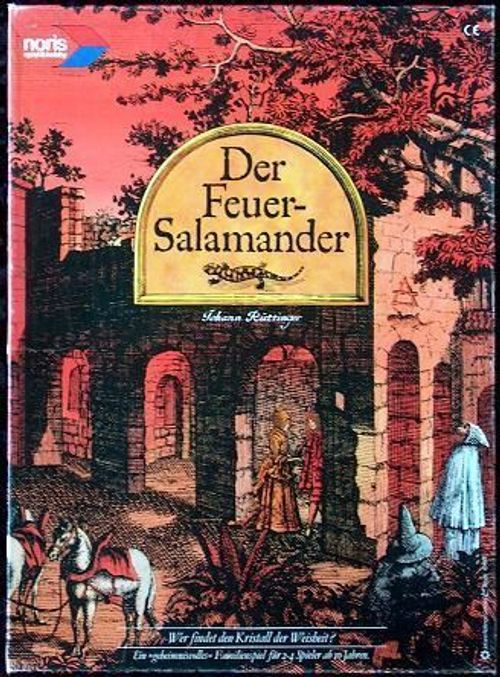
Der Feuersalamander
Der Feuersalamander Rulebook
Table of Contents
Table of Contents
- Components
- Preparatory Explanations
- The Game Board (Der Spielplan)
- The Hiding Place (Das Versteck)
- The Throwing Sticks (Die Wurfstäbe)
- The Playing Figures (Die Spielfiguren)
- Game Preparation (Spielvorbereitung)
- Aim of the Game (Ziel des Spieles)
- Course of Play (Spielverlauf)
- Throwing the Sticks (Das Werfen der Wurfstäbe)
- Setting the Playing Stones (Das Setzen der Spielsteine)
- Moving the Playing Figure (Das Ziehen mit der Spielfigur)
- Why Does One Move at All? (Warum zieht man überhaupt?)
- What Does One Ask About? (Wonach fragt man?)
- Why Does One Ask? (Warum fragt man?)
- The Answer to a Question (Die Antwort auf eine Frage)
- Laying Down a Complete Combination
- Winning the Game (Wer gewinnt das Spiel?)
- Going to the Dungeon (Wann kommt ein Spieler ins Verlies?)
- Further Important Rules (Weitere wichtige Regeln)
- End of the Game (Ende des Spieles)
Components
Players: two to four. Age: from 10 years. Playing time: varies, between 30 minutes and 2 hours, as the players choose.
- Large game board
- 4 large wooden playing figures (King / red, Queen / yellow, Monk / white, Robber / grey)
- 4 playing stones (markers) in the colours of the playing figures
- 8 answer cards (2 per player)
- 47 Salamander cards
- 3 throwing sticks (2 number sticks, 1 symbol stick)
- Rulebook
Preparatory Explanations
The Salamander Cards
Each Salamander card bears one indication (coordinate). The 47 cards are distributed as follows:
- Each element (wing) is present 4 times = 16 cards. The elements are Air (Luft), Water (Wasser), Earth (Erde) and Fire (Feuer).
- Each stone field is present 5 times = 15 cards. The stone fields are One-Stone (Ein-Stein), Two-Stone (Zwei-Stein) and Three-Stone (Drei-Stein).
- The rows are distributed as follows: 1 x Row 1, 2 x Row 2, 3 x Row 3, 4 x Row 4, 3 x Row 5, 2 x Row 6 and 1 x Row 7 = 16 cards.
The Game Board (Der Spielplan)
The game board shows the cross-shaped hiding place of the Fire Salamander with its 84 chambers. In the centre of the hiding place is the dungeon (Verlies). The starting places (Startplätze) of the four figures lie between the four wings of the hiding place: the palace of the King, the palace of the Queen, the abbey of the Monk, and the ruin of the Robber.
The spaces that pass the starting places form, despite the interruptions, together a "circuit" (Rundkurs), on which the playing figures move clockwise during the game.
At the beginning of the game (with four players) all 4 playing figures and the corresponding playing stones stand on their respective starting places. Each player receives the two answer cards (YES/NO) that correspond to his figure. The 47 Salamander cards are well shuffled and placed face down in a stack at the edge of the game board. The illustration shows the layout for 4 players. (If only three or two players play, the playing figures, playing stones and answer cards that are not needed are removed from the game.)
Board labels: spaces of the circuit (Felder des Rundkurses); the King in the red "palace"; the Queen in the yellow "palace"; the Monk in his "abbey"; the Robber in his "ruin"; the hiding place of the Fire Salamander with 84 chambers; the dungeon.
The Hiding Place (Das Versteck)
Of the 84 chambers of the hiding place, 21 chambers are located in each wing. Each individual chamber can be precisely determined by 3 indications (coordinates):
1st Indication: The Wing (Der Flügel)
The four wings of the hiding place are named after the four known basic elements – Air (Luft), Water (Wasser), Earth (Erde), Fire (Feuer).
2nd Indication: The Row (Die Reihe)
Each wing is divided into 7 rows. Thus in each wing there is a 1st, 2nd, 3rd row and so on. (The planet symbols on the right-hand side of the rows have no special meaning.)
3rd Indication: The Stone Fields (Die Stein-Felder)
Each row is divided into three fields: the "One-Stone field" (Ein-Stein-Feld), the "Two-Stone field" (Zwei-Stein-Feld) and the "Three-Stone field" (Drei-Stein-Feld). The stone fields are recognisable by the number of stones depicted in the three outer fields, which stand in for all stone fields.
By the indication of one wing, one row and one stone field, a chamber is precisely determined.
Two examples:
- The chamber "Water" – "3rd Row" – "Two-Stone" is located here. (Map label.)
- The chamber "Fire" – "7th Row" – "One-Stone" is located here. (Map label.)
The Throwing Sticks (Die Wurfstäbe)
The two number sticks (Augenstäbe) show numbers from 1 to 4. They determine how far a figure may go on the circuit.
Illustrations: the two number sticks (showing 2 and 4 pips), the symbol stick, and the three sticks showing the key symbol.
A special rule applies:
The player may choose to add together the numbers of the two sticks or to subtract them from one another. If the numbers are added together, one can move between 2 and 8 spaces. One makes "big steps". If the numbers are subtracted from one another, one moves between 0 and 3 spaces. One makes "small steps".
It is therefore possible in this game to remain standing even after a throw: namely when a player decides to subtract the pips and the two throwing sticks show the same value (4 – 4 = 0, 3 – 3 = 0 and so on).
The symbol stick (Symbolstab) shows the "Salamander symbol" twice and the "playing-stone symbol" (Spielstein-Symbol) twice.
Whoever throws the "Salamander symbol" must take one Salamander card from the stack of face-down Salamander cards. Whoever throws the "playing-stone symbol" must place his playing stone on one of the 84 chambers of the hiding place. (How it is placed is explained in detail below!)
On the edge of all three throwing sticks there is a "key symbol" (Schlüssel-Symbol).
In the normal course of the game this key has no significance and need not be taken into account. If a player, however, lands in the dungeon, he must – in order to get free – make the "key throw" (Schlüsselwurf). This works as follows:
The player has at most 5 throws available. His aim is to get all three keys to lie face up. If a stick shows the key, that stick is left lying and the player continues to throw with the remaining sticks. If a player succeeds in getting all three keys to lie with at most 5 throws, he is free. That is: he may set his figure on his starting place and immediately throw all sticks once more for a normal move. If a player does not succeed in getting all three keys, then when he is next on turn he must try the key throw again. In the meantime his figure remains in the dungeon.
The Playing Figures (Die Spielfiguren)
- The King (red) – Der König (rot)
- The Queen (yellow) – Die Königin (gelb)
- The Monk (white) – Der Mönch (weiß)
- The Robber (grey) – Der Räuber (grau)
Game Preparation (Spielvorbereitung)
Each player chooses a playing figure (plus playing stone), places both on the corresponding starting place and, if possible, sits at the side of the game board on which his starting place lies. He takes the two answer cards that match his figure (recognisable on the back!). Now a player deals out, going around the table from the stack of Salamander cards, 2 Salamander cards to each player; these are taken face down. Before the game begins each player therefore has 2 Salamander cards in hand, which he must on no account show to the other players.
Important: If the two cards dealt out are of one kind (two wing cards, two row cards or two stone-field cards), the player concerned must immediately discard one of them – and indeed face up next to the stack of Salamander cards. However, the player receives no replacement card for it! At the start he therefore has only 1 Salamander card in hand.
An example: A player is dealt a Fire card and a Water card. He thus has two cards of one kind (namely two wing cards) in hand. He must immediately discard one of them.
At the end of game preparation the players throw a number stick in turn. Whoever reaches the highest result may begin the game.
Aim of the Game (Ziel des Spieles)
Each player always pursues two main goals:
First, he tries to obtain combinations of 3 Salamander cards of different kinds, which he may then lay down face up. Second, he tries to reach, with his laid-down combinations, a certain number of points agreed on beforehand, because every complete combination (consisting of one wing card, one row card and one stone-field card) has a certain value lying between 1 and 84 points. (Calculation examples follow!)
Whoever first reaches or exceeds the agreed point value with one or more laid-down combinations has won the game.
Course of Play (Spielverlauf)
Throwing the Sticks (Das Werfen der Wurfstäbe)
Each player normally has one throw, in which he lets all three sticks fall at the same time from a height of about 15–20 cm.
Illustration: a hand dropping the sticks onto the table.
When the three sticks have come to rest, the player begins evaluating his throw:
First the symbol stick is evaluated.
If it shows the "Fire Salamander" symbol, the player concerned must take the top of the face-down Salamander cards, without the other players seeing it. If the player already has two Salamander cards in hand (almost always the case at the start!), he must – after looking at the card taken – immediately discard one of the three cards, and indeed face up next to the stack of face-down Salamander cards.
The following double rule applies throughout the game:
A player may never hold more than 2 Salamander cards in his hand. Furthermore, he may never keep 2 Salamander cards of the same kind.
If a player has only one or no Salamander card, he must keep the card taken – unless he already has one of that kind (see the double rule).
Setting the Playing Stones (Das Setzen der Spielsteine)
If the symbol stick shows the "playing stone" symbol, the player concerned must place his playing stone (which until then lay on the starting place) on one of the 84 chambers, and indeed in such a way that the coordinate information(s) which he holds in the form of his Salamander cards in hand at this moment are represented truthfully by the playing stone.
Examples:
If at the moment he throws the "playing stone" symbol a player has "Water" and "Three-Stone" in hand, he must place his playing stone on the Water wing and there on a Three-Stone field. Whether he chooses a Three-Stone field in row 1, 2, 3 or any other row is immaterial. The only important thing is that his stone lies on the Water wing and on a Three-Stone field.
Illustration: the Water wing grid, with the red playing stones placed on the three-stone column in rows 1 to 7.
If a player has only one Salamander card, for example "Fire", in hand, he must place his stone on the Fire wing, but there he may choose any of the 21 chambers as he likes, since he has no other information apart from "Fire". If a player has no card in hand, he of course need not place the stone.
The interesting thing about placing the playing stones is that the other players do receive hints about the Salamander cards of a player, but they can never know why a certain chamber was chosen: it can after all have happened for three different reasons...
When placing the playing stones one must act truthfully, nevertheless one may bluff!
Furthermore, a playing stone that has been placed remains on the chamber until the player concerned throws the "playing stone" symbol again. This means that during the game playing stones may also lie wrongly, namely when the information of a player changes through taking up and discarding Salamander cards, without the player having meanwhile thrown the "playing stone" symbol. Only when he throws the "playing stone" symbol again must he correct the playing stone!
Moving the Playing Figure (Das Ziehen mit der Spielfigur)
After a player has thrown and evaluated the throwing sticks, he moves. A player always "enters" the circuit via the middle of the 5 spaces that pass his starting place:
Illustration: the castle with an arrow leading onto the circuit.
He then always moves clockwise around in a circle, passing the starting places of the other players. How far he moves is determined by the two number sticks, whose values – as already described – may be added together or subtracted from one another.
A player who moves clockwise away from his starting place counts the middle of the 5 spaces as the first space.
Important: If a player throws a pair (both number sticks show the same value), then after completing his move the player may make a new throw with all three sticks and act accordingly.
Why Does One Move at All? (Warum zieht man überhaupt?)
Whoever comes to a stop with his playing figure on any of the 5 spaces that pass a player's starting place may ask that player one question.
Example: If the "Monk" comes to a stop with his playing figure on one of the 5 spaces that pass the "King's" palace, then the "Monk" may ask the "King" one question.
Important: If a player makes "small steps" and thereby remains, over several moves in succession, within the 5 spaces of one starting place, then he may ask the "visited" player one question each time.
What Does One Ask About? (Wonach fragt man?)
One asks about the information on a Salamander card that the "visited" player holds in hand.
There are three ways of asking:
a) The question about a wing. Form of question: "Do you have a Fire card (Water, Air, Earth card)?" One may ask about only one wing per question.
b) The question about a row. Form of question: "Do you have the 1st (2nd, 3rd, etc.) row?" One may ask about only one row per question.
c) The question about a stone field. Form of question: "Do you have One-Stone (Two-Stone, Three-Stone)?" One may ask about only one stone field per question.
The playing stones placed by the players give very good pointers for questions!
Why Does One Ask? (Warum fragt man?)
The aim is to lay down combinations of three Salamander cards. One may hold only two cards oneself. Therefore one must ask another player for the third card.
The Answer to a Question (Die Antwort auf eine Frage)
While a player must put his question to the "visited" player orally, so that it is understood by all players, the answer of the player asked is always given with the help of the two answer cards that each player has.
Rules for this: The question must be answered truthfully with "YES" or "NO". So that the other players do not see the answer, the answering player holds up the corresponding answer card to the questioner so that it cannot be seen by the others.
Important: If a question is answered with "YES", that does not yet mean that the questioner immediately receives the card he has guessed. Rather, it remains in the possession of the player asked and can even be discarded if this player may draw a new Salamander card. Only when a player is able to lay down a combination may he have cards given to him by other players.
An important matter in connection with questions: If a player who is asked a question is in the dungeon, he is freed by the question – without having had to make a "key throw". He may immediately place his figure on his starting place. (By a "key throw" one can free oneself, by a question one is freed by other players!)
Laying Down a Complete Combination
The aim of every player is to lay down complete combinations – consisting of one wing card, one row card and one stone-field card. For this the player depends on at least one card of another player. For this reason one constantly asks about the information on the Salamander cards of other players.
If a player now believes that he has found out, by asking another player, the third card still missing for a complete combination, he must return to his starting place as quickly as possible along the circuit (clockwise!). There he must – again via the middle space – leave the circuit and go directly to his starting place (the number rolled may be higher than necessary when turning onto the starting place!).
Illustration: the castle with an arrow.
Only when the figure stands on the starting place may the player lay down the combination.
This is how it works:
The player first lays his own Salamander cards that he needs for the combination face up on the table. Then he names the player or players who in his opinion have the missing cards, and names these cards precisely. (For example: "The Queen" has the "5th row" in hand, and so on.) If he is right in his claim, the players named must hand over the cards named. These are added to the cards already lying down – the combination is complete. It stays face up in front of the player who laid it down. The player then tries to obtain further combinations by collecting Salamander cards and asking questions...
If, however, it turns out that the player was not right in his claim (a named player did not hold the card named), then the player who wanted to lay down the combination must take his laid-down cards back into his hand and go into the dungeon! The disadvantage: the other players now know his cards exactly and may perhaps be able to lay down combinations themselves.
The Value of a Laid-Down Combination
The individual cards have the following values:
| Card | Value |
|---|---|
| One-Stone (Ein-Stein) | 1 |
| Two-Stone (Zwei-Stein) | 2 |
| Three-Stone (Drei-Stein) | 3 |
| Air (Luft) | 1 |
| Water (Wasser) | 2 |
| Earth (Erde) | 3 |
| Fire (Feuer) | 4 |
| Row 1 | 1 |
| Row 2 | 2 |
| Row 3 | 3 |
| Row 4 | 4 |
| Row 5 | 5 |
Every complete combination has a certain value, which is calculated quite simply:
One multiplies the values of the three cards together.
Calculation examples:
- The combination "Earth" – "Three-Stone" – "2nd Row" has the value 3 x 3 x 2 = 18.
- The combination "Air" – "One-Stone" – "1st Row" has the value 1 x 1 x 1 = 1 (the worst combination).
- The combination "Fire" – "Three-Stone" – "7th Row" has the value 4 x 3 x 7 = 84 (the best combination).
Winning the Game (Wer gewinnt das Spiel?)
The player whose combinations together reach or exceed a previously agreed target value has won the game. The order of the others results from the value of their face-up combinations.
Possible target values:
- 49 points (for a quick game)
- 84 points (the last target value that can be reached with a single combination)
- 85 points (the first target value that can no longer be reached with a single combination)
- 100 points (for enduring players)
Naturally, a game round is free to agree on other target values as well.
Going to the Dungeon (Wann kommt ein Spieler ins Verlies?)
- Whoever comes to a stop with his playing figure on a space on which another playing figure already stands sends the "thrown" figure into the dungeon.
- If a player, when laying down a combination, does not receive a card of another player because he was mistaken in his supposition.
Incidentally:
The dungeon does not only have disadvantages! It may be that a player who does not make the "key throw" or to whom no question is put is, for a longer time, "out of action". On the other hand, it is the case that on being freed one returns to one's starting place. That, after all, is the condition for being able to lay down a combination.
Whoever thus comes out of the dungeon may immediately lay down a combination, if that is possible for him. However, one may do so only if one is on turn, that is, has been freed by a key throw. (Not if one was freed by a question!)
Further Important Rules (Weitere wichtige Regeln)
- It is not absolutely necessary to fall back on the two Salamander cards of one's own when one wants to lay down a combination. Rather, two or even three cards of other players may also be used for one's own combination. If, however, one makes a mistake in naming the cards, then players whose cards have become known may exchange them for new ones, if they wish! And as a "penalty", the player concerned must reveal his own card(s), without being allowed to exchange them.
- If only two players are playing, the answer cards are not needed.
- With fewer than 4 players the circuit is shortened, that is, when moving one simply skips the five spaces of the unoccupied starting place. The circuit then has only 15 spaces (with three players) or 10 spaces (with two players).
- If a player has laid down a combination and has used the two Salamander cards for it, he takes his playing stone off the chambers and places it on his starting place.
End of the Game (Ende des Spieles)
If a player has reached the agreed point total (target value), the game is over. If several games are played, the individual results of the players can be added together in order to determine an overall winner.
And now much fun with this Noris game!