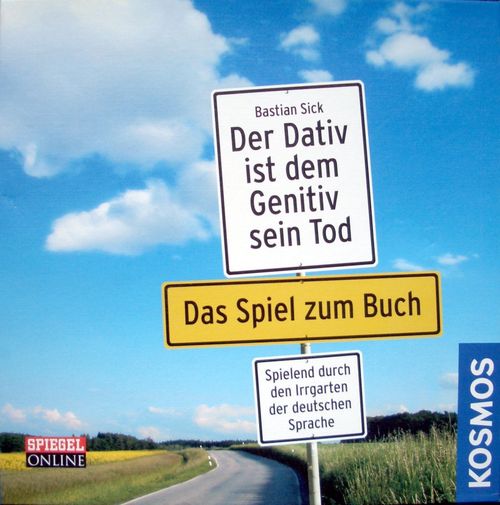
Der Dativ ist dem Genitiv sein Tod
Der Dativ ist dem Genitiv sein Tod Rulebook
Table of Contents
Table of Contents
Components
- 180 cards with 360 sentences on the themes of the books
- 5 guess cards marked „RICHTIG“ (RIGHT)
- 5 guess cards marked „FALSCH“ (WRONG)
- 100 point chips
- 1 Decoder
- 1 rulebook
Setup
Before the first game, carefully punch the guess cards out of their frames. Each player receives one „RICHTIG“ guess card and one „FALSCH“ guess card. The point chips stay in the box as a supply.
Shuffle the game cards and place the following number of them as a draw pile in the middle of the table:
- 5 players: 20 cards
- 4 players: 24 cards
- 3 players: 24 cards
- 2 players: 26 cards
Unneeded cards and surplus guess cards go back into the box.
The Cards
Each card has a sentence with one gap on both sides. Below each sentence are two to four solution options. At least one of the given options is correct. At the very bottom of the card is the solution in encrypted form. It can be read through the red viewing window of the Decoder.
Card layout, labelled on the card diagram:
- Category (what topic it is about)
- Sentence with a gap
- Solution options
- Encrypted solution
Hint: If you look very closely, it is possible to decipher the text on the lower part of the card even without the Decoder. Players should therefore play fair and concentrate on the upper part of the card until the solution is revealed, or cover the lower part with their hand.
Game Flow
The youngest player begins as the reader (Vorleser). The reader places as many point chips from the supply in the middle of the table as there are players taking part (including themselves).
The reader draws the top card from the draw pile and chooses the front or the back side. They name the category of the card side, choose exactly one of the offered variants of the sentence, and read it aloud clearly. The other variants are not named yet. The variant read aloud does not have to be the correct one: the reader may also read out a wrong version.
Now the reader and all other players vote secretly with their guess cards on whether the read-out sentence is right or wrong. If the other players do not know what to pay attention to, the reader should also say which part of the sentence is concerned.
Once all players have placed a guess card, everyone reveals their guess cards at the same time. The reader places the card in the Decoder and names the correct version of the sentence, or the correct versions if several answers are correct.
Hint: The reader should not just say "Right are a and b", because the other players have only heard one solution option. The reader therefore reads aloud all correct versions of the sentence. The reader may also read out the wrong solution options if they find them especially funny, but should point out which answers are wrong and which are right.
After that, the reader reads aloud the explanatory text. Each player who voted correctly receives one chip from the middle of the table. If the reader read out a wrong variant, the players who voted „FALSCH“ receive one chip each. If the reader read out a correct variant, the players who voted „RICHTIG“ receive one chip each.
The reader receives all chips that were not won by the other players, but only if the reader has correctly judged whether the sentence they read out was right or wrong. If the reader is wrong, they win nothing. The card is put back into the box. Then the next player clockwise takes a turn. They draw a new card from the draw pile and refill the point chips in the middle of the table from the supply until there are again as many chips out as there are players taking part.
When all cards of the draw pile have been used up, the game ends. The player with the most point chips wins.
Tactical hint: The reader should read out the variant that they
a) are more certain is wrong or right, and ... b) suspect the other players will get most wrong.
The game is therefore not only about knowing the book themes well, but also about judging the other players and possibly leading them astray. If the other players make many mistakes, the reader wins the most points.