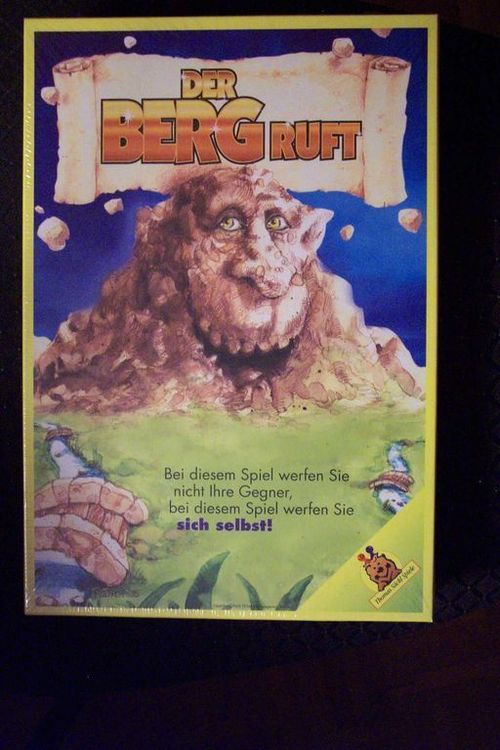
Der Berg ruft
Der Berg ruft Rulebook
Table of Contents
Table of Contents
Goal
Little 'Heidi' is visiting her uncle, who lives on top of a high mountain, the Phototapetetl. Because she does not know the way, she is guided by 'Peter', the mountain guide. Importantly, Heidi can never overtake Peter while climbing. As soon as this happens, the pair must start over. The game ends as soon as a player's Peter reaches the summit. The winner, however, is the player whose pair causes the 'smallest' rockslide.
Setup
- The game board is laid out. The Phototapetetl mountain is divided into 17 'steps'. Each step has rock boulders and stones on it. One rock boulder counts as 5 stones. These stones and rocks determine the size of the rockslide each player causes at the end of the game.
- Each player chooses a pair ('Heidi' + 'Peter') and places 'Heidi' in front of the stream and 'Peter' behind it (on the mountain side).
- The starting player receives the screen and the 15 little flags.
Gameplay
Each turn involves two players: the first player (= the Caller, 'Rufender') makes the mountain 'call', and the second player (the player to the left of the previous one, = the Guesser, 'Tippender') tries to find out how many times the mountain does so.
The number of times the mountain 'calls' is set by the number of flags the first player stands upright behind the screen. This number is at least 0 and at most 15.
The second player now tries to guess this number and makes a first guess. If it is wrong, the first player may allow a second guess. To do so, the first player must first state whether the number sought is smaller or larger than the first guess. The second player must take this information into account. This is repeated a third (and final) time if the guess was again wrong. After this third guess, the screen is removed. The first player may, however, also remove the screen after the first or second guess. (It is the first player who determines how many guesses the opponent may make.)
If the number of flags is not guessed, the game pieces of the first player are moved as follows:
- The figure 'Peter' is moved first. The number of steps he advances equals the difference between the last guess and the truth. (If the difference is greater than 3, see the note!)
- The figure 'Heidi' is moved as many steps as the number of guesses made (at most 3). If, as a result, 'Heidi' is at least at the same height as 'Peter' (equal or further), the pair must start over. Both figures are then placed again on their starting spaces.
The figures of the second player remain where they are in this case.
If the number of flags is guessed correctly after one, two or three guesses, the pair of the first player must start over, and the pair of the second player receives a bonus (both figures may then move forward a few spaces!):
- correct guess after 1 turn: both figures move forward three spaces
- correct guess after 2 turns: both figures move forward two spaces
- correct guess after 3 turns: both figures move forward one space
Notes:
- If, after a third wrong guess, the difference between the guess and the truth is still greater than three, the first player's 'Peter' figure may nevertheless move only three spaces forward. The second player is penalized for this bad guessing: their 'Peter' must move back one space, and their 'Heidi' must move back three spaces. If their 'Heidi' figure thereby reaches its starting space again, their 'Peter' must also be placed back on its starting space. By deliberately guessing wrongly, one cannot really hit the opponent... on the contrary! (The first player may, however, ignore this rule and let their 'Peter' figure move more than three spaces forward. In this case the second player is of course not penalized.)
- If the first player accepts the first (or second) guess where the difference is greater than three, all steps must be placed (and nobody is penalized).
End of Game and Scoring
The game ends as soon as a 'Peter' figure reaches the summit. The summit does not have to be reached exactly. Excess steps are forfeited.
Conditions for being allowed to reach the summit and end the game:
- The first player may reach the summit after a first guess only if their 'Heidi' figure is at most three steps behind (this is the step with the two rock boulders). If this is not the case, the first player must still allow at least one more guess. The 'Heidi' figure must then move as many steps forward as there were guess turns, but may in no case reach the summit.
- The second player may reach the summit only if they make a correct guess and their 'Peter' figure can reach the summit thanks to the bonus. Their 'Heidi' figure must then also move as many steps forward as the 'Peter' figure needed to reach the summit.
The player who reaches the summit first is not simply the winner. For each participant, the rockslide they caused is calculated with the following formula: the number of stones on the step of the 'Peter' figure is multiplied by the number of free steps between the paired 'Peter' and 'Heidi' figures. This result can vary greatly. If both figures stand directly behind each other, the result is zero, and the pair has played excellently.
If several players have the same result, the winner is the player whose two figures stand closest together. If several players score 'zero', the winner is the player whose pair has got furthest.