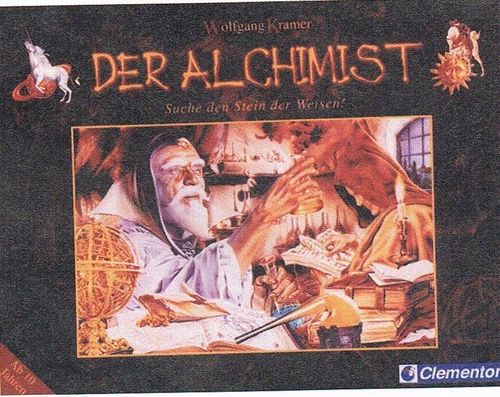
Der Alchimist
Der Alchimist Rulebook
Table of Contents
Table of Contents
- Game Contents
- Object of the Game
- Game Setup
- The Alchemist Cards
- Course of Play
- The Philosopher's Stone
- Explanation of the Spaces on "The Path of Life"
- Alchemy Points for the "Path of Life"
- Alchemy Points for Answering the Questions
- Determining the Winner
- Example of a Game Turn
- The Questions and the Answers
Game Contents
- (1) Board
- (6) Alchemists (Pawns in 6 colours)
- (90) Alchemist Cards (Alchemistenkarten), consisting of:
- 64 Competency Cards (Fähigkeitskarten):
- 16 Wisdom (Weisheit) (light blue borders)
- 16 Fantasy (Phantasie) (yellow borders)
- 16 Energy (Energie) (pink coloured borders)
- 16 Humour (Humor) (light green borders)
- 26 Special Cards (red borders):
- 12 "Philosopher's Stone" cards ("Stein der Weisen")
- 9 Gold cards
- 5 Challenge cards (Herausforderungskarten)
- 64 Competency Cards (Fähigkeitskarten):
- (96) Creativity Cards
- (32) Question Cards (8 each in yellow, blue, green and red)
- (160) Answer Cards (40 each in yellow, blue, green and red)
- (1) Philosopher's Stone
- (5) Letter Dice
- (1) 30 second Sand Timer
- (100) Point Chips with Alchemy Points (30 ones, 25 twos, 20 fives, 20 tens, 5 fifties)
- (1) Bag for the Point Chips
- (3) Rules Summaries
Object of the Game
Every player would like to become an alchemist. He will be successful, if he accumulates more than 60 Alchemy Points. The winner of the game is the player who collects the most Alchemy Points. You collect Points Chips, if you:
- make progress on the path of life. (the further you go, the more points you get.)
- find the appropriate word for a Creativity Card.
- find the correct answer to a Question Card.
- play all of the Alchemy Cards from your hand. (Bonus).
Game Setup
First of all punch out the Point Chips and place them in the draw bag. Sort the Question and Answer cards into the four colours: yellow, blue, green and red. At the beginning of the game, players choose with which colour they wish to play. The Question and Answer cards of the colours not chosen are not required for this game.
The Question and Answer cards cover the following concepts:
- Yellow: harmony, culture, positive thinking, selflessness, repression, chance, doubt
- Blue: consciousness, equanimity, luck, hope, creativity, feelings of inferiority, sense of life, responsibility
- Green: anxiety, energy, friendship, patience, humour, longing, play, time
- Red: research, freedom, art, love, meditation, fantasy, self-awareness, wisdom
Pawns: Every player places his/her pawn on the space with the castle.
The Philosopher's Stone is placed on the space of wisdom in the middle of the board.
The Alchemy Cards get shuffled. Each player is dealt 5 cards. Place the remaining cards in a pile on the board space marked Alchemy Cards (Alchimistenkarten).
The Question Cards: Choose one of the four colours and shuffle the 8 cards of the corresponding colour (the border on the back of the card). Each player receives a Question Card secretly, looks at it and places it privately in front of them. The remaining question cards are set aside. They are no longer required for this game.
The Answer Cards of the chosen colour (border on the reverse side of the card) will be dealt in 5 equal piles (each with 8 cards) and are placed on the pre-printed spots on the board. The spaces are directly next to the Book Spaces and are distinguished by a scroll.
The Creativity Cards are shuffled and placed in a face down deck on the space of the board with the words "Creativity Cards".
The 5 Letter Dice are placed next to the deck of Creativity Cards.
The Point Chips and the Sand Timer are placed next to the board.
Hand out the copies of the Rules Summary.
The Alchemist Cards
The Alchemist cards consist of:
- 64 Ability cards (16 Wisdom cards, 16 Fantasy cards, 16 Energy cards, 16 Humour cards)
- 26 Special cards (12 "Philosopher's Stone" cards, 9 Gold cards, 5 Challenge cards)
You must move your pawn forward exactly the number of spaces on the board as the number shown on an Ability card.
You may only play an Ability card which matches the area where Philosopher's Stone is currently placed.
Explanation of the Special Cards:
You can play special cards on your turn regardless of which area the Philosopher's Stone is currently located.
The "Philosopher's Stone" Cards: If you play such a card you are able, if you want to, to move the Philosopher's Stone to another area. Afterwards you may take another turn. You are able to play another Alchemy card or draw another 1-2 Alchemy cards from the deck.
The Gold Cards: With these cards you have the choice of moving your pawn 1, 2, or 3 spaces.
The Challenge Cards: When you play a Challenge card, you start a competition. It goes to whomever shows the highest total value of cards of the ability where the Philosopher's Stone is currently located. The cards have a "value" equal to their number. Gold cards are worth "3" in this case. All players must participate in this competition. Every player may play as many valid Ability and Gold cards as they want to. It is also possible to play no cards. After everyone has selected their cards, turn the cards over and add the values for each player.
Whoever played the cards with the highest total moves as many spaces on the board as the difference between the two highest totals. If two players are tied for the highest total, neither may move their pieces forward. Whoever shows the lowest total value must move 2 spaces back. If more than one player plays the lowest total value, all of those players must move two spaces back.
Discard all cards used in the challenge afterwards.
Example: Chris plays a Challenge card. The Philosopher's Stone is on the "Humour" area. Arno has a total of 8, Berta 4, Chris 12 and Dora and Erich have 0 as they did not play any cards. Chris moves his pawn 4 spaces forward, Dora and Erich must move 2 spaces backwards. The pawns of Arno and Berta stay where they are.
It is perfectly legal to land on a special space as a result of this action. If it is not currently your turn, this has no effect – with the exception of the Desert. Anyone who lands on a Desert space must go back 2 spaces!
Maximum of 12 Alchemy Cards in One's Hand: You are only allowed to have a maximum of 12 cards in your hand. If you are unable or unwilling to play a card during your turn, you may discard 1-2 cards and then replace them from the draw pile. Your turn then ends.
Exhausting the Alchemy Card Draw Deck: When the Alchemy Card draw deck runs out, shuffle the cards from the discard pile and make a new draw deck.
Bonus (No more cards in your hand): When you have played all of the cards in your hand, take 5 new cards from the draw deck and a 5 point chip. This also applies when you get rid of all your cards during a challenge.
Course of Play
Randomly choose which player starts first. Play then proceeds clockwise.
Every player moves their pawns by playing Alchemy Cards. How many spaces their pieces are moved forward are determined by the cards played. Every turn, you have two possible choices:
- a) You draw 1-2 Alchemy Cards from the deck into your hand.
- b) You play a card from your hand.
a) Drawing Alchemy Cards. If you draw 1-2 cards, your turn ends and the player to your left goes next. Your pawn does not move.
b) Playing an Alchemy Card. If you play an Alchemy Card, you are able to move your pawn forwards as many spaces as the number on the card. If your pawn lands on a normal space, your turn ends and play continues with the player to your left. If your pawn lands on some other type of space then your turn continues. The played card is discarded (form a discard pile to one side of the board). More than one pawn is permitted to be on the same space on the board.
The Philosopher's Stone
The Philosopher's Stone is always located in one of the four spaces of the circle in the middle of the board. It indicates with which of the four abilities you advance on the path of life. You are only able to play cards of the same ability or special cards.
Example: The Philosopher's Stone is currently in the Fantasy space. You may play only Fantasy cards or special cards.
Explanation of the Spaces on "The Path of Life"
(Trans. Note - The Board)
More than one pawn may occupy a space on the board. There are not any problems.
There are rules which apply when a player moves his/her pawn to a special space on the board. If your pawn is moved to a new space by board or card effects, then pay no attention to the special rules (exception – Desert).
The numbers on the spaces at the end of the Path of Life are the Alchemist points which a player receives at the end of the game for making progress along the path.
The spaces on the Path of Life have the following meaning:
The Normal Spaces
If you land on such a space, your turn ends. Play continues with the player to your left.
The "Philosopher's Stone" Space
If you land on one of these spaces you may, if you want to, move the Philosopher's Stone to another spot in the circle and take another turn, i.e. you may play another card and move your pawn or you do not move and you take 1-2 cards from the deck.
In this way, you can make great progress when you land on a "Philosopher's Stone" space, change to a new Ability, play an Ability card which matches the newly chosen Ability, then move to another "Philosopher's Stone" space, change to yet another Ability, and so on. Refer to the example at the end of the rules.
The Creativity Space
If you land on a Creativity space, everyone participates in a "word search" creativity competition. Draw the top card from the Creativity Card deck and read it aloud. Then roll the 5 letter dice and turn over the sand timer. All players now search for a word which matches a letter shown on one of the dice and relates to the topic read from the card.
When you think of a word, shout it out and take the die whose letter corresponds with the word you said. A player may take more than one die in this way. If someone said an incorrect word but took a die, they must return the die.
When all of the dice are claimed or the sand timer has run out, the creativity competition is over. The player whose turn it is receives 2 Alchemy Points for every die they claim for saying a valid word. Other players receive 1 Alchemy Point for every die they correctly took.
Vote when it is unclear whether a word is valid or not. A word is not correct when a majority votes against it. In a similar way, valid words are decided.
An example of a Creativity competition (4 Players: Arno, Berta, Chris, Dora). Arno has landed on a Creativity space. He draws the top card from the Creativity deck: "Something which one should not forget!" Arno rolls and turns over the sand timer. The Dice come up A, D, N, U and W. Dora says "Unlisted Number" and takes the die with the "U". Berta says "Wedding Day" and takes the die with the "W". Dora says "Names". The die with the "N" goes to her. Arno wants to take the die with the "A" and says "Account Number". Dora takes the last die with the "D" for herself by saying documents. Arno as the player whose turn it is gets 2 points. Berta, who also took one die, gets 1 point. Chris claimed no dice and gets no points. Dora has 3 dice and gets 3 points.
After the creativity competition, the Creativity card is discarded and the next player takes their turn.
The Book Space
If you land on a book space, take the pile of Answer Cards which is next to the space. Scan the cards to see if you can find a card which answers the Question card which you received at the beginning of the game. After you have looked through the stack of cards, it is now the next player's turn.
If you find one or more appropriate Answer Cards, take one and place it in front of you. Return the stack to its spot on the board.
If you are on a space whose deck contains multiple appropriate Answer Cards, on your next turn you may choose to look through the deck again and select another card. If you do this, you may not do any other action. In this way, you are able to look through a deck more than once.
If you look through a deck and find no suitable cards, then take a Point Chip worth 5 points. With this you may no longer look through this deck and cannot receive more than 5 points for this space.
The Desert Space
The desert spaces must be avoided. If you land on a desert space, you must move backwards two spaces. It is legal to find yourself on another special space by going backwards.
If you find yourself on a desert space as a result of a Challenge Card competition, you must move your piece two spaces backwards. Should you land on another special space, it has no effect if it is not your turn.
A pawn can never stay on a desert space.
The Space "Temple of Knowledge"
Each player should try to reach this space. From this space forward, the points on the "Path of Life" rise sharply. When a second player reaches or passes this space, the game ends.
The Space of the Sun
The Space of the Sun is the last space on the "Path of Life". This space will never be reached in most games, as the game will finish before this happens. However should a player reach this space (through card play) the game ends.
Game End
The game ends if a second player reaches or passes the "Temple of Knowledge" space or when the first player reaches the last space on the "Path of Life" (through card play).
Now every player claims Alchemy Points for their progress on the "Path of Life" and for answering the questions which they received at the beginning of the game.
Alchemy Points for the "Path of Life"
Every player gets the number of points equal to the number printed on the space where their pawn is at the end of the game.
Alchemy Points for Answering the Questions
Beginning with the player furthest along the "Path of Life" and continuing in turn every player reads out their Question Card and then each of their Answer Cards. With every Answer Card, all of the players decide whether the answer is right, i.e. whether it fits. The player whose turn it is likewise decides.
The player receives 10 Alchemy Points for every right answer.
An answer is suitable if the majority of players think that it is.
If a majority is not reached, then the player whose turn it is can declare a veto.
- If he decides not to veto, then nothing happens and no points are awarded.
- If he does veto, then he can check his answer at the back of the rules book. The questions are listed there in alphabetical order with every correct answer beneath it.
If his answer is correct according to the back of the rules, then he receives 10 Alchemy Points. Every player who voted against his answer must return (lose) 10 Alchemy Points.
If this answer is incorrect, he loses 10 Alchemy Points.
Notice: To declare a veto is always risky! An answer which is agreed to by a majority of players is always correct even if it is not listed as one in the back of the rule book. There are answers which fit several questions. The decision here depends upon acceptance of the players. A Veto can only be declared by the player whose turn it is.
Determining the Winner
Now all of the players total their Alchemy Points. Whoever has more than 60 points has accomplished the goal of the game. He can be called an alchemist. The winner of the game is the player who has the most Alchemy Points.
Example of a Game Turn
(with follow on play)
At the beginning of the turn, you are on the starting space and the "Philosopher's Stone" is on the Ability "Wisdom" and you play the following cards from your hand: First, you play the Gold card (A) and move 3 spaces forward onto the "Philosopher's Stone" space. You move the stone to "Humour" (1) and take another turn. You play the card "Humour 5" (B) and move your pawn to the next "Philosopher's Stone" space. Now you move the stone to "Wisdom" (2) and take another turn. You play the card "Wisdom 2" (C) and advance to the next "Philosopher's Stone" space. There you leave the stone on "Wisdom" and play "Wisdom 5" (D). This move takes your pawn to the next "Philosopher's Stone" space. Now you move stone back to "Humour" (3), play the card "Humour 1" (E) and move to the first book space. You have played all of your cards and received a chip worth 5 points and draw a new hand of 5 cards.
Before the next player takes their turn, look at the deck of Answer Cards next to the book space and see whether any of the cards in this deck suitably answer your question.
The Questions and the Answers
The questions are listed in alphabetical order, each followed by its correct answers.
(Angst) Fear – What is it?
- A feeling of oppression, emptiness, despair
- A reaction to an unknown threat
- An oppressive feeling in the breast and heart
- A reaction to danger from the outside world and domestic life
- A basic existential condition which is created by the separation of the spirit and the body (Kierkegaard)
(Bewußtsein) Consciousness – What is it?
- The entirety of the immediate life of the soul (K. Jaspers)
- The knowledge of one's own mental condition (Descartes)
- Clarity and alertness of the spirit
- It is to notice one's own emotions, motives and feelings
- It is to notice one's self and environment
(Energie/Tatkraft) Energy – What is it?
- The potential to act
- The ability to keep up
- The ability to overcome obstacles and resistance
- The ability to take life in hand
- To strive towards progress and to get ahead
(Forschen) Research – What is it?
- To be ready to learn over one's entire life
- Observation, experimentation, proving, reflection
- To teach oneself something new
- To seek a new way, to tackle a problem, to take on a challenge
- To work for oneself, to develop a new ability
(Freiheit) Freedom – What is it?
- Independence
- Absence of an obligation
- The condition to act as one wants
- The possibility for self-determination and self-improvement
- To live one's life in such a way as one wants
(Freundschaft) Friendship – What is it?
- The relationship of two people to each other
- A relationship which develops based on tolerance, attention and understanding
- Mutual sympathetic consideration between two people
- The internal solidarity of two people
- An open and honest relationship of two people who go beyond acquaintance and comradeship
(Geduld) Patience – What is it?
- Something to pursue with perseverance and determination
- The ability to deal with difficulties and suffering with equanimity
- To be able to deliberately wait until the time is right
- To not give up when difficult problems arise
- To unwaveringly pursue something to achieve a goal
(Gelassenheit) Equanimity – What is it?
- The strength of inner calm, independent of other drives
- The peace derived by distancing oneself from worldly things
- Inner Harmony, inner freedom, inner joy
- To stay above things
- Independently of one's feelings to regard things impartially
(Glück) Luck – What is it?
- The state of internal agreement between desire and satisfaction
- The feeling of harmony and perfect satisfaction
- The state of high feeling that all people desire
- An indescribable feeling that comes to us unexpectedly
- The combination of different things in harmony
(Harmonie) Harmony – What is it?
- A pleasing combination of musical tones
- An agreement of parts when arranged as a whole
- A state of contentment and amusement between those involved
- The unity of body and calm granted through God (Leibnitz)
- Different things working together in consonance
(Hoffnung) Hope – What is it?
- To not give up in distressing situations
- A great feeling of confidence
- A joyous expectation
- An urge to master the future
- The strong belief that things will get better
(Humor) Humour – What is it?
- The ability to not take everything so seriously
- The ability to laugh at oneself
- The attitude to see things affectionately and to forgive them
- The ability to deal with events easily and with understanding
- A view of life which views events with magnanimity, sympathy and inner understanding
(Kreativität) Creativity – What is it?
- The ability to solve problems
- The ability to create something new from a combination of existing things
- The ability to produce and idea
- To find a new unknown solution
- To develop new methods with passion and patience
(Culture) Culture – What is it?
- The epitome of all human endeavours
- Everything that humans undertake to make use of and overcome nature
- Care, treatment and perfection of a thing for a certain purpose
- Mechanisms and works of man
- A Measure of a people's outward expression (Nietzsche)
(Kunst) Art – What is it?
- The product of creative people
- Things which are not required to have to live
- The creative ability of humans which brings about works
- A free act which has no purpose
- Works which lend longevity and expression to human life
(Leben) Life – What is it?
- Self-movement (Plato)
- To become one with God (Philosophers in the Middle Ages)
- Natural and mental activity
- The amazing property of an organism
- The greatest good of the world
(Liebe) Love – What is it?
- To accept others as they are
- The readiness to selflessly care for others
- The readiness for reconciliation and forgiveness
- To think of another's well-being
- To strive for oneness and unity
(Meditation) Meditation – What is it?
- To find calm in oneself
- To find one's centre
- To leave behind one's everyday stress and hectic life
- To sink into a distinct level of consciousness (Buddhism, Hinduism)
- A direct connection with the Holy (Plotin, Mystic of the Middle Ages)
(Minderwertigkeitsgefühl) Feelings of Inferiority – What is it?
- A belief that one is worth less than others
- The inability to believe in oneself
- A deep seated feeling of worthlessness and hopelessness
- A belief that one is "good for nothing"
- A feeling of physical, mental, social or modal inadequacy when compared to requirements of the world
(Positives Denken) Positive Thinking – What is it?
- A mental outlook to always see the bright side of things
- A conviction that frames our outlook
- An opinion that life is controlled by good forces
- Confidence that good things happen through mental outlook
- The first step to success
(Phantasie) Fantasy – What is it?
- The ability to be aware of phenomena
- The ability to create vivid images
- To create pictures from experiences, memories and ideas
- Through the strength of the imagination to produce something new
- To combine the vivid and imaginative to create new pictures
(Sehnsucht) Longing – What is it?
- An intimate, loving and painful urge
- An inability to bear the current situation
- Feelings which one could gladly do without
- Another form of love of something
- A feeling of painfully missing something
(Selbsterkenntnis) Self-Awareness – What is it?
- Insight into one's abilities, goals and failings
- The centre of all knowledge (Lessing)
- To recognize ones true feelings
- To accept oneself
- To recognize the strengths and borders of ones fortunes
(Selbstlosigkeit) Selflessness – What is it?
- A maturing process where one puts others ahead of oneself
- To help and to be there for others
- To leave behind and step back from oneself and ones own abilities
- To not show off; to have modesty
- To put yourself in the service of others
(Sinn des Lebens) Meaning of Life – What is it?
- To realize what ones own goals are
- To work with perseverance and determination towards ones goals
- To realize that one is alive here and now
- To learn to understand nature and life
- The possibility to realize a dream
(Spiel) Game – What is it?
- A voluntary activity from which only pleasure is sought
- A small world which has its own borders, chances and actions
- A contest with a measurable outcome
- A procedure which despite firm rules can have multiple outcomes
- A bridge with brings together people of many generations
(Verantwortung) Responsibility – What is it?
- To accept the consequences of ones own actions
- To deliver an account of ones own actions
- To be aware of ones actions and upright conduct
- To be prepared for consequences
- To be under an obligation to oneself and others
(Verdrägung) Repression – What is it?
- To force back unpleasant memories
- To suppress wishes and desires
- The presence of unconscious wishes and memories
- Acting appropriately and holding back in all of life's situations
- Expelling a painful concept from the unconscious
(Weisheit) Wisdom – What is it?
- Maturity in people
- Life experience, insight, understanding and tolerance
- Understanding about the origin, purpose and ways of the world
- To act appropriately and to restrain oneself in all of life's situations
- Knowledge regarding sense and life's goals
(Zeit) Time – What is it?
- Not reversible nor repeatable after the fact
- A way in which we notice change
- Something which is completely connected and homogenous but still divisible
- A sequence of events in nature and history
- Something which each person possesses and from which each person takes something different
(Zufall) Coincidence – What is it?
- An essential element in games
- Arbitrary happenings
- Besides necessity, the reason for our world
- Everything which occurs unexpectedly, which we are not able to know a reason
- Everything which is unpredictable in an individual, but is predictable in a group
(Zweifel) Doubt – What is it?
- A condition of indecision
- A condition of uncertainty without firm knowledge or firm conviction
- Vacillating between different views
- A method to question predominant thought
- A fundamental driving force in all philosophers
Sources of the questions and answers: The answers and the questions have come from the following books:
- Meyers Pocket Encyclopaedia
- Dictionary of Philosophical Concepts
- Philosophical Dictionary
- Young Person's Philosophical Encyclopaedia