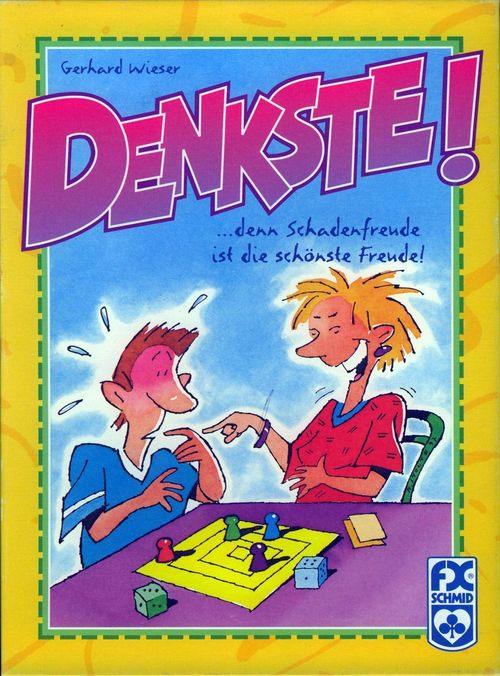
Denkste!
Denkste! Rulebook
Table of Contents
Table of Contents
Matériel (Components)
- 1 board, 1 set of parts to punch out, 4 pawns, 4 rivets.
Before playing for the first time, detach the various parts from their support and assemble them. Fix the blue dial to the blue square card with one rivet, and in the same way fix the other dials to the yellow rectangular card, making sure that each colour matches, from left to right, the colour of the three levels of the board, counted from the outside towards the inside.
Mise en place (Setup)
- Each player takes one pawn and places it on the space of the same colour on the outer yellow track of the board (level 1).
Note: it is preferable for the order of the players to match the sequence of the starting spaces on the board. If there are only two players, choose two diagonally opposite colours.
- The first player is chosen at random. They receive the "Go" card, while the player seated to their right takes the yellow "Stop" card.
Note: for clarity, as long as there are no pawns on levels 2 and 3, it is recommended to turn the right-hand and middle dials so that no number is displayed (set them between 6 and 1, for example).
Déroulement du jeu (Gameplay)
-
The first player chooses a number on the "Go" card without revealing it to the other players. The bigger the number, the better, but it is also the most obvious. Or perhaps not? Think!
-
Meanwhile, the opponent seated to their right likewise selects a number on the "Stop" card, the one they think the other player has chosen. So think carefully! This player first uses the leftmost dial of the "Stop" card, which applies to the first level. It is easy to recognise, since the dial and the level are the same colour. We will talk about the other dials a little further on...
-
Both cards are revealed and compared:
-
If the cards show different values, the first player may move their pawn on the board, clockwise, by the number of spaces shown on the "Go" card.
-
If both cards show the same value, the player cannot move their pawn.
-
-
It is then the next player's turn. The two cards change hands, passing clockwise. In other words, the player to the left of the first player becomes the one trying to move their pawn, while the former first player does their best to prevent them.
-
The game continues in this way. The "Go" and "Stop" cards are set, compared, and then the pawn is moved (or not) — think carefully! — and then the cards change hands.
-
A space can only be occupied by one pawn. If a player, during their turn, chooses a number that would place their pawn on an occupied space, they cannot make the move. Too bad!
-
The starting spaces of the other players are treated as ordinary spaces during a move.
-
A player also gains access to the next level through their starting space. When a player's pawn has completed a full lap of a level, it continues its journey on the next level from its new starting space, still moving clockwise (see the figure on the right of page 3 of the German rules). The same rule applies to reach the target space at the centre of the board.
Variante : Hâte-toi lentement ! (Variant: Make Haste Slowly!)
Harder now:
From level 2 onwards, the player holding the "Stop" card may choose the same number on two dials. If they thus guess the value chosen by the active player, not only does that player not move their pawn, but it is sent back to the starting space of the level it is on.
From level 3 onwards, the player holding the "Stop" card may choose the same number on all three dials. If they guess the value chosen by the active player, that player's pawn is sent back to the starting space of level 2. Yes, it is a dirty trick.
If a pawn is sent back to its starting space while that space is occupied, then in this one and only case, an exception is made to the rule that forbids sharing a space.