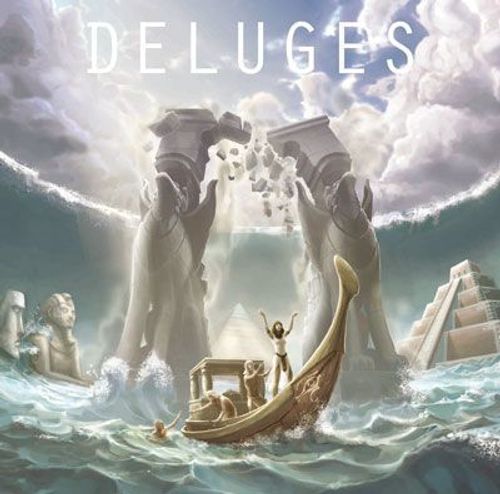
Deluges
Deluges Rulebook
Table of Contents
Table of Contents
Aim of the Game
To be the civilization which leave the most traces of its existence as Fanatics and catastrophes bring development to an end.
End of the Game
At the end of a turn, if the Deforestation and Sea Level Rise scale reaches 14, the game ends.
Pawns
There are four colours: yellow, blue, green and white. One for each player. The number of pawns on the map is limited to the number of players in the game.
Red pawns represent Fanatics.
- Workers: Workers exploit the resources of the land. Their numbers grow every turn.
- Boats: Boats can only occupy Sea cells. They can either move or transport pawns. Their number is limited to 8 per civilization.
- Warriors: Warriors fight for your people. They can enslave other players' Workers. Their number is limited to 5 per civilization.
- Fanatics: They are former workers. They don't produce anything, don't move and reproduce only amongst themselves. If at any one time there are more Fanatics than any other type of pawn in a given cell, they take control of that cell. That cell is then lost permanently and nobody can move onto it.
- Slaves: They are workers enslaved by warriors of another colour. They remain of their native colour. They exploit resources for their captor. The Warrior that enslaved them can move with them. They can be freed. They reproduce amongst themselves.
Set-up
In the case of 4 players, each player starts with 4 Workers on the Heart cell of each continent of his colour.
In the case of 3 players, each player starts with four Workers on the Start cell of the ores of his colour and one Boat placed on an adjacent Sea cell.
The Resources
There are five types of resources: Wood, Gold (yellow), Bronze (green), Marble (white), Granite (black).
Note: the source gives the green resource as "Bronze" here but as "Copper" in the Harvest, Construction and Maps sections. Both names are transcribed as printed; it is the same green resource.
A Turn and Its Different Phases
- Move
- The Harvest and Fanaticism
- Trade
- Construction
- Forest and Population Growth
- Deforestation & Rise of the Sea Level
- End of turn
1. Moves
Clockwise and in turn, players move their pawns. The following turn, the player to the left of the one starting the current turn will be the one to go first.
Each pawn can move one cell on each Move phase.
The land pawns (Workers, Warriors...) can move one cell:
- Either from one land cell to another land cell
- or be transported by Boat (or a line of Boats) from one land cell to another land cell.
Only Warriors can enter a cell controlled by a pawn of another player. In that case there is a conflict (see "Conflict" below) which is immediately played out. Workers and Slaves can't move into a cell controlled by another player at the beginning of the Move phase.
Boats move from Sea cell to Sea cell as per other pawns. When a boat moves into a Sea cell already occupied by another player, this causes a conflict (see "Conflict" below).
Ferrying
Boats can transport land pawns instead of moving. The number of pawns ferried and their destination is unlimited.
A land unit can cross several Sea cells, so long as each cell has at least one Boat to transport them. A Boat can transport a pawn from a different player (should the player who owns the boat wish) even if it has moved during its Move phase.
Fanatics
They never move. If, while moving, a player leaves more fanatics in a cell than all other types of pawn combined, then the cell is immediately and permanently lost to Fanatics.
Slaves
Slaves do not move by themselves. Only a warrior can make them move by bringing them with him to a new cell not controlled by another player. A warrior can also leave the slaves behind. In this case, they are freed.
Conflict
Terrestrial conflict
When warriors from different players are on the same cell there is a conflict which is solved the following way:
The player with the most warriors wins and loses as many warriors as the losing side had.
Example: Player A attacks Player B with 3 warriors, and Player B has only 2 warriors. Player B loses all of his warriors and Player A wins with 1 warrior remaining.
When a cell is won over by a Warrior, the captured Workers become Slaves but do not change colour. The buildings on the cell are then controlled by the conquering player but the Legacy points from the dolmens still go to the player who built them.
If, for any reason, the Warriors disappear from a cell full of Slaves, they are automatically freed. If in that same cell there are also Workers from a different colour, ensues a civil war. Workers then fight as Warriors and the player with the most workers on the cell wins.
Naval conflict
Naval conflicts are solved in the same way as terrestrial conflicts.
2. Harvest and Fanaticism Phase
Harvest
The players harvest cells they own. Workers can produce resources of five types: Wood, Gold (yellow), Copper (green), Marble (white), Granite (black).
A Worker (or a Slave) can produce only one resource at a time.
At the beginning, each cell includes:
- Three forests
- One quarry, which can produce one of four ores depending of the colour of the cell or the type of ore drawn in the cell (for instance, if the cell is yellow or if there is yellow ore depicted in the cell). We will see later that building Mines can increase ore production.
Workers can either:
- Cut down a tree to produce one wood unit. One of the forests from the cell is then tagged with "Razed" counter.
- Work in a Quarry/Mine and produce one of four ores (depending of the type of cell).
- Refuse to work. The Worker is then idle.
It may also happen that in highly populated cells that workers may not find work. They then become idle.
Fanaticism
Idle Workers (or Slaves) are changed into Fanatics just after the harvest.
At any one time, if they are more Fanatics in a cell than any other type of pawn, they engage in a coup and take control of the cell. This may also happen during any other phase such as Construction, Population Growth or after a conflict.
Any cell where the Fanatics have taken over is permanently lost.
Slaves
In a cell where there are Slaves and Workers, work is first given to the Slaves and then to the Workers if there is any left.
3. Trade
Players can exchange resources between them. Resources are kept in open view of other players. Trade is freely regulated between players.
4. Construction
In turn, players can spend their resources (Wood, Gold, Copper, Marble, Granite) to build improvements (Boats, Mine, Warriors, Dolmens).
Constructions are made from the resources of each player. There are two types of constructions: 1) terrestrial (Mines, Warriors, Dolmens) and 2) naval (Boats). Terrestrial constructions can only appear on a cell controlled by the building player and Boats in cells adjacent to a land cell controlled by the building player.
Boat
Boats cost 4 Wood and can move and transport on Sea cells.
If a Boat is built in a cell already occupied by another player's Boat there is automatically a conflict.
Terrestrial Constructions
Constructions (Mines, Warriors, Dolmens) have all the same cost. This cost depends on the number of different types of resources used in the construction as showed in the table below:
| Number of different Resources used | Number of Resource units | Number of Constructions built |
|---|---|---|
| 1 Resource used | 10 | 1 |
| 2 Resources used | 4+4 | 1 |
| 3 Resources used | 2+2+2 | 1 |
| 4 Resources used | 1+1+1+1 | 1 |
Mines
With a Mine a player can increase the production of ore on the cell where the Mine is built. Each Mine allows up to 3 Workers or Slaves to produce one ore each. It is possible to build up to 3 mines in a given cell.
Dolmens
Dolmens give 2 Legacy points when built (see "Victories" below). Only one Dolmen can be built per cell. When a player conquers a cell where a Dolmen has been built, the Legacy points are still given to the player who built it.
Warriors
They can only appear in cells controlled by the player. A player can only have 5 warriors at a time.
5. Forest and Population Growth
The workers and forest reproduce themselves by pair.
Every couple of pawns of the same colour on the same cell gives birth to a pawn of the same colour. Examples of couples:
- 2 green Workers give birth to a green Worker.
- 2 yellow Slaves give birth to a yellow Slave.
The Fanatic population grows the same way.
Forests grow the same way. If there are two forests in the same cell, a new forest can grow. However forests are limited to 3 per cell. In a cell where there is only 1 forest left, the rest will never grow back.
6. Sea Rising
For each totally deforested cell, the Deforestation and Rise of the Sea Level scale gains a notch.
The first major rise in the sea level happens when the number of cells totally deforested is equal to 5. Islands are submerged (as well as cells marked 1 on the 3-player map). Place a "Flood" counter on these cells to show that they are now Sea cells.
The second major rise in the sea level happens when the number of cells totally deforested is equal to 8. The cells marked as "Flooded on the Second Rise in the Sea Level" on the map (or the cells marked with a 2 on the 3-player map) are then flooded.
The last rise in the sea level happens when the number of cells totally deforested is equal to 11. Cells marked as "Flooded on the Third Rise of the Sea Level" on the map (or the cells marked with a 3 on the 3-player map) are then flooded.
At last, when the scale reaches 14 the land is so barren that life on Earth becomes very difficult and the game ends.
Flooded cells become new ocean cells where boats can sail. The Dolmens built on that cell stay and will count towards Victory Points. Fanatics accept their fate and perish. They stay on the flooded cell and die while other pawns try to escape. They can only flee to an adjacent friendly cell. Whilst fleeing, Warriors cannot fight. Boats cannot be used to escape the flood.
7. End of Turn
If at the end of a turn the marker "Deforestation and Rise in Sea Level" reaches 14, the game ends (see "Victories" below), otherwise a new turn begins. In this case, the player to the left of the player who started the previous turn goes first.
Victories
To count the Legacy points:
Each player scores 2 points per Dolmen built (even for those flooded cells).
Bonuses
- The player who controls the most untouched forests scores 3 points.
- The player who owns the most Boats scores 3 points.
- The player who has the most Warriors scores 3 points.
- The player who controls the most Mines scores 3 points.
If the tallies are even, no bonus is awarded for that category.
The winner is the player with the highest Legacy score.
Maps
There are two maps: a World map for 4 players and on the other side an archipelago for 3 players.
4 Players
The continents:
- In the Americas (White), you can gather only wood and marble (white ore).
- In Eurasia (Yellow), you can gather only wood and gold (yellow ore).
- In Africa (Blue), you can gather only wood and granite (black ore).
- In Oceania (Green), you can collect only wood and copper (green ore).
The islands: There are four islands: Mu, Easter Island, Atlantis and Antarctica. These islands have as many forests as the continent cells (3). Their ore production is the same as the continents of the same colour.
Earth: It is important to note that the Earth is round and that the cells to the East and West are the same.
3 Players
You can either play on the archipelago side or on the world map leaving Africa empty.
On the archipelago map each player starts with 4 workers and 1 boat placed on an ocean cell close to its Start cell. The island produces an ore of the same colour as the one drawn on each cell. The ocean cell around the map is a single cell.