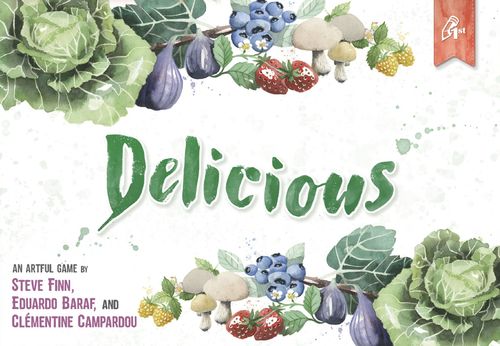
Delicious
Delicious Rulebook
Table of Contents
Table of Contents
Objective
Earn the most points by planting fruits and vegetables in your makeshift containers and planters. Will you create the most delicious garden?
Components
- 30 Fruit / Tool tokens
- 1 bag
- 30 Vegetable cards
- 100 Garden sheets (double-sided)
- 2 Top / Bottom position markers
- 1 Jar of Honey card
- 4 pencils
- 1 Crow token
- 100 Play sheets (double-sided)
Game Setup
Player Garden Setup
Give each player a Garden sheet, Play sheet, and Pencil (4 included). Players may place the Play sheet to the left or right of their Garden sheet as desired.
Each player should acquaint themselves with the garden areas, fruit and vegetable types, the containers for the vegetables, and the planter for the fruit.
Community Supply Setup
- Set up the community supply in the middle of the table, visible to all players. The community supply can be set up and managed by a single player, or as a group.
- Shuffle the 30 Vegetable cards and then remove 6 from the game without looking at them. These will never be used nor seen.
- Split the remaining 24 Vegetable cards into 2 decks of 12 cards each. Place these face-down in a column in the community supply and place the Top and Bottom markers to the left of each deck, creating a top position and a bottom position. Leave space for cards to be flipped face-up next to each deck.
- Place all Fruit / Tool tokens into the bag. Place the bag near the 2 decks of cards in the community supply.
- Place the Jar of Honey card near the bag.
- Reserve space above the Vegetable cards in the community supply for the Compost pile.
Playing Over Video: If you want to play with friends online, only one player needs to own Delicious. That player should set up and manage the community supply – which should be fully viewable on camera. All other players can print out a Garden / Play sheet combo from here: pencilfirstgames.com/DeliciousH2P
Need More Sheets?: If you run out of Garden or Play sheets, or would like larger sheets, you can print them in color or black & white from here: pencilfirstgames.com/DeliciousH2P
Get Your Pencils Ready!
Over the course of a game of Delicious, players fill their respective gardens with fruits and vegetables by sketching them based on cards and tokens that are revealed in the community supply. Players take their turns sketching simultaneously each round as these plants are revealed. Here are the fruits and vegetables you'll be drawing!
Vegetables: Lettuce, Mushroom, Onion, Pepper, Broccoli, Carrot
Fruits: Blueberry, Fig, Golden Raspberry, Strawberry, Watermelon
Not Interested in Sketching? If this is your first game or you're not feeling artistically inclined, feel free to use letters as alternatives, as indicated on the Play sheet.
Your plants have roots! Once sketched, a fruit or vegetable may not be erased, moved, or changed.
Understanding Your Garden
Your garden contains 2 areas with containers and the fruit planter. Vegetables always go into the containers in the top or bottom area. Fruits always go into the planter.
- Containers for Vegetables: a Top Area and a Bottom Area, each holding several containers.
- Planter for Fruits: a single planter shared across the garden.
Remember, the top position marker is associated with the top vegetable area and the bottom position marker is associated with the bottom vegetable area.
Gameplay
A game lasts 12 rounds. Every round, 2 Vegetable cards are flipped (1 from each deck) and a Fruit / Tool token is placed on each card. Each player then decides to use one or both cards (and their tokens), given certain restrictions. Using both the card and token, you mark your Garden and Play sheets, trying to get different combinations of fruits and vegetables. After 12 rounds, the player with the highest score wins.
A Game Round
Prepping the Community Supply
First, plants for the round are revealed in the community supply. This can be managed by a single player, or as a group.
Revealing New Plants
- Flip 1 Vegetable card from the top position deck and 1 Vegetable card from the bottom position deck and place them face-up, making sure to keep the cards in their respective positions. The distinction between the top and bottom position is important for the Choose Plants step.
- Draw a Fruit / Tool token from the bag to place on top of each flipped card.
- If the card has a fruit symbol, place the token fruit side up.
- If the card has a tool symbol, place the token tool side up.
Filling the Gardens
After the reveal, players simultaneously perform two steps: Choose Plants, then Sketch Plants.
1. Choose Plants
Each player decides which card(s) and token(s) they will use by marking one of the circles in the Plant Choice section at the top of their Play sheet.
- When marking their Play sheets, they do not need to announce their decisions. However, if asked they should reveal what they chose.
The Plant Choice section contains 4 options. The circle you've marked determines which card(s) and in which position(s) it may be used. How to use the fruit / tool tokens will be described later, in Fruits and Tools.
- 1 card (as is): Use 1 card in its current position.
- 1 card (reverse): Use 1 card in the reverse position.
- 2 cards (as is): Use both cards in their current positions.
- 2 cards (anywhere): Use both cards anywhere.
Each Plant Choice circle may only be marked once, and all will be marked at the end of 12 rounds. A detailed description of each Plant Choice can be found in Understanding Plant Choice Selections, below.
2. Sketch Plants
For each card chosen based on your Plant Choice, you use both the Vegetable card and the Fruit / Tool token.
Vegetables
Each card shows 1 of 6 different vegetable types.
- For each vegetable, you must pot it into 1 of the 6 containers on your Garden sheet, or put it into a Wild or Bonus spot on your Play sheet.
- To pot a vegetable, you sketch the vegetable's icon (or write its letter) into a space in a container.
Vegetable Containers
Each container holds a different combination of vegetables: same, different, or pairs, as indicated by the banner underneath the container.
- The same container must have 1 vegetable type. That is, after sketching the first vegetable, all future vegetables must match it.
- The different container must have different vegetable types.
- The pairs container must have different pairs of vegetable types.
- Each pair of vegetables must be in the same linked spaces.
- 2 pairs of the same vegetable type are not allowed.
Understanding Plant Choice Selections
The distinction between the top / bottom position in the community supply relates directly to how vegetables are sketched in the Player Garden.
- If you choose the 1 card (as is) option, you must pot the vegetable in 1 container in the top or bottom area to match the card's position. Specifically, if you choose 1 card (as is), you must pot the top position vegetable in the top area OR the bottom position vegetable in the bottom area.
- If you choose the 2 cards (as is) option, you must pot the top position vegetable in 1 container in the top area AND the bottom position vegetable in 1 container in the bottom area.
- If you choose the 1 card (reverse) option, you must pot the vegetable in the opposite area. That is, you must pot the top position vegetable in 1 container in the bottom area OR the bottom position vegetable in 1 container in the top area.
- If you choose the 2 cards (anywhere) option, you may pot both vegetables in any containers anywhere. The only restrictions you must follow are the bottom-up rule and container combinations (same, different, or pairs).
Placing a Vegetable
Based on your Plant Choice selection, first you choose any container in that area for your vegetable. Then, you'll pick a space in that container from the bottom up.
In the example given in the rulebook, the Pepper card was drawn in the top position, and the player selected the 1 card (as is) Plant Choice. Legal plays are marked with a check mark while illegal plays are marked with an X. The player chose the wheelbarrow.
From the Bottom Up
You must fill the lower rows in a container before placing any vegetables in higher rows, planting from the bottom up.
- You must start at the bottom row and fill it before potting a vegetable in the second row.
- You may fill the lowest row in any order and do not need to start in the left-most space.
- Vegetables may not be added to containers with no available spaces.
In the example given in the rulebook, the player chose the right-most open space in the bottom row. The only other legal play was the middle open space in the bottom row.
Vegetables on the Play Sheet
Instead of potting a vegetable in a container, you may sketch a vegetable into the wild or bonus spot on the Play sheet. When sketching a vegetable on the Play sheet, the selected top / bottom position does not matter.
Vegetable Wild Spot
If you sketch a vegetable in the wild spot, you immediately pot any 1 vegetable into any 1 of the 6 containers.
- You may not use this to sketch a vegetable in the bonus spot.
- You may do this in order to change which area the vegetable will be placed in.
- You must still follow the bottom-up rule.
Vegetable Bonus Spot
If you sketch a vegetable in the bonus spot, you score 2 points at the end of the game for each container on the Garden sheet that includes this vegetable. This bonus can score a maximum of 12 points.
Fruits and Tools
Tokens have two sides. One side has 1 of 5 fruits; the other side has 1 of 6 tools. Once a token has been placed on a flipped card (see Revealing New Plants) it is never changed. All players must use the side shown, if selected. (See Choose Plants)
Placing a Fruit
If a Fruit token is on a selected Vegetable card, you may plant the fruit in the planter by sketching its icon (or writing its letter) in any appropriate space in the planter.
- The appropriate space is a space matching the garden icon on the card.
Garden Icons and Planter Spaces: Hexagon Planter Space, Oval Planter Space, Star Planter Space.
In the example given in the rulebook, the Watermelon token was placed on the Carrot card with the hexagon garden icon. The player could sketch the Watermelon in any open hexagon space in the fruit planter and chose the indicated space.
Fruits on the Play Sheet
Instead of putting a fruit in the planter, you may sketch a fruit into the wild or bonus spot on the Play sheet. When sketching a fruit on the Play sheet, the garden icon on the selected card does not matter.
Fruit Wild Spot
If you sketch a fruit in the wild spot, you immediately put any 1 fruit into any 1 type of space (hexagon, oval, or star) in the planter.
- You may not use this to sketch a fruit in the bonus spot.
- You may do this in order to change which type of space in the planter a fruit can be placed in.
Fruit Bonus Spot
If you sketch a fruit in the bonus spot, you score 1 point at the end of the game for every instance of this fruit in your planter. There is no maximum score for this bonus, and you are only limited by the size of the planter and the fruits you are able to plant.
Using a Tool
If a Tool token is on a selected Vegetable card, it may be used to add any 1 fruit OR any 1 vegetable to the garden. However, the fruit or vegetable must be put into a row or column designated by the tool.
- If using the token to pot a vegetable, you still must follow the top or bottom position based on the Plant Choice and selected Vegetable card.
- If using the token to pot a vegetable, you may do so before OR after potting the vegetable from the card.
- You must also follow the container requirements and bottom-up rule.
- Cross out the tool icon after using the tool.
In the example given in the rulebook, the depicted card and Tool token appeared in the top position and the 1 card (as is) Plant Choice was used. The player chose to use the tool to draw a vegetable in the wheelbarrow container and crossed out the corresponding tool icon. Alternatively, they could have chosen to draw a fruit in an available space in the corresponding column in the planter. There is also a matching tool in the bathtub container, but due to the top and bottom position restriction, the spaces in the bottom area are not available this turn, even though they meet the requirements of the bottom-up rule.
Losing a Vegetable, Fruit, or Tool
In rare cases, you may be unable to pot a vegetable, plant a fruit, or use a tool you've selected. In these cases, you lose the vegetable / fruit / tool, but there is no additional penalty.
Ending the Round
Once all players have chosen and sketched their plants, the round ends. Typically, the player managing the community supply asks players if they are done, but any indicator, such as everyone placing their pencils down, can be used. Then:
-
Check for the First Potter Bonus and Jar of Honey.
First Potter Bonus: At the end of a round, if any player(s) is the first to completely fill a vegetable container, they say it out loud ("I finished the boots!") and check off the First Potter Bonus icon on the container. They will score 1 extra point at game end for doing this. All other players who did not finish this vegetable container this round must cross out the corresponding First Potter Bonus, as it is no longer available to them.
Jar of Honey: At the end of a round, if any player(s) is the first to completely fill all the containers in the top area OR all the containers in the bottom area, they say it out loud ("I finished all the top area containers!") and circle the 3 points over the Honey icon on the Garden sheet. They will score these 3 extra points at game end for doing this. The Jar of Honey card is then moved to the Compost pile.
Multiple players can earn a container's First Potter Bonus or earn the Jar of Honey within the same round, but then no one else can in subsequent rounds.
-
Move the 2 revealed cards and 2 tokens in the community supply to the Compost pile.
-
If all 12 Plant Choice circles have been marked, proceed to Game End and Scoring. Otherwise, start a new round.
Game End and Scoring
After the end of the 12th round, all players calculate their scores for vegetables in containers, fruits in the planter, and any bonus points. Use the back of your Play sheet as a quick tally guide for your score.
Vegetables in the Containers
Each container scores points based on how many rows are completed in the container. Look at the point indicator on the right side of each row in each container.
- Circle the point value to the right of your highest completed row. You do not add up each row of points.
- Remember to add 1 point if you completed the container first.
- Write the total points for each container in the corresponding point circle.
- Extra vegetables from unfinished rows within a container are not worth any points (unless they are the bonus vegetable).
In the example given in the rulebook, the First Player earns 11 points for the wheelbarrow container: 10 for completing the top row and 1 for the First Potter Bonus. The Second Player crossed out the First Potter Bonus earlier in the game, and now scores 2 points for completing the bottom row. The extra Onion in the second row scores nothing.
Fruits in the Planter
Only rows and columns of 3 or more fruits are worth points. These scoring rows and columns are indicated by tool icons and have score bubbles to note if you earned any points.
- 3 different fruits in the row / column scores 1 point, 4 different scores 2 points, and 5 different scores 3 points.
- 3 of the same fruit scores 3 points, 4 of the same scores 4 points, and 5 of the same scores 5 points. The same fruits must be contiguous, so in order to score, a row or column can not be divided by a different fruit.
A row / column might have a mix of both the same and different, but you can only score for one. Example: You have 3 blueberries, 1 strawberry, and 1 watermelon in a column. You can score for 3 different (blueberry, strawberry, and watermelon) OR 3 of the same (blueberries).
Bonus Spots and Jar of Honey
- Vegetable Bonus Spot: Score 2 points for each container that includes this vegetable. (See Vegetable Bonus Spot, above)
- Fruit Bonus Spot: Score 1 point for every instance of this fruit in your planter. (See Fruit Bonus Spot, above)
- Jar of Honey: Score 3 points if you earned the Jar of Honey. (See Jar of Honey, above)
Determining a Winner
The player with the most points wins.
If there is a tie, the player whose fruit planter score is higher wins.
If there is still a tie, the player who has marked the most First Potter Bonus icons wins.
Scoring Example
- Add the totals from your top area of vegetable containers.
- Add the totals from your bottom area of vegetable containers.
- Add the total from your fruit planter.
- Add the totals from your bonus spaces.
- Add the points for the Jar of Honey if you claimed it during the game.
- Total all your points and compare to your opponents' scores.
How to Draw the Delicious Way!
The rulebook closes with step-by-step drawing guides for sketching each vegetable and fruit icon: Broccoli, Carrot, Lettuce, Mushroom, Onion, Pepper, Blueberry, Fig, Golden Raspberry, Strawberry, and Watermelon.
Check out more Dr. Finn's Games at www.doctorfinns.com and PencilFirstGames.com