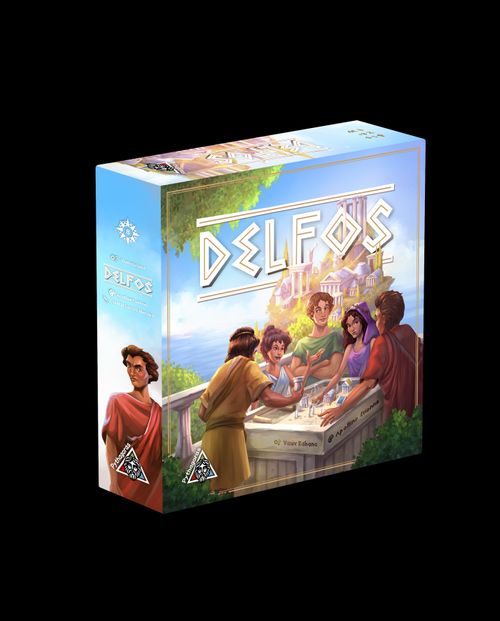
Delfos
Delfos Rulebook
Table of Contents
Table of Contents
Overview
In Delfos, you step into the role of one of five master architects, each devoted to a vital pillar of the new city: Politics, Water and Leisure Infrastructures, Religion, Housing, and Commerce and Markets. Each architect brings a unique vision, a distinct philosophy, and the ambition to shape Delfos according to their domain's ideals.
The game unfolds in a series of turns, passing clockwise around the table, as the new city slowly rises from the ruins. On your turn, you move one of your two architects orthogonally across the remnants of ancient Delfos. Wherever you stop, you recover a tile, one of the five types, representing a fragment of the old city's plan.
By claiming it, you gain the right to place that tile in the new Delfos. Your goal is threefold: establish dominance by controlling the largest areas of each tile type; earn extra points from tiles aligned with your own domain's ideals; and fulfill your objectives, balancing your secret personal goals with the shared public objective that defines how the city will be judged.
When the final tile is placed and the reborn city stands complete, the gods turn their gaze upon your work. Victory points are awarded for majorities, speciality influence, and objective fulfillment. The architect who earns the greatest favour, measured in victory points, claims the glory of designing the new Delfos.
Components
- 1 Ancient Delfos Game Board
- 60 Building Tiles: 12 each of 5 colours; 2 tiles of value 1, 4 and 5; 3 tiles of value 2 and 3 (each tile has a front and a back)
- 8 Scoring Cards (front and back)
- 5 Architect Cards, 1 of each player colour (A-side and B-side)
- 20 Goal Tiles, 4 for each Architect in the player colour (front and back)
- 10 Architect Markers, 2 of each player colour
- 100 Architect Tokens, 20 of each player colour
Solo Mode components
- 20 Khaos Cards (front and back)
- 9 Campaign Goal Cards (front and back)
- 1 Solo Score Card (front and back)
- 1 Bag
- 1 Score Pad (double sided)
General Set-Up
- Place the Ancient Delfos Game Board in the centre of the table within reach of all players. Reserve a similar space beside it for the rebuilding of Delfos.
- Put all 60 Building Tiles into the bag and mix them well. Randomly draw tiles and place them face-up on the brown-outlined spaces of the Ancient Delfos Game Board, filling rows from top to bottom. Do not place tiles on the 3 white-outlined spaces in the middle row. After placing all tiles return the bag to the box.
- Shuffle the Scoring Cards and draw 1 placing it face-up beside the board. Return the remaining cards to the box. For your first game we recommend using 1 of the Scoring Cards worth 4 Victory Points.
- Place the Score Pad beside the board for use later when scoring the game.
Player Set-Up
Each player chooses a colour and takes the following components of that colour, placing them in front of them:
A. The Architect Card with the same side face-up for all players. For your first game we recommend using Side A.
B. The Goal Tiles. Shuffle and draw 2 keeping them face-down hidden from the other players. Return the remaining tiles to the box.
C. The 2 Architect Markers.
D. A number of Architect Tokens based on the player count:
| Players | Architect Tokens |
|---|---|
| 2 | 20 tokens |
| 3 | 15 tokens |
| 4 | 10 tokens |
| 5 | 9 tokens |
Return any unused tokens to the box.
Randomly select the first player.
Game Length
Delfos is played over a fixed number of rounds depending on the player count:
| Players | Rounds |
|---|---|
| 2 | 20 rounds |
| 3 | 15 rounds |
| 4 | 10 rounds |
| 5 | 9 rounds |
Player Turn
The first player takes the first turn and play continues clockwise. A round consists of each player taking exactly one turn.
On your turn you must perform the following two actions in this order:
- Move Architect
- Place A Building Tile
At the beginning of your first turn, before you take the Move Architect action, place one of your Architect Markers on the Ancient Delfos Game Board. You may only place it on 1 of the 3 white-outlined spaces, or on a space that already contains another Architect Marker.
At the beginning of your second turn, you must place your second Architect Marker on to the board following the rules above. That second Architect is the one you must move during your second turn.
At the start of their second turn the red player must place their second Architect Marker before moving it. They may place it on any of the 3 empty white-outlined spaces (white circle) or on a square occupied by another Architect Marker (yellow circle).
1. Move Architect
Choose 1 of your Architect Markers and move it in a straight line orthogonally until it reaches a space containing a building tile. Take the building tile off and place the Architect Marker on that space.
Movement Rules
A) Architect Markers move in a straight line orthogonally; either along its row or column, until it reaches the first space containing a building tile.
The blue Architect Marker has 4 movement options. It can move left to the value 3 purple building tile; move up to the value 1 blue building tile; move right to the value 5 red building tile; or, move down to the value 2 green building tile. In all cases the building tile chosen is removed and the player's Architect Marker is placed on that space.
B) Architect Markers may move over squares where there is another Architect Marker. These pieces are ignored during this movement.
The blue player decides to move their upper Architect Marker to the left. It passes over the red and purple Architect Markers to reach the value 3 red building tile, which the blue player takes, placing their blue Architect Marker on that space.
C) An Architect Marker may move off one edge of the board and reappear on the opposite edge, remaining in the same row or column and continuing its straight-line movement.
The purple player decides to move their upper Architect Marker to the left. It passes over the blue Architect Marker and crosses the edge of the board reappearing on the opposite side of the same row. It then reaches the value 5 red building tile, which the purple player takes, placing their purple Architect Marker on that space.
D) In the rare case that neither of a player's Architect Markers can reach a building tile with an orthogonal movement, the player must instead place 1 of their Architect Markers on 1 of the 3 white-outlined spaces, or on a space that already contains another Architect Marker. Then proceed with the usual Move Architect action.
At the beginning of their turn, the blue player has both Architect Markers positioned in rows and columns with no building tiles available. They may now move 1 of their Architect Markers placing it on one of the 3 white-outlined spaces, or on a space that already contains another Architect Marker. They choose to place it on the rightmost of the 3 white-outlined spaces and then continue their turn as usual.
2. Place A Building Tile
The building tile taken by the player during the Move Architect action is used to rebuild the new city of Delfos. Each turn the player places the building tile orthogonally adjacent to an already placed tile expanding the city.
Placement Rules
A) The first tile of the game, placed by the first player, must be positioned roughly in the centre of the reserved area beside the game board.
B) All subsequent tiles must be placed orthogonally adjacent to at least one previously placed tile.
C) The new city of Delfos must be contained within the following limits dependent on the player count:
- In a solo, 2 or 4-player game: 8 columns × 5 rows
- In a 3 or 5-player game: 9 columns × 5 rows
After the first player (purple) has placed the value 5 green building tile in the centre of the reserved space (1), the red player places a value 1 red building tile above it (2). On their next turn the purple player places a value 1 green building tile adjacent to their previous building tile (3). The red player now has 7 legal placement options, as shown, for the value 5 blue building tile they picked up (4).
After placing a building tile, the player places one of their architect tokens on top of it. This ends their turn and play continues clockwise.
The game ends when players have no more architect tokens; the new city of Delfos is completely filled and rebuilt!
Game End And Scoring
The game ends when all players have placed all of their architect tokens, the new city of Delfos is completely filled and rebuilt. Players will now calculate their victory points using the Score Pad.
Scoring is divided into the following 3 categories:
- Area Majorities
- Architect Cards
- Scoring Card
1. Area Majorities
Identify the largest area of orthogonally adjacent building tiles of each colour. Each player counts their architect tokens in each area and scores:
1st The player with the most architect tokens scores the total value of all the building tiles in the area where they have placed architect tokens. If players are tied, all tied players score the total values where they have architect tokens.
2nd The player with the second most architect tokens scores the total of their 2 highest-value building tiles on which they have placed an architect token. If there is only 1 building tile they score the value of it. If players are tied, all tied players score the highest values of 1 or 2 architect tiles.
3rd The player with the third most architect tokens scores the value of 1 of their highest-value building tiles on which they have placed an architect token. If players are tied, all tied players score their highest-value architect tile.
If 2 or more areas are tied for the largest area; they are equal in the number of building tiles of 1 colour, then each such area is scored separately and the scores added together.
If 2 players tie for 1st place there will be no 2nd place. If 3 or more players tie for 1st place there will be no 2nd or 3rd place. If 2 players tie for 2nd place there will be no 3rd place.
All scoring examples relate to the new city of Delfos shown on page 8 of the rulebook.
Green Area Building Tiles: There are 2 largest areas of green building tiles, each containing 4 orthogonally adjacent tiles. In the upper area, the yellow player has the majority with 2 architect tokens and scores 10 victory points (5 value building tile + 5 value building tile). Green and purple are tied for second place with 1 architect token each. Green scores 4 points and purple 2 points. In the lower area, only green has architect tokens, so they score 12 points (4+2+3+3) for the building tiles they placed.
Yellow Area Building Tiles: There is 1 largest area of yellow building tiles of 4 tiles. Four players each have 1 architect token in this area so each scores the value of the building tile where they have placed an architect token: The purple player scores 2 victory points; blue 5; red 4; and yellow 4.
Blue Area Building Tiles: There is 1 largest area of blue building tiles of 6 tiles. The purple and blue players are tied for first place with 2 architect tokens each. Purple scores 6 victory points (4+2), and blue scores 8 (5+3). Because of the tie for first place no second place is awarded. Green and yellow are tied for third place with 1 architect token each: green scores 5 points and yellow 3.
Red Area Building Tiles: There is 1 largest area of red building tiles of 11 tiles. The red player has the majority with 4 architect tokens and scores 14 victory points (3+4+5+2). Purple and blue are tied for second place with 3 architect tokens each: purple scores 6 points (3+3); and blue scores 6 (5+1), using their two highest-value tiles. Because of the tie for second place no third place is awarded; green is fourth and does not score.
Purple Area Building Tiles: There is 1 largest area of purple building tiles of 6 tiles. The yellow player is first with 3 architect tokens and scores 7 victory points (2+4+1). Red is second with 2 architect tokens and scores 7 points (2+5). Purple is third with 1 architect token and scores 3 points.
2. Architect Cards
The architect cards have two sides: Side A, which provides simple and identical scoring for all players; and Side B, which offers more advanced asymmetrical scoring. There is an "A" or "B" in the top right hand corner of each side of the card. All players must use the same side during the game.
Side A
If players are using the side A of their architect card each player scores 3 victory points for every architect token they have placed on the same colour building tile.
In other words, each of your architect tokens placed on a building tile that matches your architect card's colour is worth 3 victory points.
Players decided to use side A of their architect cards. The green player scores 18 victory points, yellow 9, blue 12, red 15, and purple 6, equal to 3 times the number of architect tokens they placed on building tiles of their own colour.
Side B
When using side B of their architect cards each player has a unique scoring condition. Players score victory points for their architect tokens placed on building tiles of their colour dependent upon their chosen colour.
Green Architect — Score 3 victory points for each of your architect tokens on a green building tile that is diagonally adjacent to at least one other green building tile, regardless of which player's architect token is on that building tile.
Yellow Architect — Score 5 victory points for each of your architect tokens on a yellow building tile that is in the column containing the most yellow building tiles. If multiple columns are tied the yellow player chooses just 1 of the tied columns to score.
Blue Architect — Score 3 victory points for each of your architect tokens on a blue building tile that is in the row containing the most blue building tiles. If multiple rows are tied the blue player chooses just 1 of the tied rows to score.
Red Architect — Score 3 victory points for each of your architect tokens on a red building tile that is orthogonally adjacent to at least 1 building tile of a lower value.
Purple Architect — Score 4 victory points for each of your architect tokens on a purple building tile that is orthogonally adjacent to at least 1 building tile with a value equal to the purple tile.
Players decided to use side B of their architect cards.
The green player scores 15 victory points with 5 green architect tokens placed on green building tiles that are diagonally adjacent to another green tile.
The yellow player scores 5 victory points with 1 yellow architect token placed on a yellow building tile in the column that contains 3 yellow tiles.
The blue player scores 12 victory points with 4 blue architect tokens placed on blue building tiles in the row that contains 5 blue tiles.
The red player scores 15 victory points with 5 red architect tokens placed on red building tiles that are adjacent to tiles with lower values.
The purple player scores 8 victory points with 2 purple architect tokens placed on purple building tiles that are adjacent to tiles of an equal value.
3. Scoring Card
The scoring card selected for this game is now scored. Each player scores the 2 goal tiles they drew during set-up based on how well they have fulfilled the objective of the scoring card.
Each goal tile shows the colour of the building tiles that are different to the player's colour.
For every architect token a player has placed:
a. on the 2 colours of building tiles on their goal tiles, and b. within the darker area shown on the scoring card;
they will score the victory points detailed on the card.
The different scoring cards:
- 4 victory points per goal tile with one of your architect tokens on it within the upper side of the new city of Delfos. Include the middle row.
- 4 victory points per goal tile with one of your architect tokens on it within the lower side of the new city of Delfos. Include the middle row.
- 3 victory points per goal tile with one of your architect tokens on it in your largest area of connected goal tiles, include both goal tiles.
- 4 victory points per goal tile with one of your architect tokens on it within the left side of the city. Include the middle column in a 3 or 5-player game.
- 4 victory points per goal tile with one of your architect tokens on it within the right side of the city. Include the middle column in a 3 or 5-player game.
- 6 victory points per goal tile with one of your architect tokens on it not orthogonally adjacent to any other goal tile, regardless of who placed the building tile. Tiles on the edges of the city also count for this scoring.
- 4 victory points per goal tile with one of your architect tokens on it not on the edges of the new city of Delfos; not in the first or last row or column.
- 4 victory points per goal tile with one of your architect tokens on it placed on the edge of the city; the first and last rows and columns.
Goal tiles of each player in the example: Green player — Blue and yellow; Yellow player — Purple and Green; Blue player — Red and Yellow; Red player — Yellow and purple; Purple player — Red and Blue.
Scoring the "4 victory points per goal tile with one of your architect tokens on it placed on the edge" scoring card, the green player scores 2 goal tiles, 8 victory points; yellow scores 3, 12 VPs; blue scores 3, 12 VPs; red scores 1, 4 VPs; and purple scores 4, 16 VPs.
Winner
The player with the most victory points wins. If there is a tie, the tied player who scored more points on the "Scoring Card" is the winner. If there is still a tie, the tied player who scored more points on the "Area Majority" scoring of their colour is the winner. If there is still a tie, the tied players share the victory.
As players used side B for scoring their architect cards the green and red players are tied for first place with 44 victory points. Using the first tie-break rule green wins because they scored more points on the Scoring Card.
Solo Mode
In the solo mode you will be facing Khaos, a rival architect attempting to undermine your vision for a new Delfos, in either a SINGLE GAME, or, a CAMPAIGN made of consecutive games.
In a single game your objective is to achieve the highest possible score and be crowned "Master Architect of Delphos". In a campaign you must complete a specific number of goals in a series of games.
Single Game
Set-Up
- Perform the general set-up for the multiplayer game.
- Perform your set-up the same as for a 2-player game including choosing which side of the architect card to score.
- Khaos set-up:
- A. Choose a player colour for Khaos and place 20 architect tokens in that colour beside the Ancient Delfos Game Board.
- B. Place 1 Khaos Architect Marker on the left white-outlined space, and the other Khaos Architect Marker on the right white-outlined space.
- C. Shuffle the Khaos Cards deck and place it face-down near Khaos' tokens.
- D. Set aside the solo score card with the front side visible.
Gameplay
The solo mode is played over a fixed number of 20 rounds, the same as a 2-player game. In each round, you always play first and Khaos next. The 2-player rules apply; therefore, the full grid of the new city must fit within 8 columns by 5 rows.
Player Turn
On your turn, take a Move Architect action followed by a Place A Building Tile action, as usual.
Khaos Turn
On Khaos's turn, draw the top card from the Khaos deck and follow the priorities on the card to select the building tile destination for the Khaos Architect Marker and to place the selected building tile in the new city of Delfos.
Move Architect
The usual movement rules apply to Khaos Architect Markers. Move the Khaos Architect Marker that first meets the priorities on the revealed Khaos card. Always follow the Khaos card priorities, in the order listed below, to select a unique target building tile and move 1 Khaos Architect Marker to that tile.
- Use the colour priority (A) to determine the colour of the target building tile. Start with the leftmost colour and proceed to the right until you find a colour that at least 1 Khaos Architect Marker can reach.
- If multiple building tiles of that colour can be reached, use the value priority (B) to determine the value of the target building tile; otherwise, skip this step. The Khaos card indicates whether you start from the lowest value and proceed in ascending order, or start from the highest value and descend until you find a value that at least 1 Khaos Architect Marker can reach.
- If multiple building tiles of the same colour and value can be reached by at least 1 Khaos Architect Markers, use the arrow priority (C) as the final tiebreaker; otherwise, skip this step. The arrows indicate which of the tied building tiles to select, using their relative positions on the Ancient Delfos Game Board: the lowest, highest, leftmost, or rightmost. Start with the leftmost arrow and proceed to the right until determining a unique target building tile. Repeat the process, if necessary, using the same card to determine which Architect to move.
- Upon selecting a single building tile move the Khaos Architect Marker to the target building tile and take it, as usual. If that building tile can be reached by both Khaos Architect Markers use the arrow priority (C) to select the Architect Marker to move using their relative positions on the Ancient Delfos Game Board.
Khaos (playing green) has blue building tiles as its priority on the drawn Khaos Card and it will target any of those it can reach. There are 2 options, both with the same value of 3, so the choice is decided by the arrow priority (C), in this case the building tile furthest to the left. Because the target blue building tile can be reached by both of Khaos's Architect Markers the marker further to the left is selected by again using the arrow priority rule.
Place A Building Tile
The usual building tile placement rules apply to Khaos. Always follow the Khaos card priorities in the order indicated below until a single space is selected to place the building tile taken by Khaos.
- Check the adjacency priority (D): The building tile should be placed adjacent to another tile of the same colour. If no adjacent spaces are available, follow the broken link rule below. The building tile should be placed orthogonally adjacent to an existing building tile.
- If no placement has been identified or there are multiple possibilities use the arrow priority (C) as the tie-breaker; otherwise skip this step. The arrows indicate where the building tile should be placed relative to the existing building tiles: below, above, left or right. Start with the leftmost arrow and proceed to the right until determining a single available space for the building tile.
- Place the building tile on the selected space, and a Khaos architect token on the tile.
Example: 1. After taking a blue building tile, the Khaos card indicates that the tile should be placed on the leftmost available space regardless of colour. 2. In this case, the blue building tile must be placed orthogonally adjacent to a tile of the same colour. Choosing the leftmost available space that meets this condition. 3. Here, there are two tied placement options for the blue building tile when following the arrow priority "left" (C) on the Khaos card, which requires placing the building tile orthogonally adjacent to a building tile of the same colour. Since both options are valid, the tie-breaker moves to the next arrow which points to the uppermost of the two tied spaces.
Game End And Scoring
The game ends immediately after placing the last Khaos architect token. Determine your score as usual and check the table on the scoring card to see how you performed!
Campaign
In a Solo Campaign you will be playing a series of games and attempting to complete a specific number of campaign goal cards, according to the difficulty level you choose. To progress from 1 game to another, you must meet 2 conditions:
- Score More Than The Difficulty Target
- Complete 1 Campaign Goal Card
If you fail to meet either condition in 2 games the campaign ends immediately and you lose. If you complete both conditions, you win!
Set-Up
Prepare the game for solo play, as usual. Then, perform the following additional steps:
- Select the Difficulty Level:
| Difficulty Level | Target Score |
|---|---|
| Easy | 60 |
| Normal | 80 |
| Hard | 90 |
| Complex | 100 |
- Select the Campaign Length:
| Length | No. Of Campaign Goals To Complete | Maximum No. Of Games* |
|---|---|---|
| Short | 3 | 2 |
| Normal | 6 | 4 |
| Long | 9 | 6 |
*For an extreme challenge play the campaign with an additional condition: you must complete the required number of goal cards in no more than the indicated number of games.
- Set-up the Campaign Goal Cards: Shuffle the campaign goal cards and draw a number of cards equal to the number of goals to complete for the campaign length selected. Place all campaign goal cards in the order shown on the next page. Keep the selected goal cards face-up, and turn the rest face-down.
Gameplay
Play your first game, as usual, and determine your score.
Then, check whether you meet both of the following conditions:
A. Your score is higher than the target score for the difficulty level you have chosen;
B. You have completed 1 or more of the face-up Campaign Goals.
If you meet both conditions the game was a success and you may progress with the Campaign. Flip the completed campaign goal card(s) face-down; they are no longer available for the remainder of the campaign.
If you do not meet both conditions you lose that game, but you still have a second attempt to pass by playing again.
Continue playing until you are declared victorious by fulfilling the number of goal cards required for the difficulty level chosen. If you lose 2 games you are defeated in this campaign.
Campaign Goal Cards
- You control 4 or more areas, by having more architect tokens than Khaos
- At least 1 area has 9 or more building tiles (control does not matter)
- No areas have 7 or more building tiles (control does not matter)
- Your architect tokens form a continuous path connecting the left and right borders
- Your architect tokens form a continuous path connecting the upper and lower borders
- Your architect tokens occupy each of the four corners
- There are 2 colours of building tiles with none of your architect tokens on
- At least 4 of your architect tokens are isolated, there are none of your tokens in an orthogonally adjacent space
- Your architect tokens occupy each of the 4 centre spaces of the middle row
Notes: Areas are groups of adjacent building tiles of the same colour. The architect-tokens icon means "architect tokens".
Reference
Move Architect — Movement Rules
A) Architect Markers move in a straight line orthogonally; either along its row or column, until it reaches the first space containing a building tile.
B) Architect Markers may move over squares where there is another Architect Marker. These pieces are ignored during this movement.
C) An Architect Marker may move off one edge of the board and reappear on the opposite edge, remaining in the same row or column and continuing its straight-line movement.
D) In the rare case that neither of a player's Architect Markers can reach a building tile with an orthogonal movement, the player must instead place 1 of their Architect Markers on 1 of the 3 white-outlined spaces, or on a space that already contains another Architect Marker. Then proceed with the usual Move Architect action.
Place A Building Tiles — Placement Rules
A) The first tile of the game, placed by the first player, must be positioned roughly in the centre of the reserved area beside the game board.
B) All subsequent tiles must be placed orthogonally adjacent to at least one previously placed tile.
C) The new city of Delfos must be contained within the following limits dependent on the player count:
- In a solo, 2 or 4-player game: 8 columns × 5 rows
- In a 3 or 5-player game: 9 columns × 5 rows
Scoring
- Area Majorities
- Architect Cards
- Scoring Card