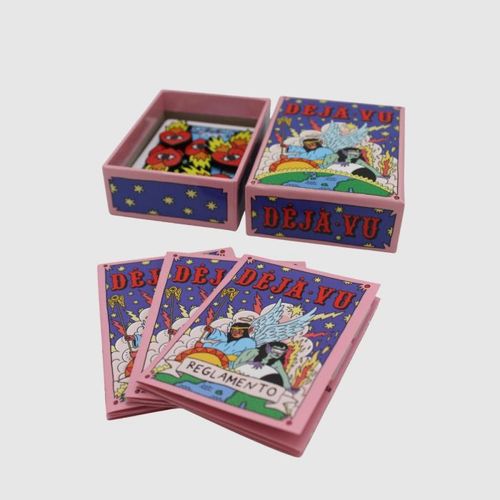
Déjà vu (2026)
Déjà Vu Rulebook
Table of Contents
Table of Contents
Objective
Gain the 7 hunch tokens or score the most points by the end of the game.
Components
- 32 Déjà Vu cards
- 1 End card
- 7 hunch tokens
Each Déjà Vu card has 2 sides:
- The blue side shows a number between 2 and 12.
- The orange side shows two numbers between 0 and 7. The sum of both numbers is equal to the number on the blue side. Each pair of numbers is unique and is never repeated in the deck.
Set Up
- Place the End card in the centre of the table.
- Shuffle all Déjà Vu cards to create a deck and place it on top of the End card with the blue side face up.
- Create a 3 × 3 grid with cards from the deck, where the deck is at the centre of the grid.
- The last player who experienced a déjà vu gets 3 hunch tokens and will be the starting player. Their opponent gets 4 hunch tokens.
How to Play
In Déjà Vu, players take turns to perform 1 of the following actions during their turn:
- Look
- Reveal
- Take the End card (only if it is visible in the grid)
In addition, you can give your opponent 1 hunch token to perform 1 extra action during your turn, which can be either look or reveal. You can repeat this process as many times as you want as long as you have enough hunch tokens.
Once you've finished playing your turn, say it out loud: the turn proceeds to your opponent.
Look
Choose 1 of the cards in the grid, secretly look at the orange side of the card, and return it to the same space of the grid.
Reveal
Flip cards to the orange side, one by one, until you are successful or make a mistake.
Success
If you reveal the same number 3 or more times, you can stop revealing cards and keep those cards, or you can continue revealing cards.
If you choose to stop, place the cards you keep in a pile in front of you with the blue side face up. You are not allowed to count or check the cards in your pile.
Additionally, if you have revealed the same number 4 or more times, take 1 hunch token from your opponent.
Finally, fill in the gaps in the grid with cards from the deck.
Mistake
If you reveal a card and it doesn't show the same number as any previously revealed card, you have made a mistake. Give your opponent 1 hunch token and flip the revealed cards. Your turn is over.
Taking the End Card
Only if it is visible in the grid, take the End card and place it on top of your pile. This must be the only action you perform during your turn (you can't use hunch tokens to perform it as an extra action or perform other actions after this one). For you, the game ends here.
Example
Alex performs the reveal action and reveals 2 + 4 and then 4 + 4. He has been successful so far because number 4 appears 3 times. Alex could stop now and keep both cards, but he chooses to continue and reveal another card. He reveals a card that shows 0 + 4. Now Alex decides to stop, and therefore keeps the 3 cards and takes 1 hunch token from his opponent.
After filling in the gaps in the grid using cards from the deck, Alex chooses to give his opponent 1 hunch token to perform 1 extra action, which is the reveal action again. The first card he reveals shows 4 + 6 and the second one 5 + 6. Since number 6 appears twice, he can continue revealing cards. The third card shows 4 + 5. There aren't any 6s, so he's made a mistake. Alex gives his opponent 1 hunch token, flips the revealed cards, and ends his turn.
End of the Game
The game can end in 2 different ways:
Victory by Hunches
If a player gets all 7 hunch tokens, they immediately win the game.
Victory by Memories
If a player takes the End card, the opponent plays 1 last turn, and then both players tally their final score:
Score 1 point for each card in your pile (including the End card). Score 0.5 points for each hunch token. The player with the most points is the winner.