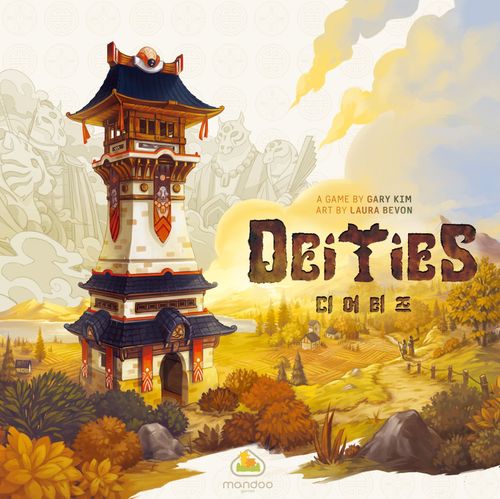
Deities
Deities Rulebook
Table of Contents
Table of Contents
Goal of the Game
In Deities, you place village tokens on the game board to claim resources. A unique game system lets you build long, straight lines of tokens, to try and collect as many resources as possible. Be careful though, as every time you collect resources, you flip them on the board, possibly giving an advantage to your opponents.
Make sure to place your village tokens on the best place! Gather resources to erect new buildings and expand your influences. Use disciple tiles and development tiles to develop your own strategy. At the end of the game, the player with the most points wins the game.
Components
- 1 game board
- 4 player boards
- 4 sanctum tiles
- 4 score markers
- 1 round marker
- 22 disciple tiles (reward for building wall)
- 18 development tiles (reward for building temple): 13 normal tiles and 5 four-points tiles
- 8 providence tiles
- 33 double-sided village tokens (3 types x 11 pcs: rice/wood, stone/wood, rice/stone). There are 3 types of village tokens in the game. Each side shows the resource produced by this token. It also shows the resource which is produced on the opposite side. The branch indicates that there is wood on the opposite side.
- 8 ruin tokens (for 2-player game and variants)
- 64 resources (4 types x 16 pcs): coin, rice, wood, stone
- 1 bag
- 48 buildings: walls (Lvl1, 4 colors x 5 pcs), temples (Lvl2, 4 colors x 4 pcs), towers (Lvl3, 4 colors x 3 pcs)
Setting Up the Game
- Place the game board in the center of the table. Place the 4 sanctum tiles on the 4 corner spaces of the game board (one tile in each corner).
- Each player receives their player board and a set of buildings in their color. Then, each player places their buildings on the appropriate spots of their player board. Each player also receives their score marker and places it on the '0' space of the scoring track along the edge of the game board. Return the player board, buildings, and score marker of the unused colors to the box.
- Depending on the number of players, return unused village tokens to the box: 2-player game: 6 (2 each); 3-player game: 3 (1 each); 4-player game: 0. Put all the remaining tokens in the bag. Then, place 4 village tokens (1 token of each kind + 1 random token) randomly on the 4 spaces in the central area of the game board. At least 1 of each kind of village token should be on the central area. Either side could be shown. Note: If it's your first game, we recommend to place tokens as shown in the illustration (upper left: 1 rice/wood token, upper right: 1 stone/wood token, lower left: 1 stone/wood token, lower right: 1 rice/stone token).
- Each player draws a village token from the bag and keeps it in their hand.
- Shuffle development tiles (except 4-points tiles) and place them face down as a draw pile next to the game board. Then, reveal 4 tiles and place them face up in a row beside the draw pile to form the Development Display. Place the 4-points tiles pile next to the Development Display.
- Shuffle all disciple tiles and place them face down as a draw pile next to the game board. Then, reveal 5 tiles and place them face up in a row beside the draw pile to form the Disciple Display.
- Create a main supply of resources next to the game board.
- Place the round marker in front of the '1' space of the scoring track. The player who is closest to the marker is the first player.
- Shuffle all providence tiles and deal 2 tiles to each player. Return any remaining providence tiles to the box without showing the front side. Each player chooses one tile to keep and returns the other tile to the box without revealing it to other players. Players keep their chosen providence tile secret until the end of the game.
Playing the Game
Starting from the first player and proceeding clockwise, each player takes their turn. The 4-player game is played over up to seven rounds. (3-player game: eight rounds, 2-player game: nine rounds.) Please refer to the 'End of the Game' part.
Note: The first player advances the round marker every round.
On your turn, proceed as follows:
- Place a village token and activate a divine line
- Build a building (as many times as you want)
- Draw a new village token
1. Place a Village Token and Activate a Divine Line
Place a Village Token
On your turn, you must first place your village token on the game board.
- You can place it on the side that you want (for instance a stone/wood token can be placed either stone side up or wood side up).
- You cannot place it in a space that is already occupied. You can place it on a space where a sanctum tile is placed though, which triggers a sanctum scoring (see 'Sanctum Scoring').
- Your token must be adjacent to another village token.
- You must place it in order to form at least one divine line (see below).
Divine Line: A divine line is a straight line (including diagonal) that starts from the village token you just placed and ends with a village token showing the same resource. There is no limit to the number of tokens in the line, but there needs to be at least one token in the middle (which means the shortest divine line possible is 3 tokens long: a start token, a middle token, and an end token). A village token with a wall can be an end token because its face is shown. A village token with a temple and/or a tower cannot be an end token but can be a middle token.
Example 1: Marco has a stone/wood token. He can place his token wood side up on A, B or C, forming a divine line with the starting wood token (respectively with rice, stone, or rice as a middle token). Or he can place his token stone side up on D, E or F, forming a divine line with the starting stone token (respectively with rice, wood, or rice as a middle token).
Sanctum Scoring
When you place a village token on a corner space with a sanctum tile, immediately resolve a sanctum scoring.
Remove the sanctum tile. The player who controls the most spaces in the quadrant area corresponding to the corner space receives 10 points. The player in second place receives 6 points. The player in third place receives 2 points. A player must control at least one space in the area to score points.
Control: You control a space when you own the topmost building of that space.
Note: When you earn points, advance your score marker accordingly on the score track.
In the case of a tie, check which player (among the tied players) controls the most spaces with towers in this quadrant, then the player who controls the most spaces with temples in this quadrant, to break ties (temples below towers do not count).
If there is still a tie, split the points between tied players (rounded down). When 2 players tie for the 1st place, the 2nd place is not awarded, so 16 points must be split between the tied players. Then the 3rd place is awarded. When 3 players tie for the 1st place, the 2nd and 3rd place are not awarded, so 18 points must be split between them.
Once the Corner Scoring is finished, the player that triggered it resumes their turn.
Note: If the fourth sanctum scoring happens, the game end condition is triggered. Please refer to the 'End of the Game' part.
Example 2: Jason placed his token on a corner space with a sanctum tile. A sanctum scoring is resolved immediately. Tylor controls one space by a Tower, but each of the other players controls 2 spaces. Among them, only Jason controls a space with a tower, so Jason earns 10 points. Marco and Eva are tied for the 2nd place and both control one space with a temple, so they each score 3 points. Since there are only 3 places to provide, Tylor cannot earn any point for this sanctum scoring. After scoring, Jason resumes his turn.
Activate a Divine Line
Now, choose a divine line and activate each space in the line to earn resources as below.
Start space: Earn the resource shown on the token.
Middle space(s):
- If there is no building, flip the village token and earn the revealed resource.
- If there is a building, the topmost building which controls the space is activated:
- You (the active player) receive the reward of the building (see table);
- The owner of the building earns 1 point (it can be you, if you activate your own building).
| Building | Reward |
|---|---|
| Wall (Lvl1) | Gain the resource shown (on the village token) |
| Temple (Lvl2) | Gain 1 coin |
| Tower (Lvl3) | Gain 1 coin |
End space:
- If there is no building, earn the resource shown on the token (do not flip this token).
- If there is a wall, activate the wall. Its owner also scores 1 point.
Example 3: Marco placed his token, wood side up, on space A. He activates a divine line. He earns 2 woods from the start space and the end space (one from each). He flips the token on the middle space and earns 1 stone.
Example 4: Jason places his token, wood side up, on space A. He can activate the divine line 1 or the divine line 2. He chooses to activate line 1. Jason earns 1 wood from the start space. The two stone tokens on the middle spaces are flipped, revealing a wood token and a rice token. Jason earns 1 wood and 1 rice from them. Then, Jason's temple is activated. Jason earns 1 coin and 1 point. Last, the end space with Tylor's wall is activated, giving 1 wood to Jason and 1 point to Tylor.
Note: Marco's wall on the second to last space does not count because it is not the topmost one.
2. Build a Building
If you have enough resources, you can choose a type of building (wall, temple, or tower) and pay resources to move the leftmost building of the matching type from your player board to the game board. You can perform this action multiple times during your turn.
The cost of each building is shown on the player board.
- You cannot build anything on the 4 central village tokens of the game board.
- You can only build on an empty village token (without a building) or on a building of a lower level (for instance, you can build a wall, a temple, or a tower on an empty building, but you cannot build a temple on another temple, or on a tower).
- If any player builds a building on a wall and/or temple, the owner of the wall or temple immediately scores 2 points (even if you build on your own wall or temple).
Every time that you build a wall, immediately replace it on your player board with one of the 5 revealed tiles from the disciple display and apply the indicated effect (if any). Then, reveal a tile from the draw pile to refill the disciple display.
Note: You can use the resource earned from the new disciple tile to build another building on the turn.
Every time that you build a temple, immediately replace it on your player board with one of the 5 revealed tiles (including a 4-points tile) from the development display. Then, reveal a tile from the draw pile to refill the development display (don't refill when you choose a 4-points tile).
At the end of the game, you will score points for your buildings and for each of your development tiles.
Note: If any player builds all their buildings, the game end condition is triggered. Please refer to the 'End of the Game' part.
Example 5: Jason builds his temple on Marco's wall. Marco earns 2 points. Jason chooses one tile from the development display and places it on the space where the building was on his board.
On Marco's turn, Marco builds his tower on Jason's temple. Both Marco and Jason earn 2 points because there is not only Jason's temple but also Marco's wall on the space.
Trading Resources
You can exchange two identical resources with one coin from the supply. A coin can be exchanged with any resource (this actually means that a coin can be used as a wild resource). There is no limit to the number of exchanges that you can do during the game, and you can do them at any time.
3. Draw a New Village Token
Draw one village token from the bag and keep it in your hand at the end of your turn. If you have more than 6 resources at the end of your turn, you must discard or trade remaining resources to keep only 6 resources.
End of the Game
After the 7th round (8th round in a 3-player game, 9th round in a 2-player game), the game ends.
In rare case, if the fourth corner scoring happens or a player builds all their buildings, finish the round so that each player has had the same number of turns. Then, the game ends.
When the game ends, players discard the village tokens (if any) from their hand. Then, resolve the end game scoring as follows:
- Remaining Sanctum Scoring. Flip any sanctum tile that is still on the game board and resolve them. Earn 5 points for 1st place, 3 points for 2nd place and 1 point for 3rd place.
- Reveal Providence Tile. Reveal your providence tile. This providence tile is resolved as a sanctum tile. However, only the owner of each tile may score the associated points (you do not score points if you fulfill the requirement of another player's tile).
- Score from Your Player Board. Count the points from your player board (from your buildings and each of your development tiles).
The player with the most points is the winner. In case of a tie, the player who has the most resources wins. If there is a tie again, tied players share the victory.
Note: When your score exceeds 80 points, flip your score marker.
Example 6: A 3-player game ends at the end of the 8th round. Players proceed to the end game scoring as below.
- Remaining Sanctum Scoring. Flip all the sanctum tiles remained on the game board.
- Upper left sanctum tile: only Marco controls 1 space in the corresponding quadrant. So only he earns 5 points.
- Upper right sanctum tile: Tylor controls most (2) spaces. He earns 5 points. Marco and Jason control each 1 space with a temple. They earn 2 points each splitting 3+1 points by 2.
- Lower left sanctum tile: both Marco and Jason control the most (3) spaces. However, Jason is the only one controlling 1 space with a tower. So, Jason earns 5 points and Marco earns 3 points. Tylor controls 1 space and earns 1 point.
- Note: The lower right sanctum tile was removed during the game and the sanctum scoring for the quadrant was already proceeded. So there is no scoring for this quadrant at the end of the game.
- Reveal Providence Tile.
- A: Both Marco and Jason control most (3) forest spaces. However, Jason controls 1 space with his tower. So, Marco earns 3 points from his providence tile.
- B: Jason controls the most (6) spaces in the highlighted area. So, he earns 10 points from his providence tile.
- C: Both Tylor and Jason control the most (2) mountain spaces. Both also control 1 space with their tower, and none with a temple. Tylor earns 4 points (splitting 6+3 points by 2) from his providence tile.
- Score from Your Player Board (Jason).
- A: Jason earns 8 points from his first development tile because he controls 4 spaces in the highlighted area.
- B: He earns 9 points from his second development tile because he has 2 stones.
- C: He earns 5 points from his third development tile because he has 1 wood. He already earned points from his stones, so he cannot exchange the 2 stones into a wood.
- D: He earns 4 points from his fourth development tile.
- E: He earns no point from wall. If he had built his fourth and fifth walls during the game, he would earn 3+5 points.
2-Player Game
In a 2-player game, after the 3rd step in setting up the game, place 8 ruin tokens and 4 random village tokens as shown on either of the illustrations. The 4 village tokens are placed showing a random side on the space marked with star. The second player starts the game with 1 coin. The remaining rules are the same as in the basic game.
Ruin Token: Ruin tokens are considered as village tokens during the game. Village tokens can be placed on any space adjacent to a ruin token. Ruin tokens can be used as a middle token to form a divine line. However, players cannot earn any resource from the ruin token and cannot build a building on a ruin token.
Variants
Ruin tokens can be used in a 3-player or a 4-player game. After the 3rd step in setting up the game, place 8 ruin tokens as shown on either of the illustrations above. Do not place the 4 random village tokens. The rules about the ruin token are the same as with the 2-player game.
Tiles
Disciple Tiles
- Resource-producing disciple tiles: When you earn any of these disciple tiles (after building a wall), immediately gain the depicted resource. From your next turn on, whenever you place a village token on a space matching the one depicted on the tile, you gain the depicted resource. If you have more than one matching tile, you gain one resource from each of the matching tiles.
- Point-conversion disciple tiles: From now on, once per turn, you can discard 1 resource of the depicted type to score the corresponding points.
- Coin-conversion disciple tiles: From now on, once per turn, you can discard 1 resource of the depicted type to gain 1 coin. If you have another tile of the same kind, you can discard up to 2 resources to gain 1 coin for each.
Normal Development Tiles
- Building tiles: At the end of the game, you score points depending on the number of the depicted buildings of the matching type that you've built during the game.
- Line tiles: Earn points corresponding to the number of spaces you control in the highlighted area at the end of the game (not inside the frame - the highlighted line itself).
- Terrain tiles: Earn points corresponding to the number of the depicted terrain spaces you control at the end of the game.
- Resource tiles: Earn points corresponding to the number of the depicted type resources you have at the end of the game. You cannot exchange the resource from which you already scored into another resource.
4-Points Development Tiles
Earn 4 points from each of these tiles at the end of the game.
Providence Tiles
At the end of the game, if you control the most or the second most spaces in the depicted area/terrain, earn the corresponding points. You must control at least one space in the area/terrain to score. If there is a tie, the player who controls most spaces with towers in the area/terrain wins. If there is still a tie, the player who controls the most spaces with temples in the area/terrain wins. If there is still a tie for the 1st place, the 2nd place is not awarded (divide the total points by the number of tied players). Only the owner of each tile may score the associated points.
Note: The specific values and icons on individual disciple, development and providence tiles are printed graphically in the rulebook and are not available as text.