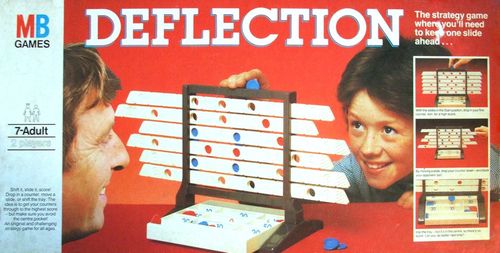
Deflection
Deflection Rulebook
Table of Contents
Table of Contents
Contents of the Game
- 1 gray game base with white box
- 1 gray game frame with 6 numbered levels
- 1 red and 1 blue grid with chips
- 4 rubber stands
- 20 chips
Aim of the Game
To pass the chips through the different levels by way of clever maneuvering, until they fall into the grading box in the base and achieve more points than the other player.
Preparation of the Game
Game Base
Insert the 4 rubber stands into the moulds at the four corners of the base. Fold the plastic sheet with the printed numbers on it along the pre-pressed lines and break them apart. These numbered plastic parts belong into the individual pockets of the white box in the game base. They show the value of each pocket.
Picture 1 shows which number belongs into which pocket. (In the center of the middle row goes the "0" and to the right and left of it the "50" each. In the row above that goes the "20" in the center and to the right and left of it the "10" each. In the lowest row comes the "10" in the middle and right and left of it the "20" each.)
Picture 2 shows how the numbered plastic pieces are placed into each of the pockets. Be careful that all numbers are pointed in the same direction. The score box is placed in the game base. The position of the score box can be altered by lifting it slightly and pushing it to the front or back. There are 3 different positions for the score box in the game.
Levels
The numbered white levels can be moved to the left and to the right direction. They have little notches that help position them by exactly one field within the frame.
Each level has various round "windows". The chips will fall through these windows and can be maneuvered to the bottom. The riffled field at each side of each level prevents the levels to be pushed out of the frame. Both the game frame and the levels are pushed slightly into the game base.
Chips
By means of gentle turning and bending, the 10 blue and 10 red chips are softly loosened from the frame. The game requires a set of 8 chips of each color. The remaining 2 chips of each color are spares in case of loss. Each player chooses his color and places them into the notches on the game base (See picture 3).
(Picture 3 shows the starting position, in which the score box is in the center position on the "0" and all levels are also exactly centered.)
Start Position
The score box and levels have a starting position (See picture 3): The score box must be placed in the middle of the three possible game positions, so that the zero-box is standing exactly under the game frame, as shown in the picture.
(Picture 4 shows the dark frame that carries the levels and highlights the slots where the initial chips can be inserted.)
Rules of the Game
-
The players decide who will start and then alternate turn order. In each turn one of the following moves must be made:
Move A – Enter a chip. A chip may be placed into one of the vacant slots in the upper level. BUT: The chip must be placed within the frame (see picture 4) and it must fall into one of the white levels and must not remain in the frame (see picture 5, which shows how the chip is falling through to the next level and doesn't remain in the frame and protrude out of it). The chip should not fall more than one level and may rest in the first top level (See picture 6 which shows that the chip drops just one level and remains in the top level.) If a player enters a chip from the top in a way that makes it fall down through several levels, then this player will miss the next turn.
Move B – Move a level. Each single level may be moved by one position to the left or right (i.e. by one "click" or one field). The riffled outer extremities cannot be pushed into the frame (see above). Whenever a level is moved, its number must be called out. BUT: it is not permitted to move the same level that the opponent has just moved in his previous turn.
Move C – Move the score box. The score box may be moved one position to the front or to the back. This move can be very helpful when the opponent is planning to drop a chip into the score box in his next turn. BUT: When the opponent has just moved the score box in his previous turn, then the player may only move the score box if he doesn't reverse the move. So when the opponent moves the score box from position 1 to position 2, then the player may only move it from position 2 to position 3 and not back to position 1.
-
Playing turn alternates. Throughout the game the player should closely observe the levels with the chips in them and the positions of the score box, to anticipate the intentions of the other player.
-
All chips that have landed in the score box are scored the value of the box they fell into. If chips jump from one box to another, then they score the value of the first box they fell into.
-
If chips fall on the table from a level from outside of the game frame then they are counted as played and are not scored.
Note: This doesn't necessarily have to be the player who first brought all of his 8 chips through the levels.