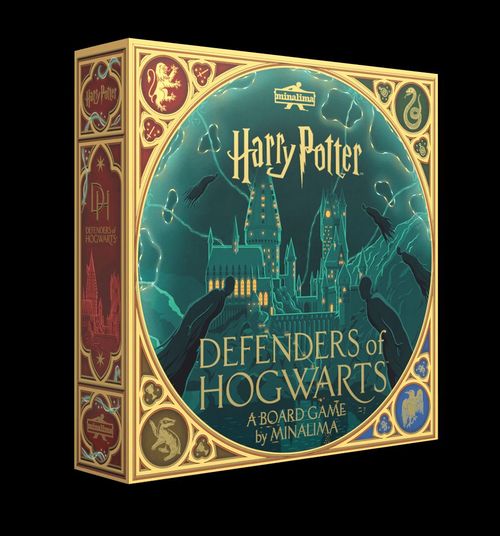
Defenders of Hogwarts
Defenders of Hogwarts Rulebook
Table of Contents
Table of Contents
- Game Components
- Game Overview
- Game Set Up
- General Key Concepts
- House Player Cards Guide
- Dark Arts Player Cards Guide
- House Player Location Deck
- Dark Arts Player Location Deck
- House Player Turn
- Hogwarts Loyalty Track
- Using the Dark Detector
- Room of Requirement
- Dark Arts Player Turn
- Dark Arts Path
- Game End
- Icon Quick Reference
- Glossary
Game Components
- 1 Side Board (with Dark Arts Path and Hogwarts Loyalty Track)
- 1 Main Board (Map of Hogwarts)
- 2 types of Defence Shield (3 of each type; 6 total)
- 5 Player Aid Cards
- 4 House Player Boards (Gryffindor™, Hufflepuff™, Ravenclaw™, Slytherin™)
- 4 x 4 House Player Pawns (Gryffindor™, Hufflepuff™, Ravenclaw™, Slytherin™)
- 4 House Markers
- 1 Dark Detector
- 1 Room of Requirement Board Piece
- 4 Dumbledore's Army (D.A.) Coins
- 7 Hogwarts Tokens
- 8 Parchment Scrolls
- 4 House Player Starter Decks (7 cards per deck; 28 cards total)
- 1 House Player Acquire Deck (42 cards)
- 1 Library Book Deck (11 cards)
- 1 House Player Location Deck (21 cards)
- 1 Dark Arts Player Board
- 7 Dark Arts Pawns
- 1 Dark Arts Marker
- 3 Dark Arts Progress Tokens
- 1 Dark Arts Player Starter Deck (7 cards)
- 1 Dark Arts Player Acquire Deck (20 cards)
- 1 Dark Arts Player Location Deck (4 cards)
- 3 Event Card Decks (5 cards per deck; 15 cards total)
The Main Board map of Hogwarts Castle and grounds has been adapted for gameplay.
Game Overview
Hogwarts House Players
As a student loyal to Hogwarts ('House Player'), your goal is to defend the School of Witchcraft and Wizardry against Lord Voldemort's imminent threat by honing your magical skills, strengthening the castle's defences, and even choosing to become a member of Dumbledore's Army.
You can achieve your goal by collecting 2 Defence Shields.
Collecting a Defence Shield
If you are in possession of the 3 items below when you land on a Defence Shield Space, you can exchange them for 1 Defence Shield.
- 1 Library Book Card
- 1 Parchment Scroll
- 1 Dark Detector OR 1 Dumbledore's Army Coin ('D.A. Coin'), whichever is depicted on the space's Defence Shield
Dark Arts Player
Your goal as the Dark Arts Player is to undermine the House Players who are preparing the castle for battle by stopping their progress, and furthering the infiltration of the castle by Dark Forces.
You can achieve your goal by both:
- Securing all the Dark Arts Progress Tokens from the Dark Arts Path; and
- Moving 1, 2 or 3 (depending upon where you are in the Red Zone of the Dark Arts Path) of your Dark Arts Pawns to a specified Dark Arts Player Location.
Game Set Up
Main Board Set Up
Place the Main Board in the middle of the table.
-
A. Shuffle the Defence Shields and place 1, face-up, on each Defence Shield Space.
-
B. Place each of the 7 Hogwarts Tokens on its space in the castle or grounds.
-
C. Give the Dark Arts Player 4, 5, 6 or 7 Dark Arts Pawns, depending upon the total number of House Players.
- 1 House Player = 4 Dark Arts Pawns
- 2 House Players = 5 Dark Arts Pawns
- 3 House Players = 6 Dark Arts Pawns
- 4 House Players = 7 Dark Arts Pawns
Then place 4 of those Dark Arts Pawns onto the 4 Deployment Spaces in the Hogwarts grounds (indicated with Dark Mask icon). Any remaining Dark Arts Pawn(s) are placed to a pool in front of the Dark Arts Player. (See step Q.)
-
D. Place 3 of each House Player's 4 pawns on the Great Hall Space on the Main Board.
-
E. Place the Room of Requirement Board Piece and the D.A. Coins near the Main Board to distribute when House Players fulfil the conditions to acquire them.
Side Board Set Up
Place the Side Board which contains the Dark Arts Path and Hogwarts Loyalty Track above the Main Board, then:
- F. Shuffle the Library Book Deck, place the deck face-down in the Library Book Draw Deck Space, and reveal 2 cards, face-up, placing 1 on each Library Book Space beside it.
- G. Shuffle the House Player Acquire Deck, place the cards face-down in the Acquire Deck Space, then deal 2 cards face-up on the Advanced Acquire Row (Ga) and 2 cards face-up on the Acquire Row (Gb).
- H. Place the Dark Arts Marker on the first space of the Dark Arts Path (top-left space).
- I. Place the 3 Dark Arts Progress Tokens on their respective spaces along the Dark Arts Path.
- J. Place the Dark Detector on its space on the Hogwarts Loyalty Track.
- K. Place the stack of Parchment Scrolls on their space.
- L. Place the remaining House Player Pawn(s) (1 per house) on the first space of the Hogwarts Loyalty Track.
- M. Shuffle the House Player Location Deck and place it face-down on the House Player Location Deck Space.
- N. Shuffle the Dark Arts Player Location Deck and place it face-down on the Dark Arts Player Location Deck Space.
Dark Arts Player Board Set Up
Note: 1 player must play as the Dark Arts Player. Until all players are familiar with the game, we recommend that the Dark Arts Player be the most experienced or most familiar with the rulebook.
Confirm which player will play as the Dark Arts Player, give them the Dark Arts Player Board, and then:
- O. Shuffle and place the Dark Arts Player Starter Deck on the Draw Space on the Dark Arts Player Board.
- P. Shuffle and place the Dark Arts Player Acquire Deck within the Dark Arts Player's area.
- Q. In a 2+ House Players game, place any additional Dark Arts Pawns in front of the Dark Arts Player.
- R. Separate the Event Cards into 3 decks by colour (white, orange and red), then shuffle each deck separately and place all 3 decks near the Dark Arts Player Board.
The Dark Arts Player draws 5 cards from their Dark Arts Player Starter Deck to their hand.
Note: Player Aid Card may be placed to the side for ease of reference during play.
House Player Board Set Up
Each remaining player chooses a Hogwarts house, takes the matching House Player Board, and then:
- S. Shuffles and places their House Player Starter Deck on the Draw Space on their House Player Board.
- T. Places their House Marker on the Items Space on their House Player Board.
Note: Return the components of any unchosen house to the box; they won't be used in this game.
- U. Draws 3 House Player Location Cards, leaving the rest of the cards on the House Player Location Deck Space on the Side Board.
Each House Player draws 5 cards from their House Player Starter Deck to their hand.
Note: Player Aid Cards may be placed to the side for ease of reference during play.
The game is ready to begin!
General Key Concepts
The House Player to the left of the Dark Arts Player goes first.
Gameplay continues clockwise until the end of the game is triggered. (See p.23, Game End.)
For details on a House Player's turn, see p.16. For details on the Dark Arts Player's turn, see p.20.
Movement & Map Elements
A pawn moves around the Main Board when the player plays a card.
- A pawn can be moved up to the number of spaces indicated as the card's movement value.
- Single movement values: Move 1 pawn up to the number of spaces indicated on the top diamond.
- Multi-move (2 movement) values: Move 1 pawn up to the number of spaces indicated on the first diamond, then move a different pawn up to the number of spaces indicated on the second diamond
OR
- Move 1 pawn up to the combined number of spaces indicated on both diamonds.
Moving 1 space means moving a pawn from 1 space to a fully adjacent space (i.e. a space that shares a full border with the initial space).
Left: Example of a card with a single movement value. Right: Example of a card with multi-movement values.
House Player Pawns can move through and land on spaces occupied by other House Player Pawns and cannot backtrack in the same turn. If a House Player Pawn ends in the same space as a Dark Arts Pawn, both pawns are stunned. (See p.16, Stunning.)
Left: Space dividers through which players can move freely. Red dividers indicate entrances/exits to and from the castle. Right: Castle walls. Players cannot move through castle walls.
Example of the Gryffindor Player's movement options.
Obstacles
4 obstacle types – Locked Doors, Protective Spells, Physical Objects and Water – block movement between some spaces.
- House Player Pawns can't move through obstacles unless they use a card that lets them do so during their move.
- Dark Arts Pawns can move freely through obstacles.
Fly Off Points
All pawns can fly from 1 Fly Off Point to any other, if the player has a card with an effect allowing them to do so. It does not cost anything to move from 1 Fly Off Point to another.
The Ravenclaw Player can use the Charms Token with an Alohomora card to exit the castle.
Secret Passageways
The 3 Secret Passageways, which connect 2 non-adjacent spaces, can only be used by the House Player(s). Only certain card effects in the game let House Players use a Secret Passageway, letting them move from the space on which they've landed to the space on the other end of the passageway. Spaces on each end of single passageways are marked with the same colour-coded icon. Moving through a Secret Passageway to another space counts as 1 movement point.
Protected Area
A Dark Arts Pawn can't pass through or end its move on any of the 4 Protected Area Spaces indicated by the blue shield icon.
Bonus Spaces
The effect of a Bonus Space can be activated only when a House Player Pawn ends its move on it.
Card Acquire
House Players can:
- Take 1 card from the Acquire Row
OR
- Take 1 card from the (face-down) Acquire Deck
OR
- Discard 1 card from their hand to take 1 card from the Advanced Acquire Row and move 1 space along the Hogwarts Loyalty Track.
Card Draw
House Players can draw 1 card from their Draw Deck.
Play Again
House Players can take another turn.
Hogwarts Tokens
There are 7 Hogwarts Tokens and a House Player can never have more than 1 at a time:
- Magical Creatures & Beings
- Transfiguration & Spell Casting
- Hogwarts Items & Artefacts
- Defence Against the Dark Arts
- Charms
- Potions
- Herbology
When a House Player Pawn lands on a space with a Hogwarts Token, the House Player may take that token (if available) and place it on their House Player Board. They must place that token back on its original space if they wish to take another one.
After obtaining a Hogwarts Token the House Player can use it starting from their next turn, as an extra Explore Action in addition to their chosen Main Action. To do so, they can play a card from their hand with that Hogwarts Token's icon. (See p.14, House Player Cards Guide.)
Once a Token is used, it must be returned to its space.
The Ravenclaw Player has landed in the Charms classroom and can now take the token to use on a future turn.
Defence Shield Space
Relinquishing the 3 items below when on a Defence Shield Space will gain the House Player a Defence Shield:
- 1 Library Book Card
- 1 Parchment Scroll
- 1 Dark Detector OR 1 D.A. Coin, whichever is depicted on the space's Defence Shield.
These are the 2 types of Defence Shields. A House Player needs to collect any 2 Defence Shields to win the game.
Once a House Player obtains any 2 Defence Shields, they win the game.
The Library & Library Book Deck
1 of the 3 items required to gain a Defence Shield is a Library Book Card, available only by visiting the Library.
Library Book Card effects must be resolved immediately.
A House Player can only have 1 Library Book Card at a time, so if a House Player Pawn visits the Library and they don't already have 1, they can take 1 of the 2 available (face-up on the Side Board) and resolve its effect immediately before placing it on their House Player Board. Any knock-on effects that occur as a result of resolving that Library Book Card effect must also be resolved at this time. The available Library Book Card Space on the Side Board must be replenished with a new card, face-up, from the Library Book Card Deck.
The Slytherin Player has landed in the Library.
The Slytherin Player can now take 1 of the 2 Library Book Cards from the Side Board and resolve its effect.
Parchment Scroll
1 of the 3 items required to gain a Defence Shield is a Parchment Scroll. If a House Player has at least 1 pawn in 2 of the 3 areas indicated on their House Player Location Cards, they immediately reveal those 2 cards, showing their pawns to be in the correct spaces, and then discard both House Player Location Cards from their hand to gain a Parchment Scroll (symbolising that the House Player has gained knowledge). (See p.17, Gain a Parchment Scroll.)
Dark Detector
1 of the 3 items required to gain a Defence Shield is the Dark Detector (on 3 of the Defence Shields only). If a House Player ends a move on a space with the Dark Detector icon, they can advance their pawn 1 space on the Hogwarts Loyalty Track on the Side Board. The Dark Detector can be obtained when a pawn lands on the fifth space or higher and is the pawn furthest along the Hogwarts Loyalty Track. (See p.18, Hogwarts Loyalty Track.)
The Hufflepuff Player has landed in a space with the Dark Detector icon.
The Hufflepuff Player can now move their pawn 1 space along the Hogwarts Loyalty Track towards the fifth space or higher to obtain the Dark Detector.
Dumbledore's Army Coin
1 of the 3 items required to gain a Defence Shield is a Dumbledore's Army Coin (on 3 of the Defence Shields only). The D.A. Coins are found on the Room of Requirement Board Piece. House Players who enter the Room of Requirement when it is revealed gain a D.A. Coin from the supply. (See p.19, Room of Requirement.)
Room of Requirement
The separate Room of Requirement Board Piece is added to the Main Board only when the Room of Requirement is revealed. It is removed when it closes. (See p.19, Room of Requirement.)
The Room of Requirement is revealed and added to the Main Board in the marked location when a House Player Pawn reaches the fifth space or higher on the Hogwarts Loyalty Track on the Side Board. (See p.18, Hogwarts Loyalty Track.)
Card Draw
Cards are drawn from the top of a player's Starter Deck on their Player Board. When the Draw Deck is depleted, the player must shuffle their Discard Pile to create a new deck from which to draw. This means that each card can potentially be played multiple times throughout the game!
House Player Cards are most commonly drawn via the Replenish Action (see p.17, Replenish), where the House Player may discard any number of cards from their hand and draw until they have 5 cards total in hand (regardless of how many are in the House Player's hand). A House Player cannot draw more than 5 cards in total during a Replenish Action.
But beware, when a House Player takes the Replenish Action, the Dark Arts Marker moves 1 space along the Dark Arts Path. (See p.22, Dark Arts Path.)
Only the House Player(s) can discard cards before drawing new cards.
The Dark Arts Player can draw with cards in their hand but cannot discard cards.
Cards may also be drawn via events, Library Book Card effects, and Bonus Spaces. Cards drawn via these methods do not move the Dark Arts Marker along the Dark Arts Path.
Starting Cards
All players begin the game with 7 Starter Deck Cards, which can be identified by the symbol in the top-right corner of the card.
Note: Starting Cards are the first set of cards players can use; they are not meant to represent basic magic.
Note: The Acquire Decks make up the full complement of cards available for the Dark Arts and House Player(s).
Hogwarts Player Starter Deck – each Hogwarts Player has the same set of Starting Cards.
Example of a Hogwarts Player Starting Card, indicated by the symbol in the top-right corner.
Dark Arts Player Starter Deck.
Example of a Dark Arts Player Starting Card, indicated by the symbol in the top-right corner.
Note: The rule text of the individual starting cards is printed on the cards themselves and is not reproduced in the rulebook body.
House Player Cards Guide
- Back of Card
- Movement Value (See p.10, Movement & Map Elements.)
- Movement Points
- Move to a Fly Off Point
- Move to a Specified Location
- Multi-Move Value (See p.10, Movement & Map Elements.)
- Illustration
- Card Type/Hogwarts Token (See p.11, Hogwarts Tokens.)
- Magical Creatures & Beings
- Transfiguration & Spell Casting
- Hogwarts Items & Artefacts
- Defence Against the Dark Arts
- Charms
- Potions
- Herbology
- Card Name
- Card Effect
- Obstacles: Water, Locked Doors, Protective Spells, Physical Objects
- Miscellaneous Icons: Fly Off Point; Secret Passageway – Blue; Secret Passageway – Green; Secret Passageway – Red; Secret Passageway – All; Reactive Effect
- Narrative Text
Dark Arts Player Cards Guide
- Back of Card
- Movement Value (See p.10, Movement & Map Elements.)
- Movement Points
- Move to a Fly Off Point
- Move to a Specified Location
- Multi-Move Value (See p.10, Movement & Map Elements.)
- Illustration
- Zone Colour Indicator
- White Zone
- Orange Zone
- Red Zone
- Card Name
- Card Effect
- Miscellaneous Icons: Fly Off Point; Reactive Effect
- Narrative Text
House Player Location Deck
- Back of Card
- Main Board Grid Coordinates
- Main Board Location Map
- Location Name
- Location Detail
Dark Arts Player Location Deck
- Back of Card
- Main Board Grid Coordinates
- Main Board Location Map
- Location Name
- Location Detail
House Player Turn
House Players want to hone their magical skills and prepare Hogwarts for the battle ahead. During their turn, they must take 1 of the following Main Actions:
- Explore
- Learn
- Replenish
Explore
House Players play a card from their hand and resolve the card's move and/or effect in the order of their choice. The card is placed on their Discard Pile on their Player Board at the end of their turn.
If they play a card that gives them the ability to play a second card, they must first resolve the move and/or effect indicated on the first card.
Card Movement
A House Player can resolve their card's move before or after its effect.
Most cards have a single movement value. For example, a movement value of '4' allows the House Player to move an un-stunned pawn of their choice up to 4 spaces.
Some empower a multi-move (2 movement values). For example, a '3 + 3' in the top left corner allows the House Player to move 2 pawns, each up to 3 spaces, or 1 pawn up to 6 spaces. The movement cannot be split any other way, e.g. 1 pawn cannot be moved 2 spaces and the other 4 spaces.
When using a multi-move card to move multiple pawns, the House Player chooses which value to resolve first.
Note: House Player Pawns can't pass through obstacles without the help of a card's effect! (See p.10, Movement & Map Elements.)
When a House Player Pawn ends a move on a Bonus Space, the House Player may activate its effect. (See p.10, Bonus Spaces.)
Card Effects
Some card effects will be active for the duration of a turn, while some will only apply when a specific condition is met during a turn.
A lightning bolt icon indicates that the card has a Reactive Effect, which occurs outside of the House Player's turn. When the effect's condition is met, the House Player can reveal the card to resolve only its effect. Cards with a Reactive Effect can be played in 2 ways:
-
They can be played like any other card for their movement value and then placed on the player's Discard Pile – avoiding the effect entirely
OR
-
When the condition of the effect is met, they can be played from a House Player's hand – resolving the effect immediately – and then placed on the player's Discard Pile.
- If there is no Reactive Effect, the card effect is resolved during the House Player's turn, before or after using the card's movement value.
- Most effects are instant, e.g. draw 1 card.
- Some effects are conditional, i.e. they can only be resolved when the stated condition is met, e.g. if the House Player ends their move outside of Hogwarts Castle, they can move 2 extra spaces.
- Some provide an effect that stays active for the whole turn, e.g. the House Player can move through 'X' obstacle during their turn.
Note: If a card effect contradicts the normal rules of the game, the card effect overrules them.
Note: Card effects are optional unless the language on the card indicates the effect must be resolved.
Stunning
When a pawn is stunned, place it sideways on the Main Board.
A stunned pawn cannot move by any means (card move or effect).
- A House Player or Dark Arts Player Pawn can be stunned by an event/card effect
OR
- When a House Player Pawn ends a move on a space with a Dark Arts Pawn on it, both pawns are stunned and the House Player must then move the Dark Arts Pawn to an adjacent space of the House Player's choice.
During a Replenish Action, all pawns of the active House Player stand up, being no longer stunned. (See p.17, Replenish.)
The Gryffindor Player ends a move on a space with a Dark Arts Pawn. Both pawns are stunned and placed sideways on the Main Board.
The Gryffindor Player moves the Dark Arts Pawn to an adjacent space.
Learn
The House Player can choose to hone their magic and even learn new magical skills!
A House Player must have at least 1 pawn outside of any Protected Area in order to take a Learn Action.
A House Player can take a Learn Action by:
- Discarding 1 card from their hand and taking 1 of the 2 face-up cards from the Acquire Row on the Side Board
OR
- Discarding 1 card from their hand and taking the top card of the Acquire Deck
OR
- Discarding 2 cards from their hand, taking 1 of the 2 face-up cards from the Advanced Acquire Row, and then advancing 1 space on the Hogwarts Loyalty Track.
Any acquired card is placed on the top of the House Player's Draw Deck on their Player Board, face-down.
Note: Cards are replenished along the Acquire Row and Advanced Acquire Row by moving remaining cards to the right and then drawing from the Acquire Deck to fill the leftmost empty space(s).
Replenish
At a cost of moving the Dark Arts Player further along the Dark Arts Path, the House Player can Replenish their hand to get ready for the battle ahead by completing the following steps, in order:
- Discard any number of cards from their hand and draw until they have 5 cards in hand. (See p.12, Card Draw.)
- Stand up all of their stunned pawns, reversing their stun status. (See p.16, Stunning.)
- Advance the Dark Arts Marker 1 space on the Dark Arts Path. (See p. 22, Advancing the Dark Arts Marker.)
Free Actions
In addition to 1 of the above Main Actions, House Players may complete as many of the below Free Actions as they desire during their turn:
Use a Hogwarts Token
Before or after a Main Action, the House Player can return a Hogwarts Token acquired on a previous turn to its space and then immediately take an Explore Action with a card of the same type as the Hogwarts Token returned. (See p.11, Hogwarts Tokens.)
Gain a Parchment Scroll
If a House Player has at least 1 pawn in 2 of the 3 areas indicated on their House Player Location Cards, they immediately reveal those 2 cards, showing their pawns to be in the correct spaces, and then discard both House Player Location Cards from their hand to gain a Parchment Scroll (symbolising that the House Player has gained knowledge). They must then return those 2 House Player Location Cards to the bottom of the House Player Location Deck on the Side Board.
If this is their first Parchment Scroll, they must draw 2 new House Player Location cards so they have a total of 3 at hand.
If it's their second Parchment Scroll, discard the remaining House Player Location Card to the bottom of its deck. They can't gain any more House Player Location Cards for the rest of the game.
The Hufflepuff Player already has 1 pawn in the Charms classroom (1 of their 3 House Player Location Cards).
The Hufflepuff Player has landed in the Astronomy Tower (another 1 of their 3 House Player Location Cards).
The Hufflepuff Player can now take a Parchment Scroll from the Side Board.
End of Turn
Once a House Player has completed their Main Action and resolved any Bonus Spaces and/or Free Actions, their turn ends. Any cards played must be placed on their Discard Pile on their Player Board and gameplay moves to the player to their left.
Hogwarts Loyalty Track
Progressing on the Hogwarts Loyalty Track on the Side Board is the only way to (a) gain the Dark Detector and (b) reveal the Room of Requirement to train with Dumbledore's Army and obtain a D.A. Coin.
Remember, for a House Player to gain a Defence Shield, they must be in possession of 3 items when they land on a Defence Shield Space.
As a reminder, a House Player must have all 3 items when on a Defence Shield Space to collect a Defence Shield. 2 Defence Shields are needed to win the game:
- 1 Library Book Card
- 1 Parchment Scroll
- 1 Dark Detector OR 1 D.A. Coin, whichever is depicted on the space's Defence Shield.
House Players can advance on the Hogwarts Loyalty Track by:
- Visiting a Hogwarts Castle/grounds space on the Main Board with a Dark Detector icon
OR
- Playing a relevant card with this ability
OR
- Discarding 2 cards from their hand to obtain 1 of the face-up cards on the Advanced Acquire Row on the Side Board.
If, after moving their pawn, a House Player lands on the fifth space or higher on the Hogwarts Loyalty Track, and they are higher than anyone else on the Hogwarts Loyalty Track, they immediately gain the Dark Detector.
If a House Player reaches the final space on the Hogwarts Loyalty Track, they stop moving and gain the Dark Detector (if they don't have it already). If another House Player is occupying the space and possesses the Dark Detector, they pass the Dark Detector to the House Player that has moved up and then drop back 1 space and draw a card from their Draw Deck to their hand.
House Player Pawns moving along the Hogwarts Loyalty Track.
There are 2 types of Defence Shields. A Hogwarts Player needs to collect 2 Defence Shields to win the game.
The Ravenclaw Player is the first to move to the fifth space on the Hogwarts Loyalty Track, so they can take the Dark Detector.
The Slytherin Player has moved to the final space on the Hogwarts Loyalty Track, where the Ravenclaw Player is already located.
The Ravenclaw Player hands the Dark Detector to the Slytherin Player. Then they move back 1 space on the Hogwarts Loyalty Track and draw a card from their Draw Deck to their hand.
Using the Dark Detector
When a House Player relinquishes the Dark Detector to gain a Defence Shield, they drop their pawn back 3 spaces along the Hogwarts Loyalty Track and return the Dark Detector to its place on the Side Board. If another House Player has already reached the fifth space or higher on the Hogwarts Loyalty Track, then the Dark Detector passes directly to them.
If 2 House Players have reached the same space on the Hogwarts Loyalty Track, then the first to move to the fifth space or higher receives the Dark Detector.
Room of Requirement
The first time any House Player reaches or passes the fifth space on the Hogwarts Loyalty Track, the Room of Requirement is revealed and placed on the Main Board to indicate that it can be accessed by the House Player(s).
House Players who now enter the Room of Requirement Space gain a D.A. Coin from the supply.
Note: House Players can only have 1 D.A. Coin at a time.
The Room of Requirement is inaccessible and removed from the Main Board when all House Player Pawns have moved below the fifth space on the Hogwarts Loyalty Track.
Note: If a pawn is in the Room of Requirement when it is removed from the Main Board, it must remain there until the room is revealed again.
In this example, the Room of Requirement has revealed itself and all House Players can access the D.A. Coins.
The Room of Requirement Board Piece can now be added to the Main Board.
The Room of Requirement is no longer accessible and has been removed from the Main Board. In this example, the Hufflepuff Player must remain there until the room has been revealed again.
All House Player Pawns have moved below the fifth space on the Hogwarts Loyalty Track.
Dark Arts Player Turn
Card Effects
Card effects operate exactly as described on p.16 in 'House Player Turn', subject to the following restrictions:
- A card effect is resolved before or after the card's move, and only if it's been unlocked.
- All effects have a colour and symbol background, indicating at which point on the Dark Arts Path on the Side Board they will be unlocked and available to use/resolve when played for the rest of the game:
- White: Effects are unlocked from the start of the game.
- Orange: Effects are unlocked from the moment the marker reaches the first orange space on the Dark Arts Path.
- Red: Effects are unlocked from the moment the pawn reaches the first red space on the Dark Arts Path.
All white effects on cards can be resolved from the start until the end of the game.
The Dark Arts Marker has reached the first orange space on the Dark Arts Path. All orange effects on cards can now be resolved in addition to white effects.
The Dark Arts Marker has reached the first red space on the Dark Arts Path. All red effects on cards can now be resolved in addition to white and orange effects.
Replenish
The Dark Arts Player can Replenish their hand by completing the following steps, in order:
- Stand up all of their stunned pawns, reversing their stun status. (See p.16, Stunning.)
- Draw until they have 5 cards in hand. (See p.12, Card Draw.)
Remember: Only House Players can discard cards. The Dark Arts Player can draw with cards in their hand but not discard when they Replenish.
End of Turn
Once the Dark Arts Player has completed their Main Action and resolved any bumps and advances along the Dark Arts Path, their turn ends. Any cards played must be discarded and gameplay moves to the player to their left.
The Dark Arts Player wants to stop the House Player(s) from honing their magical skills and defending the castle, all the while helping to ensure that Hogwarts can be infiltrated by Lord Voldemort.
During their turn, they must take 1 of the following Main Actions:
- Explore
- Replenish
Explore
The Dark Arts Player plays a card from their hand and resolves its move and/or effect in the order of their choice. The card is placed on the Discard Pile on their Player Board at the end of their turn.
If they play a card that gives them the ability to play a second card, they must first resolve the move and/or effect indicated on the first card.
Card Movement
A Dark Arts Player can resolve their card's move before or after its effect.
As a reminder, most cards have a single movement value. For example, a movement value of '4' allows the Dark Arts Player to move an un-stunned pawn of their choice up to 4 spaces.
Some empower a multi-move (2 movement values). For example, a '3 + 3' in the top left corner allows the Dark Arts Player to move 2 pawns, each up to 3 spaces, or 1 pawn up to 6 spaces. The movement cannot be split any other way, e.g. 1 pawn cannot be moved 2 spaces and the other 4 spaces.
When using a multi-move card to move multiple pawns, the Dark Arts Player chooses which value to resolve first.
If a Dark Arts Player chooses to bring in a Dark Arts Pawn that is not on the Main Board, they must spend 1 of their movement points to place it on 1 of the available Dark Arts Deployment Spaces. The Dark Arts Deployment Spaces are marked with a Dark Arts icon.
Remember: Dark Arts Pawns can pass freely through obstacles, but they can never enter a Protected Area Space! (See p.10, Movement & Map Elements, for the rest of the Map's elements.)
Note: A Dark Arts Player cannot deploy a pawn to a Deployment Location that already has a Dark Arts Pawn in it (including stunned pawns).
Bumped
When a Dark Arts Pawn ends its move on a space occupied by a House Player Pawn, the House Player Pawn is bumped. Resolve a bump as follows:
- If more than 1 House Player Pawn is on the space, the Dark Arts Player chooses which one will be bumped.
- The Dark Arts Player returns the chosen House Player Pawn to the Great Hall and adds the Dark Arts Pawn to their pool, off the Main Board.
- Next, they take the House Marker from the House Player whose pawn was bumped, if they don't have it already.
Note: Once the Dark Arts Player has all the House Players' Markers, they must advance the Dark Arts Marker on the Dark Arts Path 1 space and return the House Player Markers to the House Player(s). (See p.22, Advancing the Dark Arts Marker.)
- Finally, the Dark Arts Player draws the top 2 cards from the Dark Arts Acquire Deck, chooses 1 to place on the top of their Draw Deck on their Player Board, and returns the other to the bottom of the Dark Arts Acquire Deck.
Note: This step is resolved once per turn, even if multiple bumps have occurred during that turn.
The Dark Arts Player cannot enter Hagrid's Hut, as it is a Protected Area Space. This Hufflepuff Player is therefore protected from being bumped.
The Dark Arts Player has ended their move on a space occupied by the Gryffindor and Slytherin Players.
The Dark Arts Player has decided to bump the Gryffindor Player. The Gryffindor Player is moved back to the Great Hall and the Dark Arts Pawn is removed from the Main Board.
The Dark Arts Player must take the Gryffindor House Marker. They must draw 2 cards from the Dark Arts Acquire Deck, choose 1 to place on their Draw Deck on their Player Board, and return the other to the bottom of the Acquire Deck.
Dark Arts Path
Advancing the Dark Arts Marker
The Dark Arts Player advances the marker 1 space on the Dark Arts Path on the Side Board when:
- A House Player Replenishes their hand (See p.21, Replenish.)
OR
- An event instructs it to happen
OR
- The Dark Arts Player gains all House Markers. (See p.20, Bumped.)
If the Dark Arts Marker lands on a space other than an Event Space, nothing happens.
If the Dark Arts Marker lands on an Event Space, the Dark Arts Player takes the topmost Event Card of that space's colour and resolves it.
On each Event Space, the Dark Arts Player may choose to take either the Dark Arts Progress Token of that zone, if available, or gain the benefit of the Event Card. However, they must take the Dark Arts Progress Token from each zone before advancing into the next one.
When the Dark Arts Marker reaches the first Red Event Space in the Red Zone, the Dark Arts Player can choose to take the last Dark Arts Progress Token. They will then draw a Dark Arts Player Location Card from the Side Board and must get 3 Dark Arts Player Pawns to that location to win the game.
The further the Dark Arts Marker moves into the Red Zone on the Dark Arts Path the fewer pawns the Dark Arts Player must get to the Dark Arts Player Location to win.
If they wait until the Dark Arts Marker reaches the next Red Event Space to take the Dark Arts Progress Token and draw the Dark Arts Player Location Card, they need to get only 2 pawns to that location to win.
On the last space of the Dark Arts Path, the Dark Arts Player must take the Dark Arts Player Location Card from the Side Board (if they have not already) and must then get just 1 Dark Arts Pawn to that location to win.
When the Dark Arts Player lands on the last space of the Dark Arts Path, all players draw up to 5 cards and cannot Replenish again. Gameplay continues with just those cards in hand until a House Player wins by gaining 2 Defence Shields; the Dark Arts Player wins if the required number of pawns reaches the Dark Arts Player Location; or the game ends in a tie because all players run out of cards before a player has won.
Note: This does not apply to card effects and draw spaces.
The Dark Arts Marker has landed on the first Red Event Space. If the Dark Arts Player chooses to take the Dementor Token, they will need to get 3 of their pawns to a specified location in order to win.
The Dark Arts Marker has landed on the second Orange Event Space on the Dark Arts Path.
As the Dark Arts Player has not yet taken the Acromantula Dark Arts Progress Token from the Side Board, they must take it in order to progress into the Red Zone.
Resolving an Event Card
An Event Card always has 2 parts to it: 1 for the House Player(s) and 1 for the Dark Arts Player.
First, all House Players must resolve the Event Card's effect, if possible.
Next, the Dark Arts Player must choose to resolve the effect or gain the Dark Arts Progress Token of that zone (if they have not already done so).
While some White Event Cards result in positive House Player effects, most Event Card effects are negative.
As the Dark Arts Marker moves from the White Zone to the Orange Zone and the Red Zone, the Dark Arts Player becomes more powerful, the events more punishing for the House Player(s), and the end of the game draws closer.
After resolving an event, the Dark Arts Player discards the Event Card near the Event Card's Deck.
Once the Dark Arts Marker moves from one colour zone to the next on the path, previous colour zone Event Cards cannot be used for the rest of the game.
Game End
The game ends when Hogwarts Castle has been defended against Lord Voldemort and his followers or when they have successfully infiltrated the school. Specifically:
- A House Player wins when they have collected 2 Defence Shields.
OR
- The Dark Arts Player wins if they have secured all 3 Dark Arts Progress Tokens and landed 3, 2, OR 1 Dark Arts Pawns on the Dark Arts Player Location simultaneously. (The number of pawns that must reach the Dark Arts Player Location depends on which Event Space the Dark Arts Player is on when they take the Dark Arts Player Location Card.)
- The game ends in a DRAW when the Dark Arts Marker reaches the last space on the Dark Arts Path and all players draw 5 final cards (with no further option to Replenish) and play them all without the Dark Arts Player or the House Players completing their primary goals. (See above.)
Example of a House Player win: The Hufflepuff Player has collected 1 Defence Shield as well as the 3 items needed to collect a second one.
The Hufflepuff Player has landed on a Defence Shield Space. They can now trade in their Library Book Card, Parchment Scroll and D.A. Coin and take the Defence Shield from the Main Board.
The Hufflepuff Player now has 2 Defence Shields so has won the game!
Example of a Dark Arts Player win: The Dark Arts Player has landed on the second Red Event Space on the Dark Arts Path.
The Dark Arts Player decides to secure the final Dark Arts Progress Token (the Dementor), so can now take a Dark Arts Location Card from the Side Board.
The Dark Arts Player already has a pawn in The White Tomb (the location specified on their Location Card). A second Dark Arts Pawn has now landed in this location so the Dark Arts Player has won the game!
Icon Quick Reference
Note: The icon artwork is not reproduced; each icon is listed by the name the rulebook prints for it.
- Hogwarts Tokens: Creatures & Beings; Charms; Defence Against the Dark Arts; Potions; Transfiguration & Spell Casting; Herbology; Hogwarts Items & Artefacts
- Miscellaneous: Acquire a Card; Dark Arts Deployment; Location (Dark Arts Player only); Dark Arts Path – Red Zone; Dark Arts Path – Orange Zone; Dark Arts Path – White Zone; Dark Detector; Draw a Card; Fly Off Point (inside castle); Fly Off Point (outside castle); Secret Passageway – Any; Secret Passageway – Blue; Secret Passageway – Green; Secret Passageway – Red; Play Again; Protected Area; Library; Special Movement; Reactive Effect
- Obstacles: Water; Locked Doors; Protective Spells; Physical Objects
Glossary
A
Acromantula Token: 1 of the 3 Dark Arts Progress Tokens. Placed in the Orange Zone of the Dark Arts Path. It must be collected by the Dark Arts Player via 1 of the 3 Orange Event Cards resolved.
Acquire Deck: A deck that makes up the full complement of cards available for each player. Placed face-down in the Acquire Deck Space for House Players and face-down in the playing area for the Dark Arts Player.
Acquire Row: The 2 face-up House Player Cards located to the far right of the House Player Acquire Deck on the Side Board. Can be acquired by the House Player(s) via the Learn Main Action or various game effects. Refreshed from the House Player Acquire Deck. The player discards 1 card from their hand and takes 1 of the 2 face-up cards from the Acquire Row.
Action: There are 3 Main Actions: Explore, Learn and Replenish (Learn is only available to the House Player(s)). There are 2 Free Actions (only available to the House Player(s)): Use a Hogwarts Token and gain a Parchment Scroll.
Adjacent Space: A space is considered adjacent to another if the two spaces share a white or red dotted line.
Advance: Move forward on either the Hogwarts Loyalty Track or the Dark Arts Path.
Advanced Acquire Row: The 2 face-up House Player Acquire Cards located to the right of the House Player Acquire Deck on the Side Board. Cards can be acquired by the House Player(s) via the Learn Main Action or various game effects. Refreshed from the House Player Acquire Deck. The player discards 2 cards from their hand and takes 1 of the 2 face-up cards from the Advanced Acquire Row. Then, they advance 1 space on the Hogwarts Loyalty Track.
At Random: Blindly selected, i.e. a card discarded at random must be done so without the player knowing which card they are choosing.
B
Backtrack: Move a pawn through spaces it already passed through in the same turn or end a pawn's movement in a turn on the space from which it started the turn.
Bonus Space(s): A space that offers a special effect to the House Player when 1 of their pawns ends its move on it (Card Acquire, Card Draw or Play Again).
Bump(ed): When a Dark Arts Pawn ends its move on a space occupied by a House Player Pawn, the House Player Pawn is bumped from that space to the Great Hall.
C
Card Effect: The effect of a card when played. Card effects are optional, unless stated otherwise, and overrule the main rules of the game.
Collecting: The act of a House Player obtaining a Defence Shield by spending the required game components when their pawn lands on a Defence Shield Space. Collecting 2 Defence Shields allows a House Player immediately to win the game.
Colour Zone: An area of specific colour (White/Orange/Red) on the Dark Arts Path.
D
Dark Arts Player Location Card: A card indicating a specific space on the Main Board. Shows the space that the Dark Arts Pawn(s) needs to reach to win the game after certain conditions are met.
Dark Arts Marker: A game component used to advance along the Dark Arts Path.
Dark Arts Path: The path the Dark Arts Player must complete to win the game, split into 3 coloured zones (white, orange, red) that each include event spaces. On the last space of the Dark Arts Path, the Dark Arts Player must take the Dark Arts Player Location Card (if they have not already) and must then get 1 Dark Arts Pawn to that location to win.
Dark Arts Progress Token: 1 of 3 tokens placed in particular zones along the Dark Arts Path that the Dark Arts Player must collect to gain the Dark Arts Location Card that shows where they must send their pawn(s) to win the game.
Dark Detector: A token that can be obtained via the Hogwarts Loyalty Track if a pawn moves highest on the track while being in at least the fifth space. The Dark Detector is one of the items needed to collect a Defence Shield. 3 Shields require a Dark Detector and 3 require a Dumbledore's Army Coin.
Dark Mask Icon: The symbol used to indicate a Deployment Space, which is where a Dark Arts Pawn must be placed when entering the Main Board.
Defence Shield: House Players must collect 2 Defence Shields to win the game. They can be collected when landing on a Defence Shield Space by relinquishing 1 Library Book Card, 1 Parchment Scroll and 1 Dark Detector or D.A. Coin (whichever is depicted on the space).
Dementor Token: 1 of the 3 Dark Arts Progress Tokens. Placed in the Red Zone of the Dark Arts Path. It must be collected by the Dark Arts Player via 1 of the 3 resolved Red Event Cards.
Depleted: When all the cards in a player's hand have been used. The player shuffles their Discard Pile to create a new deck from which to draw.
Deploy: The Dark Arts Player can deploy, or put into play, an off-board Dark Arts Pawn by placing it on a Deployment Space.
Deployment Space: Indicated by a Dark Mask icon, a Deployment Space is where a Dark Arts Pawn enters the Main Board.
Draw(s): A player draws a card when they take a card from the top of a deck to their hand, unless otherwise specified.
Draw Deck: A deck from which players can draw cards.
Draw Space: The space on which House Players and the Dark Arts Player place their Starter Decks on their respective Player Boards.
Directly: Some card effects allow a player to move 1 of their pawns directly to a specific space. A pawn moved 'directly' does not stop on any spaces en route to the destination space.
Discard: Place a card on top of the respective Discard Pile, face-up.
Discard Pile: A pile of cards next to a Draw Deck created by discarding cards from that deck. When a player's Draw Deck is depleted, their Discard Pile is shuffled and placed face-down in the Draw Deck Space.
Dumbledore's Army Coin ('D.A. Coin'): A token that can only be found in the Room of Requirement Board Piece and is one of the items needed to collect a Defence Shield. A D.A. Coin can be obtained by ending a House Player Pawn's move on the Room of Requirement Board Piece when it is revealed on the Main Board.
E
Effect: The outcome of playing a particular card, landing on a particular space, or using a particular game component.
Event Card: A type of card that is resolved every time the Dark Arts Marker lands on an Event Space on the Dark Arts Path. An Event Card is resolved by the Dark Arts Player, resulting in a (often negative) effect for the House Player(s) and a positive effect for the Dark Arts Player.
Explore: 1 of the Main Actions a player can take on their turn, which allows them to play 1 card from their hand, resolving its movement and/or effect.
F
Fly Off Point: Allows special travel across the Main Board. Player Pawns can fly from 1 Fly Off Point to any other if the player has a card with an effect allowing them to do so.
Free Action: In addition to taking 1 Main Action (Explore/Learn/Replenish) during their turn, a House Player can take one or both Free Actions, in any order (using a Hogwarts Token or gaining a Parchment Scroll).
G
Gain: Obtain, acquire or take, as a token, card or game effect/ability.
Giant Token: 1 of the 3 Dark Arts Progress Tokens. Placed in the White Zone of the Dark Arts Path. It must be collected by the Dark Arts Player via 1 of the 3 resolved White Event Cards.
Grid Coordinates: The letters and numbers along the Main Board's edge used to help players pinpoint the spaces depicted on a Location Card.
H
Hand: The set of cards in a player's hand during their turn.
Hogwarts Token: There are 7 Hogwarts Tokens in the game and each matches 1 of the 7 card types. House Players can only have 1 Hogwarts Token at a time and can gain them by landing on their dedicated space on the Main Board. Before or after a Main Action, the House Player can return the Hogwarts Token acquired on a previous turn to its space and then immediately take an Explore Action. The played card's type must match the Hogwarts Token returned.
Hogwarts Loyalty Track: A 7-space track on the Side Board. House Players advance along it via card effects, Bonus Spaces on the Main Board, and taking a card from the first 2 spaces of the Acquire Row. Progressing on the Hogwarts Loyalty Track is the only way to gain the Dark Detector and access the Room of Requirement, where players can gain a D.A. Coin. (Players need to possess a D.A. Coin or Dark Detector to collect a Defence Shield.)
House Marker: Each of the 4 House Markers represents 1 of the 4 House Players. The Dark Arts Player takes a player's House Marker when they bump 1 of that player's pawns. When the Dark Arts Player controls all House Markers, they immediately advance 1 space on the Dark Arts Path and return the House Markers to their owners.
House Player Location Card: A card indicating a specific location on the Main Board. A Parchment Scroll, 1 of the items a House Player must relinquish to collect a Defence Shield, can be gained when the House Player has pawns in 2 of the 3 areas indicated on their House Player Location Cards.
I
Instant Effect: A card's effect that is resolved immediately when the card is played and is not subject to any conditions.
Icon: A symbol on a card or board that acts as a shortcut to game information for ease of review while playing or indicates game elements that are connected, e.g. when using a Hogwarts Token, a House Player can only play a card with the same icon as the returned Hogwarts Token.
L
Learn: 1 of 3 Main Actions only a House Player may take during their turn. Involves discarding 1 card from their hand and taking 1 face-up card from the Acquire Row or 1 face-down card from the Acquire Deck. (To acquire 1 of the face-up cards from the Advanced Acquire Row during a Learn Action, the House Player must discard 2 cards; however, they may then also advance 1 space on the Hogwarts Loyalty Track.)
Library: The space on the Main Board representing the Hogwarts Library. 1 of the 3 items required to gain a Defence Shield is a Library Book Card, available only by visiting the Library.
Library Book Card: Accessible in the Library, a Library Book Card is 1 of the 3 items required to gain a Defence Shield.
Lightning Bolt: A symbol in a card's effect section that indicates a Reactive Effect. Such an effect can be played outside a player's turn, provided the specified conditions are met.
Location: A specific space on the Main Board, depicted on a House Player or Dark Arts Location Card.
Location Cards: House Player Pawns and Dark Arts Player Pawns must reach certain locations on the Main Board to achieve various goals. Location Cards contain detail regarding these locations, including Main Board grid coordinates and map specifics.
Locked Door: 1 of 4 obstacle types in the game that block House Player Pawn movement between spaces. Certain card effects allow House Player Pawns to pass through a Locked Door.
M
Main Board: The central board of the game that includes Hogwarts Castle and grounds.
Main Action: There are 3 Main Actions in the game: Explore, Learn and Replenish. Explore and Replenish are available to all players, while Learn is available only to House Players. Each player can take 1 Main Action during their turn.
Movement Point: Certain cards have movement values on them, allowing players to move their pawns. Moving 1 space spends 1 of the value's movement points.
Movement Value: The number on the top-left corner of a card indicating the number of movement points a player can spend moving a pawn or pawns (not stunned) when playing that card. Cards with 2 movement values allow the player to move up to 2 pawns. A player need not use all the movement points and can combine 2 movement values to move 1 pawn. However, they must use the 2 designated movement values when moving 2 pawns and cannot backtrack.
Multi-Move: 2 movement values on a card allowing a player to move 1 or 2 pawns. Each of the 2 values may be used separately by 2 different pawns, or their total can be applied to the same pawn, e.g. a '3 +3' value allows the player to move each of 2 pawns up to 3 spaces or 1 pawn up to 6 spaces. The movement cannot be split any other way.
N
Narrative Text: Text that references moments or content from the Harry Potter™ films, found at the bottom section of a card.
Negate: Cancel a game effect, such as a bump or the effect of a Hogwarts Token. When the effect to be negated is the result of a card, the effect will not take place and the card is discarded.
O
Obstacles: There are 4 obstacle types in the game that block movement between some spaces: Locked Doors, Protective Spells, Physical Objects and Water. While Dark Arts Pawns can move freely through obstacles, House Player Pawns can't move through them unless they use a card that lets them do so during their move.
Off-Board: Refers to the location of a pawn being off the Main Board. (Only applies to the Dark Arts Pawns.)
On-Board: Refers to the location of a pawn being on the Main Board.
Orange Zone: The second section of the Dark Arts Path, where the Dark Arts Player can acquire the Acromantula Progress Token.
P
Parchment Scroll: One of the items a House Player must exchange to collect a Defence Shield, a Parchment Scroll can be obtained when the House Player has pawns simultaneously in 2 of the 3 areas indicated on their House Player Location Cards.
Path Colour Indicator: The icon on the left side of a Dark Arts Player's Card matching 1 of the 3 zones of the Dark Arts Path and indicating the zone that unlocks the card's effect. If the Dark Arts Path Marker is in or past the indicated zone, the card's effect is unlocked for the rest of the game and can only be resolved once the card is played. If the zone has not yet been reached, the card's effect is ignored when the card is played.
Pawn: The game piece representing a player.
Physical Object: 1 of 4 obstacle types that block House Player Pawn movement between spaces. Certain card effects allow House Player Pawns to pass through Physical Objects.
Pool: The collective term for the location near the Dark Arts Player where off-board Dark Arts Pawns are held.
Protected Area: A space containing the blue shield icon. A Dark Arts Pawn can't enter a Protected Area Space.
Protective Spell: 1 of 4 obstacle types that block House Player Pawn movement between spaces. Certain card effects allow House Player Pawns to pass through a Protective Spell.
Player Aid Card: A quick-reference card depicting a player's turn structure, as well as important symbols in the game.
R
Reactive Effect: If a card has a Reactive Effect, indicated by a lightning bolt on the card, the effect occurs outside of the House Player's turn when the effect's condition is met.
Red Zone: The third and last section of the Dark Arts Path, where the Dark Arts Player can acquire the Dementor Progress Token.
Relinquish: A component is relinquished when it is removed from a player's hand or their Player Board Items area and returned to its original location or the Discard Pile.
Replenish: 1 of the Main Actions a player can take on their turn. It lets them Replenish their hand by drawing up to 5 cards from their Draw Deck, and reverse all stun effects applied to their pawns by standing them up. As part of a Replenish Action, House Players must advance the Dark Arts Marker one space and may also discard any number of cards before drawing back to 5.
Reveal(s): A player reveals a card when they show the rest of the players the information on its face.
Reversing a Stun: Negating the stun status from a pawn by standing it up, denoting that it's no longer stunned. The most common way for any player to reverse stunning is via the Replenish Main Action where they do so to all of their pawns.
Room of Requirement Board Piece: The piece symbolising the Room of Requirement. The first time any House Player reaches or passes the fifth space of the Hogwarts Loyalty Track, the Room of Requirement is revealed and its piece placed where indicated on the Main Board so that it can be accessed by the House Player(s).
S
Secret Passageway: 2 non-adjacent spaces marked with the same colour-coded icon that are considered adjacent only via certain card effects and only for House Players. There are 3 Secret Passageways in the game (Red/Green/Blue).
Side Board: The board that includes the Hogwarts Loyalty Track and the Dark Arts Path.
Single Move: Most movement values empower a single move (vs a multi-move), e.g. a '4' in the corner of a card allows the House Player to move 1 pawn up to 4 spaces.
Skip: If a player is forced to skip a turn, they must let the next player go ahead with their turn without taking their own turn, e.g. if the Dark Arts Player uses the Confundo card, they can force a House Player to skip their turn.
Specified Location: A specific location on the Main Board. Movement values may require a player to move their pawn to a specified location rather than a number of spaces.
Starter Deck: The set of cards that make up a player's Draw Deck at the start of the game. It is distinguished by the symbol in their top-right corner.
Stun (Stunned): A pawn placed sideways on its space. A stunned pawn cannot move by any means (card move or effect). Pawns can be stunned by a card effect, and the Dark Arts Pawns can be stunned when a House Player Pawn ends on their space (in that case, also moving them to an adjacent space).
Swap: Exchange of position of 2 game components. For example, pawns are swapped by exchanging their positions on the Main Board.
T
Targets: When the negative effect of a card is aimed at a House Player by the Dark Arts Player, the House Player is considered targeted. Certain House Player cards can negate such an action.
Token: A physical object representing an element in the game, e.g. a Parchment Scroll or a Dark Arts Progress Token.
Turn: The game moment during which 1 player acts. Players take turns in order until the game ends.
W
Water: 1 of 4 obstacle types that block House Player Pawn movement between spaces. Certain card effects allow House Player Pawns to pass through Water.
White Zone: The first section of the Dark Arts Path, where the Dark Arts Player can acquire the Giant Progress Token.
Z
Zone: A specifically coloured section on the Dark Arts Path on the Side Board.