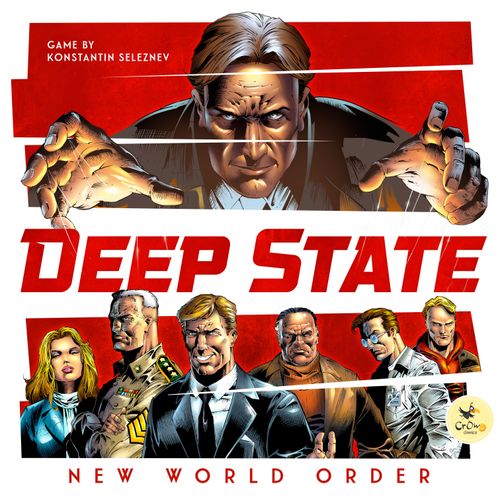
Deep State: New World Order
Deep State: New World Order Rulebook
Table of Contents
Table of Contents
- Reality and Fiction
- Lead the World Government
- Game Components
- Game Setup
- Game Process
- Action Phase
- Object Cards
- Shadow Agents
- Action: Carry Out a Special Operation
- Action: Advance in a World Domination Project
- Action: Prepare an Agent
- World Domination Project Boards
- Capture Phase
- Alliance Phase
- Alliance Cards
- World War Cards
- Secondary Object Cards
- World Domination
- Examples of Calculating Influence from Object Cards
- Mini-Expansion: "Professionals"
- Quick Reference
Reality and Fiction
The game Deep State: New World Order invites you to immerse yourself in an alternate history of our world and take part in events that could have become real — or perhaps, in fact, did become real, only most of us remain unaware.
We ask that you regard everything happening in the game as fiction, and any coincidences or resemblances as accidental. The game in no way seeks to disparage the interests of any country, organization, or individual. Before you is an imagined dystopia in the form of a board game.
Lead the World Government
The game is won by the participant who has earned the most influence points by the end of the game. You will earn these points by seizing control of the world's most important institutions of power — secret laboratories, banks, media, and law-enforcement agencies — by forming profitable alliances, carrying out special operations, and taking part in projects of world domination.
Game Components
- Agents — 40 tokens (10 tokens each of 4 colors)
- Shadow Agents — 8 tokens
- Curator — 1 token
- Secondary Objects — 34 cards
- World Domination Projects — 4 boards
- Special Operations — 6 tokens
- Alliances — 46 cards
- Alliance tokens — 3 tokens (Cosa Nostra, Yakuza, Triads)
- Objects — 55 cards
- Notepad — 48 sheets
- Rulebook and Appendix — 2 booklets
- Reference cards — 8 cards
- Mini-expansion "Professionals" — 18 cards
Game Setup
1. Alliances
Shuffle the alliance deck (1a).
- When playing with beginners, deal each participant 4 alliance cards face down (1b).
- If all players are well familiar with the rules, deal each of them 6 alliance cards face down. Participants keep 4 cards in hand (1b), and discard the rest face down. Without looking, shuffle all discarded cards back into the alliance deck.
- Experienced players can use draft mechanics. Each player receives 6 cards, chooses one of them and places it face down in front of themselves, passing the rest to the player on their left. Having drafted 4 cards this way (1b), discard the remaining cards face down and shuffle them back into the alliance deck without looking.
Opponents cannot look at your cards, but the information about how many cards you hold is public.
We recommend choosing your alliances so that they complement each other and/or have similar requirements.
2. Objects
The number of Object cards used in a game depends on the number of players. When playing with four, use all Object cards; when playing with three, return to the box the Object cards marked "4" in the bottom right corner; when playing with two, return the Object cards marked "3+" and "4". Regardless of player count, use both World War cards included in the Object deck. Shuffle the resulting deck.
Take cards one at a time from the top of the Object deck and lay them out in a row face up. This row is called the Infiltration Zone. When playing with four, it consists of 9 cards; when playing with three or two, it consists of 8 (2a).
If you reveal a World War card, set it aside and reveal the next card instead. Once the Infiltration Zone is laid out, shuffle the set-aside World War cards back into the Object deck. This way, these cards will not appear in the game before the second round.
The first 3 cards in the Infiltration Zone (the leftmost ones) are called available objects, and you may deploy your agents onto these objects. Place the Object deck to the right of the Infiltration Zone (2b), leaving room for a discard pile.
3. World Domination Projects
Place all 4 World Domination Project boards above the Infiltration Zone in any order (3). We recommend the following order: "Deep State," "Comintern," "United Nations," and "Espionage."
4. Special Operations
Place the stack of 6 Special Operation tokens next to the Infiltration Zone (4), face up. The tokens in the stack are arranged in ascending order of influence points (the number in the top right corner). This way, the token "Removing Obstacles" with 6 influence points will be on top of the stack, and the token "Deploying Troops" with 16 points will be at the bottom.
5. Agents
Give each player 10 agent tokens of one chosen color. Players place 3 of them in front of themselves: this is their active roster (5a). Agents from the active roster can be used to perform various actions.
Players set the remaining 7 tokens aside: this is the reserve (5b). Agents in the reserve can be recruited (i.e., moved into the active roster), but until they are recruited, they cannot be used to perform actions. Place the reserve away from the active roster so you don't accidentally mix them up.
6. Remaining Cards and Tokens
Give each player 2 reference cards. Place the remaining tokens, as well as the Secondary Object cards, on the table — this is the common supply (6).
7. Start of the Game
The player who most recently read a book or watched a movie about world conspiracies decides who receives the Curator token and goes first (7).
The battle for control of the world begins!
Game Process
The game lasts several rounds, each of which consists of several Action and Capture phases that alternate with one another. At the end of a round, the Alliance phase occurs, after which a new round begins.
1. Action Phase
Starting with the player holding the Curator token, each participant performs 1 action.
2. Capture Phase
Players take the objects they have captured, place them in front of themselves, and recall a certain number of agents from these cards, returning them to their active roster.
Then, if there are still Object cards remaining in the Infiltration Zone, a new Action phase begins (the Alliance phase is skipped for now).
3. Alliance Phase
The Alliance phase occurs after the Capture phase, if there are no cards left in the Infiltration Zone. Each player may form 1 alliance. Then a new Infiltration Zone is laid out and the next round begins.
The game ends if, at the end of the Alliance phase, there are not enough cards left in the Object deck to lay out a new Infiltration Zone. After this, influence points are tallied and the winner is determined.
In a two-player game, the match lasts 5 rounds, and in a three- or four-player game — 6.
Action Phase
In this phase, all players perform 1 action each, after which the Capture phase begins.
At the start of the Action phase, the Curator token is always passed to the next player clockwise (except during the very first Action phase of the game). The Curator's arrival has both advantages and disadvantages.
The Curator is a specially trusted operative of the Committee. He is incorruptible, and his true identity is unknown. He oversees the activities of division heads. While under the Curator's watch, a player is limited in their actions.
The player holding the Curator token always goes first in the Action phase. First, he recruits 2 agents — moving them from his reserve into his active roster, if possible. If only 1 agent remains in the reserve, the player recruits just that one; if no agents remain in the reserve, he receives no new tokens. This does not count as an action.
After recruiting agents, the first player performs one of two actions:
- Deploy to an Object;
- Carry out a Special Operation.
After that, the remaining players take turns clockwise, each performing one of four actions:
- Deploy to an Object;
- Carry out a Special Operation;
- Advance in a Project;
- Prepare an Agent.
Thus, the first player cannot perform the actions "Prepare an Agent" or "Advance in a Project." However, he does receive up to 2 agents before performing his action.
You must carry out actions in full. If you lack the agents or symbols on cards required for an action, you cannot perform it.
If you cannot perform any action, pass the turn to the next player. However, if you can perform at least one action, you are required to do so. For example, if you are the first player and your active roster has enough agents to deploy to an object or carry out a special operation, you must perform one of these actions, even if you don't want to.
Action: Deploy to an Object
Deploying agents into state and public structures, and obtaining key patents and technologies, are among the most important tasks of a division head, tasks that the Committee rewards.
On your turn, you may spend your action to send your agents to any of the available objects. To do this, take the required number of agents from your active roster and place them on the chosen Object card.
The number of agents required depends on whether another player's agents are already on that object.
If there are no other player's agents on the chosen object, place on it as many agents as indicated in its bottom left corner. You may, if you wish, deploy more agents than required. This will make it harder for other players to seize the object from you, or make it impossible (see below).
If there are another player's agents on the chosen object, you may seize it. To do this, place on the card at least 1 more agent than is already on it.
If you seize the object, the other player's agents that were there return to their active roster, and they receive 1 card in hand from the top of the Alliance deck.
In games with 3–4 players, a particularly valuable Object card may be seized multiple times in a single phase.
Examples
Example 1. To deploy to the "Law Enforcement" card, 1 agent is enough, while to deploy to the "Governments" card, at least 4 agents are required.
Example 2. On the "Law Enforcement" card there is 1 agent belonging to the Yellow player. On their turn, the Blue player seizes this object by sending 2 agents. The Yellow player returns their agent to their active roster and draws an Alliance card from the deck. The Blue player's agents remain on the object.
Episode 1: Deploying to Consulates
The Curator token belongs to Ivan, so at the start of his turn he receives 2 agents from his reserve. Now he has 5 agents in his active roster.
The available objects in the Infiltration Zone are: "Media" (requires 1 agent to deploy), "Consulates" (3 agents), and "Corporations" (6 agents). With 5 agents in his active roster, Ivan can only deploy to "Media" or "Consulates."
Ivan decides to deploy to "Consulates" and places 3 agents on this card. He could have added a 4th or even a 5th agent to play it safe, but decides to save his agents — a choice that will later backfire on him.
The turn passes to Alice. She has 4 agents in her active roster, and she could easily deploy to "Media," but instead decides to disrupt Ivan's plans and seize "Consulates." (Ivan's turn is now over, with 2 agents remaining in his active roster.)
Alice sends all 4 of her agents to the "Consulates" card. A margin of just 1 agent is enough to seize the card, so Ivan's agents return to his active roster, and he immediately receives 1 Alliance card from the deck. Alice has seized "Consulates," and now her 4 agents are there.
Object Cards
- Group. Each Object card belongs to one of six groups: Control, Finance, Science, Power, Support, and Inner Circle. Each group has its own unique color and symbol (see p. 16 of the Appendix).
- Name. There are 18 different Object cards in the game in total.
- Influence Points. Control cards (red), Finance cards (yellow), and Science cards (blue) each yield 1 influence point. Power cards (green) yield influence points based on other cards of the specified group lying in your play area. Support cards (purple) do not yield influence points, while Inner Circle cards (gray) yield influence points according to special rules (see pp. 4–5 of the Appendix).
- Symbols. The following symbols may appear on the right side of the card: Agitators, Peacekeepers, Spies, Special Interest. These are needed for advancing in World Domination Projects and for forming certain alliances.
- Minimum number of agents required to deploy. For example, deploying to "Ruling Parties" requires at least 1 agent, "Stock Exchanges" requires at least 4, and "Consulates" requires at least 3.
- Minimum number of players at which the card is used in the game. This applies to some Power and Inner Circle cards.
See the Appendix for detailed descriptions of all Object cards and their groups.
Shadow Agents
You receive Shadow Agents by advancing in the "Comintern" project and by forming the "Cosa Nostra," "Yakuza," and "Triads" alliances. They are not part of your active roster, and can only be used to deploy to objects and carry out special operations.
All Shadow Agent tokens are double-sided: one side shows 1 Shadow Agent, and the other shows 3. You may, at any time, exchange 3 tokens showing 1 agent for 1 token showing 3 agents.
-
Side with 1 Shadow Agent
-
Side with 3 Shadow Agents
-
Each Shadow Agent counts as 1 agent token when deploying to objects and carrying out special operations. When deploying to an object or carrying out a special operation, you must use all of your Shadow Agents. You cannot use Shadow Agents for other actions.
-
You must always use at least 1 regular agent token — you cannot deploy to an object or carry out a special operation using only Shadow Agents. Someone has to lead them on the ground!
-
Shadow Agents are never placed in the reserve, and cannot become the target of any effects.
By common agreement among players, you may choose not to physically place Shadow Agent tokens on Object cards and Special Operation tokens each time, and instead simply keep them visibly in front of you and account for them when performing the relevant actions.
Examples
Example 1. You have 2 Shadow Agents, so to deploy to "Universities" you only need 2 regular agent tokens. If another player decides to seize "Universities," they will need at least 5 agents (including Shadow Agents).
Example 2. Shadow Agents cannot deploy to an object without regular agent tokens. On the "Patents" card there are 3 agents (2 Shadow Agents and 1 token) — although Shadow Agents alone would be enough to meet the deployment requirement, they cannot carry it out without at least 1 regular token.
Action: Carry Out a Special Operation
Between countries and coalitions, invisible conflicts always smolder. Mounting tension sooner or later erupts into raging flame. Sometimes just a single spark is enough.
On your turn, you may spend your action to carry out 1 special operation. To do this, take the top token from the Special Operations stack, place it in front of yourself, and place on it as many agents (including Shadow Agents) as indicated on its lower part. You cannot carry out a special operation if you do not have enough agents.
The next special operation in the stack immediately becomes available, and the next player may, if they wish, carry it out on their turn. After the last special operation in the stack ("Deploying Troops") has been carried out, players can no longer carry out special operations.
Unlike Object cards, a Special Operation token cannot be seized, and you cannot send more agents to a special operation than required.
At the end of the game, each special operation grants the player who carried it out as many influence points as indicated in the top right corner of its token.
Note that you have only 10 agent tokens in total, and that the same number is required to carry out the "Deploying Troops" special operation. Participating in World Domination Projects (see below) reduces the number of agent tokens available to you, so if you have no Shadow Agents and/or the professional card "Emissary" (from the "Professionals" mini-expansion), you will not be able to carry out the most costly special operations. Plan your actions carefully!
Special Operation Tokens
- Assassination of a Political Leader — 8
- Revolution in a Banana Republic — 14
- Sponsored Guerrilla War — 10
- Deploying Troops — 16
- Military Coup — 12
- Removing Obstacles — 6
Special Operation tokens are always arranged in the stack face up in ascending order of influence points (the token with the highest number of points is at the bottom of the stack). There are 6 Special Operation tokens in the game in total.
- Top of the token: the name of the special operation and the number of influence points at the end of the game.
- Bottom of the token: the number of agents required to carry out this special operation.
Action: Advance in a World Domination Project
A world revolution sweeping across dozens of countries in the name of lofty ideals. An invisible power turning heads of state into obedient puppets. United governments deploying peacekeeping troops in the name of peace on Earth. Spy networks tracking the every move of every person on the planet. Boundless possibilities!
On your turn, you may spend your action to join any World Domination Project ("Project," for short), or to advance to the next stage of a Project in which your coordinator is already present.
Advancing in a Project: Joining a Project
You always join a World Domination Project at Stage 1 (the top-left cell on the Project board, marked with the Roman numeral I in its name). The bottom part of the Stage 1 cell shows the requirements for joining.
To join a Project, you must return the indicated number of agents from your active roster to your reserve. For the "Deep State" project, you also need to discard certain cards.
Once you have met the requirements, take 1 agent from your reserve (not from your active roster!) and place it in the Stage 1 cell. This agent becomes your coordinator for that project.
Advancing in a Project: Moving to the Next Stage
Project coordinators advance through the stages sequentially (see p. 13). They cannot "skip" stages or advance more than 1 stage per action.
To move to the next stage, you must meet the requirements listed at the bottom of that new stage's cell, and then move your coordinator there.
Rules for Advancing in Projects
- Both joining a Project and moving to its next stage count as the "Advance in a Project" action. This is important to keep in mind for certain Alliance cards.
- You may join any number of Projects. Each Project must have its own coordinator.
- You can have only 1 coordinator per Project. You cannot join the same Project twice.
- Any number of players may participate in each Project. Their coordinators do not interfere with one another.
- The benefits of a stage (including Stage 1) take effect as soon as your coordinator advances onto it. You receive the benefits only of the stage where your coordinator currently stands (previous stages' benefits do not carry over).
- You cannot remove a coordinator from a Project, nor move back to previous stages.
- Shadow Agents cannot be used to join Projects or to move between their stages.
- You cannot join Projects or advance to their new stages if you are holding the Curator token.
See the Appendix for a detailed description of each World Domination Project.
Keep in mind that participating in several Projects significantly reduces the number of agents available to you.
Action: Prepare an Agent
Each of them was secretly selected from among thousands of candidates. They underwent interviews at private security firms and special divisions of the intelligence services, never suspecting that all these organizations were controlled by the Committee. The few who passed selection were met by an unremarkable man in a gray suit, who made them "the offer of a lifetime."
On your turn, you may spend your action to recruit 1 agent, that is, to move 1 agent token from your reserve into your active roster.
You cannot perform this action if you are holding the Curator token.
Remember that each time the Curator token comes to you, you immediately add 2 agents (or fewer, if that many are not left in your reserve) from your reserve to your active roster.
This action, which grants 1 agent, and receiving the Curator token, which grants up to 2 agents, are the main ways to gain agents. Some Alliance cards also allow you to recruit agents.
World Domination Project Boards
Every World Domination Project consists of five stages. In the first three, you build up your influence; the fourth reflects the formation of a force the world is forced to reckon with; and in the fifth, you draw closer to world domination.
-
Project Name. For example, the "United Nations" project.
-
Sequence of stages. Yellow arrows on the board show the sequence in which a coordinator advances through the project. The "United Nations" project consists of the following stages: "Peace Initiatives I" (Stage 1); "Peace Initiatives II" (Stage 2); "Peace Initiatives III" (Stage 3); "Peacekeeping Troops" (Stage 4); "International Expansion" (Stage 5).
Your coordinator always joins a Project at Stage 1, then moves to Stage 2, and so on. Joining and each subsequent move each require a separate action — so you will need 5 actions to reach the final stage of a Project.
-
Stage name and the benefits it grants. For example, the stage "Peace Initiatives III." The symbol in the top right corner of a stage indicates the benefit you receive upon moving to it. See the Appendix for detailed explanations of all benefits.
-
Requirements for advancing to a stage. For example, to advance from Stage 2 to Stage 3 of "United Nations," the cards in your play area must show 2 Peacekeeper symbols, and you must return 3 agents from your active roster to your reserve.
Episode 2: Preparing the World Revolution
The "Comintern" project's stages are: "International I," "International II," "International III," "Socialist Bloc" (20), and "World Revolution" (40).
Julia (Green player) returns 2 agents from her active roster to her reserve and places 1 agent from her reserve on Stage 1 of "Comintern" as the coordinator for that project.
Alice (Blue player) meets the requirements for Stage 4 of "Comintern" and moves her coordinator into the corresponding cell.
Example 1. Julia (Green player) decides to join "Comintern." She meets the requirements of Stage 1 of this project: she returns 2 agents from her active roster to her reserve. Then she immediately places one of them in the "International I" cell as coordinator.
Example 2. Alice (Blue player) decides to move to Stage 4 of "Comintern." Her cards show 3 Agitator symbols, so the first part of the requirement is met. Alice sends 3 agents from her active roster to her reserve, fulfilling the remaining requirement, and moves her coordinator from the "International III" cell to the "Socialist Bloc" cell. She does not discard the cards bearing Agitator symbols.
Capture Phase
After every player has performed one action (or passed), the Capture phase begins. It consists of 3 sequential steps:
- Capturing Objects.
- Recalling Agents.
- Moving to a new Action phase or moving to the Alliance phase.
Step 1: Capturing Objects
The man in the gray suit would appear as if from nowhere. He had not long ago been appointed to a leadership position. But who exactly was he? He was always impeccably dressed, composed, polite, and professional. And from the moment of his appearance, everything around began to change…
If your agents are on an Object card in the Infiltration Zone, place that card in your play area (on the table in front of you). The object is captured and from this point belongs to you.
Remove any Shadow Agent tokens from the captured card (if present), but leave the regular agent tokens on it.
If cards remain in the Infiltration Zone, slide them together so there are no gaps between the cards. In the next Action phase, the first 3 cards will once again become the available objects (or fewer, if less than 3 cards remain in the row).
Step 2: Recalling Agents
The task facing you and your agents is to bring organizations under the Committee's control. It takes time to recruit the right people and get rid of the unneeded ones. As this task is accomplished, the Committee has more and more agents at its disposal, ready to be sent on new assignments.
Return 1 agent to your active roster from each card where your agents are present. If you carried out a special operation, also return 1 agent from it to your active roster. This is called recalling agents.
Then the following happens:
- Agents on Object cards remain on them. You will recall them one at a time from each Object card during subsequent Capture phases;
- All agents remaining on a Special Operation token return to the reserve. Combat operations demand sacrifices!
For game effects and influence point scoring, it does not matter whether there are still agents on a captured object. The card already belongs to you, and you may use it as you see fit.
However, if for any reason you lose an Object card, all agents remaining on it return to your reserve (not to your active roster!).
When attaching an "Inner Circle" card to another Object card, move all agents remaining on the "Inner Circle" card onto that Object card (see the description of "Inner Circle" cards in the Appendix).
Step 3: Moving to a New Action Phase or Moving to the Alliance Phase
- If at least 1 Object card remains in the Infiltration Zone, a new Action phase begins. Don't forget to pass the Curator token to the next player.
- If no Object cards remain in the Infiltration Zone, the Alliance phase begins, after which the round ends.
Alliance Phase
The Alliance phase occurs if, at the end of the Capture phase, no cards remain in the Infiltration Zone, and consists of 3 sequential steps:
- Forming Alliances.
- Discarding Excess Alliances.
- Refreshing the Infiltration Zone or ending the game.
Step 1: Forming Alliances
There are organizations it's easier to negotiate with than to strong-arm. They may agree to cooperate with the Committee for their own benefit, or under duress.
Each participant, starting with the player holding the Curator token and continuing in turn order, may form 1 alliance. Alliances grant significant benefits during play and/or yield influence points in the final scoring. How useful a given alliance is to you personally depends largely on your strategy.
You may form an alliance by choosing any Alliance card from your hand. Do not show the cards in your hand to other players (however, the number of your cards is public information).
Episode 3: Ready for a New Assignment!
Example 1. Alexei has captured the "Governments" card. It has 6 agents on it (4 would have been enough for Alexei, but he decided to play it safe). Also, from previous turns, his "Stock Exchanges" card has 2 agents on it, and his "Intelligence Services" card has 1 more. When recalling agents, Alexei returns 1 agent to his active roster from each of these 3 cards.
Example 2. Julia carried out the special operation "Assassination of a Political Leader." She returns 1 agent to her active roster, and the remaining 5 agents to her reserve.
- In each Alliance phase you may form no more than 1 alliance (unless stated otherwise).
- You may only form an alliance whose requirements you meet. The requirements are shown at the bottom of the Alliance card.
- Once you form an alliance, lay its card face up on the table in front of you. It will remain there in front of you until the end of the game. All players may look at it.
See the Appendix for detailed explanations of all Alliance cards.
Step 2: Discarding Excess Alliances
If you have more than 6 Alliance cards in hand, discard the excess ones of your choice. Alliances you have already formed do not count as cards in your hand.
Step 3: Refreshing the Infiltration Zone or Ending the Game
- Refreshing the Infiltration Zone. If the Object deck has enough cards to create a full Infiltration Zone, the player holding the Curator token creates a new Infiltration Zone next to the deck (9 Object cards when playing with four, 8 when playing with two or three). Then the Action phase of a new round begins. Remember that the Curator token passes to the next player at the start of each Action phase.
- The end of the game occurs if the Object deck does not have enough cards to create a full Infiltration Zone (see "World Domination," below).
Alliance Cards
- Alliance Name.
- Alliance Requirements. Cards, symbols, etc. that you must have (or must not have) to form the alliance. Only the presence of the specified cards, symbols, etc. is required — you do not need to discard them. All requirements are shown at the bottom of the card as symbols with a text description.
- Alliance Effect. A description of how the alliance functions after it is formed. This is also shown using symbols and text. There are 3 types of effects in the game in total: instant, persistent, and final. For clarity, the color of the top and bottom parts of the Alliance card corresponds to its effect type.
| Effect Type | Application | Color and Symbol |
|---|---|---|
| Instant Effect | The alliance's effect applies once, immediately after forming the alliance (e.g., "Federal Reserve") | Dark red with a lightning-bolt symbol |
| Persistent Effect | The alliance's effect lasts until the end of the game (e.g., "Yakuza") | Dark green with a target symbol |
| Final Effect | The alliance's effect applies at the end of the game (e.g., "Federation of Trade Unions") | Dark blue with a wreath symbol |
Example cards:
- Federal Reserve (4) — Effect: You may immediately form an alliance if the top right corner of its card shows a Peacekeeper symbol or a Finance card symbol. You may disregard this alliance's requirements. Requirement: 3 Finance cards + the "Corporations" card.
- Yakuza — Effect: Take the Yakuza token. "Yakuza" grants you 2 Shadow Agents for deploying to the 2nd Object card in the Infiltration Zone. You may immediately form 1 more alliance (its requirements must still be met). Requirement: The greatest number of agents on Object cards.
- Federation of Trade Unions — Effect: Each Agitator symbol and each "Governments" card grants an additional 3 influence points. Requirement: A Power card + the "Governments" card.
- Alliance Benefit. Shown in the top right corner of the card.
- A number (e.g., 4 or 5): at the end of the game, the alliance will grant you the indicated number of influence points (for example, "Federal Reserve" grants 4 influence points).
- An Agitator, Peacekeeper, or Spy symbol: the alliance immediately grants you an additional Agitator, Peacekeeper, or Spy symbol. This will help you advance in Projects and form new alliances (for example, "Federation of Trade Unions" grants 1 Agitator symbol).
- A colored card icon (Control, Finance, Science, or Support): the alliance immediately grants you the specified Secondary Object card (for example, "Yakuza" grants a Control card).
At the end of the game, the deck will always have 1 or 2 Object cards left in it (depending on the number of players). We advise using varied tactics rather than concentrating on just one, since a card that is critical to you may simply remain stuck in the deck. For example, you might aim to collect Control cards, counting on "Governments," which yields influence points for each such card. However, "Governments" itself may not appear in the game before the match ends, or may fall to an opponent. It's risky to put all your effort into a single direction. Diversify your approach!
World War Cards
The twentieth century is a century of two world wars. It is impossible to control a war that has engulfed dozens of countries. However, unique opportunities open up during a period of military conflict.
There are 2 World War cards in the Object deck. They do not count as objects, and special rules apply to them.
-
After you lay out a new Infiltration Zone, it may contain 1 or 2 World War cards. Place them next to the Object deck, then slide the cards in the Infiltration Zone together so there are no gaps between them. Do not lay out a new Object card in place of a removed World War card.
Remember that during game setup, any World War cards that end up in the Infiltration Zone are replaced with Object cards and shuffled back into the deck.
-
World War cards remain in effect for the entire round and are discarded before the start of the Alliance phase.
-
World War cards change the requirements for advancing in Projects. During a world war, it becomes much easier to move to new Project stages, since you need fewer of the relevant symbols. However, regardless of whether you are joining a Project or advancing to its next stage, you will need 1 more agent.
-
If both World War cards come into play in the same round, their effects stack. Thus, if both World War cards are revealed at once, advancing in a Project will require you to return 2 more agents to your reserve, but you will need 2 fewer symbols.
| Project Requirement | Change Due to World War |
|---|---|
| Number of agents that must be returned to the reserve | 1 more agent is required |
| Number of Agitator, Peacekeeper, Spy, or Special Interest symbols required for advancing | 1 fewer symbol is required |
Examples
To join the "Comintern" project, you need to return 3 agents to your reserve instead of 2. To move to Stage 2, you need 4 agents (instead of 3) and 0 Agitator symbols. To move to Stage 3, you need 5 agents (instead of 4) and 1 Agitator symbol (instead of 2).
If both World War cards were in effect at once, joining "Comintern" would require 4 agents; advancing to Stage 2 would require 5 agents and 0 Agitator symbols; to Stage 3 — 6 agents and 0 symbols; to Stage 4 — 5 agents and 1 symbol; and to Stage 5 — 4 agents and 2 symbols.
Secondary Object Cards
Secondary Object cards can only be obtained through alliances.
-
Control Group — 10 cards
-
Science Group — 10 cards
-
Finance Group — 10 cards
-
Power Group — 4 cards
-
By themselves, Secondary Objects do not yield influence points, but they count as Object cards for Power group cards and for many alliances. Example. The "Governments" card yields 1 influence point for each Control card and for each Secondary Object card of the same group (that is, for all red Object cards).
-
Some alliances require you to give an Object card to another player. In this case, you may give the corresponding Secondary Object card instead of a regular one.
-
The number of Secondary Object cards is limited. If a particular Secondary Object card is not available in the common supply, it cannot be obtained.
World Domination
In the penthouse of his skyscraper, panoramic windows span the entire wall. He enjoys sipping his coffee while gazing at the world spread out at his feet — his latest acquisition.
The game ends if, at the end of the Alliance phase, the Object deck does not have enough cards to lay out a new full Infiltration Zone. Participants proceed to tally influence points.
Final Scoring
First, remove all agents from Object cards. Then discard all Alliance cards remaining in your hand — only the alliances you actually formed count in the final scoring.
If you have any unattached "Inner Circle" cards lying separately, you may attach them before scoring.
Take the scoring notepad. Write the players' names in the first row. In the top left, you may note the date of the game. Moving from top to bottom, record each player's influence points earned for the following:
- Row 1 — Object cards that yield 1 influence point each (Control, Finance, and Science cards);
- Row 2 — the "Governments," "Universities," and "Stock Exchanges" cards;
- Row 3 — the "Criminal Organizations" cards;
- Row 4 — the "Corporations" cards;
- Row 5 — "Inner Circle" cards not attached to other Object cards. When playing with expansions, also record here any points earned under their rules;
- Row 6 — Special Operation tokens;
- Row 7 — Projects in which your coordinator reached Stage 4 or 5 (25 or 50 points in the "Deep State" project, and 20 or 40 points in the other Projects);
- Row 8 — Alliance cards;
- Row 9 — Alliance effects. Sometimes alliances require separate calculations, which is why the cells in this row are larger.
In the last row, add up the numbers from rows 1–9. This is the final result.
Victory
The player with the most influence points wins the game.
In case of a tie, the winner is whichever of the tied players reached Stage 5 in at least 1 Project. If the tie persists, the winner is whichever tied player advanced furthest in the "Deep State" project. If the tie still persists, the tied players share the victory.
Examples of Calculating Influence from Object Cards
See the Appendix for detailed explanations of Object cards. We recommend opening the Appendix and consulting it while studying the examples below.
Example 1: "Governments" and Control Group Cards
At the end of the game, you have the following cards: "Ruling Parties" and two "Media" cards.
"Ruling Parties" and both "Media" cards belong to the Control group and each yield 1 influence point — 3 points total. "Governments" yields 1 point for each Control card, including Secondary Objects — 5 points total. In total, the cards shown yield 8 influence points.
"Universities" and "Stock Exchanges" work similarly, yielding influence points for Science and Finance cards, respectively.
Example 2: "Criminal Organizations" and Three-Color Sets
At the end of the game, you have the following cards: "Valuables," "Ruling Parties," "Media," 2 "Laboratories" cards, "Patents," and 2 "Criminal Organizations" cards.
"Ruling Parties," "Media," "Patents," 2 "Laboratories" cards, and "Valuables" together yield 6 influence points.
Among these cards there is only 1 three-color set for "Criminal Organizations" (since there is only 1 Finance card). Thus, each of the 2 "Criminal Organizations" cards yields 3 influence points, for 6 points total. The overall total is 12 influence points.
If you had 1 more Finance card ("Valuables," "Real Estate," "Banks," or a Secondary Object card), each "Criminal Organizations" card would yield 6 points instead of 3. The overall total would then be 18 influence points.
Example 3: "Corporations" and Power Cards
At the end of the game, you have the following cards: a Power Secondary Object, "Criminal Organizations," 2 "Stock Exchanges" cards, and "Corporations."
"Corporations" yields 3 influence points for each other Power card. The overall total is 12 influence points.
Example 4: "Inner Circle" and "Universities"
At the end of the game, you have the following cards (the "Inner Circle" card is attached to "Universities"): 3 "Research" cards, "Patents," "Laboratories," and "Universities" with "Inner Circle" attached.
"Patents," "Laboratories," and 3 "Research" cards yield you 5 influence points. All these cards, as well as your Secondary Object card, belong to the Science group. "Universities" yields 1 influence point for each of your Science cards, and "Inner Circle" doubles the points yielded by "Universities." Thus, "Universities" yields 2 influence points for each Science card, for a total of 12 points. The overall total is 17 influence points.
The "Inner Circle" card itself does not yield influence points, since it is attached to "Universities." Otherwise, it would have yielded 4 points, as indicated on it.
Mini-Expansion: "Professionals"
The Committee employs specialists from a wide range of fields. Some move in high political circles and, at the right moment, can suggest the "correct" decision even to a head of state. Others handle matters that call for a blunt approach — or, conversely, a creative one.
The Committee allows you to bring in these specialists to carry out complex tasks and untangle difficult situations. Use their abilities wisely, and they will exceed your boldest expectations!
We recommend using this mini-expansion only if all participants are well familiar with the mechanics and principles of the game.
Setup
Shuffle the Professionals deck and place it face down within reach of all players.
Obtaining Professional Cards
Each time you recruit agents, you may instead take 1 Professional card into your hand from the top of the deck.
It does not matter how many agents you are due to recruit — in any case, you receive only 1 Professional card instead.
The following count as recruiting agents:
- receiving the Curator token;
- the "Prepare an Agent" action;
- Alliance card effects that allow you to recruit agents;
- the effect of the "Recruiter" card from this expansion.
- You must take 1 Professional card from the deck into your hand if you are recruiting agents but have no agent tokens left in your reserve. For example, this can happen when the Curator token passes to you.
- When playing with this mini-expansion, you may perform the "Prepare an Agent" action even if you have no agent tokens left in your reserve, in order to take a Professional card.
Sample Professional Cards
- Gray Cardinal — Additional action: advance in any Project, spending 1 fewer agent.
- Intermediary — Choose an Object card in the discard pile. Return from your active roster to your reserve the number of agent tokens indicated on it, then place that card in front of yourself. It is considered captured.
- Informant — (text partially obscured by an overlapping card in the source rulebook) ...take the top cards [of a deck]... take... the rest... of the deck, in any [order]...
- Emissary — Additional action: carry out a special operation, sending 1 fewer agent to it.
- Assassin — (text partially obscured by an overlapping card in the source rulebook) ...an agent from a card... Then you [may]... one more... [profession]al.
- Recruiter — Recruit up to 3 agents.
You cannot have more than 3 Professional cards in hand. If you draw a 4th such card, you must immediately discard one of them face up.
Other players cannot look at your Professional cards, but the number of them is public information. If the Professionals deck runs out, shuffle the discard pile to form a new deck.
Playing Professional Cards
On your turn during the Action phase, you may play 1 Professional card before performing your action.
- You cannot play more than 1 Professional card per turn, unless stated otherwise.
- You may play a Professional card even if you cannot perform any action.
- You cannot play a Professional card after performing your action.
- You may play a Professional card after recruiting agents thanks to the Curator (including a card you might have taken instead of recruiting, upon receiving the Curator token).
After applying the card's effect, place it face up in the discard pile next to the Professionals deck.
All Professional cards are described in detail in the Appendix.
Quick Reference
Actions
Deploy to an Object. Place agents from your active roster on one of the available (first 3) Object cards in the Infiltration Zone. You cannot deploy to more than 1 object per turn. Two cases are possible:
- There are no other player's agents on the chosen Object card. ➔ Place at least as many agents as indicated in the card's bottom left corner;
- Another player's agents are present on the chosen card. ➔ Seize the card by placing on it at least 1 more agent than is already there. The opponent's agents return to their active roster, and they draw 1 Alliance card from the deck.
Carry Out a Special Operation. If you have enough agents, take the top Special Operation token, place it in front of yourself, and place on it the indicated number of agents.
Advance in a Project.
- Joining a Project. ➔ Return from your active roster to your reserve as many agents as indicated at the bottom of the Stage 1 cell of the chosen project. Place 1 agent from your reserve in this cell — this is your coordinator for this project. Note: for the "Deep State" project you need to discard cards with 2 Special Interest symbols.
- Moving to the next stage of a Project. ➔ Having met the requirements listed at the bottom of the next stage's cell, move your coordinator into it. You cannot "skip" stages — each move requires spending an action.
Prepare an Agent. Take 1 agent from your reserve and place it in your active roster.
World War
- During a world war, you need 1 more agent and 1 fewer symbol to advance in any project (both for joining it and for moving to a new stage).
- If both World War cards are revealed in the same round, you will need 2 more agents and 2 fewer symbols to advance in any project.
- A World War card is in effect for 1 round and is discarded before the start of the Alliance phase.
Game Round
Action Phase. Pass the Curator token to the next player clockwise. This player recruits 2 agents (or fewer, if that many are not left in their reserve) and performs one of the following actions:
- Deploy to an Object;
- Carry out a Special Operation.
Then all players in turn perform one of the following actions, passing the turn clockwise:
- Deploy to an Object;
- Carry out a Special Operation;
- Advance in a Project;
- Prepare an Agent.
If a player cannot perform any action, they skip their turn and pass it to the next player.
After all players have performed 1 action (or skipped their turn), the Capture phase begins.
Capture Phase.
- Capturing Objects. ➔ All players whose agents are on Object cards in the Infiltration Zone take those cards and place them in front of themselves.
- Recalling Agents. ➔ All players return 1 agent from each of their Object cards and Special Operation tokens to their active roster. After this, all agents still remaining on Special Operation tokens return to the reserve.
If there are no more cards in the Infiltration Zone, the Alliance phase begins; otherwise, a new Action phase begins.
Alliance Phase.
Each player may form 1 alliance whose requirements they meet.
Players with more than 6 Alliance cards in hand discard the excess.
Players lay out a new Infiltration Zone.
- 4 players: lay out a row of 9 cards;
- 2–3 players: lay out a row of 8 cards.
If the Object deck does not have enough cards to lay out a full row, the game ends and participants proceed to tally influence points. The player with the most points is declared the winner!