Deep Future
Deep Future Rulebook
Table of Contents
Table of Contents
Introduction
Deep Future is a card-driven board game for 1-3 players of empire and innovation spanning the rise and fall of the countless worlds of the galaxy. You will settle on planets, expand your influence across sectors, invent new technologies and rediscover old ones, and face challenges that threaten to tear your civilization apart as you try to achieve one of several paths to victory.
This is a "Make-as-You-Play" game, which means that the game starts with a few materials (a map, paper, index cards, and colored cubes) and the remaining components will be generated as needed during play. Each game will see the addition of new cards, which represent the worlds in the galaxy, the techs invented, and the lasting impact of previous civilizations.
These rules include tables and guidelines for creating new cards as needed, and this makes every copy of Deep Future an evolving galaxy. In addition, it means that each game inherits all components added or changed in the previous games. The galaxy's content - its worlds, techs, and history - can grow endlessly over a connected campaign as players return to see what each new era holds for the future of humanity.
1 Basics and Setup
1.1 Components Needed
These rules include template tables needed to produce the game's components. Games are played on a galaxy map that can be copied or printed from the last page of the rules. A sheet of paper to serve as a chronology is also needed.
Players will need a deck of index cards, preferably half-size cards (3" by 2.5") because they are easier to shuffle. Some of these will be made into an initial deck, but others will be required during play as the deck grows. Pens are also needed for each player as cards are made during gameplay. Pencils can be used instead if players are concerned about making mistakes.
Other components needed are a quantity of wooden cubes in colors equal to one more than the number of players allowing a color for each player and one for neutral rivals. Instead of cubes, coins can be used.
1.2 Cards' Suits and Numbers
Each card will have a number and a suit. The numbers on the cards are 1 - 6. Apart from one, the 6 suits are different from the traditional suits but are distinctive icons that can be drawn by hand. They are 1 (sun), 2 (moon), 3 (heart), 4 (skull), 5 (hand), and 6 (foot). These suits will be used to take specific actions and determine challenges.
Figure 1-1 shows an example of a blank card with a number and suit (1 and moon). When the rules refer to a card's number and suit, it refers to the card's corners. If players find it difficult to draw, they may substitute the following letters: S for sun, M for moon, R for heart, K for skull, H for hand, and F for foot.
1.3 Generating Randomness
Periodically the rules will require the player to generate a random number or suit. To do this, the top card in the deck should be discarded and the number or suit in the corner noted and applied. There will also be cases where the rules require new cards to be generated. To do this, discard 2 cards from the deck, noting the number on the first and the suit on the second, using that combination as the number and suit of the new card. This means the deck will not have an even distribution of numbers and suits on its cards as games progress, but this also gives each galaxy its own unique biases and makes certain challenges or tasks easier or more difficult in that campaign.
1.4 Card Rules and Types
Cards can be in several states: in the deck, in the discard pile, in the players' hands, in the tableau (or play space) in front of the players, temporarily in a challenge pile, or in the neutral worlds line. If a player must draw cards and there are none left, shuffle the discard pile to make a new deck. Cards remain in the players' hands until discarded. Cards in the tableau remain until a rule says they can or must be discarded.
The numbers and suits in the cards' corners are independent of the remaining content on the cards. The card types in Deep Future - worlds, techs, and civilizations - are all shuffled into the same deck.
Worlds represent the planets in specific sectors (hexes) of the galaxy. Numbers on the sectors are used to indicate where the planets are found. For a new world, a curve is drawn at the top of the card. Inside this curve, the sector index and the name of the world are written. Below this, there is a line with the era of the campaign (or O if it is in an original world) next to the word World. Below this are 1 to 3 suits with related advancements from Table 5, and the era in which it was added. Below each of the advancement lines is the action when the advancement applies (or the start of the turn) and a reminder of its effect. An example world is shown in Figure 1-2, and a more advanced world is shown in Figure 1-3. When a world is first created, a single advancement will be randomly chosen from the table and added. In games, worlds will either be a neutral world, a player's homeworld, or a world they have settled in their controlled sectors.
Techs represent powerful advancements or futuristic cultural institutions that are invented as games progress. Old techs may also be utilized or augmented by future civilizations. When a tech is created, the player writes below the top corner box the era and the word Tech. A column of 3 random suits should be drawn in below this on the left side of the card. This represents up to 3 advancements that can be written on the card during gameplay. When the rules allow a player to add advancements, one of them can be chosen by the player from the 6 possible (indicated by circling the suit), and the others are random. Any one of the 3 can be the player-chosen advancement; it does not need to be the first. The advancements will be added over the course of a game. When all 3 are added, the player who added the third advancement can add a title to the card he thinks captures the 3 advancements in a single future tech concept. In an example incomplete tech in Figure 1-4, 2 of the advancements have been added, and a player chose one to be Society. In another example (Figure 1-5), Energy, Spacecraft, and Ecology have been combined into a tech named "Terraform Fleet."
Civilizations represent the lasting influence of a previous era's most successful interstellar society. Winners create these; an example is shown in Figure 1-6. The top half has the era when the civilization rose to power followed by Civilization with the card effects below it. The bottom half holds the history: the homeworld and the techs produced by the civilization. At the top of the card is the sector # followed by the civilization's name.
1.5 Map, Tracks, and Tableau
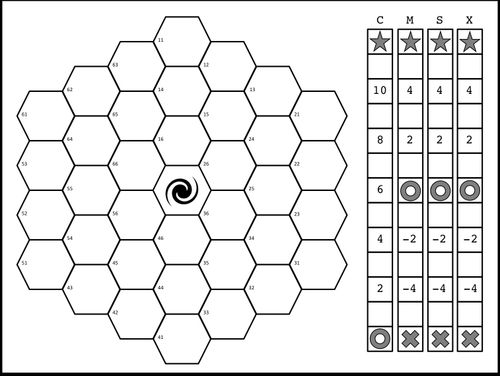
The map can be copied and printed from the last page of these rules. It is a hex grid of 37 sectors, 36 of them numbered with combinations of digits from 1 to 6. The middle hex, the center of the galaxy, is a supermassive black hole that cannot hold cubes between turns and has no habitable worlds.
To the side of the galaxy map, 4 tracks represent the state of the players' civilizations. Player cubes begin on the circles in these tracks. If a player ever reaches X, he loses the game. If a player ever reaches the star and has a homeworld with 3 advancements and 3 techs with 3 advancements, he wins. From left to right these tracks represent Culture (C), Might (M), Stability (S), and Xeno Relations (X). The first 3 represent intrinsic aspects of the civilization and will rise because of actions combined with advancements and fall due to challenges. The last track represents the interspecies interactions with a mysterious alien culture, the Xeno. They share the galaxy with humanity, forever lurking between the stars. If humanity's innovations allow, these relations can ensure a civilization prospers, but failure to appease the Xeno can instead result in the sudden annihilation of a civilization.
Track layout on the printed map page (from the star end to the start end): the Culture track runs star, 10, 8, 6, 4, 2, circle (start), with blank spaces between the numbered ones. The Might, Stability, and Xeno Relations tracks each run star, 4, 2, circle (start), -2, -4, X.
Each game features a neutral worlds line of up to 6 worlds. These can grow in size during the game and be conquered by players. They can also be replaced periodically, which means the texture of the map's perils may shift throughout a game.
The tableau is the player's personal table space where he puts cards into play. This consists of 2 rows. The upper row contains the player's homeworld and his techs. The lower row contains any other worlds on which the player has settled during the game. These cards have advancements, which can be applied to augment actions in the game. The upper row of cards in the tableau can hold upkeep cubes, which can be used to pay for challenges.
Figure 1-7 depicts an ongoing game with a solo player (dark cubes). The player's homeworld is Prospero, and he has 2 techs, one complete ("Mobile Resorts") and one incomplete. He has also settled on the world Drome in a sector he controls. Cubes represent the population and position of the player and his neutral rivals (gray cubes) on the map, the current position on the tracks, and the upkeep on the cards in the player's tableau. The neutral world line contains Kranax, Obelisk, and Galen.
1.6 Campaign Setup
Games can be played in succession using the same deck in a campaign. Before the very first game, print out a fresh galaxy map and collect 36 new index cards. These cards will form the initial deck and will be given an even distribution of the 6 numbers and 6 suits. A combination of each number and suit should be drawn in boxes in the corners of the 36 cards as shown in Figure 1-1. The players will need more cards during the first game.
Some of these initial cards will remain blank while others will get some content to seed the campaign, specifically 12 original worlds that exist in the galaxy, which can be an initial homeworld or settled by players. These worlds should be created using the blank cards in the initial deck following the method described in 1.4. Do not add names just yet.
The 12 worlds should be in randomly generated locations each with a randomly generated starting advancement. It is acceptable if there are worlds with the same sector or the same starting advancement. The era of each of these starting cards is O, indicating it is an original. Future eras will be numbered, starting with 1, and incremented as games are won.
After the worlds' sectors and advancements are generated, these cards should be dealt evenly to the players. Each player then adds names to the worlds dealt to him.
The players also take the sheet of paper for the chronology and write a 1 on the first line to indicate the games begin in the first era.
1.7 Game Setup
At the beginning of an individual game, the players choose a color for their civilization and collect the cubes of that color, which will represent their power in the sectors of the galaxy.
Now players will select homeworlds. They take all created cards and shuffle them into a single deck. One after another, players discard 5 cards from the deck and choose 1 world discarded to be their homeworld for the game. Later players cannot choose a world in the same sector as one already chosen by a previous player.
A player that did not receive a homeworld must create and name a new homeworld on a new card in a randomly chosen sector (not one of those occupied already by a player).
A drawn or created homeworld can have anywhere from 1 to 3 advancements on it. If the players have a different number of advancements on their homeworlds, the players must add advancements to the homeworlds with fewer than the one with the most until they all have an equal number. If no advancement has been circled on the world yet, when the suit is randomly chosen, the player may select 1 of the 6 related advancements. The player circles the suit of any chosen advancement.
Players place their homeworlds in their tableau in front of them. Players add 3 cubes of their color to the map sector where their homeworld is located.
The neutral worlds line is then created. Players discard cards from the deck adding world cards to the neutral worlds line. If any is in the same sector as a player homeworld it is discarded. These are placed in order based on the number in the card's corner. The process ends when there are 6 worlds in the line or a card with a number matching a world already in the line is discarded; this last world is not added. Therefore there can be anywhere between 1 and 6 neutral worlds at the start of a game. For each of these worlds, add 3 neutral color cubes to their sector. If multiple worlds are in the same sector, add 5 cubes to that sector instead.
On all remaining empty sectors that a player named in a previous game add 1 neutral cube representing the presence of an existing civilization that must be dislodged before a player can move into that area. If there are more than 12 named sectors, add a cube to each sector with a wonder and generate 12 random sectors, each time adding a cube to each sector not occupied by a player or no cube if a sector occupied by a player is generated. This may add cubes to unnamed sectors, multiple cubes to some sectors, and no cubes to some named sectors.
Players then place cubes of their color on the circles of the different tracks to mark the initial positions. The starting player is chosen randomly.
2 Turns
Players take turns going clockwise. A turn consists of 4 phases: start, action, payment, and challenge.
2.1 Start Phase
The player draws cards until he has 5 cards in his hand. If the player already has 5 or more cards, he does not draw any. If the player starts his turn with more than 10 cards, he must discard randomly until he has 10 cards.
If the player has any advancements on the worlds and techs in his tableau that take effect during the start phase, he may choose to apply them. If he has any complete techs in his hand with start phase advancements, he may discard them for their effects.
There are 6 advancements (listed below) that can take effect at the start of the player's turn after he has drawn up to 5 cards. They may occur in any order the player chooses, but they must precede the first action of the next phase. If a player cannot reduce a track for an advancement that requires it, he cannot take its effect.
- Art increases the Culture track by 1.
- Computation allows the player to draw an extra card when drawing provided he then discards any card from his hand immediately afterward.
- Economy allows the player to draw 2 cards provided he reduces a track by 1.
- Exploration allows the player to move 1 of his cubes to an unoccupied adjacent sector provided he reduces a track by 1. He can entirely vacate a sector in doing this, but he loses all worlds he has in that sector if so. Note that this does not count as an expand action, so it is unaffected by FTL and will not allow a wonder to be exploited.
- History allows the player to look 1 card deeper down the top of the deck; ordinarily he cannot look at the top of the deck at all. If he has multiple history advancements he can look that many cards deep. He replaces the cards examined without reordering them.
- Infrastructure allows the player to place an upkeep cube on a card in his tableau provided he reduces a track by 1 and there are fewer than 3 cubes on that card.
2.2 Action Phase
The player may take up to 2 different actions. A player takes an action by discarding a card from his hand with a suit matching the suit of the desired action. The plan and evoke actions do not require a specific suit. Some actions can be augmented by advancements, which are available to use whenever they appear on a card in the player's tableau or on a complete tech discarded from his hand, provided the player follows the rules of using the advancements.
Possible actions are depicted in Table 1. The actions' details are listed below along with the required discarded suit.
Table 1: Action summary
| Action | Suit | Effect Summary |
|---|---|---|
| POWER | 1 | Draw 2 cards |
| SETTLE | 2 | Add a world to your tableau |
| GROW | 3 | Add 2 cubes to a sector you control |
| ADVANCE | 4 | Add an advancement to a tech or world |
| BATTLE | 5 | Remove cubes to remove adjacent rival cubes |
| EXPAND | 6 | Move cubes to an adjacent sector |
| PLAN | N/A | Discard your hand and create a new card |
| EVOKE | Civ | Play civilization card for a sector you control |
-
POWER, suit 1: The player draws 2 cards into his hand. Advancements that may augment a power action are:
- Devices increases the Culture track by 2.
- Empire increases the Might track by 1.
- Energy allows the player to draw 1 extra card in addition to the 2 he already draws.
- Industry requires the player discard a card, but then he can draw 2 additional cards.
- Labor increases the Stability track by 1.
-
SETTLE, suit 2: After the player discards the card to settle, he will add a world to his tableau, below his homeworld and techs. Where the world comes from may vary:
- If the player has cubes in a sector containing a world in the neutral worlds line, he may add it to his tableau. When he does, he may immediately take a free power and a free advance action for completing the conquest of a rival civilization.
- If he has any worlds in his hand in a sector he controls, he selects one and adds it to his tableau and draws 1 card.
- If he has no worlds in his hand and but has a blank card, he creates a new world with a random advancement on it, choosing a sector he controls. He places it in his tableau and draws 1 card.
- If he has no worlds and no blanks, he randomly generates a new card with a world and random advancement, choosing a sector he controls. He places it in his tableau but does not draw a card.
- If the player has worlds in his hand but none are in sectors he controls, he cannot take the settle action.
When the player settles on a new world, either a blank in his hand or a new card, he must reveal his hand.
Advancements that may augment a settle action are:
2.2.1 Action Phase Notes
If a player takes an action and has an advancement on a world or tech in his tableau that takes effect during that action, he may perform its effect. Frequently these adjust the player's tracks, but sometimes they can alter the action (e.g., FTL lets a player move his cubes 1 additional sector). If a player has multiple advancements of the same type, their effects stack.
If a player has a complete tech card in his hand and takes an action that matches at least one action (but not necessarily the suit) of an advancement on that tech, he may discard it to apply any number of matching advancement effects to his action. This represents the tech's pervasiveness across the galaxy in the eras after it was invented and used by only one civilization.
Some special conditions should be noted:
- When a player chooses to apply an advancement on a world in his tableau other than his homeworld, he must discard it; settled worlds provide one time boosts until they are resettled.
- When a player uses an expand action to enter an empty sector that has a wonder he may take the special action of that wonder if he discards a card with the matching suit, noting the number # on the discarded card. Table 2 lists the wonders' effects.
- Advancements that adjust tracks only affect the tracks of the players who control the cards; players do not adjust one another's tracks.
Table 2: Wonder effects
| Type | Letter | Effect |
|---|---|---|
| Territory | T | Draw # cards |
| Population | P | Add # cubes to this sector |
| Culture | C | Add # to Culture |
| Might | M | Add # to Might |
| Stability | S | Add # to Stability |
| Xeno | X | Add # to Xeno Relations |
- If a player has multiple advancements, even of the same type, that can augment an action, they all may take effect as the player chooses.
- If a player ever loses all the cubes in a sector, he must discard all worlds from his tableau in that sector. If his homeworld is discarded, he has lost the game, unless he has another world in his tableau in a different sector, which he can choose to replace the lost world as his new homeworld. Upkeep cubes on the lost homeworld are not kept.
- If a player loses his homeworld, it is added to the neutral worlds line, replacing any world with the same value in the corner.
2.3 Payment Phase
The player pays upkeep for his homeworld and each tech in his tableau (not the other worlds in his tableau though). To do this, he may discard a card from his hand for each provided the suit of the discarded card matches the suit of a completed advancement on the card. If he pays for a card, he places a cube on the card if there are fewer than 3 cubes on the card. No card may have more than 3 upkeep cubes.
For every card he does not pay for, the player adds a card from the top of the deck to a facedown pile. When he is finished, he adds an extra card to the pile. This pile will be used in the next phase to provide challenges, and always has at least 1 card.
2.4 Challenge Phase
The player reveals cards one at a time from his facedown challenge pile, noting the suit in the card's corner. The player must either meet the challenge or accept a negative consequence. To meet a challenge the player may do one of the following:
- Discard a card from his hand matching the suit of the challenge
- Remove a cube from a card with a completed advancement whose suit matches the challenge's
- Discard a world in his tableau with a completed advancement whose suit matches the challenge's
If a player does not meet the challenge, it will have a negative effect. The player discards a card from the deck and notes its number value. Using this number and the challenge's suit, he refers to Table 6 to see what negative effect takes place. If the player met the challenge, no additional card is discarded and no negative effect takes place.
Some negative effects are straightforward. If a player is told to reduce a track, he adjusts it. If the track cannot move further, it moves to the most extreme point it can go and stops.
If the player is told to add a world to the neutral worlds line, he discards cards from the deck until he discards a world. He adds this world to the neutral worlds line. If a present world has the same value in the corner, the player discards it first.
If a player is told to add some number of random rival cubes, he must select a sector using the following rules. If the player added a new world to the neutral worlds line, he must pick that sector. Otherwise the player will discard a card from the deck. If the value of that card matches a world in the neutral worlds line, he must pick its sector. If the value does not match, the player will pick a random sector by discarding 2 more cards. The effect of adding cubes depends on what is in the selected sector and is described below:
- If the sector is empty, add the number of neutral rival cubes specified to that sector.
- If the player facing the challenge has cubes in that sector, first remove cubes one-for-one for those to be added and then add any remaining neutral rival cubes when empty.
- If a different player has cubes in that sector, add 1 cube of his color there, if he is not at the limit.
- If there are neutral rival cubes in the sector, add cubes until the limit is reached and, for the remainder, randomly select an adjacent sector:
- Discard a card from the deck and, using its corner value, choose the adjacent sector counting clockwise around the central sector with 1 referring to the sector above it. If this would place cubes outside the galaxy, none are placed.
- If the adjacent sector is empty or has neutral cubes add the remaining neutral cubes, and if the limit is reached again repeat this process.
- If the adjacent sector contains any player's cubes, remove cubes one-for-one for those to be added and add remaining neutral rivals when empty.
The player continues drawing cards from the challenge pile and following this procedure until there are no cards left in the pile. When this happens, play proceeds to the next player. Cubes placed on the homeworld and techs that are not removed during challenges carry forward into subsequent rounds. Any cubes in the center of the map, where the black hole is, are removed from the board.
3 Winning and Losing
In order to win, a player must have in his tableau a homeworld and 3 techs with 3 advancements on each card. Also he must meet 1 of the following conditions:
- Control 12 sectors (Territory victory)
- Have 25 cubes (Population victory)
- At the star on the Culture track (Culture victory)
- At the star on the Might track (Might victory)
- At the star on the Stability track (Stability victory)
- At the star on the Xeno Relations track (Xeno victory)
As an additional requirement for games with 1 player, he must have settled worlds for each wonder on the map (to a maximum of 4), where each world is in a different sector and is outside the homeworld sector.
A player wins as soon as the conditions above are met. If a player has multiple victory conditions, he may choose which one applies.
If the player's homeworld is in a sector that is not yet named, he names it and writes the name of the sector at the bottom of the corresponding sector on the board. The player then will create a civilization card following the style depicted in 1.4. He will create a new card with a random value and suit and write in the bottom half of the card the name of his homeworld and each of his complete techs. In the top he will write just below the boxed corner the current era and the word Civilization to indicate the card type. Below this the card effects are generated partly based on the victory type and partly based on the player's choice. Given the victory achieved, the player adds an effect from Table 3. The player then adds an effect from Table 4, provided he has at least 2 advancements of the chosen suit across those on his homeworld and complete techs. When the civilization card is complete, the player writes at the top the sector number and a name for his civilization.
The player also checks if his civilization was sufficiently specialized to produce a wonder. If there are 5 or more of the same suit of advancements across his homeworld and complete techs and there is no wonder in his homeworld's sector, the player adds a wonder to the sector on the map using Table 2 to determine the letter and picking a suit appearing at least 5 times across the player's advancements to pair with it (there can only be 1 wonder for every victory/suit pair on the map). In future games, players who expand into that sector and discard a card of the suit achieve a special effect. If the player's homeworld sector has a wonder or all possible wonders he could add are on the map, he adds nothing.
Players lose whenever they reach X on a track or lose their homeworld (such as happens when all cubes are removed from the homeworld sector and the world cannot be replaced). If a player loses while others are still playing, he discards all cards in his tableau and his upkeep cubes are removed. His remaining sectors are cleared and 1 neutral rival is placed in each. His homeworld is added to the neutral worlds line, replacing any present world with the same number in the corner. He may quit or take a new homeworld and begin afresh on his next turn (as in 1.7, but initial balancing advancements are not added to this new homeworld). If all players have lost a game before someone wins, the game ends with no winner.
When the game ends, the players record each player's name and his homeworld(s). If there was no winner, draw a dashed line below these entries. If there was a winner, mark that player and his homeworld with an asterisk and draw a solid line below the entries. Below this line write a number with the era incremented by 1 as a reminder for the next game. The winning homeworld founded a civilization that has lasted a millennium before fading as all civilizations must, and only in a new era can new civilizations rise from the ashes of the old.
Table 3: Civilization effects from victory type
| Victory | Effect |
|---|---|
| Territory | Add 1 cube to an empty adjacent sector |
| Population | Add 4 cubes to a sector you control |
| Culture | Add 3 to Culture |
| Might | Add 2 to Might |
| Stability | Add 2 to Stability |
| Xeno | Add 2 to Xeno Relations |
Table 4: Civilization effects from advancements
| Suit | Effect |
|---|---|
| 1 | Draw 3 cards |
| 2 | Settle on a new world |
| 3 | Add 3 cubes across sectors you control |
| 4 | Advance a tech; pick either 1 suit or value |
| 5 | Add 1 to a track; remove 1 adjacent rival cube |
| 6 | Expand into 2 adjacent sectors |
Tables
Table 5: Advancement Table
| Suit | # | Advancement | Action | Note |
|---|---|---|---|---|
| 1 | 1 | Computation | START | draw 1 card; discard 1 card |
| 1 | 2 | Engineering | ADVANCE | increase M by 1 |
| 1 | 3 | Communication | EXPAND | increase M by 1 |
| 1 | 4 | Weapons | BATTLE | increase M by 1 |
| 1 | 5 | Industry | POWER | discard 1 card; draw 2 cards |
Table 6: Challenge Failure Table
| Suit | # | Challenge | Failure |
|---|---|---|---|
| 1 | 1 | Pervasive corruption | decrease Might by 2 and decrease Xeno Relations by 1 |
| 1 | 2 | Dwindling resources | decrease Might by 3 and decrease Culture by 1 |
| 1 | 3 | Space pirate attacks | decrease Might by 2 and decrease Culture by 2 |
| 1 | 4 | Rising warlord | decrease Might by 3 and add 1 random rival cube |
| 1 | 5 | Determined separatists | decrease Might by 1 and add 3 random rival cubes |
| 1 | 6 | New civilization emerges |