Deduckto
Deduckto Rulebook
Table of Contents
Table of Contents
Contents
- 49 Suspect cards
- 4 Suspect guides
Overview
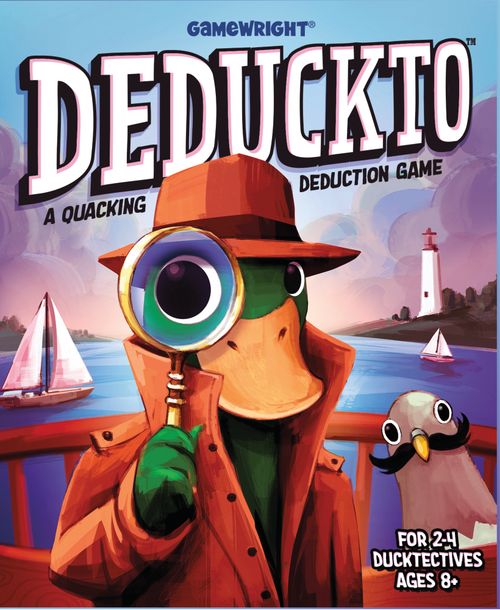
Calling all ducktectives! Seven cagey critters are on the loose and it's a race to nab your secret suspect! Reveal cards one at a time, gathering evidence about the animal, disguise, and location on your hidden card. Use deduction to eliminate attributes that don't fit the clues.
Be the first to correctly figure out the who, where, and wearing-what and win!
Setup
- Give each player a Suspect guide for reference.
- Look through the Suspect cards and note that each card features an animal, disguise, and location. (There are seven of each — refer to the Suspect guide for details.) Also note that every Suspect card is unique — meaning that no two share more than one attribute.
- Shuffle the Suspect cards and deal five cards, face-down, to each player. (Hold cards in your hand, concealed from opponents.)
- Deal each player a sixth face-down card. This is your secret suspect! Without looking at your Secret Suspect card, add it to your hand face-out, so all other players but you can see it.
- Stack the rest of the Suspect cards in a face-down deck, within easy reach of everyone.
- All players should simultaneously give the player on their left a card from their hand that shares an attribute (animal, disguise, or location) with that player's secret suspect. If you don't have a card that shares an attribute, give them a card that has nothing in common with their card, and inform them that none of the attributes match. Place the card you receive face up in front of you to form one of two clue piles: one for cards that have an attribute that matches your secret suspect ("Yes" pile), and one for cards where no attributes match your secret suspect ("No" pile).
- All players draw a card from the Suspect card deck to replace the one they gave away.
How to Play
Whoever most recently fed a duck goes first and play continues to the left. On your turn, take one of the following actions:
- Reveal a card from your hand.
- Try to guess your secret suspect.
Revealing a Card
If you choose to reveal a card from your hand, show it to your opponents. All other players then reply with either a simple "Yes" or "No" based on whether or not the card you revealed shares an attribute with your Secret Suspect card.
Depending on the answer, add the card face up to either your "Yes" or "No" clue pile.
Tip: overlap the cards so that you can see the range of attributes.
End your turn by drawing a card from the Suspect deck to replace the one you revealed.
Note: If the Suspect card deck runs out, continue to play cards from your hand without drawing replacements. In the event you have no cards to play, you must guess your secret suspect.
Guessing Your Secret Suspect
Instead of revealing a card on your turn, you may try to guess your secret suspect by naming the animal, disguise, and location on your Secret Suspect card. Your opponents should respond with a simple "Yes" or "No." You may only make one guess per turn, but you will have three total chances to correctly guess your card. If your first guess is incorrect, you must flip over either your entire "Yes" or "No" pile (your choice) as a penalty — this pile remains face-down for the rest of the game. (Any subsequent cards you play may be placed face up.) The second time you are incorrect you must flip over the other pile. And if you are incorrect a third time, you are eliminated from the game and must lay your entire hand face up for all players to see.
If you are the first to correctly guess your secret suspect, congratulations, ducktective! You win the game!
A Word from Gamewright
We love games that offer a little mental challenge. When we first came across Robert Kerr's brain-twisting deduction game, we were immediately smitten by the combination of simple rules and compelling strategy. But like a good mystery something was missing. Then we cracked (quacked?) the case with Kwanchai Moriya's charming artwork and a new avian hero, and suddenly the game was a (webbed) foot! With a quick playing time, we hope that whenever you have an itch for deduction, this game will fit the bill!
Game by Robert Kerr. Licensed by Puzzling Pixel Games. Illustrations by Kwanchai Moriya. Graphic Design by Mitch Morris.