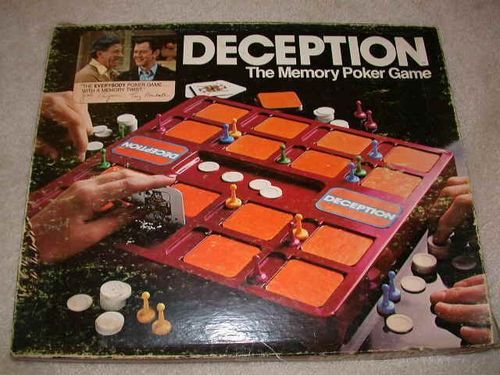
Deception (1975)
Deception (1975) Rulebook
Table of Contents
Table of Contents
Contents
Chips, 20 markers (5 of each color), plastic playing tray, card showing rank of hands, and a SPECIAL deck of 28 cards containing 4 each of 9, 10, jack, queen, king, ace, PLUS 4 wild cards.
To Prepare the Game
Place the playing tray in the center of the players.
Carefully separate the playing cards from the sheet. Place the cards on the table, FACEDOWN, and mix them up.
Deal 2 cards, FACEUP, to each of the players and place 10 cards, FACEDOWN, in the spaces provided on the tray as shown on the cover. The extra cards are set aside.
Give each player all markers of one color.
Distribute the chips equally to all players.
Each player antes 5 chips to the pot in the center compartment of the tray.
Editor's note: the Tesera listing description of this game says 16 cards are placed face down on the tray. The rulebook text says 10, and is transcribed as printed.
Object
Win the chips in the pot with the highest poker hand.
Rules
Seven Card Version
Play begins with the player to the dealer's left and continues clockwise until each player has placed ALL 5 of his color markers on the tray.
Each player, in his turn, must SECRETLY look at TWO of the down cards on the tray and MUST mark ONE of these as his card by placing a marker of his color in the marker pocket next to the card he selected. Once he has placed a marker he may not move it. A player may not mark a card that HE already marked.
If any player, in his turn, wishes to look at a down card already marked by an OPPONENT, he must FIRST pay two of his chips to the owner of the marker. If there are two markers in the marker pocket he must pay two chips to the owner of EACH of the markers.
With four players, a maximum of 3 markers may be placed next to a card. With three players a maximum of 2 markers may be placed next to a card. With two players in the game a player may pay to look at only two of his opponent's marked cards.
- When a player has placed a marker next to a card he may not look at that card again until AFTER the betting, and ONLY then if he must show the hand he declared. See Rule #10.
Editor's note: "Rule #10" is printed here as it appears in the source. In the source, the showing-of-hands paragraph (after the betting paragraphs below) is unnumbered; it is the paragraph meant.
-
When all players have placed all five of their markers on the board the cards are FINAL. Now the players must remember what cards they have marked. Using these, plus the two previously dealt, each player must BET his hand as in poker, using any five of his seven cards. Refer to paragraph 15 "Rank of Poker Hands."
-
The player who began the game starts the betting which proceeds clockwise. When the betting begins each player in turn has the following options:
He may DROP OUT of the hand by turning his two dealt cards facedown.
He may CALL by placing the required number of chips in the pot.
He may RAISE by placing the required chips plus an additional number of chips in the pot.
Only THREE raises are allowed. Chips bet are placed in the pot. Betting limits may be set by the players.
When the betting is finished, each player must DECLARE what poker hand he has. Each hand will consist of any 5 of his 7 cards (the two originally dealt plus the five he marked on the tray).
The player with the highest declared hand must SHOW it. He must remember the cards he marked and turn up ONLY the cards he needs for his declared poker hand. The cards on the tray that he turns over must be turned over in place. If he does not show his hand correctly the player with the NEXT highest poker hand must show his hand in the same manner.
WINNING:
The player with the highest declared poker hand, who correctly LOCATES his needed cards, wins ALL the chips in the pot. Tying hands split the pot.
Five Card Version
The five card version of DECEPTION is the same as the seven card version except that each player may ONLY place 3 markers on the tray. The players must bet their hands on the 5 cards they have (the 2 originally dealt plus the 3 cards marked).
After a hand is played the deal passes clockwise to the next player.
Rank of Cards
Rank of Cards in order of importance, from highest to lowest:
Wild Card: this may be given the value of any card listed below.
Ace: this card has the highest value.
King
Queen
Jack
Ten
Nine: this card has the lowest value.
A player may determine the value of any wild card in HIS hand (dealt or marked) according to his needs. If a wild card is marked by more than one player, each player that marked it determines its value in his own hand.
Rank of Poker Hands
- Rank of poker hands in order of importance, from lowest to highest:
High Card: Ace is high, nine is low. Highest card or cards wins the hand.
One Pair: 2 cards of the same denomination. For example, 2 kings.
Two Pair: 2 separate pairs. For example, 2 queens and 2 nines.
Three of a Kind: 3 cards of the same denomination. For example, 3 aces.
Straight: 5 cards in numerical sequence, of different suits. For example, ace of spades, king of hearts, queen of clubs, jack of hearts, ten of diamonds.
Flush: 5 cards of the same suit. For example, ace king, jack, ten, nine of diamonds.
Full House: 3 of a kind and a pair. For example, 3 kings and 2 tens.
Four of a Kind: 4 cards of the same denomination. For example, 4 jacks.
Straight Flush: 5 cards, in numerical sequence, of one suit. For example, king, queen, jack, ten, nine of hearts.
Royal Straight Flush: the 5 highest cards in one suit. For example, ace, king, queen, jack, ten, of spades.
Five of a Kind: 5 cards of the same denomination. For example: 5 jacks