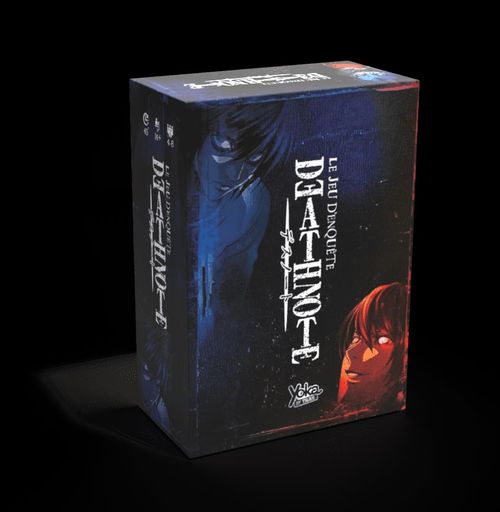
Death Note: Le Jeu d'Enquête
Death Note: Le Jeu d'Enquête Rulebook
Table of Contents
Table of Contents
How to Use This Manual
- You must read this manual before you can explain the game to other players.
- After reading this manual, if a rule seems unclear to you, reread it and then reach out to us on social networks.
- It is not necessary to know Death Note to play this game.
- If you want to play, you follow all the rules in this manual; otherwise, you do not play.
- The person in possession of this manual is in charge of enforcing the rules of the game.
- One does not cheat with the rules of Death Note.
- A player may consult this manual at any time.
- Each player must take responsibility for their actions and exposes themselves to the animosity of their opponents.
- The above rules must be respected, at the risk of dying in terrible agony.
Components
- 1 Ryuk pawn (to be assembled)
- 46 Action cards
- 25 Investigation tiles
- 9 Role cards
- 90 tokens:
- 52 Apples
- 30 Suspicions
- 8 Role tokens
- 4 player aids
Setup
1. Assigning Roles
- Shuffle, without revealing them, as many Role cards as there are players, always including the Detective and Light.
- Example: for a 5-player game, shuffle 5 Role cards including the Detective and Light.
- Each player receives a Role card, secretly reads their character and objectives, then keeps their Role face down in front of them.
- The player with the Detective Role reveals it by placing their Role face up in front of them, and takes the 8 Role tokens, which they also place in front of them (colored sides up).
- Note: in this game and this manual, the term "player" excludes the player who plays the Detective.
- The remaining Role cards are shuffled and placed face down in the center of the play area. These are the inactive Roles.
- Example: for a 5-player game, there will be 4 inactive Roles in play.
2. Preparing the Investigations
- Separate the Investigations into 5 piles of 5 tiles, according to the number on the back of the tiles (1 to 5).
- Shuffle the 5 piles separately, face down, then stack them into a single pile in order (the 5s at the bottom, the 1s on top) in the center of the play area.
3. Preparing the Actions
- Shuffle the Actions and form a face-down draw pile.
- If there are fewer than 6 players, first remove the cards marked with the 6+ symbol in the bottom left corner of the cards.
- For the first few games, we invite you to first remove cards no. 28 to no. 36 (number in red).
- The Detective draws 5 Actions.
- Each other player draws 2 Actions, keeps one in hand and discards the other face down (an Action is always discarded face down).
- Place the Ryuk pawn and the Suspicion and Apple tokens within reach of the players.
Goal of the Game
The goal of each player is to accomplish the objectives listed on their Role.
When the game ends, each objective accomplished by a player earns them victory points in the form of Apple tokens.
The game unfolds over a succession of up to 5 rounds. Each round corresponds to a series of 5 Investigation tiles whose number on the back matches the number of the round.
Playing a Round
Start of the Round
If the Detective still has Actions in hand, they must give one to the player of their choice, then the players take their turns.
Player Turns
Starting with the player next to the Detective, and proceeding in the direction shown on the top of the Investigation pile (the round direction), each player must secretly look at the Investigation on top of the pile for the current round, then chooses one of two options:
- A. Put the Investigation back on top of the pile. In this case, they draw an Action (see page 9).
- B. Discard the Investigation face down. In this case, they do not draw an Action.
Note: this choice is only possible if the Investigation is not the last one of the current round.
The player must announce when they have finished their turn.
Once all players have finished their turns, the Detective's turn begins.
The Detective's Turn
The Detective reveals the Investigation on top of the pile and resolves the following steps in order:
- If the Ryuk icon is present on the Investigation, the Detective gives one Suspicion to the player holding the Ryuk pawn.
- The effect of the Investigation is applied.
- The Detective gives as many Suspicions as indicated on the Investigation. They distribute them simultaneously, as they wish, among the unrevealed players.
Once the Investigation has been resolved, all the Investigations of the current round are discarded face down (unless the Investigation states otherwise) and the next round can begin.
Suspicions
Suspicions are used to reveal the Roles of players.
Most Suspicions are given out by the Detective, but certain effects allow other players to give them out too.
Received Suspicions are kept near the player's Role card.
At any time during the game, if a player has accumulated at least the number of Suspicions indicated in the table below, they must reveal themselves immediately.
| 4 Players | 5-6-7 Players | 8 Players |
|---|---|---|
| 7 Suspicions | 6 Suspicions | 5 Suspicions |
A revealed player discards all their Suspicions and can no longer receive any, but they continue to play normally.
When a Role is revealed, you may place the associated Role token on it, to more easily keep track of the remaining unrevealed Roles.
Death
If a Role dies, it is immediately revealed and its Role token is turned over (skull side up).
If the Role belonged to a player, that player discards all of their Actions, and their Suspicions are returned to the supply.
A dead and revealed character can no longer receive Suspicions or be affected by effects; they are eliminated from the game.
The player will still earn Apples at the end of the game for each objective they accomplished.
End of the Game
The game ends immediately as soon as one of these 3 conditions is met:
- Light is revealed: the investigation is solved.
- 3 Roles are dead and revealed: the investigation becomes too dangerous and the investigation team is dissolved.
- At the end of the 5th round, the Detective dies without Light having been unmasked.
Each player reveals their Role and earns Apples for each of their objectives accomplished. An objective is accomplished only if its conditions are met at the end of the game.
A new game may begin; players keep their Apples from one game to the next. It is recommended to play several games to determine the winner (the player with the most Apples).
Role Cards
The Role card defines the character played by the player and their objectives for the game.
A player may consult their Role at any time, but it is forbidden to reveal their Role unless an effect requires it.
Key points:
- A revealed Role is turned face up, which makes it possible to deduce the remaining Roles by elimination.
- An unrevealed Role stays face down and can only be looked at or revealed by the resolution of a game effect, or if the Role receives the necessary Suspicions.
- An inactive Role is not played by any player; its Role card is placed in the center of the play area.
- Playing the Detective: a special character with specific rules (the game master), and the only character who reveals themselves at the start of the game.
- Playing a Kira: a character whose Role has a red background naming the Kira faction (Light, Misa or Higuchi).
- Playing an Investigator: a character whose Role has a blue background naming the Investigators faction (Yagami, Matsuda, Aizawa, Mogi or Watari).
Light (Kira)
Light is a Kira. Objectives:
- 2 Apples: You are not revealed.
- 1 Apple: At least one Kira player is not revealed.
- 1 Apple: You have at least one Ryuk Action in hand.
Note: this manual only reproduces the objectives of Light, the Detective and Matsuda, which are printed in the manual's illustrations. The objectives of the other Roles are printed on their own Role cards and are not reproduced in this text.
The Detective
The Detective is the game master role. Objectives:
- 3 Apples: Light is revealed.
- 1 Apple: At least one Kira other than Light is revealed and alive.
Matsuda (Investigator)
Matsuda is an Investigator. Objectives:
- 1 Apple per living, revealed player.
- 1 Apple: No player is dead.
- 2 Apples: Light is the only dead player.
Action Cards
Action cards can help you accomplish your objectives, so do not hesitate to play them.
You are not limited in the number of Action cards in your hand.
To play an Action card, you must respect the condition indicated on it.
A played Action is revealed, then discarded face down once its effect has been applied.
- If 2 players play an Action at the same time, the effects are resolved in round order.
- The start of a player's turn lasts until that player looks at the Investigation (several Actions may be played at this specific moment).
About half of the Action cards are Ryuk Actions. When you play these, you must take the Ryuk pawn.
Some effects refer to Actions bearing the Action symbol: these are the cards with that symbol in the top left corner (Death Note, Shinigami Eyes, etc.).
Key points:
- No limit on the number of Actions in hand.
- No limit on the number of Actions played during a single turn.
- If 2 players play an Action at the same time, the round order is respected for the resolution of their effects.
- Do not forget to take the Ryuk pawn if the Action asks you to.
- An Action that is discarded is always discarded face down.
- The Detective can never be targeted by an Action effect unless that effect directly names the Detective.
Ryuk Pawn
No one holds the Ryuk pawn at the start of the game.
The Ryuk pawn circulates between players as Actions are played.
Being in possession of the Ryuk pawn has 2 consequences:
- Whether they keep or discard the Investigation, the player holding the Ryuk pawn always draws an Action.
- When the Detective reveals an Investigation with the Ryuk icon, they immediately give one Suspicion to the player holding the Ryuk pawn.
Note: as the game progresses, Investigations with the Ryuk icon become more frequent.
Player Aids
Player Aid: The Glossary
- Reveal: show a card or tile to all players.
- Look at: take a card or tile and consult it secretly; it is then returned to its place.
- Discard: the player places the card or tile face down in the discard pile.
- Designate: point at the player or the Role that will be affected by the effect.
- Name a Role: announce aloud the name of a Role that will be affected by the effect.
- Give Suspicions: the player takes the indicated number of Suspicion tokens from the supply and gives them to the player(s) affected by the effect.
- Neighbor: the first player to your left or to your right, excluding the Detective and the dead. The 2 players next to the Detective are therefore neighbors of each other... at least at the start of the game.
- Additional objective: an objective to be taken into account at the end of the game, as if it were written on the Role of the player concerned.
- A hand: the set of Action cards that a player has in their hand.
Player Aid: The Detective
Make the most of every piece of information you pick up. Are the cards you give used or not? Who discarded and who left the Investigation? Why did such-and-such play or not play this card, and why did they target this player? You may use the tokens to represent the suspects remaining around the table. Avoid having deaths by giving your cards last, to trusted players.
The Detective is the most difficult Role; it is best to know the objectives of the other Roles well in order to draw conclusions from what is happening.
Rather than mixing this Role with the others during setup, you may freely decide to give it to the player of your choice.
Player Aid: Kira
Light: as long as you are not revealed, you necessarily fulfill your first 2 objectives. The simplest way to play is to make yourself forgotten, hoping that another player draws suspicion onto themselves. You can also pass yourself off as another Role, which will be all the easier if you can look at an inactive Role. Help the Investigation a minimum to win over the Detective, but avoid revealing other players, because the more revealed players there are, the tighter the net closes. As Light, you will often want to discard Investigations; do so sparingly if you do not hold the Ryuk pawn, since it may look suspicious to be the only one discarding them.
Misa: your priority is to identify Light, or failing that, to identify your neighbors in order to eliminate them and thus get closer to Light. If you are revealed and are not next to Light, you have a better chance of dying. You can play very aggressively, which will help Light stay hidden, or which will on the contrary allow him to be aggressive without the Detective knowing which of the 2 to target.
Higuchi: you must remain discreet so as not to be revealed, but jump at every opportunity to eliminate Matsuda. The Detective will thus understand who you are and divert their attention away from you. But beware of the other Investigators who have an interest in revealing you, such as Yagami and Aizawa. Let through the Investigations that reveal or kill inactive Roles.
Player Aid: Investigators
Yagami: even if they are not among your objectives, try to find out which Roles are inactive, so you know how many Kira remain around the table. Be direct, even if you become suspect. The sooner you are revealed, the sooner the Detective can give you Actions.
Matsuda: the mission is simple: a maximum of Apples and a minimum of deaths. Try to identify Light so as to avoid revealing him; the longer the game lasts, the more players will be revealed. You have an interest in revealing yourself, but as late as possible, to avoid being killed by Higuchi, or even by Light trying to pass as Higuchi.
Watari: you are the best ally of the Detective, and your Actions will necessarily go in their direction. As the most useful Investigator, you are therefore a prime target for the Kira. Wait for an opportunity to discard cards so you can get rid of those you do not want to play.
Mogi: inactive Roles are often the quickest to reveal, especially by killing them, but be careful not to fall on Misa, whom you must protect.
Aizawa: you do not fear being revealed. You can be aggressive, but it is better to start by revealing inactive Roles, to be sure not to miss any Kira before revealing Light.
Player Aid: The Actions
Actions are powerful in the game because they can kill a Role. When a Ryuk Action is played, the player must immediately take the Ryuk pawn.
- Death Note: you play the Action card taken from the targeted player's hand, as if it were in your hand. You must respect the conditions of the Action taken in order to play it. The player dies only after you have fully resolved the Action you took from them, and after you have returned their hand of cards to them. As long as the effect of the Death Note has not finished resolving, the designated player is still alive. The game continues until the end of the resolution of the Death Note effect, even if the Action played in the meantime causes a third death.
- Page of Death Note: a very dangerous card, even for yourself. A Blackmail on you, and you risk dying. If you do not intend to play it, it is better to get rid of it quickly; otherwise try to learn the identity of an inactive Role without revealing it, just in case... After seeing the targeted Role, but before either of you dies, it is still possible to play a Fake Death Note, a False Identity, a Staging or a Top Secret.
- Rem: you cannot play this card if you are revealed. If the targeted player is not revealed, it is up to them to say whether they die or not, without (or before) revealing their Role. You may designate a revealed Role; if it is a Kira, nothing happens.
- Kira Supporter: you must choose, before looking at the inactive Role, whether you are going to reveal it or only look at it. You may look at an inactive Role that is already revealed, even if it is dead.
- Alibi: if the player designated by the Alibi dies, [the Detective] still receives the additional Suspicion. On the Detective's turn, if the only players still unrevealed have an Alibi, the Detective cannot give out Suspicions. An unrevealed dead player may be targeted by an Alibi.
- Search: if you still hold the Ryuk pawn when you discard the Investigation, you draw 2 Actions; if you no longer have it, you still draw one Action. If you play two Search cards in the same turn, their effects are cumulative: you draw 2 or 3 Actions when discarding the Investigation, depending on whether you have the Ryuk pawn or not.
Player Aid: The Investigations
Find here additional information about the Investigations: how to apply their effects, the advantages or disadvantages of letting an Investigation pass for the Detective, and some tips for using them.
Investigations No. 1
- Rebirth: if the designated player is an Investigator and decides to kill their Role in order to exchange it, it is that player who killed their Role, not the Detective. Yagami, Watari and Naomi have every interest in discarding this Investigation.
- Confrontation: if there is no unrevealed inactive Role, the Investigation has no effect. This Investigation is especially interesting for Higuchi, Aizawa and Aiber.
- Pact: a player protected by an Alibi does not receive a Suspicion if they are part of the group designated by the Detective. The more players there are, the more this Investigation is interesting for the Detective.
- Pursuit: the effect is resolved just before the game ends and each player tallies their points. An unrevealed Investigator may play a Lie in order to be the player benefiting from the additional objective. A revealed player cannot play Lie to prevent their neighbor from achieving this objective. If the first unrevealed Kira is dead, they do not fulfill this objective, since they have no neighbor.
- Tactic: if the player discards, the Detective gives the additional Suspicion at the same time as the base one of the Investigation. A player with no Action in hand cannot discard.
Investigations No. 2
- Rift: the Detective decides when to trigger the vote. As long as they do not, all players may discuss, and voters may come to an agreement. A player protected by an Alibi may be designated by the Detective, but cannot receive a Suspicion as a consequence of the vote; in that case the second designated player receives 0 or 1 Suspicion as a consequence of the vote, but does not receive the Suspicions that concerned the player protected by the Alibi.
- Overcast: if the designated player does not reveal themselves, they must not say whether it is because they do not want to or cannot do so. The designated inactive Role may or may not be revealed.
- Gaze: if no player has a Suspicion, or if no player with Suspicions has an Action in hand, nothing happens.
- Contact: the additional Suspicions that the Detective gives thanks to Alibi also prevent the players who receive them from drawing an Action.
- Doubt: if the designated player has no Action in hand, or if no player has exactly 1 Suspicion, nothing happens. A rather lenient Investigation for the Kira, but it may prove dangerous if you store cards while waiting for the right moment, or if you have Actions that grant Suspicions which you have not yet played.
Investigations No. 3
- Assault: the discarded Action is not necessarily one of the 2 Actions drawn. If the targeted player reveals themselves, it is considered that the Detective revealed them, because the player had no choice.
- Love: if the designated players die or change places, they keep this additional objective until the end of the game. For the Detective, it is better to designate a pair of Kira in order to avoid adding allies to Light. Yagami and Mello are also good targets.
- Confession: the Detective may designate a dead unrevealed player; since that player cannot make a choice, the outcome is necessarily that the Detective gives 2 additional Suspicions.
- Friend: if the next player to play an Action has no Suspicions, the effect of the Investigation resolves anyway and nobody else will be able to lose the 2 Suspicions. With this Investigation, the Detective would rather concentrate their 3 Suspicions on one player, to reveal them before they lose them.
- Wager: if the Detective must give several Suspicions thanks to an Alibi, they choose which of the Suspicions given allows the player receiving it to look at the Role of a neighbor. If the player receiving the Suspicion has no unrevealed neighbor, nothing happens.
Investigations No. 4
- Decision: Light can still play cards if forced to by a Blackmail. Light can protect himself from this effect by playing a Lie.
- Execution: an extremely powerful Investigation; think carefully before letting it pass.
- Ally: the Detective must necessarily name Investigators among those in the game, but may name Roles already dead or revealed. If the first Investigator named in counter-clockwise direction is already revealed, the effect ends and the second Investigator does not have to reveal themselves. A dead player with Top Secret must reveal themselves like the other players if their Role is named by the Detective.
- Matsuda: if Matsuda is not in the game, the Detective necessarily gives 2 Suspicions. If a player is Matsuda but died without being revealed (Top Secret), they reveal themselves.
- Expedient: the Detective distributes all the Suspicions accumulated by this effect at the same time as the base one granted by the Investigation.
- Performance: the Detective must designate 2 unrevealed neighbors; if there are none, nothing happens. An unrevealed dead player (Top Secret) cannot be designated, since they no longer have neighbors. A player covered by an Alibi may exchange their Suspicions.
Investigations No. 5
- Conduct: all the Suspicions are received simultaneously by all the players concerned. Then the Detective gives the Suspicion granted by the Investigation. The ideal Investigation for Watari and Wedy, and a nuisance for Light and Aiber.
- Frenzy: if the Detective benefits from an additional Suspicion thanks to an Alibi, they must give it to the same player to whom they give the 3 Suspicions of the Investigation.
- Resurrection: if there is no longer a living inactive Role, this Investigation has no effect other than the Suspicion it grants to the Detective. The Detective designates the players still alive one by one, in the order of their choice. If a player reaches the Suspicion limit and must reveal themselves, they do so immediately, before continuing to resolve the effect of the Investigation. If Light is revealed during the resolution of the effect, the game ends immediately.
- Silence: if an unrevealed Role is killed, it is the player who designated it who is considered to have revealed it, and not the Detective.
Tips
- Do not hesitate to play your Action cards, otherwise the Detective will have a lot of difficulty drawing conclusions from your actions.
- Receiving Suspicions is not necessarily negative; it depends on the objectives of your Role and on your bluff.
- If you are a Kira, stay impassive and simply regret the time lost suspecting people other than the real culprit.
- The Detective cannot reveal everyone; they will quickly have to make choices.
- The Detective is a difficult Role to play. It requires knowing the other Roles and their objectives well in order to draw conclusions from what is happening. Rather than mixing this Role with the others during setup, you may freely decide to give it to the player of your choice.
- Light may seem difficult to play because he has few allies. You must take advantage of the contradictions between the objectives of the different Investigators. Draw attention to the Roles that do not want to be revealed, and count on Matsuda, Higuchi and Yagami, who have no interest in you being revealed as long as they have not achieved their own objectives. Avoid killing Roles too quickly, unless you can pass for Misa, Higuchi or Aizawa, who are not afraid to get their hands dirty.
Notes on This Transcription
- The Role objectives reproduced in this manual are only those of Light, the Detective and Matsuda, which are shown in the manual's illustrations. The objectives of the other Roles are on their own Role cards and are not printed in the text.
- The player aids and some Investigation notes name characters (Naomi, Wedy, Aiber, Mello, Takada) who do not appear among the Roles listed in the Role card section. They are transcribed as printed.
- Icons were rendered as words: the red circle icon as Apples, the black pin and magnifier icons as Suspicions, and the boxed "L" icon as the Detective.
- Role, Action and Investigation titles were translated from the printed French; where the source gives no English title, the translation is the transcriber's own.