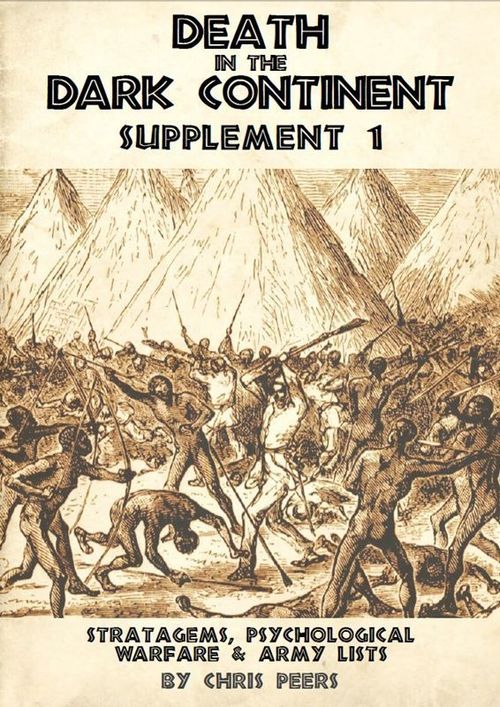
Death in the Dark Continent: Supplement 1
Official rulebook: North Star Military Figures · PDF
Death in the Dark Continent: Supplement 1 Rulebook
Table of Contents
Table of Contents
Army Lists
81. The Legend of Tarzan, 1888-19…
Tarzan was a sensation when introduced and remains one of the most successful fictional characters to this day and is a real cultural icon. This list represents the forces summoned by Tarzan at the end of the film The Legend of Tarzan, and therefore based on the seminal work by Edgar Rice Burroughs, Tarzan of the Apes, published in 1912. From my reading of the book I think Tarzan was raised by Chimpanzees not Gorillas as in the film. Burroughs never published a book called The Legend of Tarzan but the movie of this name attempts to place Tarzan in a slightly more historical context about the exploitation of the Belgian Congo. The allied villagers are those who join with Tarzan and the animals to defeat The Force Publique at the end of the movie. The British Naval Landing Party are there for a "what if scenario" if HM Governments implicit support for Tarzan was turned into actions (and I have some).
- Ag 0, Tribal
- Tarzan, Gorillas or other great apes, Elite Warriors (9 points) — 1–3
- Elephants, Rhinos, Giraffes, Water Buffalo etc, Elite Protected Heavy Cavalry with close combat weapons only (15 points) — 0–2
- Wildebeests, Oryx, Zebra, Kudu etc, Heavy Cavalry with close combat weapons only (9 points) — 3–10
- Crocodiles or Hippopotamuses, Elite Warriors (8 points) — 0–3
- Lions and other big cats or Hyenas or even Ostriches, Elite Heavy Cavalry with close combat weapons only (13 points) — 0–3
- Monkeys including Baboons, Mandrills etc and Warthogs, Pygmies with spears (7 points) — 0–3
- Muzungu with breech-loader (28 points) — 0–1
- Freed Slaves: Untrained Skirmishers with breech-loaders (8 points) — 0–2
Notes
- A Chief representing Tarzan must be Outstanding (+25 points).
- The Muzungu represents George Washington Williams an American envoy, who reveals his suspicions that the Belgians are enslaving the Congolese population. Williams persuades Tarzan to go back to the Congo in order to prove his suspicions.
- Home terrain can be of any type the player wishes.
- Defences: Pitfall traps.
- Stratagems: Drums, Surprise, Scouting, Witchcraft.
- Muzungu may only be used if Tarzan in used as an Outstanding Chief.
- Allies: Generic villagers (List 1, page 66), British Naval Landing Party (List 65, page 120).
Special Rule: Tarzan is always a single Elite Warriors base and never has to take morale tests, if he is a chief he can also be a single base unlike in normal Tribal armies. The weapons for animals don't actually represent real weapons of course just the effects. They never need field Baggage. It is of course completely fictional and should probably not be allowed in historically based scenarios, or in tournaments without the agreement of all concerned.
82. REI BOUBA, 1890-1899
The late 19th century army of Rei Bouba is one of the options covered by army list number 10 in my "Death In The Dark Continent" rules, "The Hausa-Fulani Emirates". The list below is, however, more specifically focused on the "silent city" under the rule of Bouba Gida, and includes a couple of new features designed to bring out its peculiar character.
- Ag 1, Disciplined if the Chief is Bouba Gida, otherwise Organised.
- Yan lifida: Protected Heavy Cavalry with close combat weapons only (10 points) — 1–2
- Shuwa Arab cavalry: Light Horse with spears (7 points) — 0–1
- Musgum cavalry: Light Horse with throwing knives (9 points) — 0–1
- Yam baka: Skirmishers with spears or bows (4 points), or throwing knives (6 points) — 1–6
- Guardsmen: Warriors (6 points) or Elite Skirmishers (8 points) with spears — 0–1
Notes
- A Chief representing Bouba Gida (1890 – 1899) may be Outstanding.
- Any or all Heavy Cavalry may be upgraded to to Elite (+4 points).
- Home terrain is Savannah.
- Defences: Town walls, Tembes.
- Stratagems: Drums.
Special Rule: Lion! We have no evidence that Bouba Gida's pet lion actually accompanied the army into battle, but we can speculate that it might have had an adverse effect on an enemy if it had done. So if the Chief is Bouba Gida he can be accompanied by a base representing a lion being held on a chain by a slave, which costs 20 points. The beast will not actually be let loose to fight, but the horses of enemy cavalry do not know this, and the sound and smell of it may cause them to panic. So any opposing mounted unit which is within 12 inches of the lion in the morale phase of a turn must take 2 morale tests for this cause. The lion moves at normal Skirmisher rate and is shot at as if it was a single base Skirmisher unit. It cannot be moved into close combat, but if an enemy contacts it it fights like an Elite Warrior base. It never needs to take morale tests itself, though if it is killed friendly units need to test as usual for seeing a unit destroyed.
83. SHILLUK
The Shilluk lived along the banks of the Nile north of the Nuer and Dinka, and so were the first to suffer from the depredations of Egyptian imperialism and the Khartoum-base slave raiders. They were cattle herders who had originally had a strong centralised monarchy under a king known as the "reth", but by the 1870s most of their settlements along the river had been destroyed and the inhabitants forced to submit to Egyptian authority. For this reason the Army Lists in the rule book have classified them as ordinary Villagers (List 1). Nevertheless some groups continued to resist, and even at the beginning of the 20th century seem still to have maintained their old way of life and relied on their traditional spears. Romolo Gessi among others described them as courageous fighters who were very reluctant to retreat even in the face of superior firepower. Classifying them as Disciplined helps to distinguish this army from similar Herdsmen types, and reflects the likelihood that those who continued to resist the invaders were more attached than some of their countrymen to the institution of kingship. Each "reth" had a bodyguard which surrounded him at all times during daylight, though he had to fend for himself at night, when challengers for the throne would often seek him out!
- Ag 0, Disciplined or Organised.
- Skirmishers with spears (4 points) — 2–9
- Skirmishers with captured guns: untrained with muskets (5 points) or breechloaders (8 points) — 0–2
Notes
- Up to 3 spear-armed Skirmisher units may be upgraded to Elite (+4 points).
- If the command type is Disciplined, we assume that this is thanks to the presence of the "reth". Therefore in this case 1 additional spear-armed Skirmisher unit may be upgraded to Elite Warriors (+4 points), representing his bodyguard. However in this case the chief must also be an Elite Warrior, and regardless of the normal rule governing Disciplined chiefs he must remain with this unit at all times.
- Home terrain is Grassland.
- Stratagems: Surprise, Scouting.
Painting a Shilluk Warband
- Skin – like other Nilotic tribes the Shilluk people are very dark-skinned.
- Robes – shades of rusty red from pale salmon to dark terracotta.
- Loincloths – leopard skin, or animal hide.
- Anklets – sheep or goatskin.
- Jewellery – ambatch reed coils around legs and arms (presumably off-white), heavy ivory bracelets and strings of whitish beads. Some warriors wore brass or iron earrings.
- Hairstyles – a wide variety of styles, sometimes straightened and bleached yellow, or partially coloured with red ochre. Feather decorations seem to have been mostly black ostrich feathers.
- Facial Scarring – sometimes the distinctive line of raised scars from ear to ear over the brow was painted red, white or alternately both.
- Shields – unpainted hide, so various shades of brown.
- Spears – long spears (up to 8 feet long) often with a tuft of black ostrich feathers near the butt. Many of their spearheads were long and wide, made of iron, but others were long and narrow, carved from bone (light brown) or made from antelope horns (black or dark brown).
- Clubs – polished wood, sometimes with darker brown or black heads.
- Bugle-Horn – made from a black antelope horn and a reddish brown gourd.
84. THE OMO VALLEY TRIBES
The valley of the River Omo, which flows south from the Ethiopian Highlands into Lake Turkana (known to the early explorers as Lake Rudolf), is often said to be the most culturally diverse region of its size in the world. There are eighteen major tribes living there, speaking languages from three different families which presumably reflect their origins at different points of the compass - Nilo-Saharans from the west, Cushites from the east and Omotics (speaking tongues related to Amharic) from the north. Not discovered by the outside world until the very end of the 19th century, they were left under the jurisdiction of Menelik's Ethiopian empire, which at first raided them for slaves and ivory but eventually left them alone. Their weapons were spears, bows, and wooden clubs. One group, the Donyiro, are thought to have been the people known today as Nyangatom or Bume. They are closely related to the Turkana, and despite their small numbers have always been especially dreaded as warriors. The Hamar speak an Omotic language and so are believed to have originally come from the north. They were also very tough customers, led in war by an age-based warrior community called the "maza", reminiscent of the Masai "moran", who were not allowed to marry until they had killed a man or a dangerous animal and had the ritual scars to prove it. Although they had no centralised authority there were "chiefs" responsible for different functions, including military ones. Nevertheless they seem mostly to have tried to avoid contact with well armed exploring expeditions. The Konso who lived in the hills further east, and the Aari in the north, are today numerous and important peoples, but we hear very little about them from the 19th century visitors. The Cushitic Konso are known to have given asylum to some of the Gabbra, a camel breeding tribe related to the Borana, after they lost their stock to disease and Ethiopian raids in the 1890s. The Aari also suffered badly from Menelik's imperialism, but were sometimes forced into an uneasy alliance with the Ethiopians.
- Ag 1, Organised.
- Elite Skirmishers with spears (8 points) — 1–8
- Skirmishers with spears or bows (4 points) — 1–8
- Gabbra: Light Horse with spears (7 points) — 0–2
- Sidam: Untrained Elite Skirmishers with breechloaders (12 points) — 0–2
Notes
- Only Nyangatom, Hamar, Suri and Mursi armies can have more Elite than ordinary Skirmishers.
- Only Konso can have Gabbra. Gabbra contingents would also include allied Wata bowmen, but these are not distinguishable in the rules from the ordinary Skirmishers.
- "Sidam" was a term used to describe not only the people of Sidamo Province to the north, but Ethiopian raiders in general, some of whom were regular troops under Ethiopian or European officers. Only Aari after 1895 can use them.
- Home terrain is Mountain if Aari or Konso, otherwise Savannah.
- Stratagems: Nyangatom: Terror. Hamar and Konso: Scouting. Others: Surprise.
85. KUKUANA
This list is based on the Kukuana people who feature in H Rider Haggard's classic story "King Solomon's Mines". It is of course completely fictional. As such it is intended only for fun, and should probably not be allowed in historically based scenarios, or in tournaments without the agreement of all concerned, even though there is nothing in it which is supernatural or otherwise totally implausible. "King Solomon's Mines" tells the story of three white explorers who reach the unknown country of the Kukuana and find a civilisation, based loosely on the Zulus whom Haggard had met in South Africa, which stands guard over the long lost diamond mines of King Solomon. After taking part in a civil war in support of their friend Umpoba, who eventually overthrows the tyrant Twala, they return home with enough diamonds to make their fortune.
Basically there are two versions of this army, representing the two sides in the civil war. Both consist mainly of disciplined regiments of the Kukuana army, but that of Twala is backed by the sinister witch Gagool, while Umbopa has the support of the three white men.
- Ag 0, Disciplined.
- Kukuana Regiments: Elite Warriors (8 points) — 2–9
- Muzungu with elephant gun (24 points) or breechloader (28 points) — 0–3
Notes:
- A Chief cannot be a Muzungu.
- Up to 3 Kukuana units per army may be veterans like Haggard's "Greys". These use the special rule for married Warriors in the Zulu list (number 58).
- Any or all veterans, and up to half of the other Warrior units, may have "tollas" or throwing knives at +2 points per base. These are the only Warriors with throwing knives in the rules, but there is no need to introduce a special rule for them, though (obviously) they are allowed to throw them, even though Warriors do not usually count spears or bows as missile weapons.
- Home terrain is Mountain.
- Stratagems: Witchcraft (not if any Muzungu are used).
A note on figures: Haggard describes the Kukuanas as closely resembling their supposed relatives the Zulus and armed with similar stabbing spears, but as well as their throwing knives they carry small round shields instead of the usual oval ones. They appear to go into battle in their full Zulu-style regalia. As for the three white men, Allan Quatermaine himself has recently been released in the "Giants in Miniature" series. Sir Henry Curtis is a huge bearded fellow who looks like a Viking. Captain Good is described as short and stout, and wearing a monocle. He also – for reasons too complicated to go into here – takes the field without his trousers. "Freddie Seelow" from North Star's Hunters and Explorers pack would probably be the closest match.
86. THE EMIRATE OF HARAR
The city state or Emirate of Harar in eastern Ethiopia had been the headquarters of the great Muslim war leader Ahmed Gran in the sixteenth century, but had since lost most of its power. It was conquered by Menelik of Ethiopia in January 1887 after the Battle of Chelenqo. Menelik reported having captured their "field guns and cannons", though we are told told how many there were. Ahmed (see below) says the Harar army numbered only 3,000, of whom only a third were equipped with firearms, many in poor condition. The explorer Richard Burton briefly describes the Harari army in his "First Footsteps in East Africa", and although his visit took place three decades before the Battle of Chelenqo his comments are among the most useful information we have. He describes the army as "not imposing". It consisted of 30 or 40 matchlockmen from North Africa, a few hundred citizens armed with spears and old German cavalry sabres, and about 30 horses, or rather "miserable ponies". There were said to be a few cannon hidden away in the palace, but Burton doubted that anyone knew how to use them. The city's main defence lay in the loyal Galla nomads of the surrounding countryside. A mixture of Somali and Arab figures will be most suitable for this army.
- Ag 0, Organised.
- Arab guardsmen, Elite untrained Soldiers with muskets (11 points) — 0–1
- Mounted townsmen, Light Horse with spears (7 points) — 0–1
- Gun-armed townsmen, untrained Skirmishers with muskets (5 points) — 1–2
- Other townsmen with spears or sabres, Warriors (6 points) — 1–4
- Smoothbore cannon (20 points) — 0–1
- Light field gun (40 points) — 0–1
Notes
- Home terrain is Mountain.
- Defences: Town Walls.
- Stratagems: Scouting.
- Allies: Galla (List 17, not Jimma or Borana).
Main sources:
- W M Ahmed, "History of Harar and the Hararis", Harar, Ethiopia, 2015.
- R Burton, "First Footsteps in East Africa", London, 1856.
87. NORTH-ENDERS
"North-Enders" was the term used by the British in Nyasaland to distinguish the brave and well organised Nkonde tribes living at the north end of Lake Nyasa (now Lake Malawi) from their less warlike cousins further south. Fred Moir, who lived with them for a time, describes the followers of the chiefs' sons as armed with stabbing assegais and knobkerries as well as throwing spears, and as "bounding along in step" and keeping perfect time. The North-Enders not only fought off many Arab slaving expeditions, but also helped the British in their war against the Arabs.
- Ag 0, Organised.
- Chiefs' followers: Elite Skirmishers with spears (8 points) — 1–3
- Skirmishers with spears (4 points) — 1–8
- Muzungu with elephant gun (24 points) or breech-loader (28 points) — 0–1
Notes:
- Home terrain is Coastal.
- Defences: Tembes.
- Allies: North-Enders should be permitted as allies in the British in Central Africa list (number 69).
88. ZAPPO ZAPS
The Zappo Zaps were a mixture of Basonge, Tetela, Manyema and other tribes who lived on the Lulua River, a tributary of the Congo. The first explorers to visit them were told that they were refugees from the Arab slavers who had established a sanctuary in this remote forest, but Harry Johnston later alleged that this was just a cover story and they were themselves a gang of slavers in league with the Arabs. Certainly they kept some dubious company, fraternising first with the Congo Arabs and later with the Belgians, who left them alone to administer a large area in the southern Congo Free State, where, says Johnston, they carried on a slave trade "as disastrous as the Arabs did in their worst days". They probably resembled a mixture of Ruga Ruga and Cannibal types, both of which are available from North Star.
- Ag 2, Organised.
- Arab-trained gunmen; untrained Soldiers with muskets (7 points) — 1-2
- Traditionally armed Manyema or similar; Warriors (6 points) — 0-3
- Other traditionally armed tribesmen: Skirmishers with spears or bows (4 points) — 1-5
- Gun-armed tribesmen; Skirmishers with muskets (5 points) — 0-2
Notes:
- Home terrain is Forest.
- Allies: Congo Arab (List 46) before 1894. Force Publique (List 79) thereafter.
89. THE SHIRE KOLOLO
Several small statelets in the region south of Lake Nyasa were ruled by Kololo chieftains who had followed Dr. Livingstone on his expeditions in the 1850s, and had been settled there and provided with guns. Thanks to the reputation of the Kololo as warriors they had amassed followings of local Yao and other tribesmen, and had remained loyal to the British, on whose behalf they resisted both the Arabs and the Portuguese. Ruga Ruga figures would be an ideal choice to represent them, available from North Star.
- Ag 0, Organised.
- Kololo chiefs and bodyguards: Elite Soldiers with muskets (11 points) — 0–1
- Other organised chiefs' followers: Soldiers with muskets (9 points) — 1–3
- Yao and similar tribesmen: Skirmishers with muskets (7 points) — 1–6
- Muzungu with elephant gun (24 points) or breech-loader (28 points) — 0–1
Notes:
- A Chief cannot be a Muzungu.
- Home terrain is Savannah.
- Defences: Tembes
90. THE ORANGE RIVER RAIDERS
During the 1860s and 70s the northern frontier of the Cape Colony was subjected to regular raids across the Orange River from the north, culminating in a full-scale war in 1878–79. The raiders belonged to a number of groups known by names such as Korana, Bovenstanders, Bondelswarts and Afrikaners (the latter not to be confused with the white people who at this time were usually known as Cape Dutch), but for game purposes it is not always easy to distinguish between them. They were all of Khoi, Tswana, San and other mixed origins, fought mostly on horseback with muskets, and resembled the Griquas or Basters, though they were generally less well equipped and organised and firearms were often in short supply. They all had a reputation as good shots, and would occupy the wooded islands in the Orange River as bases from which to operate against the Cape. At the time of the Griqua and Xhosa wars against the British they were joined by large numbers of refugees from these peoples.
- Ag 2 if Home terrain is Steppe, Ag 0 if Forest. Tribal or Organised.
- Korana or similar: Light Horse, up to two thirds with muskets (9 points), rest with spears (7 points). — 2–7
- Griquas: Elite Light Horse with muskets (13 points). — 0–2
- Xhosa: Skirmishers, up to two thirds untrained with muskets (5 points), rest with spears (4 points). — 0–2
- Bushmen: Elite Skirmishers with bows (10 points) — 0–2
Notes:
- The Special Rule for Bushmen in their own list (number 63) applies here.
- Home terrain may be Steppe or Forest.
- Stratagems: Surprise.