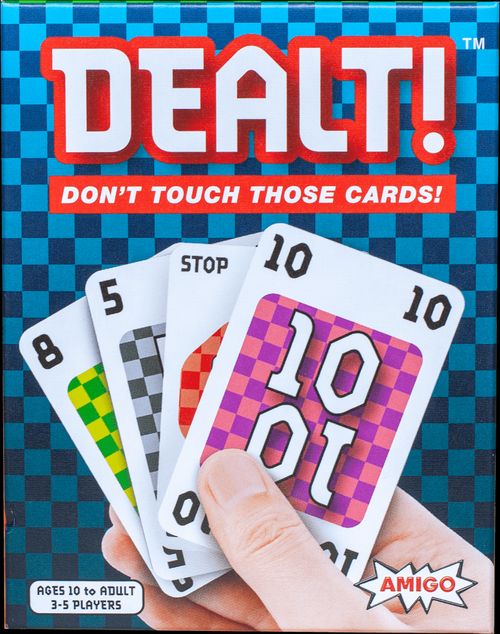
Dealt!
Dealt! Rulebook
Table of Contents
Table of Contents
Components
- 48 cards numbered 1–12 (4 each)
- X-Card, Redraw-Card, Stop Card (2 of each)
- 15 chips
Setting Up the Game
The oldest player gives two chips to each player. Put your chips in front of you. If you fancy a longer game, you can give each player three chips. Put any chips you don't need back in the box.
Then, the oldest player shuffles all the cards and deals ten cards to each player (seven cards if there are 5 players).
This is the most important rule in the game! Don't take your cards into your hand until you have all ten (or seven) cards in front of you. Then take them up and fan them out, but do not change the order. During the game, no player may change the order of the cards in their hand.
Once all players have received their cards, the oldest player also puts two reserve cards down in front of each player, face up. Put all remaining cards in the center of the table as a face-down draw pile.
Playing the Game
The player to the left of the dealer begins the first turn. A round consists of several turns and ends when a player has to hand in a chip.
What is a turn?
One after another, in clockwise order, each of you plays one card combination from your hand. A combination may include one, two, or three cards, but you can only play cards that are adjacent to each other in your hand.
If you are the player who begins (opens) a turn, you can play any card combination. All subsequent players must outbid the most recently played combination.
What does 'outbid' mean?
Each player must play a card combination that is ranked higher than the highest combination played so far: either by playing the same combination with higher numbers, or by playing a higher combination.
The card combinations are ranked in this order:
- Solo: a single card
- 2-straight: two cards of neighboring values
- Pair: two cards of the same value
- 3-straight: three cards of neighboring values
- Trips: three cards of the same value
Important: The two or three cards in your combination must be adjacent to each other in your hand. The order doesn't matter, however: 8-10-9 is just as good a 3-straight as 9-8-10 or 8-9-10.
Example: Andy plays an 8 as a Solo. Carla outbids the Solo by playing a 12. Nico outbids this by playing a 5 and a 4 that are adjacent in his hand as a 2-straight, which Susie can outbid by playing a higher 2-straight with her 5 and 6.
When do the reserve cards come into play?
If you can't—or don't want to—outbid a combination, you must instead take one of your reserve cards into your hand. When you do, you can place that card anywhere in your hand that you want to.
Example: Susie plays a Pair of 11's. Andy outbids it with a 3-straight of 6, 7, and 8. Carla can't play a higher combination, so she must take one of her reserve cards. She chooses the 7. Carla puts it next to her 6, so she can play both as a 2-straight in a later turn. Nico can't outbid, either, and takes the 12 from his reserve.
Who wins a turn?
Once all players have either played a card combination or taken up a reserve card, the turn ends. The player who played the highest card combination wins the turn and begins the next turn.
If the winner of a turn does not have any cards left in his or her hand (reserve cards that may still be in front of the player don't count), the player who had the second-highest combination begins the next turn.
If in such a case the winner of a turn was the only player who played a card combination, their right-hand neighbor begins the next turn.
Important: The point of the game is not to win turns, but rather, to get rid of your hand of cards as fast as possible. All cards which are played in a turn are put on a common discard pile.
The X-Card, the Stop Card, and the Redraw Card
- The X-Card can assume any value from 1 to 12. You may play it on its own or as part of a combination. However, like other cards, it can only be part of a combination with adjacent number cards. When you play an X-Card, you have to call out the value it is supposed to be.
- The Stop Card can only be played on its own. When you play a Stop Card, you immediately end and win the turn, even if some players have not yet played a card combination at this point.
- The Redraw also can only be played on its own. When you play it, you don't have to outbid anyone, so you can always play it. The player following you must then outbid the combination which was played before your Redraw Card or take one reserve card. Both Redraw Cards can be played in the same turn.
If you win a turn that includes a Redraw Card, you draw three cards (six cards if both Redraw Cards were played) from the draw pile, one by one, and sort them into your hand one after the other in the position of your choice.
Example: Andy plays a 12 as a Solo. Carla plays a 2-straight with a 7 and a 6. Nico plays a 2-straight of 11 and 12, and Susie plays her Redraw Card. Nico wins the turn. Because of Susie's Redraw Card, he has to draw three new cards from the draw pile, one by one, and sort them into his hand. Then Nico starts the next turn.
If you open a turn with a Redraw Card, the player following you can play any card combination or take up a reserve card. If all players take up a reserve card (or one of them plays the second Redraw Card), you win the turn.
If you win a turn in which a Redraw Card has been played, you must redraw even if you just played the last remaining card/s from your hand. You remain in the current round with the cards you have redrawn.
End of a Round
If you don't have any cards left in your hand at the end of a turn (your reserve cards don't count), you're out of the current round. A round ends when only one player has cards left in his or her hand at the end of a turn. A round also ends if, during a turn, a player can't outbid the highest combination and doesn't have any reserve cards left to take. In either case, that player loses the round and has to put one of his or her chips back into the box.
There may be cases when, at the end of a turn, several players have to hand in a chip at the same time. This happens if all the players still left in the round end up without any cards in their hands after a turn. In this case, all players who were part of this last turn in the round have to hand in a chip—except for the winner of the last turn.
The Next Round Begins
The oldest player shuffles all the cards again and deals them out as explained under "Setup," above. The player who had to hand in a chip opens the first turn of the new round. If several players had to hand in a chip at the end of the last round, the oldest player opens the first turn of the new round.
The End of the Game
A player who has handed in their last chip still continues to play. Only when a player has to hand in a chip but can't (because he or she doesn't have any chips left) does that player lose the game.
Should this happen to more than one player at the same time, they have all lost. All other players can consider themselves the lucky winners!