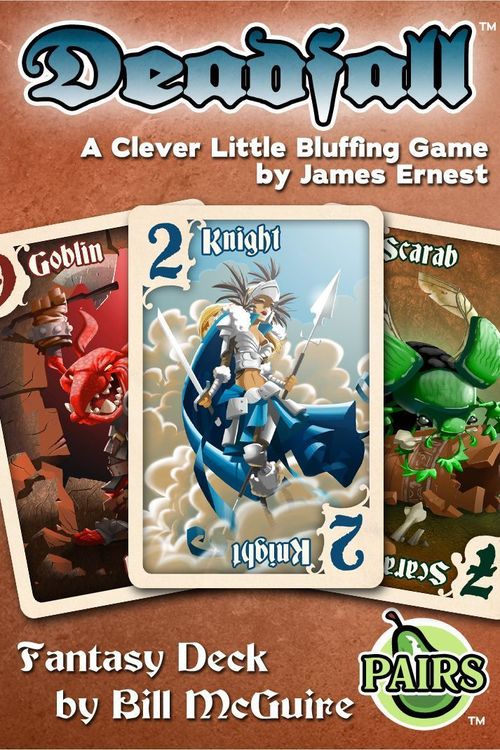
Deadfall
Deadfall Rulebook
Table of Contents
Table of Contents
Summary of Play
Players take turns playing cards. When you play a card, you are claiming that someone still holds a card of that rank. To win, you must catch someone in a lie, or trap them into calling you. (A "deadfall" is a simple gravity-powered trap.)
Rules
Players: 2 to 7
You Need: A Deadfall deck, and coins or chips for keeping score, about 50 per player.
Starting the Hand
Each player antes 1 coin. Shuffle the deck and deal a hand of cards to each player. The number of starting cards depends on the number of players:
| Players | 2 | 3-5 | 6 | 7-8 |
|---|---|---|---|---|
| Cards | 7 | 6 | 5 | 4 |
Door Cards
Each player chooses one card from his hand, called the door card. These cards are revealed at the same time. The lowest door card will take the first turn.
Ties
If there is a tie for lowest door card, then everyone plays another door card. Determine the first player by the second card only, using the first door card as a tie breaker. If both cards are tied, this continues to a third round and so on.
Each Turn
On your turn you have two options: you may play a card, or you may call another player.
If you play a card, stack it atop the cards you have played so far, so that each card is visible but the last card is clearly on top.
If you call, you are choosing another player's top card, and claiming that card is dead. "Dead" means there are no more cards of that rank in any player's hand, including your own. If you are right, you win. If you are wrong, you lose. Either way, the hand is over.
Restrictions on Calling
You may usually call any player's top card. However, if there are multiple top cards of the same rank, you may choose only the one that was played last (that is the one closest on your right).
For consistency, this restriction applies even for door cards, even though they were actually played at the same time.
In the example in the rulebook's diagram (players A through F seated around the table; top cards shown: F 6, A 2, B 5, C 9, D 5, E 4), Player A will go first, and she may call any player's door card except player B. Both D and B have played a 5, and D's was played "later" by the normal direction of play.
The Showdown
When a player calls, this ends the hand. All players reveal their remaining cards.
The calling player is claiming that no more cards of the called rank are in anyone's hand, so if she is correct, she wins, and if she is wrong, she loses.
Penalties
The loser pays the winner a number of coins equal to the value of the called card. The winner also collects the antes. In the example above, if A calls D's 5, the following two results are possible:
- 5's are dead. Player A is correct, and she collects 5 coins from Player D, as well as the antes.
- Someone still holds a 5. Player A is wrong, and she pays 5 coins to D. Player D also collects the antes.
Strategy
You obviously need to pay attention to which cards have been played, but this is fairly easy because the cards remain exposed.
However, you must also watch how and why those cards were played. This will come with experience.
Choosing a Door Card: Usually, you want to get rid of an unpaired low card when you choose your door. So if your hand is 3-4-6-8-8-10, you probably want to play the 3 or the 4.
The reason to ditch low cards first is that they are hard to play later in the hand. The hand doesn't always go to the last card, but if you are stuck with several low cards, you will almost certainly get called.
However, unless you are leading the Dragon (1), playing too low a door card might burn you. This is because going first isn't all that great, and if someone plays a lower door card, you might get called right away.
Getting Called: There are times when you want to be called, and times when you don't. To get ahead in this game, you must do more than just avoid conflict. You should learn how to trick others into calling you, and how to read other players well enough to call them.
Saving Pairs: Often, you will want your last two cards to match, so that if you get called with one card left, you are safe. This isn't always an option, but players do typically save pairs until their last two cards.
"Running": Inevitably, you will have single cards that you need to get rid of without being called. "Running" a card simply means playing it in the hopes of not being called.
This is easier with high cards, and harder with low cards. Once you get a sense for when people try to do this, you can learn to catch them at it.
Bluffing: There are a few fairly obvious moves in this game. Leading low, holding pairs until the end, running middle cards mid-game, and so on.
Experienced players can be fooled. Once they understand "obvious" moves, you can use those moves deceptively. One example is taking time to choose between two cards in your hand, even when they are the same rank. Beginners don't hesitate. Decent players pretend that it's a hard decision. Experts never do it the same way twice.
Variations
Here are some of the more popular variations on Deadfall.
Blind Start: Players do not play a door card. Instead, the leader is the winner of the last hand (choose a random player on the first hand).
Cherry: If a player is called and doesn't have a matching card himself, but another player has one (and therefore saves him from losing), then the called player pays 1 coin to the player who saved him. If there are multiple saviors, they each get a coin. This kickback is called a Cherry.
Note: Nearly everyone plays with the "Cherry" rule though it's not technically part of the basic rules. It's named after the #3 card in the original Pairs deck.
Cold Call: In this variation, players are allowed to "cold call" their opponents. Rather than declaring that the last played card is a lie, you can state the exact contents of your opponent's hand (this is easiest when it's just one card).
The penalty for correctly (or incorrectly) cold-calling is the total of all cards in the called player's hand. For example, if you cold-called a player's pair of 10's, that player would owe you 20 coins.
Cold calling certainly breaks people of the habit of holding a pair as their last two cards!
Red Devil: In Red Devil, each player passes one card to the left after the deal, before the door cards are played.
Double Devil: In Double Devil, there are two passes: once before the door card, and once after.